Zero Tax on Turnover Up to Rs. 2 Crore FY 2025-26 | Section 44AD Guide
This guide explains how the presumptive taxation regime under Section 44AD of the Income-tax Act, 1961 works and what it means for small businesses when assessing tax on business turnover. You will learn who can opt for the scheme, which kinds of businesses are excluded, how taxable income is computed under the presumptive route (including the difference between digital and non-digital receipts), and whether a proprietor or other form of assessee can end up with zero tax in an illustrative case. Understanding these points matters because the presumptive scheme simplifies bookkeeping and compliance for many small taxpayers by allowing income to be computed as a fixed percentage of turnover instead of detailed profit accounting. That translates into lower compliance cost and easier tax reporting, but the practical tax outcome depends on the assessee type and other reliefs they may be eligible for. This article uses the verified example of a Rs. 2,00,00,000 turnover where all receipts are digital to illustrate how presumptive income is computed and to show how rebate availability for resident individuals affects the final tax position. Read on for clear explanations of eligibility, exclusions, the computation method, and the real-world implication of choosing Section 44AD for the relevant businesses.
Presumptive Taxation Scheme for Businesses
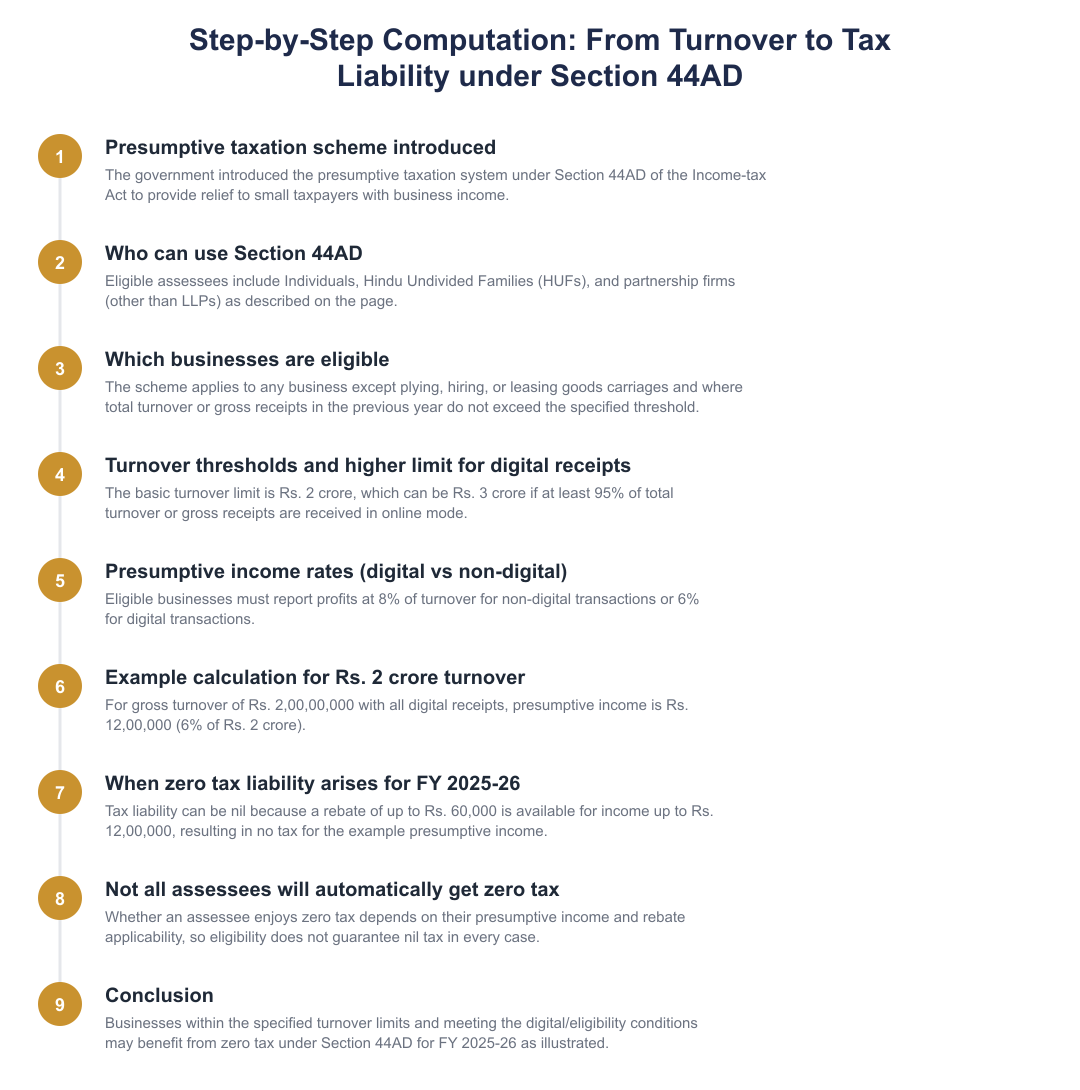
The presumptive taxation system was introduced under Section 44AD of the Income-tax Act, 1961 to provide a simplified method of computing business income for eligible small taxpayers. Instead of maintaining full books and calculating actual profits and expenses, assessees who opt for the scheme report income as a fixed percentage of gross turnover or receipts. This reduces compliance burden and makes tax reporting more predictable for small enterprises.
Under Section 44AD, the key computation rule prescribes that eligible businesses declare profits at 8% of turnover or gross receipts for non-digital transactions and 6% where the receipts are digital. The percentages are applied to the gross turnover to arrive at presumptive income, which is then the taxable business income for the year under the scheme.
Choosing the presumptive route has practical implications: it relieves the assessee from maintaining exhaustive books of account for tax purposes and from detailed profit-and-loss computation. However, assessees who opt for it are required to follow the compliance and reporting obligations tied to the presumptive basis of taxation.
Eligible Assessees under Section 44AD of the Act
Section 44AD is available to specific categories of taxpayers. The verified eligible assessees include Individuals, Hindu Undivided Families (HUFs), and partnership firms, with the explicit exclusion of limited liability partnership (LLP) firms. These are the types of taxpayers who may elect to compute business income on a presumptive basis under this provision.
Because the scheme is tied to the assessee’s legal form, the tax outcome and availability of certain personal reliefs can differ across assessees. For example, some tax rebates are applicable only to resident individuals, which affects whether a proprietor (an individual) might get a zero tax outcome in a particular situation, whereas HUFs and firms cannot claim those rebates.
Eligible Business under Section 44AD of the Act
Section 44AD applies to businesses except those specifically excluded by the Act. The verified exclusion is the business of plying, hiring, or leasing goods carriages, which is governed separately under Section 44AE. Therefore, businesses engaged in plying, hiring or leasing of goods carriages cannot use Section 44AD for presumptive taxation.
Other businesses not falling into that excluded category may consider Section 44AD if they meet the other eligibility conditions and find the presumptive basis beneficial for simplified compliance and reduced bookkeeping effort.
Example: How Presumptive Income and Tax Position Can Look
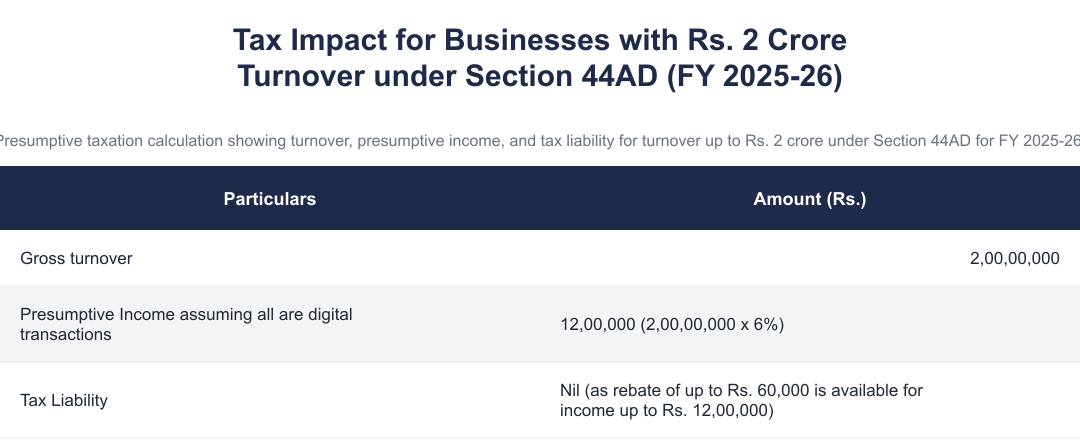
| Particulars | Amount (Rs.) |
|---|---|
| Gross turnover | 2,00,00,000 |
| Presumptive income assuming all are digital transactions | 12,00,000 (2,00,00,000 x 6%) |
| Tax Liability | Nil (as rebate of up to Rs. 60,000 is available for income up to Rs. 12,00,000) |
Will All Assessees u/s 44AD Enjoy Zero Tax Liability with Turnover Up to Rs. 2 Crore for FY 2025-26?
The illustrative example above shows that a Rs. 2,00,00,000 turnover with all digital receipts produces presumptive income of Rs. 12,00,000 under the 6% rule. Whether that results in zero tax depends on who the assessee is and what rebates or reliefs they can claim. One verified point is that the rebate under Section 87A is applicable only to resident individuals; therefore only resident proprietors (individuals) could potentially use that rebate to reduce tax to nil in such a scenario.
HUFs and partnership firms, on the other hand, cannot claim rebates that are available exclusively to resident individuals. Consequently, even with the same presumptive income figure, an HUF or a firm may have a different final tax liability than an individual proprietor because they lack access to that specific rebate.
How to Opt for and Report under Section 44AD (High-level)
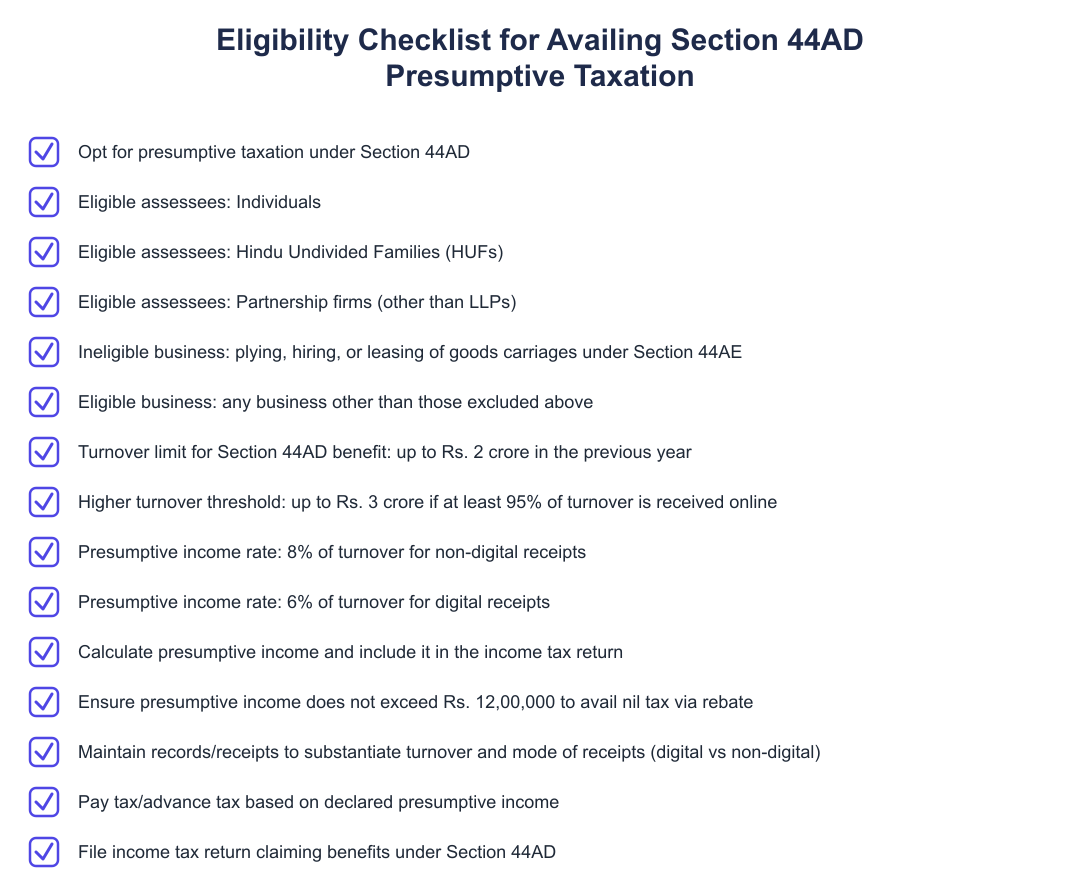
Confirm that the business is not the excluded category (plying, hiring, or leasing goods carriages) and that the assessee’s legal form is one of those permitted to opt for Section 44AD (Individual, HUF, or partnership firm, excluding LLPs).
Apply the prescribed percentage, 8% for non-digital receipts or 6% where receipts are digital, to the gross turnover or gross receipts to arrive at presumptive income.
Report the presumptive income in the tax return and follow the compliance and reporting obligations attached to opting for the presumptive basis of taxation.
Frequently Asked Questions
Q: Who can use Section 44AD? A: The verified eligible assessees are Individuals, HUFs, and partnership firms (other than LLPs). The scheme excludes the business of plying, hiring, or leasing goods carriages covered by Section 44AE.
Q: How is income computed under Section 44AD? A: Presumptive income is computed at 8% of turnover or gross receipts for non-digital transactions and 6% where receipts are digital.
Q: Does everyone with a given presumptive income get zero tax? A: Not necessarily. As shown in the example, a rebate that can reduce tax to nil (such as under Section 87A) is available only to resident individuals, so proprietors who are resident individuals may achieve a zero tax outcome in some cases, while HUFs and firms cannot claim that particular rebate.
Section 44AD’s presumptive taxation provides a simple, percentage-based method to compute business income for eligible small taxpayers. The 6% and 8% rates (for digital and non-digital receipts respectively) make it easy to estimate taxable income from turnover. Using the verified example of Rs. 2,00,00,000 turnover with all digital receipts produces presumptive income of Rs. 12,00,000, and whether that yields zero tax depends on the assessee’s ability to claim individual-specific rebates. Before opting in, assessees should confirm eligibility and understand the reporting obligations attached to presumptive taxation.
Frequently asked questions
Who can get zero tax if business turnover is up to Rs. 2 crore in FY 2025-26?
Resident individual proprietors who opt for presumptive taxation under section 44AD and whose presumptive business income does not exceed Rs. 12,00,000 can have zero tax liability for FY 2025-26 due to the rebate available under section 87A. The rebate of up to Rs. 60,000 applies to resident individuals with total taxable income up to Rs. 12,00,000, so a proprietor with Rs. 2 crore turnover and presumptive income of 6% (Rs. 12,00,000) will have nil tax after the rebate. Other assessee types like partnership firms, HUFs or LLPs are not eligible for the section 87A rebate, so they will still have tax on the presumptive income even if turnover is within Rs. 2 crore. This zero-tax outcome also assumes no other taxable income that pushes total income above the Rs. 12,00,000 limit used for the rebate calculation.
What is the presumptive taxation scheme under section 44AD?
Section 44AD is a presumptive taxation scheme that allows eligible small businesses to declare business income as a specified percentage of turnover in place of maintaining detailed books and actual profit computation. Under 44AD, eligible businesses must declare 8% of turnover as profit for cash transactions or 6% if at least 95% of receipts are digital, simplifying tax compliance for turnover up to Rs. 2 crore (or Rs. 3 crore in certain cases). The scheme is intended for small taxpayers and removes the need for cumbersome bookkeeping and audit provided the assessee continues to follow the presumptive rules in subsequent years as required. Choosing 44AD also affects how losses and deductions are treated, so taxpayers must understand the conditions before opting in.
Which businesses are not eligible for section 44AD presumptive scheme?
Businesses engaged in plying, hiring or leasing of goods carriages (covered by section 44AE) are not eligible for the section 44AD presumptive scheme. Additionally, limited liability partnerships (LLPs) are excluded because 44AD applies to individuals, Hindu Undivided Families (HUFs), and partnership firms (other than LLPs). To qualify for 44AD, the business's total turnover or gross receipts in the previous year must not exceed Rs. 2 crore (or Rs. 3 crore if at least 95% of receipts are received in digital mode).
How does digital receipt affect the presumptive income rate under section 44AD?
If at least 95% of a business's total turnover or gross receipts are received through digital mode, the presumptive income rate under section 44AD is 6% instead of 8%. This lower rate reduces taxable presumptive income and can help proprietors stay within rebate thresholds (for example, 6% of Rs. 2 crore equals Rs. 12,00,000 presumptive income). The 95% digital receipt condition also allows the higher turnover threshold of Rs. 3 crore in certain contexts and encourages digital payments; documentation or bank statements should support the digital receipts claim. Failure to meet the 95% criterion will require applying the 8% rate and may increase tax liability.
Is the Rs. 2 crore turnover limit absolute or is there any higher limit for digital transactions?
The basic turnover limit for eligibility under section 44AD is Rs. 2 crore, but this threshold is effectively extended to Rs. 3 crore in the context mentioned if at least 95% of the total turnover or gross receipts are received online. That means businesses with up to Rs. 3 crore turnover may be treated favorably when they meet the 95% digital receipts condition, although the presumptive income rate applied will be the digital rate (6%). In all cases the specific exclusions (like goods carriage businesses and LLPs) remain applicable, and taxpayers should maintain records to demonstrate online receipts. Check the exact legislative or circular language for any year-specific procedural requirements before relying on the higher threshold.
Will a partnership firm with turnover up to Rs. 2 crore have zero tax under 44AD for FY 2025-26?
No, a partnership firm will not have zero tax simply because its turnover is up to Rs. 2 crore, because the section 87A rebate that can bring tax to nil applies only to resident individuals (and as per the cited guidance, the zero-tax example is for proprietors). Partnership firms opting for presumptive taxation under section 44AD must still pay tax on the computed presumptive income at the applicable corporate or firm tax rates without the individual rebate benefit. Thus a firm with Rs. 2 crore turnover and presumptive income of 6% (Rs. 12,00,000) would still incur tax based on firm tax rates and would not be covered by the Rs. 60,000 rebate available to resident individuals. Firms should compute tax liability separately and cannot rely on section 87A to reduce tax to nil.
How is the presumptive income calculated for Rs. 2 crore turnover, can you show an example?
For Rs. 2 crore turnover, presumptive income under section 44AD is calculated as 6% of turnover if receipts qualify as digital, or 8% otherwise; for example, at 6% the presumptive income is Rs. 12,00,000 (2,00,00,000 x 6%). If the taxpayer is a resident individual with no other income and eligible for the section 87A rebate, the tax on Rs. 12,00,000 presumptive income may be reduced to nil because the rebate of up to Rs. 60,000 is available for income up to Rs. 12,00,000 as shown in the worked example. This computation assumes no other adjustments, deductions or incomes; taxpayers with additional income should combine all income heads before applying rebates and tax rates. Keep records proving digital receipts or turnover in case of scrutiny.
How do I opt for the presumptive scheme and what are the filing implications?
To opt for the presumptive scheme under section 44AD, a taxpayer must declare income at the prescribed presumptive rate in the income-tax return for the relevant assessment year and follow the scheme’s conditions, including not claiming profits lower than the prescribed percentage. Once a taxpayer opts for 44AD, they are generally required to continue the scheme for the block of years specified by law or follow prescribed rules when switching back to regular taxation; also, they should maintain basic records to substantiate turnover and mode of receipts. The return should show the declared presumptive income (6% or 8% of turnover) and tax computation; failure to properly declare may lead to disallowance, assessment adjustments or the requirement to maintain detailed books and an audit. Consult a tax professional to ensure correct election, filing and compliance for the year concerned.
If I have other sources of income, can I still get zero tax with turnover up to Rs. 2 crore?
Not necessarily; zero tax will apply only if the taxpayer's total taxable income (including presumptive business income and all other income heads) qualifies for the rebate threshold, specifically in the cited example, residents with total income up to Rs. 12,00,000 get a rebate that can reduce tax to nil. So if a proprietor has Rs. 2 crore turnover with Rs. 12,00,000 presumptive income but also has salary, interest or other taxable income that pushes total income above Rs. 12,00,000, the rebate may not fully eliminate tax and the taxpayer will have a positive tax liability. All income must be aggregated when computing tax and rebate eligibility; keep accurate records and compute combined taxable income to determine whether zero tax applies. If in doubt, run a full tax computation or consult a tax adviser.
Need help staying Income Tax compliant?
MoneyGence's AI Finance OS tracks your compliance, wallet share, and finances in one place, built for agencies and growing businesses.
Get started with MoneyGence