What is Bookkeeping? Definition, Process & Key Tasks
This guide explains bookkeeping: what it is, who performs it, the core tasks it covers, and how the two main measurement approaches, accrual and cash, affect financial records. Whether you are a small-business owner aiming to keep tighter control of cash flow, a freelancer wanting to understand client billing and receipts, or a new bookkeeper building practical skills, this page will help you grasp the essential concepts you need to maintain reliable financial records. Good bookkeeping is the foundation of trustworthy financial information; it supports timely decision-making, tax compliance, payroll accuracy, vendor relationships, and efficient operations. By the end of this guide you will understand the role of bookkeeping in the accounting cycle, the everyday tasks bookkeepers undertake, and the implications of choosing accrual versus cash basis accounting for how and when transactions are recorded.
What is Bookkeeping?
Bookkeeping is the systematic recording and organisation of a business’s financial transactions. It captures the day-to-day flow of money into and out of the business and creates the underlying records that accountants use to prepare financial statements, file returns, and analyse performance. At its core bookkeeping seeks to ensure that every sale, purchase, receipt and payment is documented in a reliable and traceable way.
Beyond mere record-keeping, bookkeeping provides the structure for categorising transactions so that income, expenses, assets and liabilities are distinguishable. This classification enables owners and managers to monitor profitability, liquidity and other operational indicators. Accurate bookkeeping also reduces the risk of errors, duplicate entries and lost invoices, making audits and reconciliations faster and less stressful.
Who are bookkeepers?
Bookkeepers are professionals responsible for maintaining the financial records of a business. Their responsibilities can range from data entry of transactions and reconciling bank statements to preparing supporting schedules for payroll, supplier payments and customer billing. In many businesses bookkeepers form the first line of defence against errors and omissions in financial records.
Depending on the size and complexity of an organisation, bookkeepers may work as in-house staff, as part of an accounting team, or as outsourced service providers. They typically liaise with management, suppliers, and accountants, providing the granular records accountants need to produce reports and advise on financial strategy. Strong attention to detail, organisational skills and familiarity with accounting software are core attributes of effective bookkeepers.
Why is bookkeeping important?
Bookkeeping underpins every reliable financial decision a business makes. Up-to-date books enable accurate tracking of cash inflows and outflows, help forecast short-term funding needs, and make it easier to manage supplier payments and customer collections. Without consistent bookkeeping, owners may misjudge their cash position, miss payment deadlines, or overstate profitability.
Accurate records also support compliance and reporting obligations and make the process of preparing financial statements, tax filings, and budget reviews more efficient. For external stakeholders such as lenders, investors or auditors, well-maintained books increase trust and reduce the time required for due diligence. Internally, clean records reduce disputes with suppliers and customers because transaction histories and supporting documents are readily available.
What is the task involved?
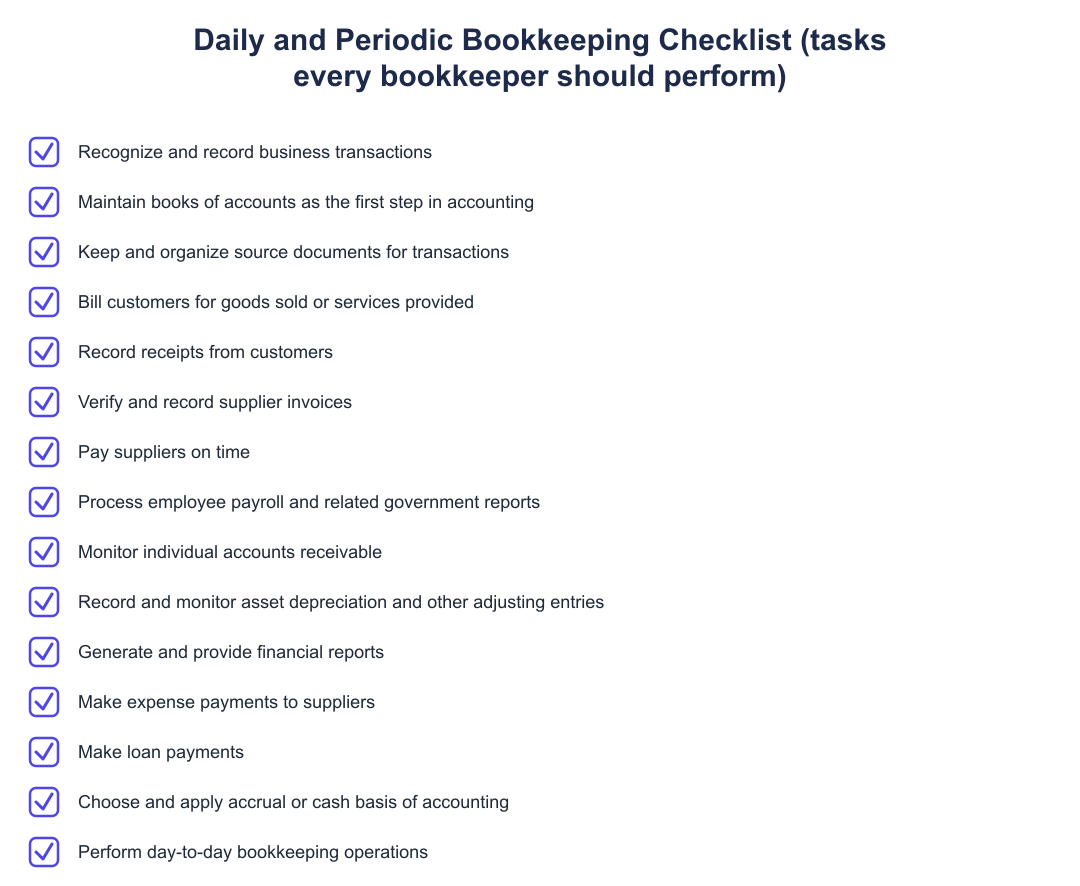
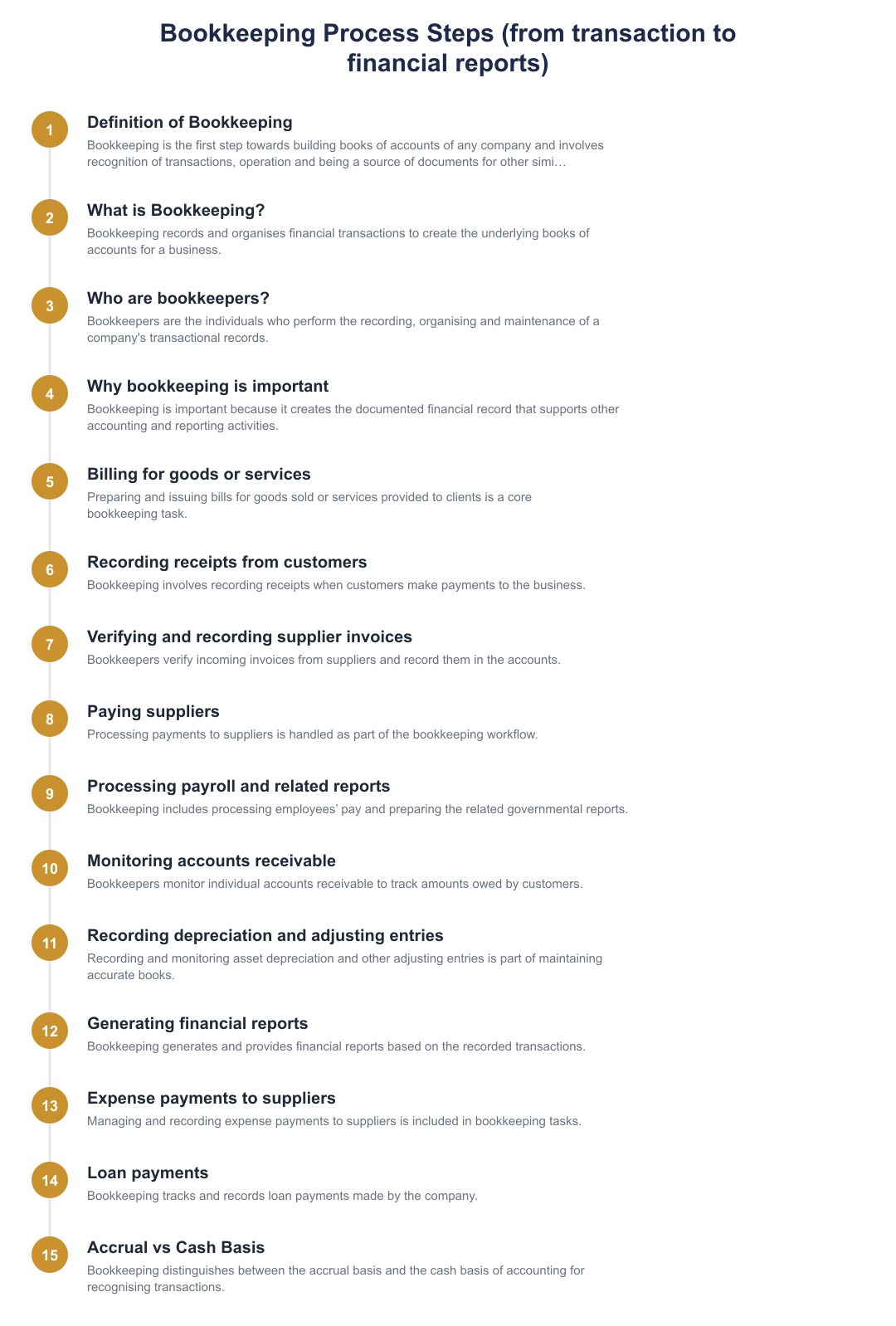
Bookkeeping tasks cover the full transaction lifecycle: creating or receiving invoices, recording receipts from customers, verifying supplier invoices and making payments, processing payroll and related government reporting, and recording loan and asset-related movements. These activities ensure that every business event that affects finances is captured and classified appropriately in the accounting system.
In practice bookkeepers also perform reconciliations between internal records and external statements, monitor accounts receivable and payable to manage cash flow, and prepare routine reports that summarise activity for management. They handle expense payments, track depreciation or other adjusting entries as required, and ensure supporting documentation is organised for future reference or audit purposes.
The Accrual vs Cash Basis of Accounting
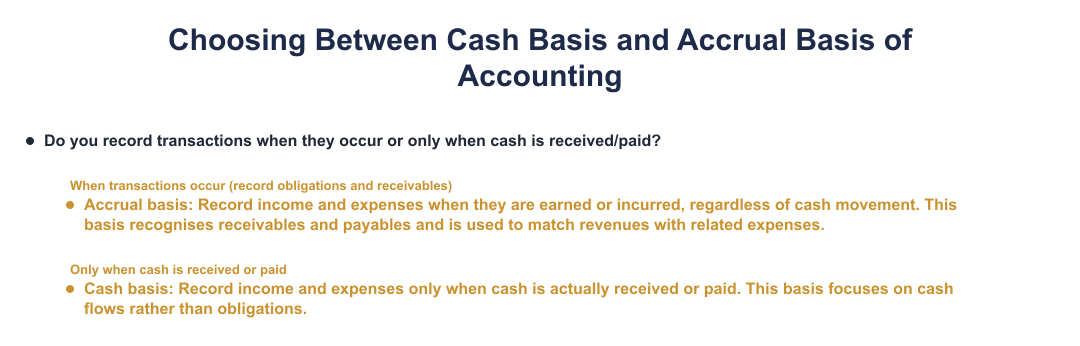
The cash basis and accrual basis are two approaches for deciding when to record transactions. Under a cash-basis approach transactions are recorded when cash actually changes hands, receipts are recorded when money is received and expenses when they are paid. This approach is straightforward and aligns closely with cash-flow management, making it popular with small or cash-focused entities.
Under an accrual approach, transactions are recorded when they are earned or incurred, regardless of cash movement. Sales are recognised when goods or services are delivered and expenses when they are incurred. Accrual accounting provides a more complete view of a business’s financial position over time because it matches revenues with the expenses that generate them, though it requires more adjustments and tracking of receivables and payables.
Consistent bookkeeping is essential for clear visibility into a business’s finances. Whether you choose cash or accrual accounting, the goal is the same: accurate, timely records that support decision-making, compliance and efficient operations. Building disciplined bookkeeping habits or engaging an experienced bookkeeper will save time, reduce errors and strengthen your control over financial outcomes.
Frequently asked questions
What is bookkeeping in simple words?
Bookkeeping is the systematic recording of a company’s financial transactions to create the books of account from which financial statements are prepared. It involves capturing sales, purchases, receipts and payments on a daily or periodic basis and classifying them into relevant accounts so totals and balances can be derived. Bookkeeping can be done using manual ledgers or software and follows methods such as single-entry (basic receipts/payments) or double-entry (every transaction affects two accounts). Accurate bookkeeping provides the raw data used for accounting, tax filings and managerial decisions.
Who are bookkeepers and what do they do?
Bookkeepers are professionals who record and maintain a business’s transactional records and ensure entries are accurate and timely. They handle tasks like billing clients, recording customer receipts, verifying supplier invoices, paying suppliers, processing payroll data, and tracking accounts receivable and payable. Bookkeepers also prepare supporting schedules (eg. depreciation) and provide periodic financial reports that accountants use to prepare financial statements and tax returns. In smaller firms a business owner may perform bookkeeping; in larger organisations dedicated staff or outsourced services handle it.
Why is bookkeeping important for my business?
Bookkeeping is important because it provides accurate, up‑to‑date financial information that supports decision making, compliance and performance measurement. Good books let you monitor cash flow, know which customers owe money, track expenses for tax deductions, and measure profitability against revenue targets. Reliable bookkeeping also simplifies statutory filings and audits, and becomes increasingly critical as the business adds taxes, assets, loans or investments. Without it, strategic planning and regulatory compliance become difficult and error-prone.
What tasks are involved in day-to-day bookkeeping?
Day‑to‑day bookkeeping includes billing clients for goods or services, recording receipts from customers, verifying and recording supplier invoices, and making payments to suppliers. It also covers processing payroll and related statutory reports, monitoring individual accounts receivable, recording depreciation and other adjusting entries, making expense and loan payments, and generating periodic financial reports. These tasks ensure transactions are captured on time and provide the documentation needed for accounting and tax compliance. The volume and frequency of these tasks vary with business size and transaction complexity.
What is the difference between single-entry and double-entry bookkeeping?
Single-entry bookkeeping records each transaction once, usually as income or expense, while double-entry bookkeeping records every transaction twice, debit in one account and credit in another. Single-entry is simpler and suited for very small businesses with few transactions, but it does not provide checks and balances or automatically produce a trial balance. Double-entry is the standard for businesses of any size because it ensures accounting equation integrity (Assets = Liabilities + Equity) and supports accrual accounting, financial statements and error detection. Most accounting software uses double-entry mechanics behind a user-friendly interface.
What is the accrual basis of accounting?
Under the accrual basis, transactions are recorded when they are earned or incurred, not when cash is received or paid. Revenue is recognised when goods or services are delivered and measurable, and expenses when obligations arise, so accounts receivable and payable reflect outstanding claims. Accrual accounting provides a more accurate picture of financial performance and position for periods that include receivables, payables, inventory or deferred items, and is required for many statutory financial statements. For example, a sale made on credit in March is recorded in March under accrual accounting even if payment arrives in April.
What is the cash basis of accounting and who uses it?
The cash basis records transactions only when cash is actually received or paid, so revenue is recognised on receipt and expenses on payment. Small businesses, sole proprietors and individuals often use cash basis because it is simpler and matches cash flow, but it can distort profitability when there are significant receivables, payables or inventory. Cash basis is usually acceptable for smaller taxpayers but larger entities or those required to follow accounting standards must use accrual accounting. For example, a credit sale in March is recorded in April under cash basis when the customer pays.
How often should bookkeeping tasks be performed, daily, weekly or monthly?
Bookkeeping tasks should be performed at a frequency that keeps records current, ideally daily for sales and receipts, weekly for supplier invoices and payroll processing, and monthly for reconciliations and financial reporting. Daily entry of transactions prevents backlog and errors, weekly processing ensures timely payments and payroll compliance, while monthly closing activities (bank reconciliations, accruals, depreciation) allow production of management reports. The exact cadence depends on transaction volume: very small businesses might update records weekly, while those with high volumes or regulatory needs should aim for daily updates.
Do individuals and non-profits need bookkeeping too?
Yes, individuals and non‑profit organisations also benefit from bookkeeping because it organises income, expenses and supports compliance and reporting. For individuals, bookkeeping helps track personal investments, loan payments and taxes; for non‑profits it ensures donor funds are tracked, expenses are properly reported and regulatory filings are accurate. While the complexity is typically lower than for commercial businesses, consistent record keeping is essential for transparency, budgeting and audit readiness. Many non‑profits use simplified charts of accounts and periodic reports tailored to donor and regulatory requirements.
Need help staying Accounting compliant?
MoneyGence's AI Finance OS tracks your compliance, wallet share, and finances in one place, built for agencies and growing businesses.
Get started with MoneyGence