Verify Income Tax Notice Online – Check & Authenticate Notices
This guide explains how to recognise, verify and respond to income tax notices issued by the Income Tax Department. You will learn what an income tax notice represents, the common reasons authorities send notices, the principal types of notices and intimations under relevant sections of the Income Tax Act, and practical, compliance-focused actions you can take after receiving one. Understanding these points matters because timely and correct responses reduce the risk of escalated proceedings, penalties or misunderstandings with the assessing officer. The guide also clarifies what an intimation under section 143(1) means and the limited but important options a taxpayer has if that intimation shows a demand, refund or an error. This is a focused, compliance-oriented resource for salaried individuals, business owners, professionals and tax practitioners who want to authenticate communications from the tax department and decide the next steps with confidence.
What is Income Tax Notice?
An income tax notice is an official communication issued by the Income Tax Department to a taxpayer regarding discrepancies, non-compliance, or additional information required related to their Income Tax Return (ITR). Notices are means for the department to seek clarification, request documents, or inform you about further action.
Notices vary in purpose and seriousness: some are simple requests for information needed to complete an assessment, while others can signal detailed scrutiny or belief that income has escaped assessment. Treat any notice as an important legal communication and avoid ignoring it, since the notice will usually set out a specific issue or query that the tax authorities wish to address.
Types of Notices/Intimations
| Section number | Notice |
|---|---|
| Section 142(1) | Inquiry before assessment (notice seeking information/documents) |
| Section 143(1) | Intimation issued after processing of ITR by CPC (intimation, not a notice) |
| Section 143(2) | Notice for scrutiny assessment (detailed scrutiny by AO) |
| Section 148 | Notice for income escaping assessment (where AO suspects undisclosed income) |
| Section 245 | Demand notice (for recovery/adjustment of tax demand) |
How to Verify or Authenticate Income Tax Notices?
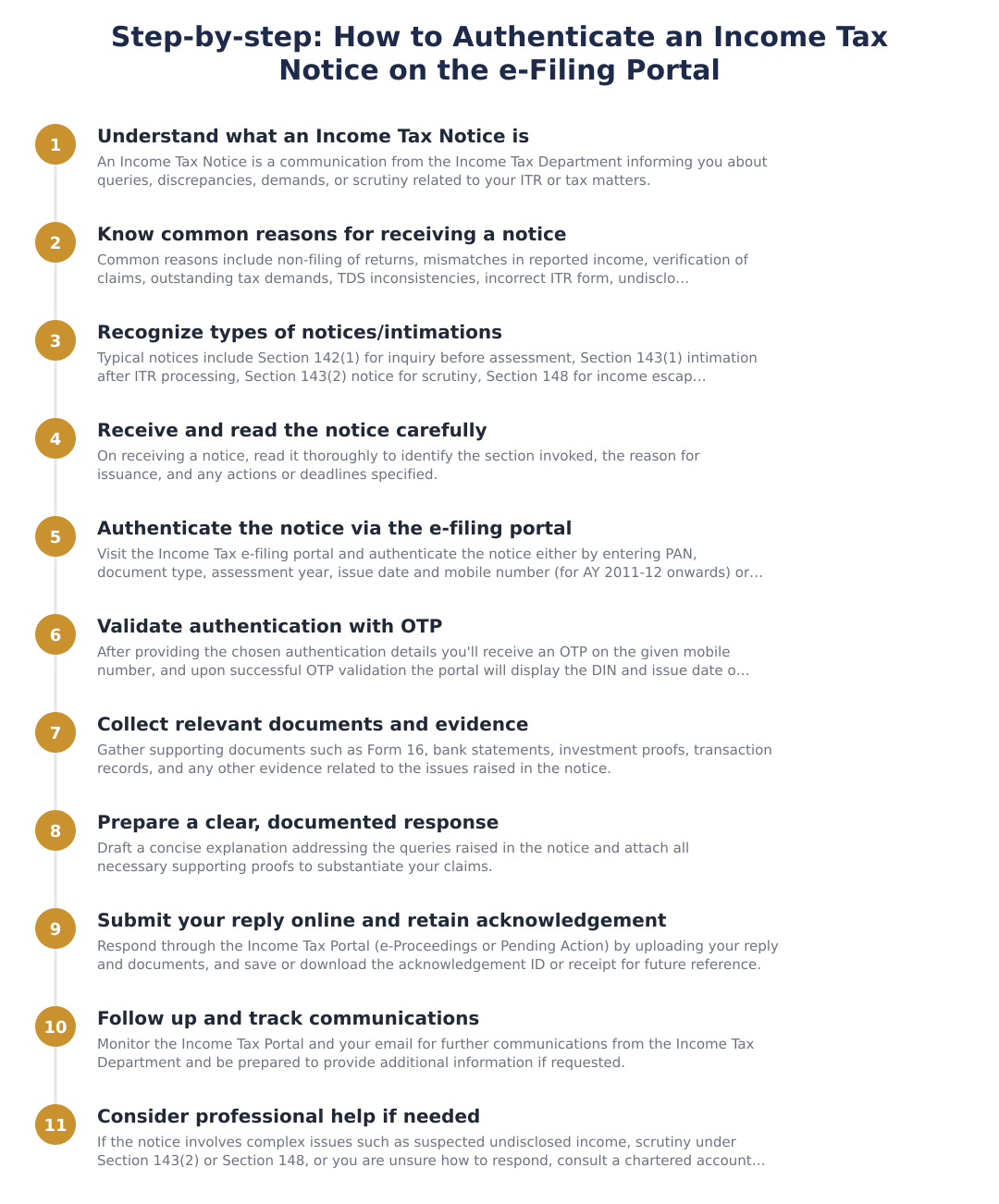
Verification and authentication are about confirming whether a communication truly originates from the Income Tax Department and understanding the statutory basis of the demand or query. The first step is to identify which section or type of communication you have received; statutory references (for example, sections 142(1), 143(1), 143(2), 148 or 245) indicate the legal basis for the notice or intimation.
Once you know the section cited, check the content carefully to determine whether the department is requesting documents, conducting scrutiny, informing you of a processing result, alleging income escape, or raising a demand. If the communication is an intimation under section 143(1), treat it differently from other notices because it follows CPC processing of your ITR and is described as an intimation rather than a notice.
Common Reasons for Receiving an Income Tax Notice
| Reason |
|---|
| Non-filing of returns |
| Mismatch in reported income (e.g., against AIS/TDS records) |
| Verification of claims |
| Demand for outstanding tax |
| Incorrect disclosure of high-value transactions |
| Incorrect ITR form used |
| Random scrutiny selection |
What to do when you Receive an Income Tax Notice?
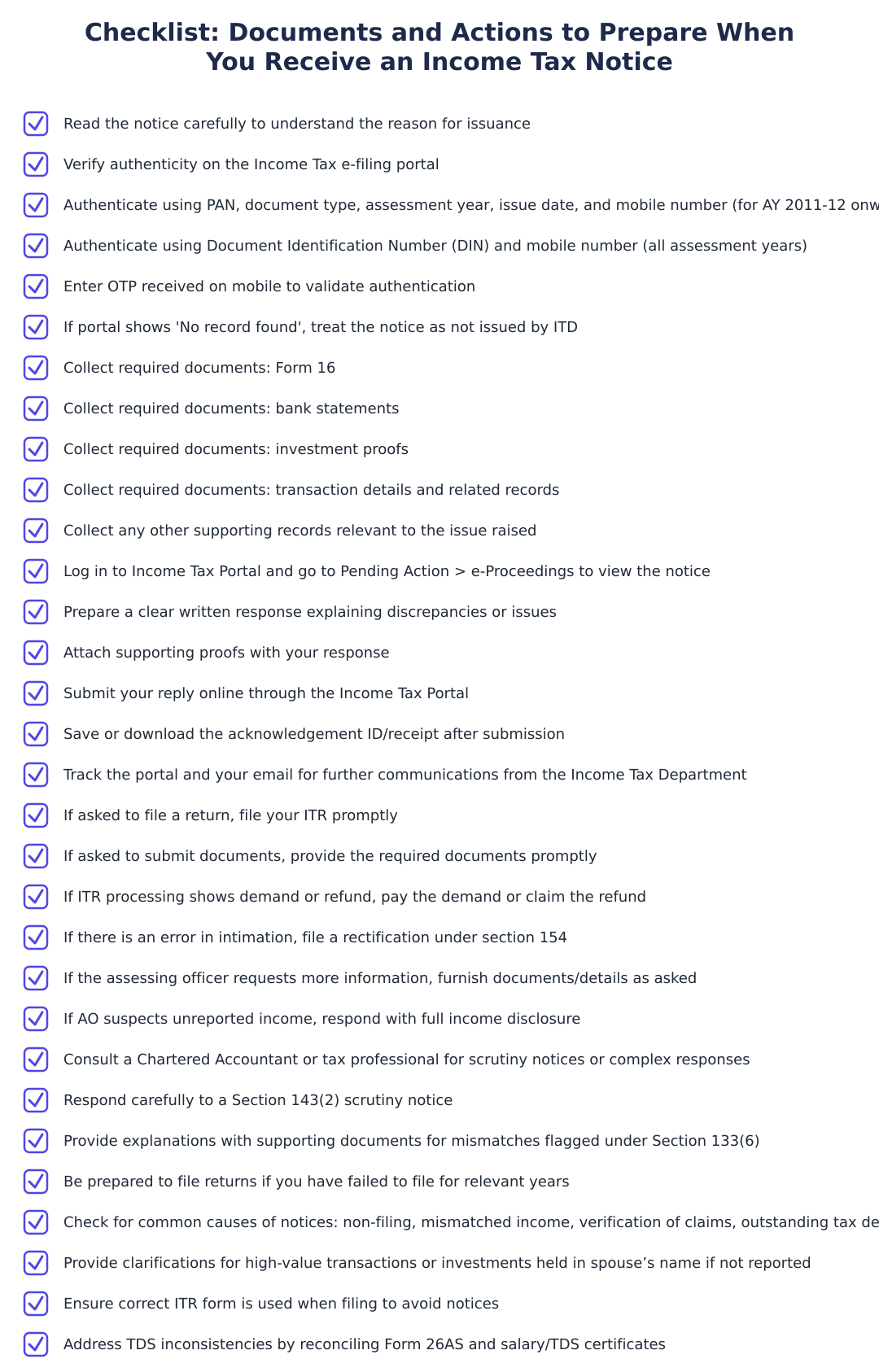
Read the notice carefully to understand the statutory section invoked and the precise information or action being requested. Notices under section 142(1) will typically seek documents or clarification before completing assessment, whereas notices under section 143(2) indicate detailed scrutiny by the assessing officer. A section 148 notice signals the officer’s belief that income has escaped assessment and requires careful attention.
If the communication is an intimation under section 143(1), it represents the result of processing by the Central Processing Centre (CPC). When a genuine 143(1) intimation shows tax due, the taxpayer’s obligation is to pay the demand; if it shows a refund, the taxpayer should claim the refund. Where the intimation contains an error, the statutory remedy is to file a rectification under section 154.
For other notices, gather the relevant documents and prepare a clear, factual response addressing each point raised. If you are uncertain about legal implications or the correct response, consider seeking professional advice from a chartered accountant or tax practitioner, especially in cases involving section 143(2) scrutiny or section 148 notices, so that submissions are complete and timely.
Frequently Asked Questions
Is an intimation under section 143(1) the same as a notice? No. An intimation under section 143(1) is issued after CPC processes the ITR and is explicitly an intimation, not a notice. Its purpose is to inform the taxpayer of the processing result, such as tax payable or refund, and it has specific remedial routes.
What should I do if the 143(1) intimation shows a demand or a refund? If a genuine 143(1) intimation indicates tax due, you should pay the demand. If it shows a refund, you should claim that refund. If the intimation contains an error, the appropriate step is to file a rectification under section 154.
Receiving an income tax notice or intimation need not be alarming if you respond methodically: identify the statutory basis, understand the issue, collect supporting documents, and take the correct remedial action. For section 143(1) intimations remember the distinct options of paying a demand, claiming a refund, or seeking rectification under section 154. When in doubt, especially for scrutiny or income-escape notices, seek qualified professional help to ensure compliance and minimise risk.
Frequently asked questions
What exactly is an income tax notice and why might I get one?
An income tax notice is an official communication from the Income Tax Department asking a taxpayer for information, clarification, or to inform them of an adjustment (like demand or refund). Notices are issued under specific sections of the Income Tax Act, common examples include Section 142(1) (inquiry before assessment), Section 143(1) (intimation after ITR processing), Section 143(2) (scrutiny notice), Section 148 (income escaping assessment) and Section 245 (demand notice). You may receive a notice for reasons such as non-filing of returns, mismatch between records and declared income, verification of claimed deductions, or demand for outstanding tax, and each notice will state the reason and required action or documents.
How do I check if an income tax notice I received is genuine?
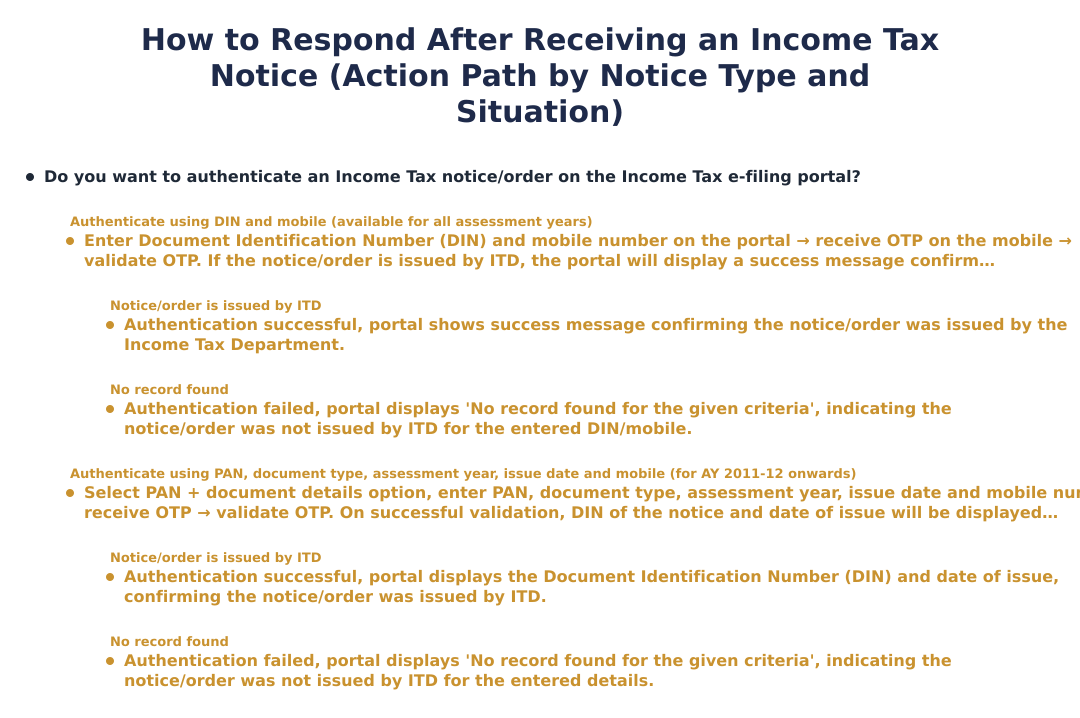
You can verify authenticity using the ‘Authenticate notice/order issued by ITD’ feature on the Income Tax e-filing portal, which confirms if the communication was issued by the Income Tax Department. Authentication can be done either by entering PAN, document type, assessment year, issue date and mobile number (for notices/orders from AY 2011-12 onwards) or by using the Document Identification Number (DIN) and mobile number (for all assessment years); an OTP is sent to the mobile and on validation the portal displays the DIN and issue date or a ‘No record found’ message. If the portal confirms issuance it’s genuine; if not, treat it as suspicious and avoid sharing personal details or clicking unknown links.
What information do I need to authenticate a notice using my PAN?
To authenticate a notice using PAN you must provide PAN, document type, assessment year, issue date and the mobile number that the department has on record; this method works for notices/orders/letters issued for AY 2011-12 and subsequent years only. After entering these details the portal will send an OTP to the mobile number, once you validate the OTP the portal displays the DIN and date of issue if the notice is genuine. If any detail does not match or OTP cannot be validated, the portal will not confirm the notice and you should check alternative verification using DIN or contact the tax department.
How do I authenticate a notice using the Document Identification Number (DIN)?
To authenticate via DIN enter the DIN printed on the notice and the mobile number registered with the Income Tax Department, then validate the OTP sent to that mobile; this DIN-based method works for all assessment years. After OTP validation the portal will show a success message and the details of the notice if it was issued by the income tax authority, otherwise it will return ‘No record found’ and you should treat the communication as potentially fraudulent. Always save the portal confirmation screenshot or acknowledgement for your records if the notice is authenticated.
What should I do immediately after receiving and verifying an income tax notice?
Read the notice carefully to understand the section under which it is issued and the specific information or documents requested, then collect supporting documents such as Form 16, bank statements, investment proofs and transaction details relevant to the query. Log in to the Income Tax e-Filing portal and go to Pending Action > e-Proceedings to view the notice, prepare a clear, factual response attaching the required proofs, submit the reply online and download the acknowledgement or receipt for future reference. Track any further communications on the portal and email, and consult a chartered accountant if the matter involves complex disclosures, assessments or potential penalties.
How do I prepare and submit a reply to a scrutiny notice under Section 143(2)?
Prepare a concise, factual reply addressing each point raised in the Section 143(2) scrutiny notice and attach documentary evidence like ledgers, bank statements, invoices, Form 16 and proofs of claimed deductions to substantiate your position. Log in to the Income Tax Portal, access Pending Action > e-Proceedings, upload the response and supporting documents, and save the acknowledgement or receipt ID after submission, if required, appear before the assessing officer on the scheduled date with originals. For complex matters or disagreements about the assessing officer’s claims, engage a CA or tax lawyer to draft replies, handle hearings and advise on options like filing rectification under Section 154 or filing appeals.
What are the most common reasons the Income Tax Department issues notices?
The most common reasons for receiving a notice include non-filing of returns, mismatches between income/TDS reported and AIS/third‑party data, inaccuracies in the filed return, missing supporting documents for claimed deductions, undisclosed high‑value transactions, use of an incorrect ITR form, and random selection for scrutiny. Specific triggers include inconsistency in TDS reported, undisclosed capital gains from stocks, large transactions not reflected in returns, or investments held in a spouse’s name that were not reported, and each reason will determine the type of notice issued and the documents you must provide. Addressing the exact discrepancy with documentary proof and timely response usually resolves most notices without penalties; persistent non-response or concealment may lead to reassessment or penalties.
What happens if I ignore an income tax notice or miss the deadline to respond?
If you ignore an income tax notice or miss the deadline you risk escalation such as assessment in absence, imposition of interest and penalties, issuance of a demand notice under Section 245, or even prosecution in severe cases of concealment; the exact consequence depends on the notice type and the reason for non-compliance. For example, failing to respond to a Section 142(1) or 143(2) notice may lead the Assessing Officer to proceed with whatever information is available, and for Section 148 (income escaping) the AO can reopen assessment subject to time limits and issue demand. If you miss a deadline, promptly respond with an explanation, request additional time if needed, and consult a tax professional to mitigate penalties or file rectification/appeal options where applicable.
What is the difference between an intimation under Section 143(1) and a scrutiny notice under Section 143(2)?
An intimation under Section 143(1) is an automated communication from CPC after processing your ITR that informs you whether your return is accepted, a refund is due, or a tax demand exists, while a Section 143(2) scrutiny notice is issued when the Assessing Officer decides to examine your return in detail. Section 143(1) usually lists arithmetic or processing adjustments and can be rectified by filing a rectification under Section 154 if you disagree, whereas Section 143(2) requires a substantive response with supporting documents and may lead to detailed assessment and possible adjustments to taxable income. Timelines and required actions differ: 143(1) intimation typically does not require immediate documents unless it creates a demand, but 143(2) specifies documents and deadlines for your response or hearing.
Need help staying Income Tax compliant?
MoneyGence's AI Finance OS tracks your compliance, wallet share, and finances in one place, built for agencies and growing businesses.
Get started with MoneyGence