Types of Accounting: Key Types & Their Importance
Accounting is the systematic process of recording, classifying, summarising and interpreting financial transactions to produce information that helps stakeholders make informed decisions. In this guide you will learn the main types of accounting used by businesses and organisations, why accounting matters for growth and compliance, and practical considerations when implementing accounting processes. Whether you are a small-business owner putting basic bookkeeping systems in place, a manager reviewing internal reports, or a student learning the discipline, understanding the different accounting functions helps you choose the right tools and practices for your needs. This article explains the major branches of accounting, their purpose, typical outputs, and how they support different users such as managers, investors, lenders and tax professionals. It also outlines the broader importance of maintaining sound accounting, including how it supports financing, performance measurement and governance. Finally, you’ll find answers to common questions about accounting careers, financial accounting varieties and auditing types, plus factors to consider when adopting accounting practices in your business. The aim is to give you a clear, practical understanding so you can apply accounting concepts more confidently in everyday decisions.
What are the types of accounting?
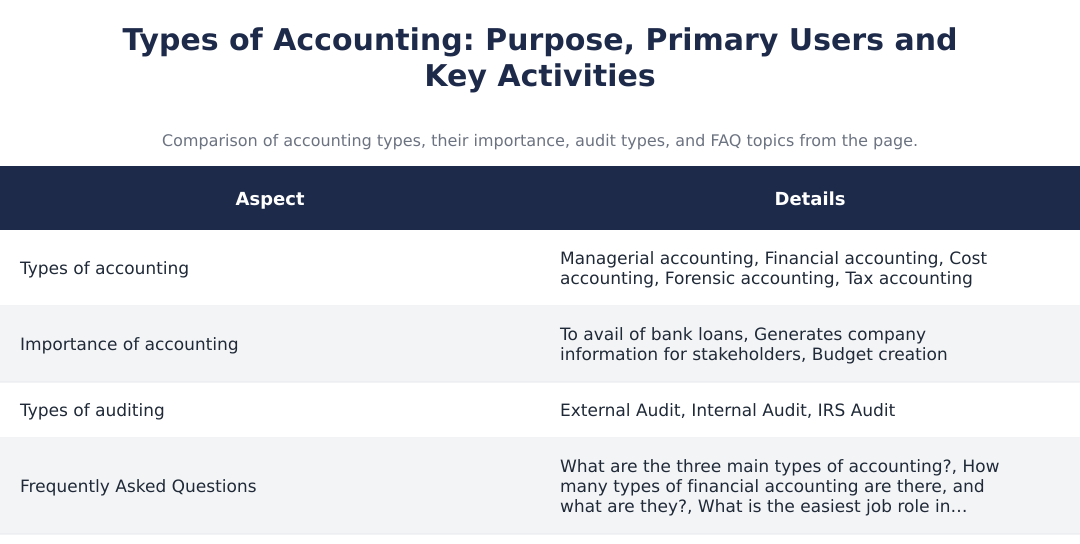
Accounting comprises several specialised branches, each serving different purposes and users. Financial accounting focuses on preparing standardised financial statements that communicate an organisation’s financial position and performance to external parties. Managerial accounting concentrates on internal decision support, producing budgets, performance reports and cost analyses that help managers plan and control operations. Cost accounting zeroes in on determining and controlling the costs of producing goods or delivering services, often feeding into pricing and profitability analysis.
Other specialised areas include tax accounting, which deals with tax compliance and planning; forensic accounting, which involves investigating financial irregularities and supporting dispute resolution; and auditing, which provides independent assurance on financial information. Each type uses overlapping techniques but differs in emphasis: whether the audience is internal or external, whether the focus is historical records or forward-looking planning, and whether outputs are formal public documents or internal management reports.
Choosing which accounting types to emphasise depends on organisational size, complexity and objectives. Small businesses may prioritise basic bookkeeping and financial statements to monitor cash flow and meet reporting needs, while larger organisations typically maintain dedicated teams for managerial reporting, cost control and tax compliance. In all cases, consistent recordkeeping, appropriate accounting policies and timely reporting are central to reliable accounting information.
Importance of accounting
Accounting is fundamental to business operation because it converts economic activity into structured information that stakeholders can use. For owners and managers, accounting helps assess profitability, track cash flows, control costs and make decisions about investments, pricing and resource allocation. Reliable accounting information reduces uncertainty and supports better operational and strategic choices.
For external stakeholders, such as lenders, investors, suppliers and regulators, accounting provides a basis for assessing creditworthiness, investment potential and compliance. Financial statements and accompanying disclosures are key tools stakeholders use to evaluate an organisation’s health, trends and risks. Good accounting practices therefore enhance credibility and can make it easier to secure financing or favourable business terms.
Accounting also supports planning and accountability. Budgets derived from accounting records set performance benchmarks and enable organisations to monitor variances and take corrective action. Additionally, accounting facilitates transparency and governance by documenting transactions and creating audit trails that help detect errors or misconduct. In short, accounting underpins financial management, trust and long-term sustainability.
Factors to remember while implementing accounting in your business
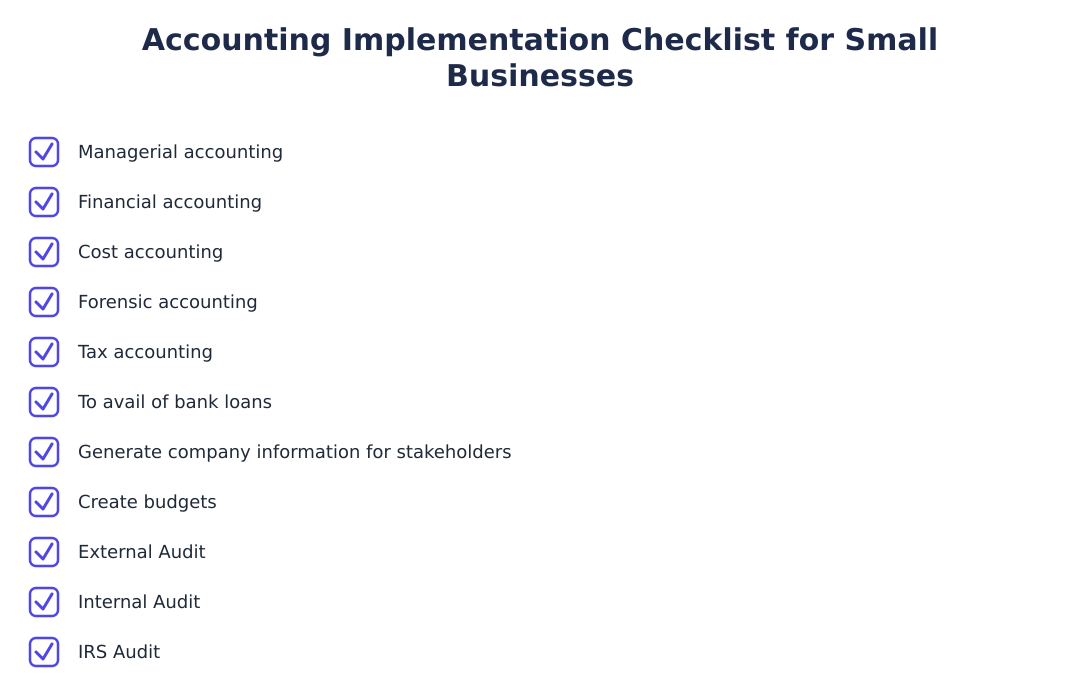
Start with clear objectives: identify what you need accounting for, statutory reporting, tax compliance, internal management, obtaining finance or controlling costs. Your objectives determine the level of detail, frequency of reporting and the expertise required. Simpler operations may be served by basic bookkeeping and periodic financial statements, while complex businesses often need more sophisticated managerial and cost accounting systems.
Design processes that ensure consistency and reliability: establish standardised methods for recording transactions, reconciling accounts and retaining documentation. Consistent processes reduce errors and make it easier to generate timely reports. Consider the technology and tools that match your needs; automation can reduce manual work and improve accuracy, but it should be implemented with proper controls and training.
Ensure segregation of duties and controls: even small organisations should separate responsibilities where feasible to prevent errors or misuse. Regular reconciliations, review of reports by an independent party and documented approval workflows strengthen internal control. Finally, invest in training or professional advice as needed, the right skills ensure your accounting information is accurate and useful for decision-making.
Different types of auditing
Auditing provides independent examination of financial records and controls to enhance the credibility of reported information. External audits are performed by independent auditors who provide an opinion on whether financial statements present a true and fair view. Internal audits are conducted by an organisation’s internal audit function and focus on risk management, internal control effectiveness and operational improvements. Both play complementary roles in a robust governance framework.
There are also specialised audit activities that target specific objectives, such as compliance reviews, operational audits, and investigative or forensic audits that examine suspected fraud or irregularities. Audits vary in scope and procedures depending on the purpose: some verify transactional accuracy, others assess the adequacy of controls, and some evaluate efficiency and effectiveness of processes. Regular audits and timely remediation of findings strengthen controls and improve stakeholder confidence.
Frequently Asked Questions
What are the three main types of accounting?, While different frameworks exist, a common way to group accounting is into financial accounting (external reporting), managerial accounting (internal decision support) and cost accounting (cost measurement and control). These three areas capture most routine business needs and have distinct audiences and outputs.
How many types of financial accounting are there, and what are they?, Financial accounting can be differentiated by the kinds of statements and reports produced (for example, balance sheet, income statement and cash flow information) and by the audience and regulatory context. The fundamental focus remains preparing externally-oriented financial information that summarises historical financial performance and position.
What is the easiest job role in the accounting profession?, Perceptions of ease vary with personal aptitude and experience. Entry-level bookkeeping or junior accounting roles typically focus on routine transaction recording and reconciliations and can be more predictable, while roles requiring judgment, tax planning or audit responsibilities often involve greater complexity and broader stakeholder interaction.
What are the different types of auditing?, Audits commonly include external audits that provide independent assurance on financial statements, internal audits that review controls and operations, and investigative audits that look at suspected irregularities. Each type has a specific objective and methodology aligned to the intended outcomes.
What are the factors to remember while implementing accounting in your business?, Key considerations include defining clear objectives for accounting, standardising processes and documentation, selecting appropriate tools, ensuring segregation of duties and internal controls, and investing in training or professional support as needed.
Sound accounting is more than bookkeeping: it is a decision-making engine that supports planning, control, transparency and trust. By understanding the different types of accounting and their roles, implementing consistent processes, and using appropriate controls and expertise, organisations can turn financial data into reliable insight that drives better business outcomes.
Frequently asked questions
What is accounting in simple words?
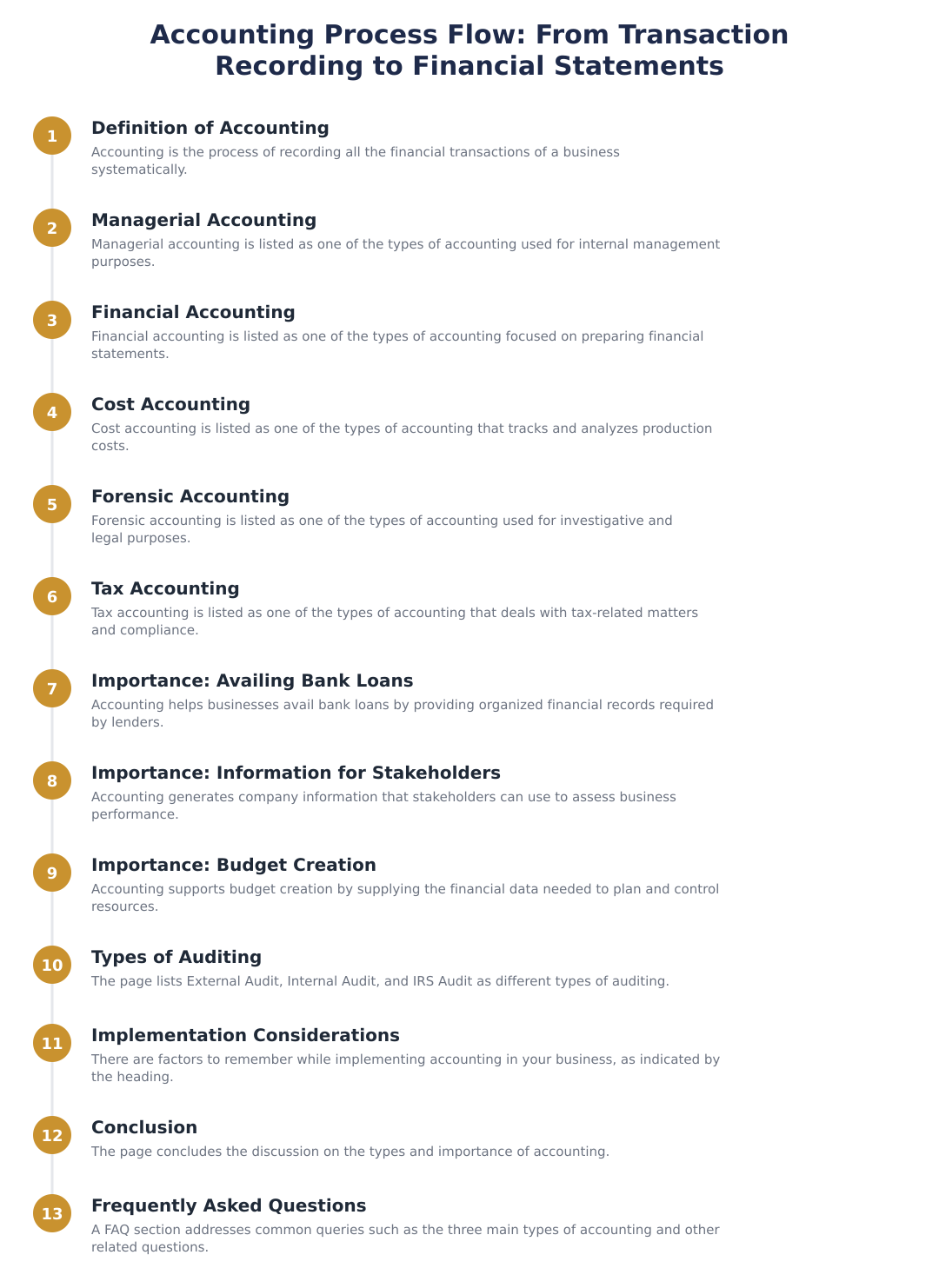
Accounting is the systematic process of recording all financial transactions of a business. It involves capturing every sale, purchase, receipt and payment in an organized way so that financial statements can be prepared, taxes can be filed and management can make decisions; accurate accounting ensures legal compliance and provides a reliable record for audits and bank evaluations.
What are the main types of accounting used by businesses today?
The main types of accounting used by businesses are managerial accounting, financial accounting, cost accounting, forensic accounting and tax accounting. Managerial accounting supports internal decision-making with budgets and forecasts; financial accounting produces external reports for stakeholders and regulators; cost accounting analyzes product/service costs; forensic accounting investigates fraud; and tax accounting deals with tax compliance and planning.
What are the three primary categories people refer to when they say 'types of accounting'?
The three primary categories commonly cited are financial accounting, managerial (or management) accounting, and cost accounting. Financial accounting focuses on preparing financial statements for external users, managerial accounting provides internal reports for planning and control, and cost accounting calculates and analyzes costs to improve profitability and pricing decisions.
How many types of financial accounting are there and what are they?
Financial accounting is commonly divided into two types: accrual accounting and cash accounting. Cash accounting records transactions only when cash changes hands, while accrual accounting records income and expenses when they are earned or incurred, which is required by most larger businesses and provides a fuller picture of financial position.
Why is accounting important for getting a bank loan?
Accounting is important for getting a bank loan because accurate financial records and statements demonstrate a borrower's creditworthiness and ability to repay. Banks rely on profit-and-loss statements, balance sheets and cash-flow statements produced by proper accounting to assess risk, set loan terms and decide loan amounts, so incomplete or messy records can lead to denial or unfavorable rates.
What role does accounting play for stakeholders like investors and owners?
Accounting generates company information that stakeholders, such as investors, owners, creditors and regulators, use to evaluate performance and make decisions. Financial statements prepared through accounting show profitability, liquidity and solvency, enabling stakeholders to assess returns, risk and the need for further investment or corrective action.
What are the common types of auditing and how do they differ?
Common types of auditing are external audit, internal audit and IRS (tax) audit. External audits are independent reviews of financial statements for stakeholders and regulators; internal audits focus on internal controls, risk management and operational efficiency; IRS or tax audits examine tax returns and compliance with tax laws.
What practical things should I remember when implementing accounting in my business?
When implementing accounting in your business remember that transactions must be recorded systematically (with incoming amounts debited and outgoing amounts credited), choose the right accounting method (cash vs. accrual), maintain supporting documents and set up internal controls. Also ensure regular reconciliations, timely financial reporting and compliance with tax and regulatory requirements to avoid errors and facilitate audits.
What is an easy entry-level job role in accounting for beginners?
An accessible entry-level accounting job for beginners is a budget analyst or junior accountant role in private firms, which often involves basic bookkeeping, preparing budgets and simple financial analyses. These positions provide exposure to managerial and financial accounting tasks, help build practical skills like ledger entries and reconciliations, and serve as a stepping stone to more advanced roles such as cost accountant or financial accountant.
Need help staying Accounting compliant?
MoneyGence's AI Finance OS tracks your compliance, wallet share, and finances in one place, built for agencies and growing businesses.
Get started with MoneyGence