Trial Balance: Concept, Preparation, Advantages & Purpose
This guide explains the trial balance, what it is, how it fits into accounting, why businesses prepare it, and the practical benefits it provides. You will learn how a trial balance functions as a bookkeeping checkpoint between the ledger and final financial statements, the conceptual logic that underpins it, and the typical outcomes accountants expect when a trial balance is in balance or out of balance. Understanding the trial balance is important for anyone handling day-to-day accounting, preparing financial statements, or reviewing internal records because it helps detect many common posting errors, supports the preparation of adjusting entries, and provides a concise summary of ledger balances that is useful for analysis and reconciliation. The content that follows is written to be practical: it describes the conceptual role of the trial balance in the accounting cycle, outlines how ledgers are summarized into a trial balance worksheet, and highlights the primary advantages and uses that make it a routine step in bookkeeping. No prior technical knowledge is required, the explanations focus on why the trial balance matters in real accounting workflows, how it saves time, and how it contributes to financial accuracy. By the end of the guide you should have a clear sense of when to prepare a trial balance, what information it offers, and how to act if the totals do not match. This will help you adopt better bookkeeping habits and make financial review processes more efficient.
What is a Trial Balance?
A trial balance is a bookkeeping worksheet that lists the balances of ledger accounts with the objective of checking the arithmetic accuracy of recorded transactions. It brings together the ending balances of all ledger accounts into a single document, typically grouping debit balances separately from credit balances so that the preparer can quickly see whether the two totals are equal.
While matching totals do not guarantee that the books are free of all errors, a trial balance is a useful early indicator that the double-entry postings were recorded with consistent debits and credits. It serves primarily as an internal control and a preparatory step before adjusting entries, reconciliations, and the preparation of formal financial statements.
Concept of Trial Balance
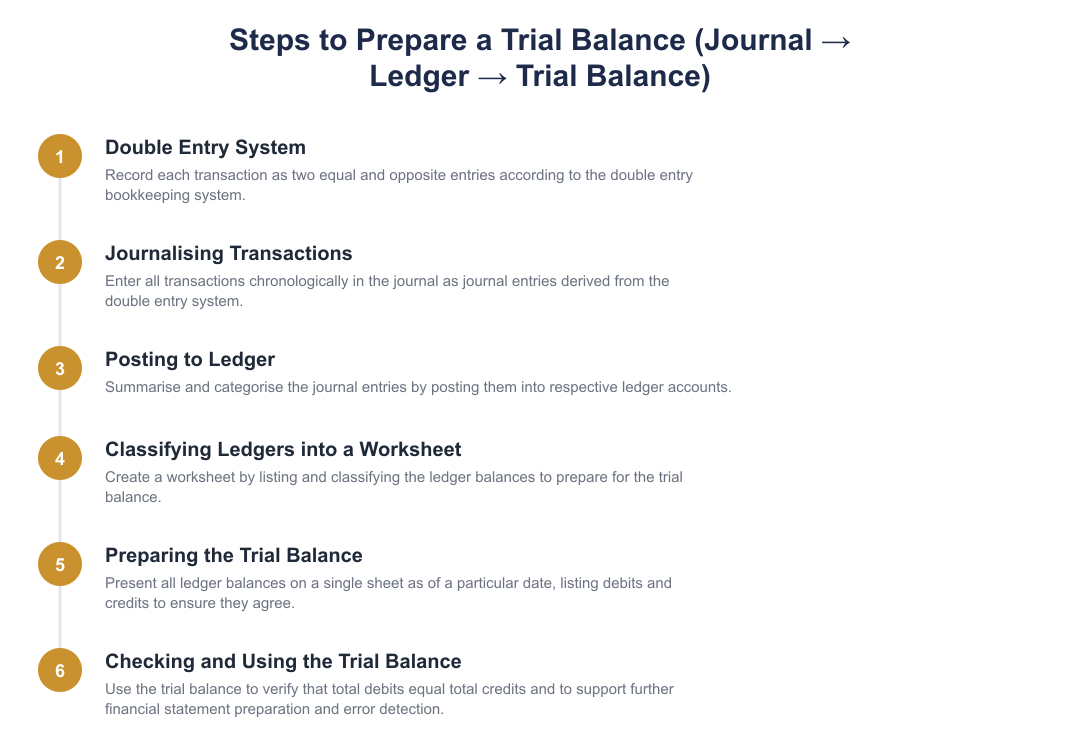
The trial balance is founded on the principle of double-entry bookkeeping, where each transaction affects at least two accounts with equal and opposite entries. By aggregating the final balances of all accounts, the trial balance provides a consolidated view that should reflect the equality inherent in double-entry accounting.
Preparing a trial balance involves pulling closing balances from the ledgers and presenting them in a structured worksheet. This process clarifies the financial position of each account at a given point in time and creates a basis for identifying mismatches that may arise from posting errors, omission, or transposition mistakes.
Because it is a summary rather than a diagnostic tool, a trial balance that balances should be followed with further checks and reconciliations. Conversely, when the trial balance does not balance, it signals the need for systematic review of journal entries, ledger postings, and calculations to locate and correct the discrepancy.
Advantages of Trial Balance
A primary advantage of preparing a trial balance is the rapid detection of many types of recording errors. Because all ledger balances are brought together, simple arithmetic mistakes and unequal postings often become apparent quickly, reducing the time needed for later corrections.
The trial balance also streamlines the preparation of adjusting entries and financial statements by providing a single reference for closing balances. Accountants use it to ensure that adjustments are applied consistently and that financial statements are constructed from a complete and organized set of account balances.
Additionally, maintaining routine trial balances supports internal control and audit readiness. Regularly prepared trial balances make it easier to review historical account activity, trace back entries when questions arise, and provide auditors or reviewers with a clear starting point for deeper examination.
Uses of Trial Balance
Beyond serving as an arithmetic check, a trial balance is commonly used as a working document in the accounting cycle. It helps preparers classify accounts for financial statement presentation and identify which accounts require adjustments, such as accruals, deferrals, or corrections.
Financial analysts and managers also use trial balances for quick internal review because they provide a snapshot of account positions without requiring a full set of financial statements. This can be useful for preliminary variance analysis, cash-flow projections, or preparing management reports.
When discrepancies are found, the trial balance guides the corrective process: it narrows the scope of investigation to those accounts and entries that contribute to the imbalance. This targeted approach saves time compared with auditing the entire ledger line by line.
A trial balance is a foundational bookkeeping tool that consolidates ledger balances to check the arithmetic integrity of accounting records and to prepare for adjustments and financial statement preparation. While it does not guarantee the absence of all errors, its regular use improves accuracy, supports internal controls, and makes the accounting cycle more efficient. Incorporating routine trial balance checks into your bookkeeping process will help catch common mistakes early and create a clearer, more reliable path to final accounts.
Frequently asked questions
What is a trial balance in simple words?
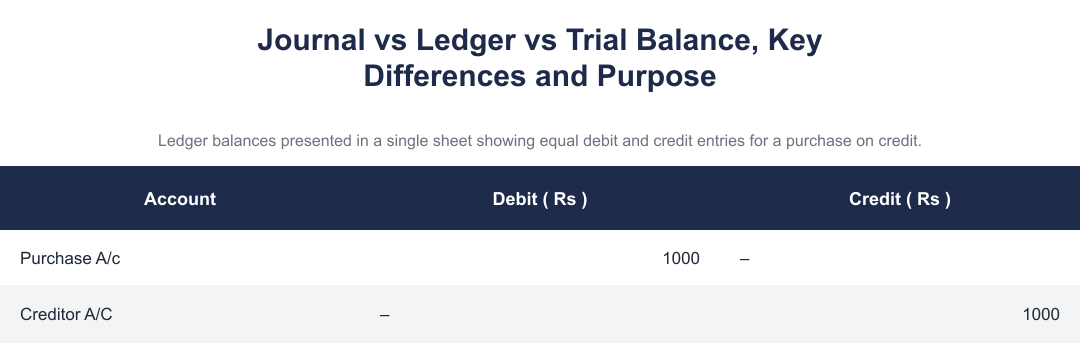
A trial balance is a single-sheet statement that lists all ledger balances (debit and credit) as on a particular date to check arithmetical accuracy of accounts. It is prepared after posting journal entries into ledgers and involves bringing together all ledger closing balances into one worksheet; for example, a purchase of Rs.1,000 on credit would show Purchase A/c Dr Rs.1,000 and Creditor A/c Cr Rs.1,000. The trial balance format normally presents two columns, Debit (Rs) and Credit (Rs), so totals can be compared. While it helps verify that total debits equal total credits, it does not guarantee absence of all kinds of accounting errors.
Why do we prepare a trial balance?
We prepare a trial balance to verify the arithmetical equality of ledger balances and to serve as the basis for preparing final accounts like the Profit & Loss and Balance Sheet. It summarises all ledger balances in one worksheet so accountants can quickly detect discrepancies in posting or totaling. The trial balance also aids in classification and further adjustments before financial statements are prepared. However, it only catches certain types of errors (like transposition or balancing errors) and may not reveal mistakes such as omissions or wrong accounts used.
How is a trial balance prepared step by step?
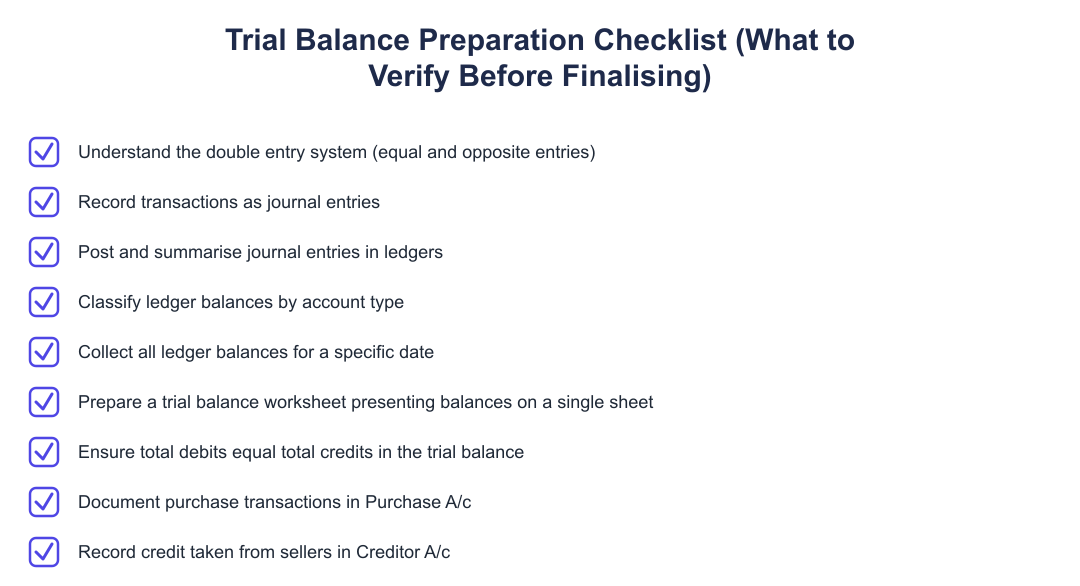
A trial balance is prepared by first recording transactions in the journal, posting them to respective ledgers, extracting the closing balances from each ledger, and then listing those balances in debit or credit columns of a single worksheet as on a specific date. For example, after posting a Purchase A/c Dr Rs.1,000 and Creditor A/c Cr Rs.1,000 in ledgers, you would place Rs.1,000 in the Purchase debit column and Rs.1,000 in the Creditor credit column of the trial balance. Finally, total the debit and credit columns to ensure they are equal; equal totals indicate arithmetical agreement. Any mismatch prompts investigation into posting, balancing, or totaling errors before final accounts are prepared.
What are the main advantages of preparing a trial balance?
The main advantages of preparing a trial balance are quick verification of arithmetical accuracy, easier preparation of financial statements, and simplified detection of certain accounting errors. By bringing all ledger balances into one sheet, accountants can confirm that total debits equal total credits, which reduces chances of posting or totalling mistakes. It also provides a convenient summary for adjustments and classification required for Profit & Loss and Balance Sheet preparation. Note that while it highlights discrepancies in totals, it cannot detect errors of omission, commission, or compensating errors.
What are the uses of a trial balance for an accountant or business owner?
A trial balance is used to check the mathematical accuracy of ledger postings, assist in locating errors, and act as a working paper for preparing final accounts like the Trading Account, Profit & Loss Account, and Balance Sheet. It summarises all account balances in debit and credit columns so accountants can quickly spot disparities and make necessary adjustments. Businesses also use the trial balance as an audit trail to review accounting records before external audit or tax filings. Despite its usefulness, it should be supplemented with reconciliations and reviews because some errors may not be revealed by the trial balance alone.
Does a balanced trial balance mean there are no accounting errors?
No, a trial balance where total debits equal total credits does not guarantee the accounts are free of all errors. While equal totals confirm arithmetical agreement, errors such as omissions (a transaction not recorded), commission (amount posted to wrong account), principle (wrong accounting treatment), or compensating errors (two mistakes that offset) will not be revealed. Therefore, additional checks like ledger reviews, reconciliations, and verification of supporting documents are necessary to ensure complete accuracy. For example, if a sale was omitted entirely from both journal and ledger, the trial balance would still balance but records would be incomplete.
What format does a trial balance follow and what columns are included?
A trial balance typically follows a two-column format showing Debit (Rs) and Credit (Rs) with each ledger account's closing balance placed in the appropriate column. Each row lists an account name (for example, Purchase A/c) and its balance under the debit or credit column, e.g., Purchase A/c Dr Rs.1,000 and Creditor A/c Cr Rs.1,000, and the column totals are compared to ensure equality. Some trial balances may include additional columns for adjustments, net amounts, or notes, but the basic purpose remains to compare total debits and credits. The date on the trial balance is important because it shows balances as at that specific point in time for preparing final accounts.
When in the accounting cycle should the trial balance be prepared?
The trial balance should be prepared after all transactions have been journalised and posted to the ledger but before preparing final accounts and financial statements. It serves as an interim check to ensure that ledger postings are arithmetically correct and to identify discrepancies that need adjustment prior to making the Trading, Profit & Loss, and Balance Sheet. Preparing the trial balance at the end of an accounting period (monthly, quarterly or annually) helps standardise the cut-off for reporting. Any adjusting entries discovered from the trial balance review should be posted to the ledger and a revised trial balance prepared if necessary.
Can a trial balance detect all types of bookkeeping errors?
No, a trial balance can detect many arithmetic and posting errors but cannot detect all types of bookkeeping mistakes. It will catch errors like unequal totals due to mis-posting or incorrect totals in ledgers, but it cannot reveal transactions omitted entirely, entries posted to wrong accounts, wrong amounts posted on both sides, or compensating errors where two mistakes cancel each other. Therefore, reliance solely on a trial balance is insufficient; supplementary procedures such as account reconciliations, vouching, and reviewing source documents are needed to uncover these other errors. For instance, if both debit and credit of Rs.5,000 were posted to wrong accounts but equal in amount, the trial balance would still balance even though accounts are misstated.
Need help staying Accounting compliant?
MoneyGence's AI Finance OS tracks your compliance, wallet share, and finances in one place, built for agencies and growing businesses.
Get started with MoneyGence