Transfer EPF to NPS: Process, Tax Treatment & Steps
This guide explains what to consider if you are thinking about moving money from one retirement account to another. It outlines the broad themes you should evaluate, how retirement investments are structured, how returns are determined, what withdrawal rules commonly look like, the potential tax consequences, and the practical steps you will likely need to follow to initiate a transfer. Understanding these topics matters because retirement savings are long-term assets: choices you make today, about where funds are invested or whether to consolidate accounts, can affect future income security, flexibility at the time of retirement, and tax liabilities. Rather than prescribing a single ‘right’ move, this guide equips you to ask the right questions of employers, custodians and tax advisors so you can decide what aligns with your retirement goals and cash‑flow needs.
1. Investment
Retirement schemes differ in how contributions are invested and in the level of investment choice offered to the subscriber. Some schemes follow a predetermined asset allocation while others allow subscribers to choose between equity, debt and alternative investment options. When comparing two accounts, consider the underlying investment philosophy, availability of actively managed versus passively managed options, and the mechanisms for rebalancing over time.
Beyond returns, other investment-related factors matter: the frequency with which you can switch funds, any limits on switching, the transparency of holdings and fees charged by the fund or intermediary. These considerations affect both the net growth of your corpus and how comfortable you will be managing your retirement savings over the decades leading to retirement.
2. Return on Investment
Returns on retirement accounts are driven by the asset mix, the skill of fund managers (where applicable), underlying market conditions and charges applied by the scheme or intermediaries. Equity portions tend to be more volatile but can offer higher long‑term growth potential; debt portions typically provide lower volatility but also lower expected returns.
When evaluating historical performance, focus on risk‑adjusted measures and consistency over multiple market cycles rather than short‑term gains. Remember that past performance is not a guarantee of future returns, and that fees will reduce the net return available to you at retirement.
3. Withdrawal
Withdrawal rules for retirement funds vary by product and jurisdiction. Common themes include a lock‑in until a specified stage of life, partial withdrawal options for specific needs, and choices at maturity between lump sums and annuity or pension-type payouts. These rules determine liquidity, how and when you can access your savings, and can influence whether you should consolidate balances across accounts.
Before initiating any transfer, check how a move may affect your future withdrawal options. A transfer might preserve the retirement character of contributions, or it could change the mix of available exit options such as immediate withdrawals, phased withdrawals or compulsory purchase of an annuity.
4. Taxation
Tax treatment is one of the most important considerations when moving retirement money. Different retirement instruments can have different tax implications for contributions, accumulation (investment growth) and withdrawals. Any transfer between retirement accounts should be examined for potential tax events or differences in future tax treatment.
Because tax rules are specific and subject to change, and because the impact depends on your personal tax position, consult a qualified tax advisor or the official guidance from the scheme administrators before completing a transfer. Doing so helps avoid unexpected tax bills at the time of transfer or at withdrawal.
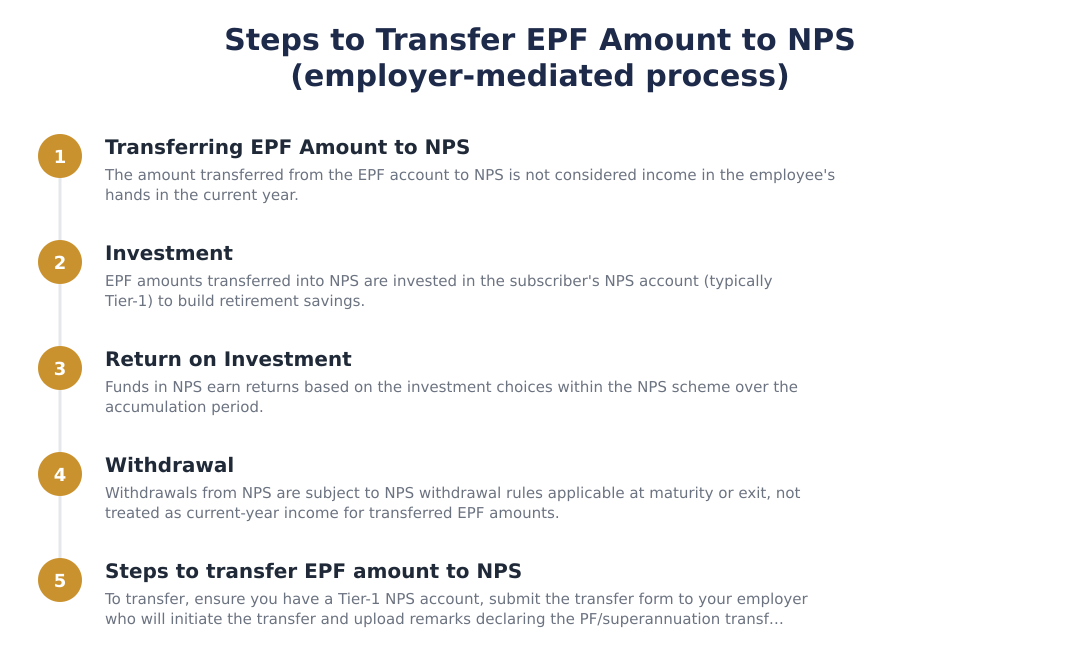
5. Steps to transfer EPF amount to NPS
A transfer typically requires confirming eligibility, completing an authorised request, and coordinating between the current custodian and the receiving plan administrator. You will usually need to gather personal identification, proof of account details and any employer or trustee authorisations that the transfer process requires.
Practical tips: contact both the account providers early to understand their specific procedures and timelines; keep copies of all submitted forms and receipts; and follow up regularly until the transfer reflects in the receiving account. If any doubt remains about process or tax consequences, obtain written confirmation or a formal opinion from a tax or retirement‑account professional.
Transferring funds between retirement accounts can make sense for reasons such as consolidating accounts, changing investment strategy, or accessing different withdrawal features. However, because investment characteristics, withdrawal rules and tax treatments can differ materially, approach any transfer deliberately: gather scheme‑specific information, verify procedural requirements with both providers, and seek professional tax or financial advice where needed.
Frequently asked questions
Can I transfer my EPF money to my NPS account without any tax implications this year?
Yes, the amount transferred from your EPF account to NPS is not treated as taxable income in the hands of the employee for the current year. This transfer is specifically excluded from income, so you won't pay tax on the transferred sum in the year of transfer. However, taxability on future withdrawals will be governed by NPS withdrawal rules and applicable tax laws at the time of withdrawal. Keep records of the transfer transaction and employer remarks for your tax file.
Do I need a Tier-1 NPS account to transfer EPF money to NPS?
Yes, you must have an active Tier-1 NPS account to transfer funds from EPF to NPS because transfers to NPS without a Tier-1 account are not permitted. The Tier-1 account is the permanent retirement account where transferred EPF sums are credited. If you do not have a Tier-1 account, open one (obtain PRAN) before initiating the transfer to ensure the employer or nodal office can process the funds correctly. Without this, the employer will not be able to complete the transfer process on your behalf.
What are the steps I must follow to transfer EPF amount to my NPS account?
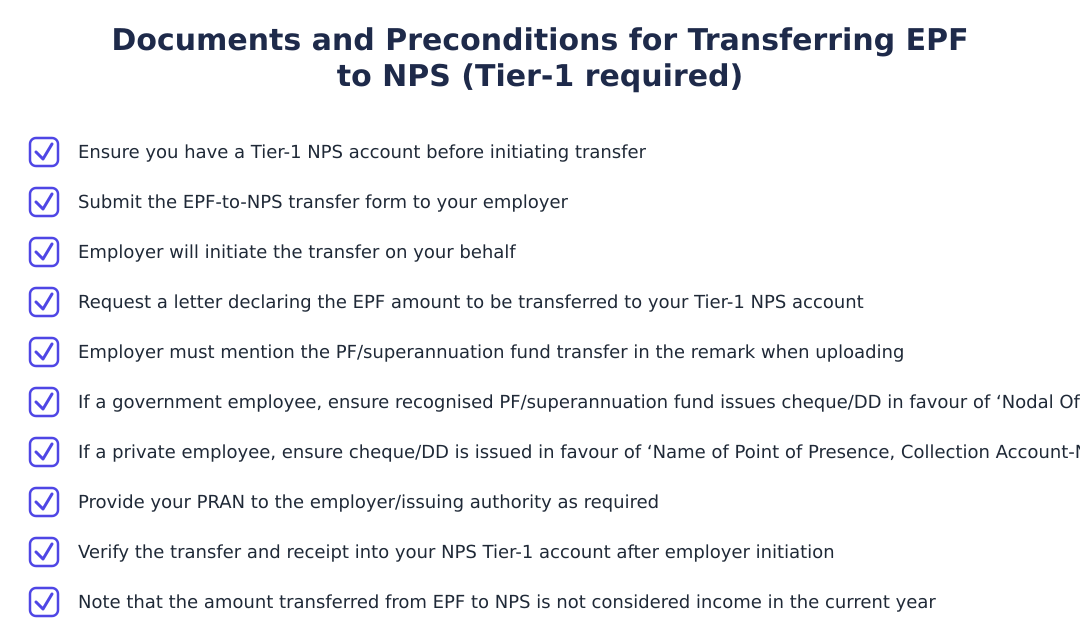
To transfer EPF to NPS you must first have a Tier-1 NPS account and then submit the transfer form to your employer, who will initiate the transfer on your behalf. You need to request and provide a letter declaring the amount to be transferred from EPF to your Tier-1 NPS account; the employer will mention the transfer from PF/superannuation fund in the remark when uploading the transfer. Depending on whether you are a government or private employee, the employer or recognised fund will issue a cheque/DD in the prescribed favour format (details differ for government and private employees). Keep the transfer acknowledgement and PRAN details for future reference.
How should the cheque or demand draft be drawn when EPF is transferred to NPS for government employees?
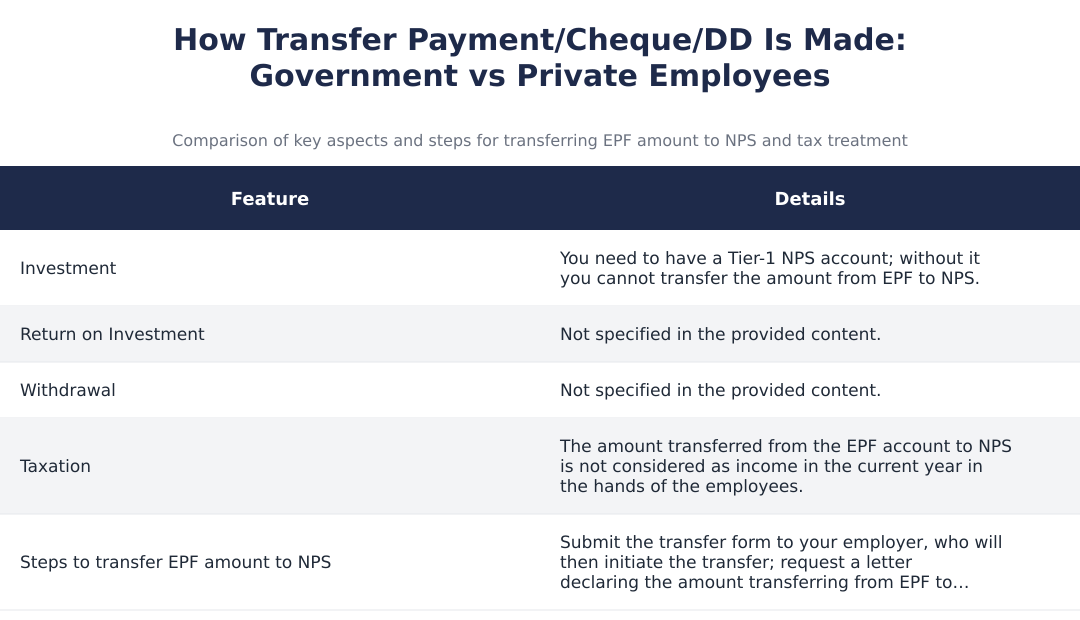
For government employees, the recognised PF/superannuation fund will issue a cheque or demand draft in favour of ‘Nodal Office Name – Employer Name – Permanent Retirement Account Number (PRAN)’. This exact naming convention ensures the funds are credited to the correct Nodal Office and linked to the employee’s PRAN for Tier-1 NPS. Make sure your employer issues or forwards this cheque/DD correctly and retains a copy of the payment instructions and receipts. Incorrect naming can delay credit to your NPS account, so verify the format before processing.
How should the cheque or demand draft be drawn when EPF is transferred to NPS for private employees?
For private employees, the cheque or demand draft should be issued in favour of ‘Name of Point of Presence, Collection Account-NPS Trust – Subscriber Name – PRAN’. This format routes the funds through the appointed Point of Presence and ensures proper credit to the NPS Trust and your subscriber account identified by PRAN. Confirm with your employer or the POP about the exact wording and include your PRAN and subscriber name to avoid processing delays. Keep a copy of the instrument and related communication until the amount appears in your Tier-1 NPS account.
Will the transferred EPF amount earn returns once it is in NPS?
Yes, once EPF funds are transferred into your Tier-1 NPS account they will be invested and will generate returns according to the NPS investment allocation and fund manager performance. Returns depend on the pension fund choices (e.g., equity, corporate bonds, government securities) and the fund manager selected within NPS, so the actual gain can vary over time. The transferred sum becomes part of your NPS corpus and will be subject to NPS rules on investment strategy, risk profile, and periodic valuation. Keep track of fund performance statements to monitor how the transferred EPF is growing within NPS.
What are the withdrawal rules after I transfer EPF amount to NPS?
After EPF funds are transferred into the Tier-1 NPS account, withdrawals will be governed by NPS withdrawal rules applicable to Tier-1 accounts. Typically, Tier-1 NPS has restricted pre-retirement withdrawal provisions and permits lump-sum and annuity options at retirement as per NPS policy, so the transfer will be subject to those conditions. The transferred amount becomes part of your NPS corpus and must follow NPS limits, vesting, and annuity purchase requirements at exit; check current NPS withdrawal norms for specific eligibility and tax implications at the time of withdrawal. Maintain documentation of the EPF-to-NPS transfer to prove the source and timing of funds when you request withdrawals later.
Do I have to inform the EPF office directly about the transfer or will my employer handle it?
You must submit the transfer form and a declaration of the amount to your employer, and the employer will then initiate the transfer with the EPF/superannuation fund on your behalf. The employer is responsible for uploading the transfer details and mentioning the transfer from PF/superannuation fund in the remark field to ensure proper processing. If additional steps are required (like issuing a cheque/DD or coordinating with a Nodal Office or POP), your employer will follow the prescribed format and process; you should keep copies of all submitted documents and follow up until the amount reflects in your Tier-1 NPS account. Direct contact with the EPF office is usually unnecessary unless there is a delay or dispute that your employer cannot resolve.
Need help staying Payroll compliant?
MoneyGence's AI Finance OS tracks your compliance, wallet share, and finances in one place, built for agencies and growing businesses.
Get started with MoneyGence