TDS TCS Restructuring FY 2026-27 – Guide to Sections 392-394
This guide explains the major TDS/TCS restructuring introduced by the new Income Tax Act, 2025 and what businesses and tax professionals must know for FY 2026-27 (Tax Year 2026-27). You will learn which scattered withholding provisions were consolidated, how reporting has been standardised, where rates and thresholds have been rationalised, and which specific withholding rules apply to common resident and non-resident payments. Understanding these changes matters because consolidation and code-based reporting affect return filing, compliance systems, and vendor onboarding; rate rationalisation and clear thresholds change when and how much tax must be deducted or collected. This guide pulls together the verified structural changes and selected rate mappings under the new Act so you can prioritise system updates, compliance checks, and advisory conversations with clients or internal teams ahead of the FY 2026-27 year.
KEY STRUCTURAL CHANGES UNDER NEW INCOME TAX ACT, 2025
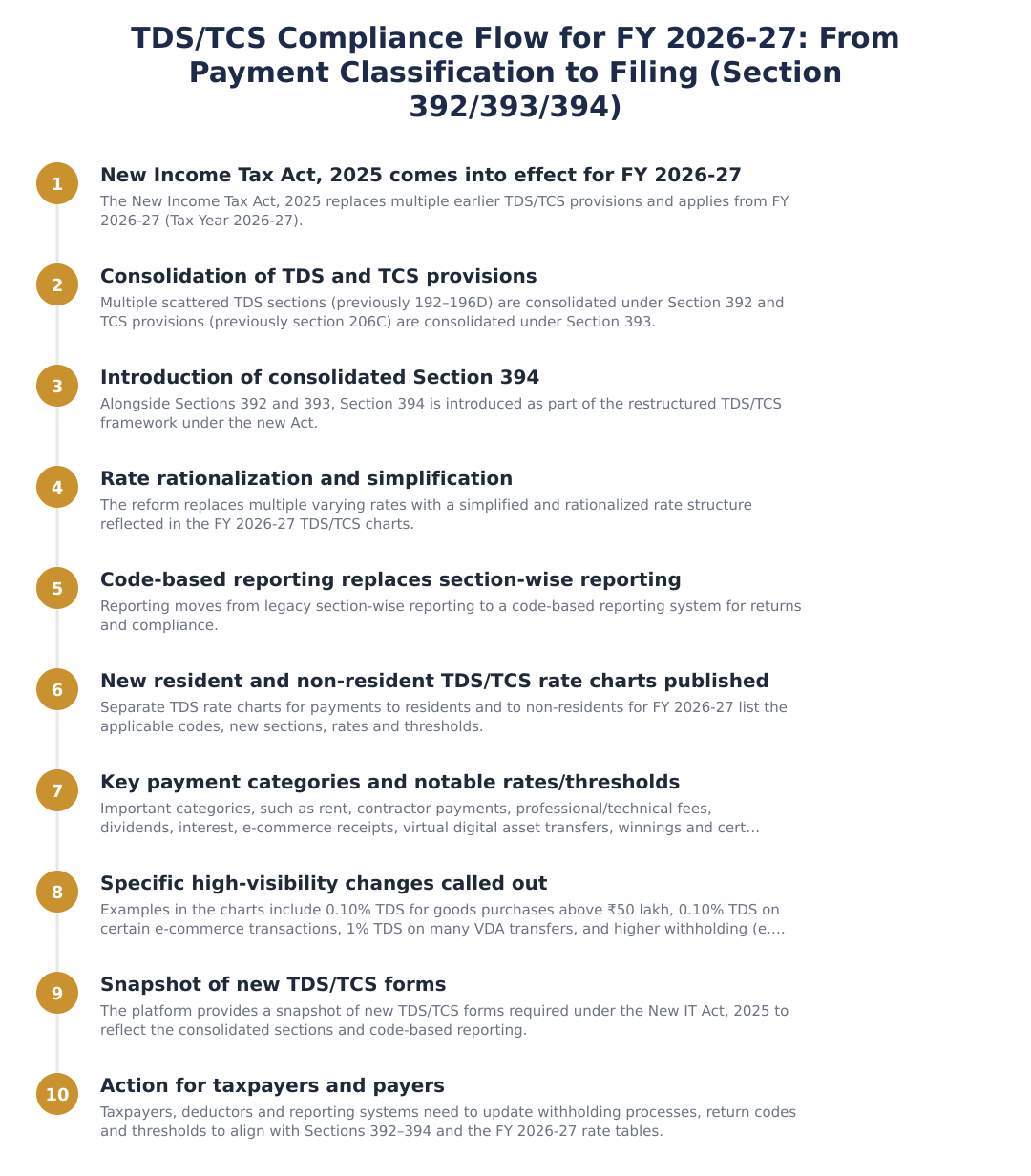
The new Income Tax Act, 2025 consolidates multiple scattered TDS provisions (which under the old law were spread across many sections such as 192–196D) into a single consolidated TDS provision under Section 392. Similarly, the TCS framework has been consolidated under Section 393. This structural consolidation is intended to simplify the statute by grouping withholding rules in a central place.
Reporting has been standardised as well: earlier returns required section-wise reporting; under the new law a code-based reporting system is introduced. This will require payers and collectors to update their accounting and payroll systems to map payments to the new codes rather than to the old section numbers.
Rate rationalisation is another visible change, multiple rates that existed under the old law have been simplified and, in some cases, made uniform. The consolidation and rate rationalisation together aim to reduce ambiguity for deductors/collectors and make compliance easier, but they also mean businesses must re-check thresholds and applicability for common payment types.
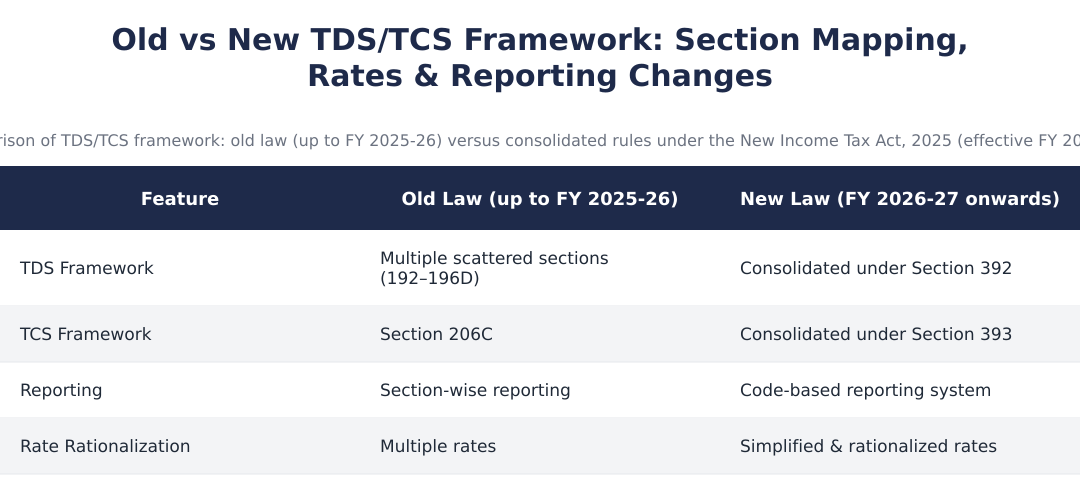
TDS/TCS FRAMEWORK, OLD LAW VS NEW ACT
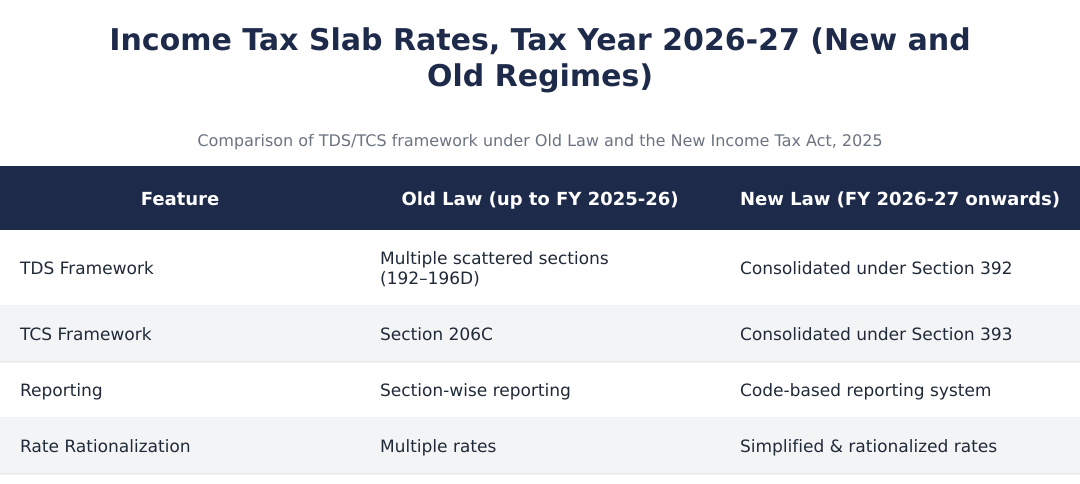
| Feature | Old Law (up to FY 2025-26) | New Law (FY 2026-27 onwards) |
|---|---|---|
| TDS Framework | Multiple scattered sections (192–196D) | Consolidated under Section 392 |
| TCS Framework | Section 206C | Consolidated under Section 393 |
| Reporting | Section-wise reporting | Code-based reporting system |
| Rate Rationalization | Multiple rates | Simplified & rationalized rates |
SELECTED TDS RATES, PAYMENTS TO RESIDENTS (FY 2026-27)
| Old Section / Code | Nature of Payment | New Section (IT Act 2025) | Rate (%) | Threshold (₹) |
|---|---|---|---|---|
| 194I(a) | Rent on machinery etc. - specified person | 393 | 2% | ₹ 50,000 per month |
| 194I(b) | Rent other than machinery etc. - specified person | 393 | 10% | ₹ 50,000 per month |
| 194J(a) | Fees for technical services / royalty for cinematographic films / call centre operator | 393 | 2% | 50,000 |
| 194J(b) | Fees for professional services; other sums referred in section 26(2)(h) | 393 | 10% | 50,000 |
| 194Q | Any sum for purchase of any goods | 393 | 0.10% | in excess of ₹ 50 lakh |
| 194O | Sale of goods or provision of services by an e-commerce participant facilitated by an operator | 393 | 0.10% | ₹ 5 Lakh (Individual/HUF) |
| 194 | Any dividends declared | 393 | 10% | ₹ 10,000 (Individual) |
| 194A | Interest other than interest on securities (various categories) | 393 | 10% | 10,000 |
| 194DA | Any sum under a life insurance policy (taxable portion) | 393 | 2% | ₹ 1 lakh |
SELECTED TDS RATES, PAYMENTS TO NON-RESIDENTS (FY 2026-27)
| Old Section / Code | Nature of Payment | New Section (IT Act 2025) | Rate (%) |
|---|---|---|---|
| 195 | Any income in respect of units of a Mutual Fund specified under Schedule VII / from specified company | 393 | 20% or rate provided in the agreement, whichever is lower |
| 196B | Income in respect of units referred to in section 208 | 393 | 10% |
| 196B | Long-term capital gains arising from transfer of units referred to in section 208 | 393 | 12.50% |
| 196C | Income by way of interest or dividends in respect of bonds or GDRs referred to in section 209 | 393 | 10% |
| 196C | Long-term capital gains arising from transfer of bonds or GDRs referred to in section 209 | 393 | 12.50% |
| 196D | Any income in respect of securities referred to in section 210(1) | 393 | 20% |
| 196D | Any income in respect of securities referred to in section 210(1) | 393 | 10% |
| 194LBC / LBB / LBA | Distributed income / income in respect of investment/securitisation trusts | 393 | Varied, examples include 5%, 10%, 30% or 35% depending on resident/non-resident and type |
PRACTICAL COMPLIANCE IMPLICATIONS
Consolidation of provisions into Sections 392 and 393 and the shift to code-based reporting mean businesses must update ERP, payroll and TDS/TCS modules to map legacy section numbers to the new codes. Where systems previously relied on section-wise reporting, mapping tables and validation logic will need to be revised to prevent mis-reporting.
Rate rationalisation and clarified thresholds change the trigger points for deduction or collection. For example, purchase-of-goods withholding (194Q mapped to 393) applies at 0.10% where purchases exceed ₹50 lakh; e-commerce-related withholding under 194O is set at 0.10% with a lower threshold for individuals/HUF. These are the kinds of rules that require procurement, vendor onboarding and accounts payable teams to be aligned so that withholding is applied consistently.
For payments to non-residents, the new Act preserves situations where treaty or contract rates determine withholding (for example section 195 style cases) and also specifies fixed rates for many capital income categories. This makes it important to review documentation for non-resident payees, nature of payment, residential status, and any treaty entitlement, before applying the standard rates in Section 393.
The 2025 Act’s consolidation and rationalisation of TDS/TCS into Sections 392 and 393, plus the move to code-based reporting and simplified rates, are structural changes with direct operational impact. Use the mappings and representative rates above to prioritise system updates, vendor documentation, and internal controls ahead of FY 2026-27. For specific application to a payment type or to confirm treaty impacts for non-residents, reconcile the relevant old section’s facts to the new-code entries in your tax engine and consult a tax advisor.
Frequently asked questions
What is the big change to TDS and TCS rules from FY 2026-27 under the new Income Tax Act, 2025?
The new Income Tax Act, 2025 consolidates most scattered TDS and TCS provisions into three central sections, Section 392 for TDS, Section 393 for TCS and Section 394 for miscellaneous rules, effective from FY 2026-27. This replaces multiple older sections (like 192–196D for TDS and 206C for TCS), introduces a code-based reporting system instead of section-wise reporting, and rationalises rates and thresholds to simplify compliance. The reform also standardises many rates (for example, several incomes attract a 10% TDS under Section 393) and sets clear thresholds (such as ₹50,000 monthly rent threshold, ₹5 lakh property payment threshold, and ₹50 lakh for purchases triggering 0.10% TDS). The consolidation aims to reduce overlap, make forms uniform, and streamline return filing and deduction/collection obligations for payers and collectors.
Which new sections apply to residents and non-residents for TDS/TCS from FY 2026-27?
From FY 2026-27 the new Act uses Section 392 primarily for TDS on payments (replacing many earlier TDS sections) and Section 393 for TCS and specified withholding on various payments to both residents and non-residents. Section 392 consolidates employer/employee and common resident payment withholding, while Section 393 covers a wide range of payments including commissions, interest, rent, professional fees, sale of goods, and payments to non-residents with rationalised rates (examples: 10% on many resident payments; non-resident rates vary and include 5%, 9%, 30% depending on the nature). Section 394 contains transitional, procedural and miscellaneous provisions such as form changes and reporting codes that apply to both resident and non-resident transactions. Payers must therefore map old-section obligations to the new code system and apply the new rates/thresholds for each payment type.
What are the common TDS rates and thresholds I should watch under Section 393 for resident payments?
Under Section 393 many common payments to residents attract simplified and often uniform rates, for example many types of interest, dividends and certain other incomes attract 10% TDS, commission/insurance brokers and some fees are 2%, and purchases of goods above ₹50 lakh attract 0.10%. Specific thresholds include rent payments where a ₹50,000 per month threshold applies for different rent types, property acquisition compensation where TDS at 10% applies above ₹5 lakh, dividend payments threshold at ₹10,000 for individuals, and interest TDS exemptions like ₹1 lakh for senior citizens in certain cases. There are also higher rates or special thresholds for categories such as winnings (30% with a ₹10,000 per transaction threshold) and special caps for cash payments by banks (₹3 crore/₹1 crore depending on payee type). Always check the exact code mapping for the payment to confirm the applicable rate and threshold.
What are the key non-resident withholding rates under the new Act that differ from resident rates?
Non-resident withholding rates under the new Act are often higher or specific to the income type, examples include interest on certain investment funds or securitisation income attracting 30% or 35% for non-resident companies, whereas resident rates are typically 10%. Other non-resident-specific rates include 5% for certain interest on foreign borrowings or infrastructure debt funds, 9% for some IFSC-listed bonds issued on/after 1 July 2023, and differentiated rates for distributed income from business trusts (5% or 10% for some items, but up to 35% for non-resident companies). The Act retains category-based distinctions so withholding agents must apply the exact non-resident rate tied to the code for that payment type (Section 393) and consider treaty relief or lower treaty rates if applicable and properly documented. Always verify whether payer needs to apply tax treaty provisions, obtain TRC/NOC, and reflect the proper code in returns.
What is the change in reporting and return filing for TDS/TCS under the new Act?
The Act replaces section-wise reporting with a code-based reporting system for TDS/TCS returns, meaning payers must use specified codes (e.g., 1004, 1020, 1035 etc.) in the new consolidated return forms instead of the old section numbers. A snapshot of new forms was published showing uniform tables and codes for every payment type mapped to Sections 392/393, which simplifies reconciliation across payments but requires payers to remap legacy section references to the new codes. The new return structure and unified forms are effective FY 2026-27, so deductors/collectors must update their payroll/accounting systems to capture the new codes, rates and thresholds and to generate the new return format. This change is intended to make automated processing and data analytics simpler for both taxpayers and the tax administration.
Has the rate for tax on purchase of goods changed under the new rules?
Yes, the new Act formalises a 0.10% TDS on purchase of goods under the consolidated code (Section 393) where purchases from a seller exceed ₹50 lakh in a financial year. This replaces the prior single provision (Section 194Q) but maintains the ₹50 lakh aggregate threshold and the 0.10% collection rate for eligible buyers who are required collectors. The obligation is generally on the buyer to collect TCS when purchases from a seller cross the ₹50 lakh threshold in that year, and the buyer must use the designated code in the return and deposit the collected tax accordingly. Exemptions, seller registration status and other specifics should be checked in the final notification and the payer’s compliance system must track aggregate purchases across the FY.
How are payments for immovable property handled under the new consolidated TDS provisions?
Payments on acquisition of certain immovable property continue to attract 10% TDS under the consolidated Section 393 when the amount paid or payable to the transferor exceeds ₹5 lakh. This maps from the old Section 194IA into the new code (for example property-related codes in the published mapping) and keeps the ₹5 lakh threshold for single transaction property transfers. The buyer/deductor must deduct tax at 10% at the time of payment or credit and report the deduction using the correct code in the new return; failure to deduct converts into the buyer’s liability. Note that special exemptions or different rates may apply for specified categories (e.g., certain government entities) so verify applicability before deducting.
What are the new rules for virtual digital asset (VDA) transfers under the consolidated framework?
Under the new Act transfers of virtual digital assets (VDAs) are subject to 1% TDS under specified codes in Section 393 when the consideration crosses the stated thresholds, with a threshold of ₹10,000 shown in the mapping for many VDA-related entries. The 1% rate applies to transfers by persons other than individual/HUF sellers in some cases and similar 1% TDS applies where receipts for VDA transfers meet the threshold; collectors must use the VDA-specific code when reporting and depositing tax. This continues the high-focus on VDAs but places the obligation squarely on the payer/collector and obliges proper reporting under the new code-based return structure; taxpayers dealing in VDAs should ensure their platforms and operators are aware of the collector responsibilities. Also verify whether any exemption or special treatment applies for small transactions or specific categories as per the final rules.
Will forms and filing deadlines change with the TDS/TCS restructuring for FY 2026-27?
The restructuring introduces a snapshot of new TDS/TCS forms aligned to the consolidated sections and code-based reporting, so the format and specific fields in quarterly and annual statements will change even if core deadlines (quarterly deposit and filing schedules) largely remain comparable. Payers must use the new forms and codes for FY 2026-27 onward, map old section references to new codes, and update software and validation rules to avoid rejections; the government has indicated standardised forms to simplify processing. While statutory deposit timelines are broadly unchanged, transitional guidance may specify specific compliance dates for migration and the tax administration may publish FAQs and toolkits, check official notifications and the new form specifications well before the first due filing. Non-compliance risks remain (interest, penalty, disallowance) so update processes, train staff, and reconcile historical mappings before the new FY starts.
Need help staying TDS compliant?
MoneyGence's AI Finance OS tracks your compliance, wallet share, and finances in one place, built for agencies and growing businesses.
Get started with MoneyGence