TDS on Transportation Charges: Rate, Limit, Applicability | Guide
This guide explains how tax is withheld on payments for transportation services, what business owners, accounts teams and transport service providers need to know to stay compliant. You will learn which obligations relate to TDS on transport charges, the critical compliance tasks (filing returns and issuing certificates), the consequences of not deducting or depositing TDS on time, and practical steps to reduce risk. The focus is on actionable items: how to record and report payments, where to preserve documentation, and which statutory consequences to watch for. While some operational details (rates and thresholds) are often part of internal policy or separate notifications, this article emphasises the compliance mechanics you must follow, the specific statutory references that come into play when TDS is missed, and recommended practices for accounts teams. By the end you will have a clear checklist of filings and proofs to maintain, an understanding of the formal penalties and disallowance rules that can affect profit and tax liability, and simple process changes that reduce the chance of costly errors. This is practical guidance for any payer of transportation charges who wants to avoid interest, penalties and potential prosecution, and to ensure timely credit of TDS to the service provider.
Understanding TDS on Transportation Charges
Tax deducted at source (TDS) on payments for transportation services is a mechanism by which the payer withholds a portion of the payment and credits it to the tax authorities on behalf of the service provider. Practically this means the recipient receives the net amount after deduction and can claim the withheld tax as a credit against their tax liability when filing returns.
From an operational standpoint, treating transport payments consistently within your accounting system is important: payments that attract TDS should be identified at source, recorded separately, and processed so deduction, deposit and reporting can be completed within statutory timelines. Failure to treat these payments correctly can create downstream issues for both payer and payee, including mismatches in tax credit records.
Compliance: Filing Returns and Issuing Certificates
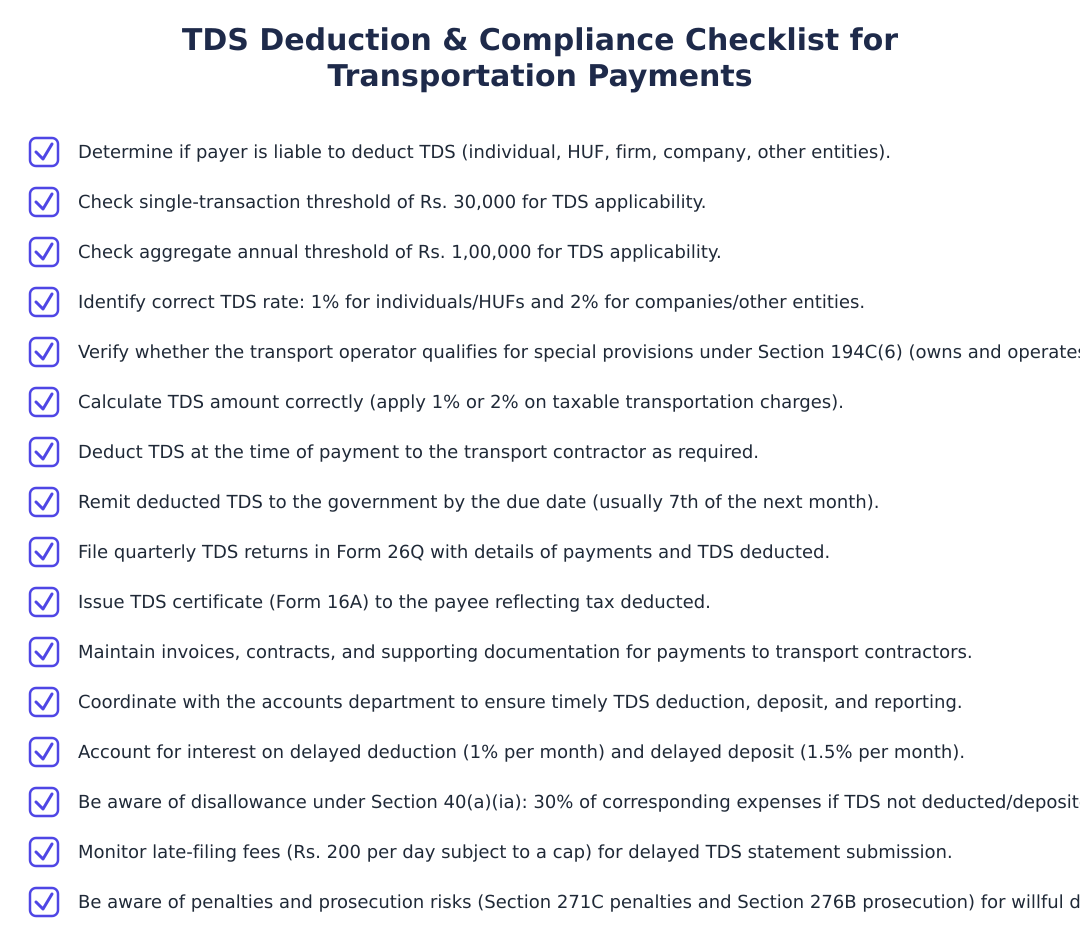
Payers must furnish details of payments and TDS deducted by filing quarterly TDS returns in Form 26Q to report non-salary deductions and remittances.
The payer must provide the service provider with a TDS certificate in Form 16A that reflects the tax deducted from non-salary payments so the recipient can claim credit.
Penalties, Disallowance and Legal Consequences
There are statutory consequences when TDS is not deducted or not deposited as required. One direct tax consequence is a disallowance under the income tax provisions: 30% of the corresponding expenses may be disallowed if TDS has not been deducted or deposited before the due date of furnishing the Income Tax Return, as set out in the relevant section.
Separate penal provisions can apply for failure to deduct or deposit TDS. A penalty under the relevant section may be levied for failure to deduct TDS, and there is also a provision for prosecution for failure to pay the tax. These outcomes can materially increase the cost of non-compliance and may include both monetary penalties and criminal proceedings in serious cases.
Calculation and Internal Controls
Operationally, the accounts team should build a simple workflow: identify transport payments that require deduction, calculate the amount to be withheld, remit the withheld tax to the government within prescribed timelines, and capture the payment and deduction details for return filing. Even where specific percentages or thresholds are referenced elsewhere, the important control points are accurate identification, timely deposit and reliable recordkeeping.
Strong internal controls include a review checklist before payment (to confirm whether TDS is applicable), segregation of duties so that different people prepare and approve TDS payments, and reconciliations between ledgers and the TDS returns. These practices reduce the risk of oversight and create an audit trail if questions arise from tax authorities or service providers.
Practical Considerations and Record-keeping
Preserve invoices, contracts and supporting documents for all transport payments. Maintaining this paperwork helps substantiate whether a payment attracted TDS and supports the entries reported in TDS returns and income tax filings. Good documentation also eases resolution of any mismatches in tax credit records between payer and payee.
Coordinate with the accounts department to ensure timely deduction, deposit and filing. Clear internal communication reduces the risk of missed deadlines and the attendant consequences. This coordination, coupled with retained documentation, forms the core practical defence against penalties and disallowances.
TDS on transport payments requires disciplined processes: identify payments, deduct and deposit tax on time, file Form 26Q quarterly, and issue Form 16A to the payee. Failure to follow these steps can trigger a 30% disallowance of the related expense and attract penalties and prosecution under the relevant provisions. Preserve invoices and contracts and keep your accounts team aligned to minimise risk and ensure the payee receives timely credit for tax withheld.
Frequently asked questions
Who has to deduct TDS on transportation charges in India?
Any person or entity paying transportation charges to a transport contractor must deduct TDS when the payment meets the prescribed threshold. This includes individuals, Hindu Undivided Families (HUFs), firms, companies and other entities making payments for carriage of goods by road. The obligation to deduct applies irrespective of the payee’s status where the payer’s turnover exceeds the limits under the Income Tax Act, and the payer must follow the specified rates and thresholds when deducting. Failure to deduct can lead to disallowance of expense and penal consequences under tax law.
What is the exemption limit for TDS on transportation charges per transaction and per year?
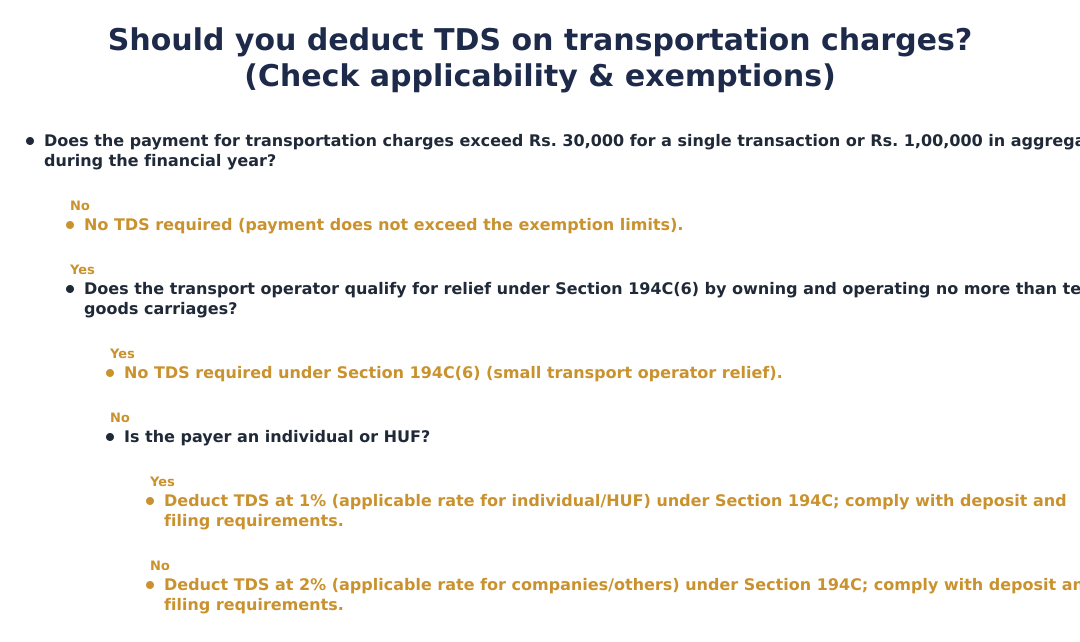
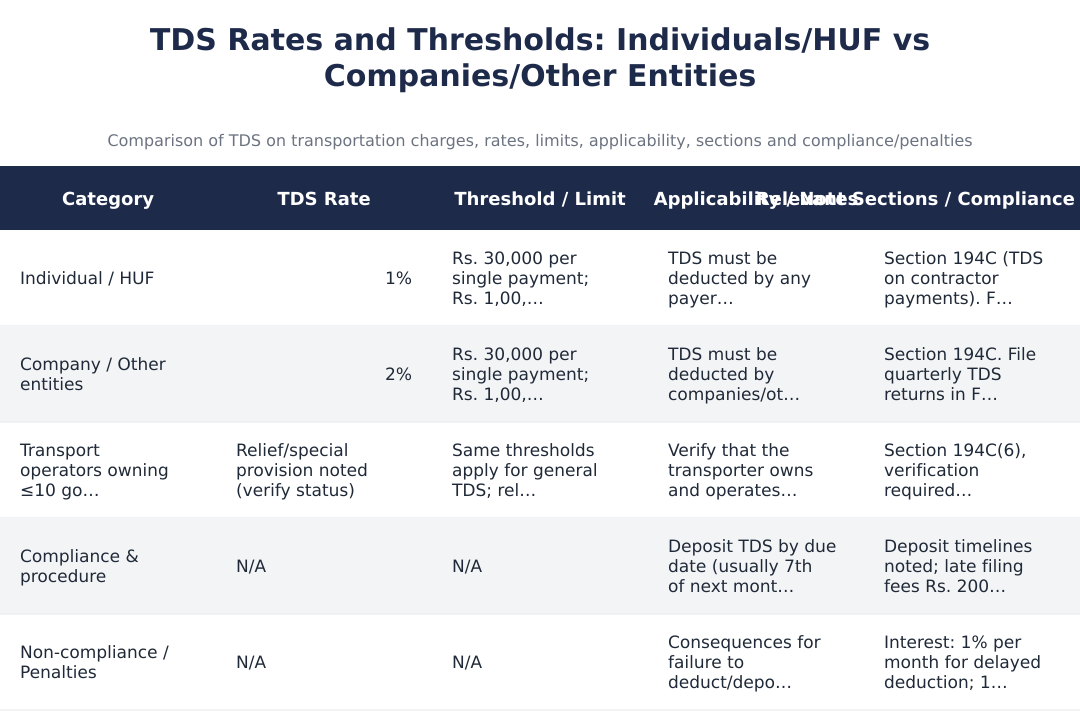
TDS on transportation charges is required only if the payment exceeds Rs. 30,000 for a single transaction or amounts to more than Rs. 1,00,000 in aggregate during a financial year. If each individual payment is Rs. 30,000 or less and the total for the year does not exceed Rs. 1,00,000, no TDS needs to be deducted. Once either threshold is crossed (a single payment above Rs. 30,000 or cumulative payments above Rs. 1,00,000), the payer must deduct TDS on subsequent payments as per applicable rates.
What is the TDS rate on transportation charges for individuals and companies?
The TDS rate on transportation charges is 1% when the payer is an individual or HUF and 2% when the payer is a company or any other person/entity. For example, on a Rs. 50,000 payment a private individual/HUF would deduct Rs. 500 (1%), while a company would deduct Rs. 1,000 (2%). These rates are applied on the gross payment to the transport contractor once the relevant thresholds are met.
Are there special provisions for small transport operators to avoid TDS?
Yes, special relief exists under Section 194C(6) where a transport operator who owns and operates not more than ten goods carriages can claim exemption from deduction of TDS by providing prescribed proof to the payer. The payer should verify that the transporter owns/operates ten or fewer goods carriages before allowing relief; otherwise normal TDS rules apply. If the transporter qualifies and valid documentation is furnished, the payer need not deduct TDS on payments to that transporter.
How is TDS on transportation charges calculated and deducted in practice?
TDS is calculated by applying the applicable rate (1% for individual/HUF, 2% for others) to the gross transport payment once thresholds are exceeded, and the deducted amount is remitted to the government by the due date. For example, a company paying Rs. 50,000 will deduct Rs. 1,000 and remit Rs. 49,000 to the transporter. The payer must also issue Form 16A to the transporter, file quarterly TDS returns (Form 26Q), and maintain records of invoices and contracts to substantiate the transaction.
What are the compliance steps and filing requirements after deducting TDS on transport charges?
After deducting TDS, the payer must deposit the tax with the government by the due date (generally the 7th of the next month), file quarterly TDS returns in Form 26Q, and issue Form 16A to the deductee showing tax deducted. Timely deposit and accurate return filing are necessary to ensure the transporter receives credit for the tax and to avoid late fees or penalties. Maintain copies of TDS challans, returns and issued certificates for audit and record-keeping purposes.
What penalties or disallowances apply for failing to deduct or deposit TDS on transport charges?
Penalties include interest for late deduction (1% per month) and late deposit (1.5% per month), disallowance of 30% of the corresponding expense under Section 40(a)(ia) if TDS is not deducted/deposited before the ITR due date, and potential fines or prosecution under Section 271C or Section 276B for willful default. Additionally, a late filing fee of Rs. 200 per day (capped at the amount of TDS deductible) may be levied for delayed TDS statement filings. These consequences make timely deduction, deposit and filing critical to avoid monetary and legal repercussions.
What practical steps should my accounts team take to avoid TDS issues on transport payments?
Your accounts team should verify transporter status (including ownership of goods carriages for Section 194C(6) relief), check cumulative payments against the Rs. 1,00,000 annual limit and single-payment Rs. 30,000 limit, deduct TDS at the correct rate, and preserve invoices and contracts for future proof. They should also schedule timely deposit of TDS (usually by the 7th of the next month), file Form 26Q quarterly, and issue Form 16A to the transporter to ensure proper tax credit. Proper coordination and documentation reduce the risk of disallowance, interest, late fees and prosecution.
If I didn’t deduct TDS on transport charges last year, what are my options now?
If TDS was not deducted, you should immediately deposit the outstanding TDS with applicable interest (1% monthly for late deduction and 1.5% monthly for late deposit), file any required retroactive TDS returns, and be prepared for possible disallowance of expenses under Section 40(a)(ia). You should also calculate and pay late filing fees for delayed TDS statements and be aware that deliberate non-compliance can lead to penalties under Section 271C or prosecution under Section 276B. It’s advisable to consult a tax professional to compute interest/penalties and to regularize records and filings promptly to minimize exposure.
Need help staying TDS compliant?
MoneyGence's AI Finance OS tracks your compliance, wallet share, and finances in one place, built for agencies and growing businesses.
Get started with MoneyGence