TDS on Salary Section 192: Guide to Employer TDS Rules & Calculation
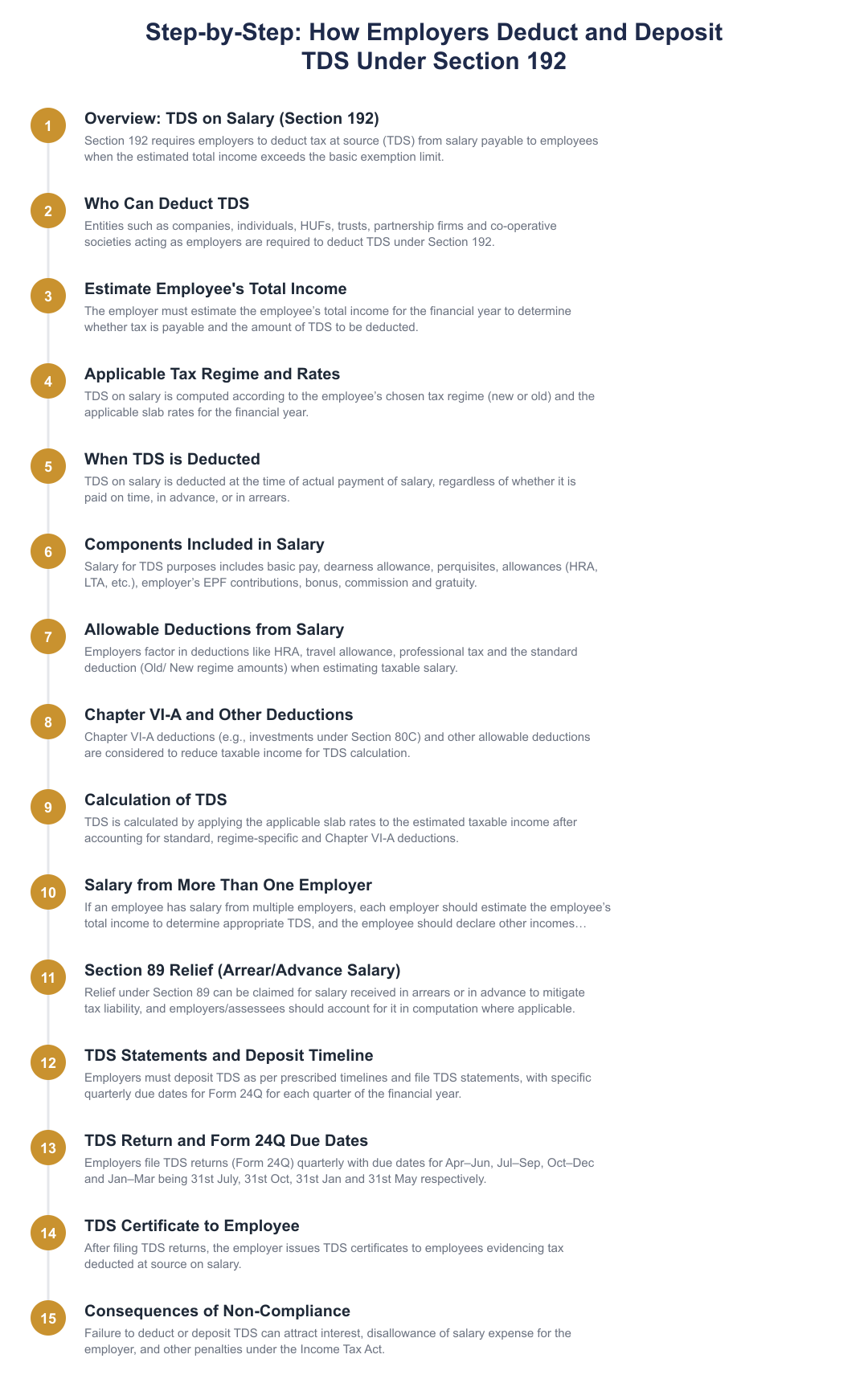
This guide explains TDS on salary under Section 192 of the Income Tax Act, what it covers, who must deduct it, when it must be deducted, how employers should estimate employees' taxable salary for withholding, and the compliance consequences of non‑deduction or non‑deposit. You will learn the practical steps an employer needs to follow when deducting tax at source from salary payments, how the choice of tax regime affects the computation, and which employer types are obligated to withhold. The guide also summarises important filing due dates for salary TDS returns and the penalties and disallowances that can arise if TDS obligations are not met. This matters because correct TDS handling protects both the employer (by ensuring salary is an allowable business expense) and the employee (by ensuring tax credits are available), while non‑compliance can trigger interest and tax disallowances. Read on for clear, actionable explanations of the rules employers must follow under Section 192 and what to watch for when managing payroll withholding.
What is TDS on Salary?
Section 192 of the Income Tax Act deals with TDS on salary income. It requires employers to withhold income tax at source when paying salary to employees, ensuring tax collection at the point of payment rather than relying solely on annual self‑assessment.
Under this provision, the employer estimates the employee's total income for the financial year and deducts tax if the estimated salary exceeds the basic exemption limit. The employer's withholding creates a running tax credit for the employee and simplifies final tax settlement at year‑end.
Who Can Deduct TDS Under Section 192?
The obligation to deduct TDS under Section 192 applies when there is an employer–employee relationship with the payee. This obligation is not dependent on the size or nature of the employer: whether the payer is a company, an individual, a Hindu Undivided Family, a firm, trust or a co‑operative society, the duty to deduct arises where the relationship exists.
In practice, this means any entity paying salary to an employee must consider Section 192 when preparing payroll and ensure that appropriate estimates and deductions are made before paying the employee.
When should TDS be Deducted u/s 192?
TDS on salary is required to be deducted at the time of actual payment of salary, that is, tax is withheld when the employer pays the salary, not when the salary is merely accrued. This rule applies regardless of whether the payment is made on schedule, in advance, or in arrears.
Before making each payment, employers should consider their annual estimate of the employee's total income and the choice of tax regime to determine whether the payment triggers a TDS deduction.
How to Calculate TDS on Salary Under Section 192
Employers must estimate the employee’s total income for the financial year and compute tax based on the applicable income tax slab rates under the employee’s chosen tax regime (old or new). TDS is computed according to those slab rates and will vary from employee to employee depending on income and eligible deductions.
While estimating taxable salary for TDS purposes, employers should factor in exemptions and standard deductions, for example, Section 10 exemptions such as house rent allowance (HRA) and leave travel allowance (LTA) and the standard deduction, so that withholding reflects the employee’s realistic tax liability on salary.
TDS Statements, Due Dates for Form 24Q
| Quarter | Due Date |
|---|---|
| April–June | 31 July |
| July–September | 31 October |
| October–December | 31 January |
| January–March | 31 May |
Consequences of Non-Compliance under Section 192
If the employer fails to deduct TDS or deducts TDS but does not deposit it with the government, interest is payable on the amount and other consequences under withholding provisions apply. Levy of interest is a primary financial consequence that increases the employer’s cost for non‑compliance.
In addition, for computing business or professional income, disallowance provisions can apply where TDS obligations are not met. The relevant treatment can lead to disallowance of salary expense: 30% of the salary payment may be disallowed where payments to residents lack proper withholding, and 100% may be disallowed for payments to non‑residents. These measures protect tax collection and incentivise correct withholding.
For employers, following Section 192 means estimating employees’ annual salary carefully, applying the correct tax regime and exemptions, deducting TDS at the time of payment, filing Form 24Q by the quarterly due dates, and depositing the withheld tax. Non‑compliance attracts interest and can lead to significant disallowances of salary expenses, so accurate payroll processes and timely deposits are essential.
Frequently asked questions
What is TDS on salary under Section 192 of the Income Tax Act?
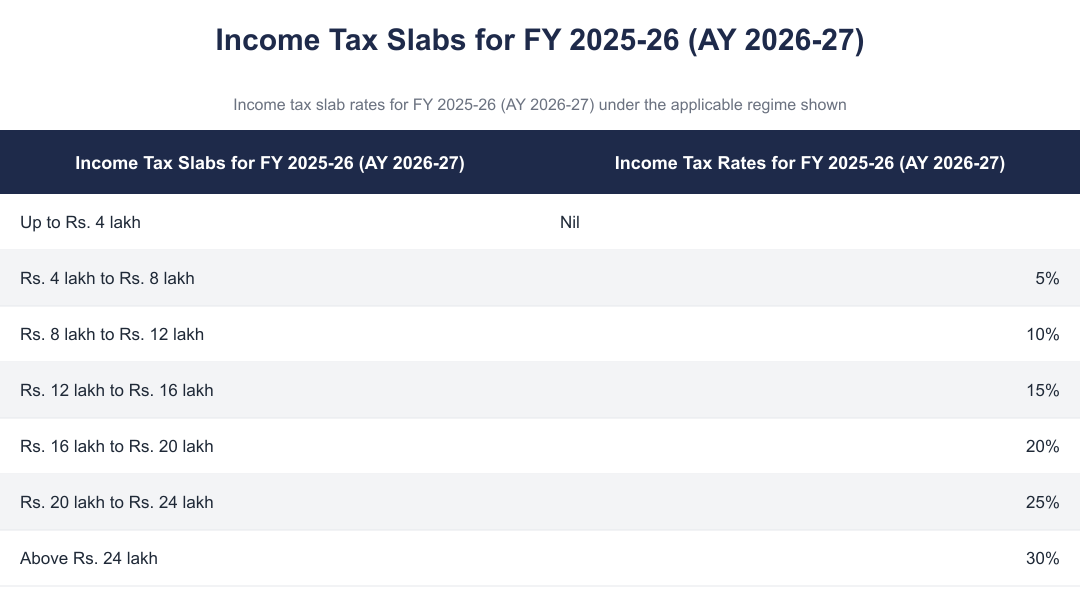
TDS on salary under Section 192 is tax that an employer must deduct from an employee’s salary at the time of payment and deposit with the government. The employer estimates the employee’s total income for the financial year, applies the applicable tax slab under the chosen tax regime (old or new), allows eligible exemptions and deductions, and deducts TDS only if the estimated taxable income exceeds the basic exemption limit. For FY 2025-26 (AY 2026-27) the income tax slabs range from nil up to Rs. 4 lakh, 5% for Rs. 4–8 lakh, 10% for Rs. 8–12 lakh and so on up to 30% for income above Rs. 24 lakh, plus applicable cess; TDS computation follows those rates. If an employee declares investments/deductions (e.g., Chapter VI-A) the employer will factor those into the estimate to reduce TDS where permitted.
Who is responsible for deducting TDS under Section 192?
The employer is responsible for deducting TDS under Section 192 when there is an employer-employee relationship and salary is paid. Deductors can be companies, firms, individuals, HUFs, trusts, partnerships or co-operative societies, the legal form of the employer does not change this obligation. The requirement to deduct is independent of the number of employees; any employer who pays salary and estimates taxable salary above exemption limits must deduct TDS. If the employer fails to deduct or deposit TDS, interest and penalties may apply and the employer may lose the deduction for that salary expenditure in certain cases.
What rates are used to deduct TDS on salary under Section 192?
TDS on salary is deducted based on the applicable income tax slab rates of the employee under the tax regime (old or new) they have chosen for the year. For FY 2025-26 (AY 2026-27) the slab rates include nil up to Rs. 4 lakh, 5% for Rs. 4–8 lakh, 10% for Rs. 8–12 lakh, 15% for Rs. 12–16 lakh, 20% for Rs. 16–20 lakh, 25% for Rs. 20–24 lakh and 30% for income above Rs. 24 lakh, plus applicable cess; the employer applies these rates on the estimated taxable income after allowed exemptions and deductions. Under the new regime fewer exemptions/deductions are allowed (new regime is default), while the old regime permits more deductions; the employer must know which regime the employee has opted for to apply correct rates. If an employee’s estimated annual income is below the basic exemption (Rs. 2.5 lakh old or Rs. 3 lakh new where applicable), no TDS is deducted.
When must an employer deduct TDS under Section 192, at accrual or payment?
An employer must deduct TDS at the time of actual payment of salary, not at the time of accrual. This means TDS is deducted when the salary is paid to the employee, whether paid on time, in advance, or in arrears (delayed payment). Employers first estimate annual salary and deductions, then compute monthly TDS amounts and deduct when making each salary payment; if payments are made in arrears, TDS is still due on payment date. If estimated total income does not exceed the applicable basic exemption limit, no TDS is required to be deducted.
How does an employer calculate TDS on salary under Section 192, stepwise?
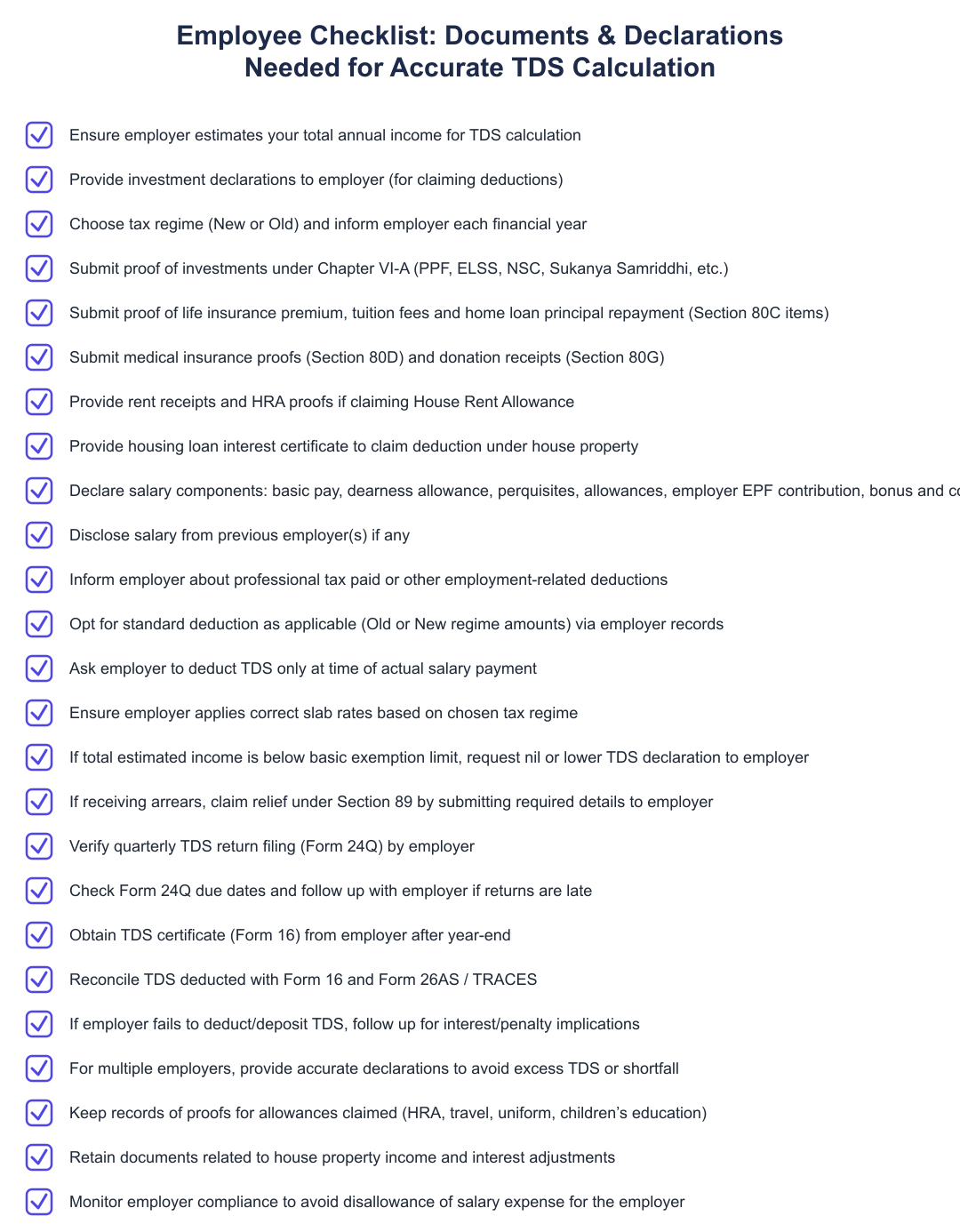
To calculate TDS under Section 192 an employer: (1) estimates the employee’s gross salary for the financial year (basic pay, allowances, perquisites, employer PF, bonuses), (2) deducts exemptions under Section 10 and the standard deduction (Rs. 75,000 under new regime w.e.f. AY 2025‑26 or Rs. 50,000 under old regime), (3) adds other declared income (house property, interest), (4) applies Chapter VI-A deductions declared (e.g., 80C limits like Rs. 1.5 lakh) if employee opts for old regime, and (5) computes tax as per applicable slab rates, adds cess, and divides by remaining months to get monthly TDS to be deducted. Employers must also consider declarations, Form 12BB (if provided), and any relief under Section 89 for salary arrears; incorrect estimates can lead to short/ excess deduction and interest consequences. Example: an employee with gross Rs. 12,00,000, standard deduction Rs. 50,000 and 80C Rs. 1,50,000 yields taxable income Rs. 10,00,000 and computed tax (with cess) of Rs. 1,17,000 for that year.
How is TDS handled if an employee has salary from more than one employer in a year?
If an employee works for more than one employer in a financial year, each employer may deduct TDS based on the salary paid by them and the employee’s declaration, but the employee should inform the current employer about earlier income so correct TDS is deducted. Typically the current (or highest paying) employer estimates total income including salary from previous employer(s) and applies deductions/declarations to compute accurate TDS; if not done, under-deduction can occur and the employee will have to pay the balance tax while filing the return. Employees can avoid excess TDS by providing full details of income and Form 12B/12BB (investment proofs) to the employer; they may also request lower deduction by submitting Form 12BB or obtain refund when filing return if excess TDS was deducted.
What is Section 89 relief and when should it be claimed for salary TDS?
Section 89 relief is a mechanism to reduce tax on salary arrears or advance salary received in a year by spreading the tax burden across years and reclaiming excess tax paid; it should be claimed when you receive salary arrears, advance salary, or family pension that relates to previous years. The employee computes tax on total income including arrears and compares it with tax on income excluding arrears but adding the average arrears amount over the relevant earlier years, and the difference is the relief refundable as refund or adjusted against tax. Employers may apply Section 89 relief at the time of TDS computation if the employee furnishes full details and requests it; otherwise the employee can claim relief while filing the income tax return and get a refund for excess TDS paid. Proper documentation and computation are needed, and Section 89 is specifically for amounts taxable in respect of past periods (e.g., arrears, retrospective pay).
What TDS statements and certificates must the employer file and provide under Section 192?
The employer must deposit deducted TDS timely, file quarterly TDS returns in Form 24Q and issue Form 16 (TDS certificate) to the employee annually. Form 24Q is filed quarter-wise with due dates: April–June by 31st July, July–September by 31st October, October–December by 31st January and January–March by 31st May; failure to file timely attracts penalties and interest. Form 16 must be issued to the employee after filing the annual TDS return and shows salary paid and TDS deducted/ deposited during the year; employees use Form 16 to file their income tax returns and claim refunds. Employers also must deposit TDS by prescribed due dates each month (usually by 7th of next month) and file the annual reconciliation in Form 24Q part B as applicable.
What are the consequences if an employer fails to comply with Section 192 TDS rules?
If an employer fails to deduct TDS or deducts but does not deposit it, they are liable to pay interest on the undeposited amount and may face penalties under the Income Tax Act. Additionally, the employer may lose the claim to deduct the salary expense from their profits if TDS was not deducted as required; disallowance can be 30% of salary paid to a resident and 100% for salary paid to a non-resident, affecting the employer’s taxable income. Persistent default can attract prosecution provisions and penalties under TDS provisions, and the employee may have to pay tax/interest on unpaid taxes at year-end if employer has not deducted; employees can claim credit for TDS only when it is deposited against their PAN.
Need help staying TDS compliant?
MoneyGence's AI Finance OS tracks your compliance, wallet share, and finances in one place, built for agencies and growing businesses.
Get started with MoneyGence