Statutory Compliances Private Company India, 15 Key Obligations
This guide compiles the 15 statutory compliances that a private limited company must observe under the Companies Act, 2013 and the Foreign Exchange Management Act (FEMA), 1999. You will learn what the compliance set covers at a high level, how the list is organised across company-law and FEMA obligations, and where to find regular calendar cues for filing and record-keeping. Understanding these 15 items helps company directors, company secretaries, finance teams and business owners prioritise recurring filings, align internal calendars and avoid lapses that can lead to penalties or regulatory scrutiny. The guide does not replace professional advice for specific transactions, but it gives a compact roadmap of the statutory landscape a private company operates in under the two statutes mentioned. You will also find how the compliances are presented (table form for clarity) and the ancillary navigation and engagement options typically included in articles on this platform. Use this guide as a checklist starter to map responsibilities across teams and to set reminders into your statutory compliance calendar.
What this list covers
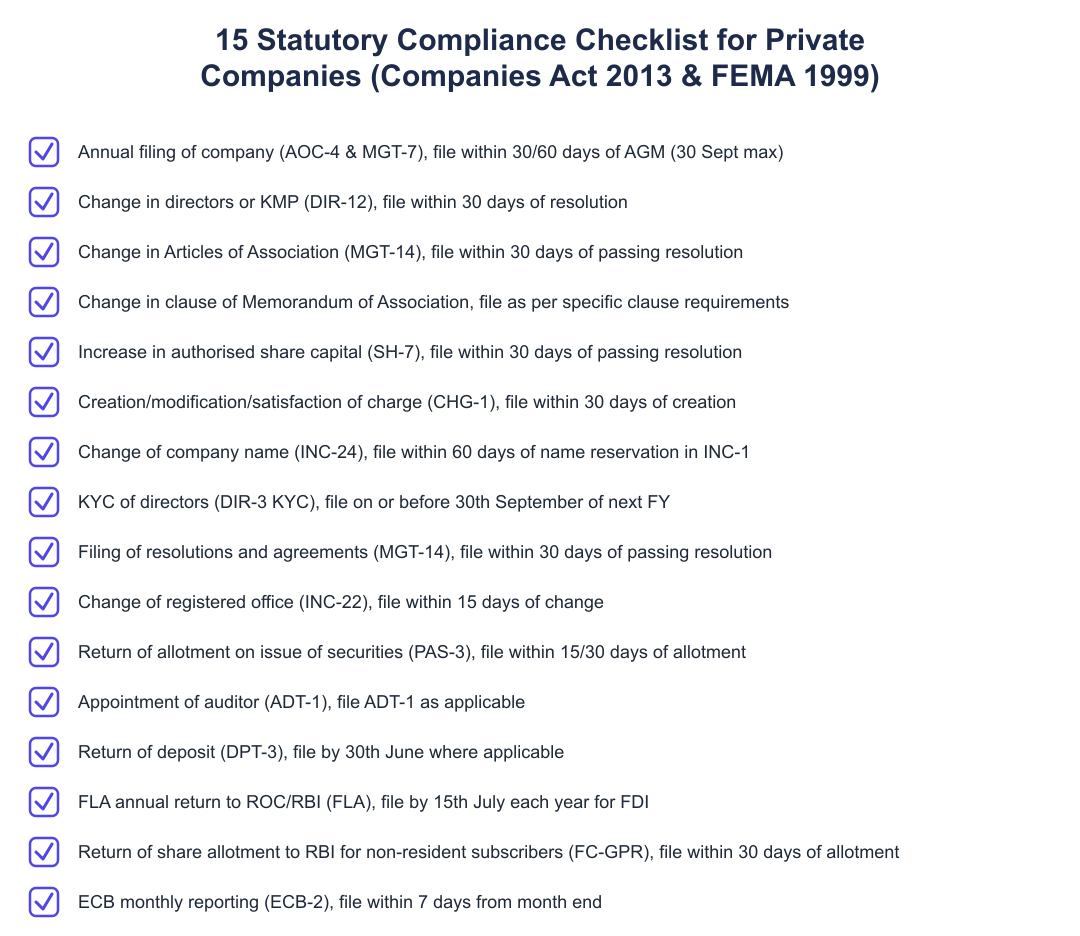
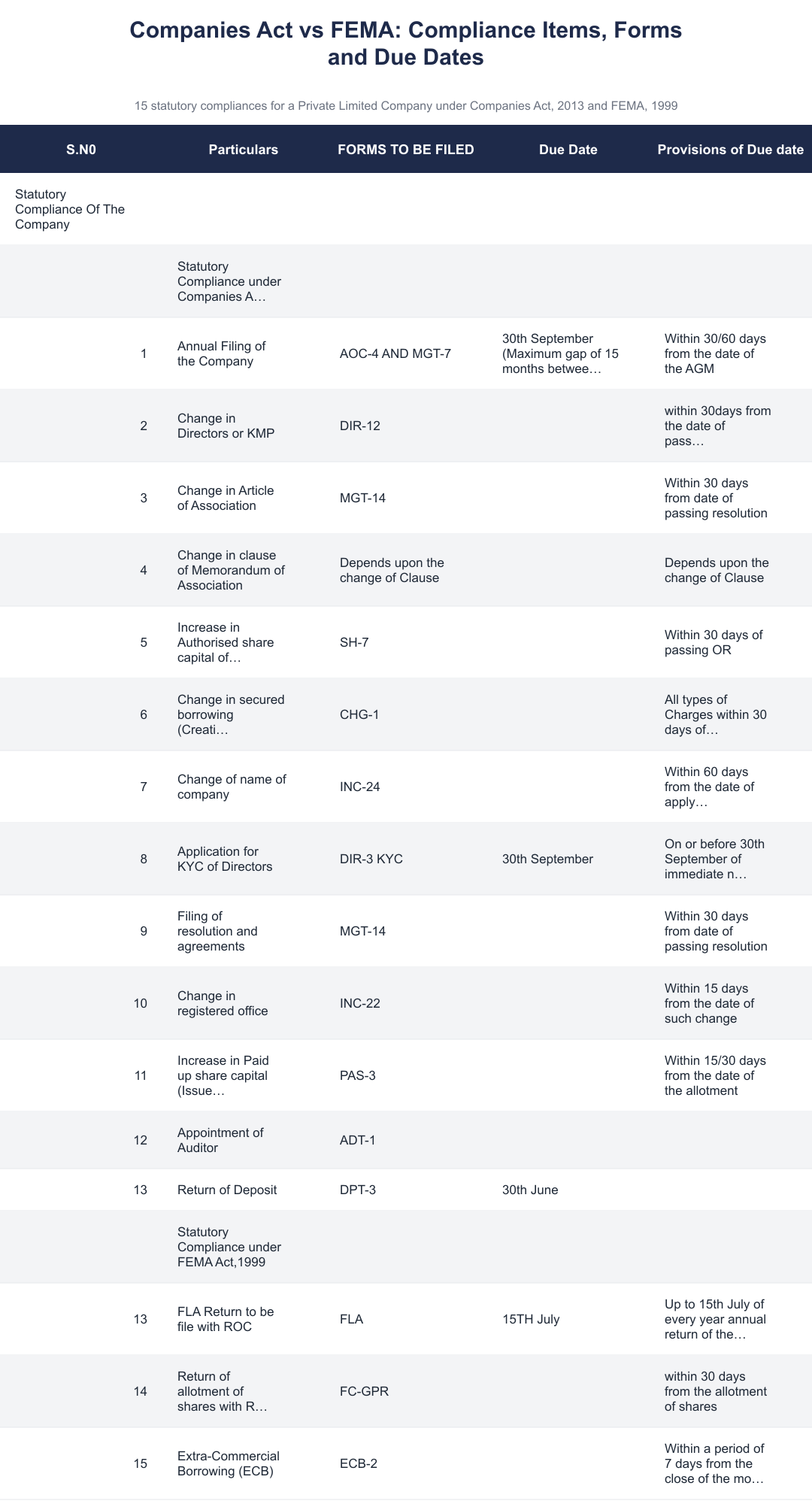
The article brings together 15 statutory compliances applicable to a private limited company, grouped under two legal regimes: the Companies Act, 2013 and the FEMA Act, 1999. This combined view helps companies that have both routine corporate law obligations and foreign-exchange-related reporting responsibilities to see the full compliance picture in one place.
Treat the compiled list as an index of recurring responsibilities rather than an exhaustive procedural manual. Each line item in the compilation represents a distinct compliance that typically requires internal ownership, documentation and a calendar entry so the company can meet the applicable filing or reporting timeline.
High-level table: the 15 statutory compliances
| Statutory Compliance Of The Company |
|---|
| Table statement: 'Statutory Compliance Of The Company' lists 15 items splitting Companies Act and FEMA compliances (table structure claim). |
Using a calendar to manage compliance
The source material presents a visual calendar layout with weekday headings M, T, W, T, F, S, S. A consistent weekly layout like this is useful when translating statutory due dates into recurring reminders, for example, to ensure board meeting filings or annual returns are scheduled on or before the required weekday in the relevant month.
Creating a compliance calendar that maps each of the 15 items to specific dates and owners reduces the risk of missed filings. Even if the exact due dates and form names are handled elsewhere, the weekly calendar grid is a practical starting point for operational planning.
Calls-to-action and reader resources
The article includes several engagement prompts that guide readers to stay updated and access more material. These include invitations to join the platform's network and to unlock enhanced features.
Specifically, the content contains calls-to-action such as 'Join TaxGuru's Network', 'Unlock the Full TaxGuru Experience', 'Subscribe Our Newsletter' and 'Get the TaxGuru App'. Such prompts are meant to help users receive timely updates on company law, FEMA, taxation and related regulatory changes.
This compilation serves as a compact reference that a private limited company can use to map statutory responsibilities under the Companies Act, 2013 and FEMA, 1999. Use the 15-item list as a checklist to assign ownership, set calendar reminders (using the weekly layout where helpful), and follow the platform’s calls-to-action to receive ongoing updates. For transaction-specific timelines, forms and detailed procedural steps, consult the relevant statutes, official regulators or a qualified professional.
Frequently asked questions
What are the annual filing requirements for a private limited company under the Companies Act 2013?
A private limited company must file AOC-4 (financial statements) and MGT-7 (annual return) annually, normally by September 30th following the financial year or within the timelines tied to the AGM (maximum gap of 15 months between two AGMs). Specifically, AOC-4 and MGT-7 are required to be filed within 30/60 days from the date of the AGM depending on circumstances, and the company must hold its AGM within six months from the end of the financial year with no more than 15 months between AGMs. Late filing attracts penalties under the Companies Act and may also require additional fees and possible notice to ROC; timely preparation of board papers and audited financials is therefore essential.
How and when should a private company inform ROC about a change in directors or key managerial personnel (KMP)?
You must file Form DIR-12 with the ROC within 30 days from the date of passing the board/shareholder resolution to notify any change in directors or KMP. DIR-12 covers appointments, resignations, cessations and changes to director details; failure to file within 30 days can lead to penalties and the company and officers may be held accountable. When filing, attach the relevant board resolution, consent to act, and any required KYC documents for the incoming director to ensure the change is accepted by the ROC.
When must a company file MGT-14 for resolutions and agreements, and what does it cover?
A company must file Form MGT-14 with the ROC within 30 days from the date of passing the resolution to file resolutions or agreements that require filing under the Companies Act (such as special resolutions, board agreements, or certain related party contracts). MGT-14 captures special resolutions, alterations to AOA/MOA that require shareholder approval, and other matters specified under the Act; delay in filing can attract penalties and may render the act not effective against third parties. Ensure you attach certified copies of the resolution and explanatory statements, and check whether exceptions (like approvals that need SR or not) apply before filing.
How do I file an increase in authorised share capital and what is the timeline?
To increase authorised share capital, a company must file Form SH-7 with the ROC within 30 days of passing the special resolution or board resolution (as applicable) approving the increase. The process normally involves altering the Memorandum of Association (capital clause), obtaining shareholder approval through a special resolution if needed, and filing SH-7 along with certified copy of the resolution and amended MOA/notice of meeting. If SH-7 is not filed within 30 days, additional fees and late filing penalties will apply under the Companies Act.
What are the compliance steps and due dates for creation or modification of charges on company assets?
All types of charges created, modified or satisfied by a company must be filed in Form CHG-1 with the ROC within 30 days of creation (and within specified timelines for modification/satisfaction) to register the charge legally. CHG-1 requires details of the charge holder, amount secured, instrument creating charge, and security particulars; failure to register a charge within 30 days can render it void against the liquidator and other creditors. For satisfaction or modification of charges, corresponding filings (like CHG-4) must also be made to reflect the charge's status and avoid discrepancies in the charge register.
How and when should a private company change its registered office address with ROC?
A private company must file Form INC-22 with the ROC within 15 days from the date of change of registered office to update its official address on record. The filing must be accompanied by a certified copy of the board resolution approving the change and proof of the new address (lease deed or property documents), and the change may require shareholders' approval if it involves shifting between states. Not updating the registered office within 15 days can attract penalties and complicate service of notices and statutory communications to the company.
What are the timelines for allotment return PAS-3 and increase in paid-up capital filings?
When a company issues shares, it must file Form PAS-3 (return of allotment) with the ROC within 15 or 30 days from the date of allotment depending on the type of issue, to record the increase in paid-up capital. PAS-3 requires details of the allotment including share classes, allottee particulars, consideration received and disclosure of utilisable capital; failure to file PAS-3 on time attracts additional fees and penalties and may affect the validity of allotments in certain cases. Alongside PAS-3, companies should ensure share certificates, share ledgers and amendments to statutory registers are completed as per the Companies Act.
What annual and event-based FEMA/FDI filings must a private company do if it has foreign investment?
A company with foreign investment must file the annual FLA return with the RBI by July 15th each year, file Form FC-GPR with the RBI/AD bank within 30 days of allotment when shares are issued to a non-resident (FDI reporting), and file ECB-2 within 7 days from the close of the month for any reportable external commercial borrowings. The FLA return reports all outstanding foreign investment as at March 31, FC-GPR documents the receipt/allotment of equity from non-residents within 30 days, and ECB-2 is a monthly compliance for ECB reporting; non-compliance can attract monetary penalties and RBI scrutiny. Work with the authorised dealer bank and ensure accurate timelines and classifications (automatic vs approval route) are followed to avoid regulatory issues.
Need help staying Compliance compliant?
MoneyGence's AI Finance OS tracks your compliance, wallet share, and finances in one place, built for agencies and growing businesses.
Get started with MoneyGence