Startup India Tax Exemptions: Eligibility, Incentives & Benefits
This guide explains the Startup India programme from the perspective of eligibility and tax-related incentives. It is written for founders, finance leads and advisors who want a clear conceptual understanding of which new businesses usually qualify for startup support and what kinds of tax reliefs and compliance relaxations are commonly offered under such government initiatives. You will learn how eligibility is typically assessed, the main types of tax exemptions that startups may request or claim, practical implications for fundraising and exits, and key compliance considerations founders should keep in mind. The aim is to equip you with the questions to ask your chartered accountant or tax adviser and to clarify how these incentives can affect early-stage decisions such as incorporation, fundraising and hiring.
Eligibility for Startup India
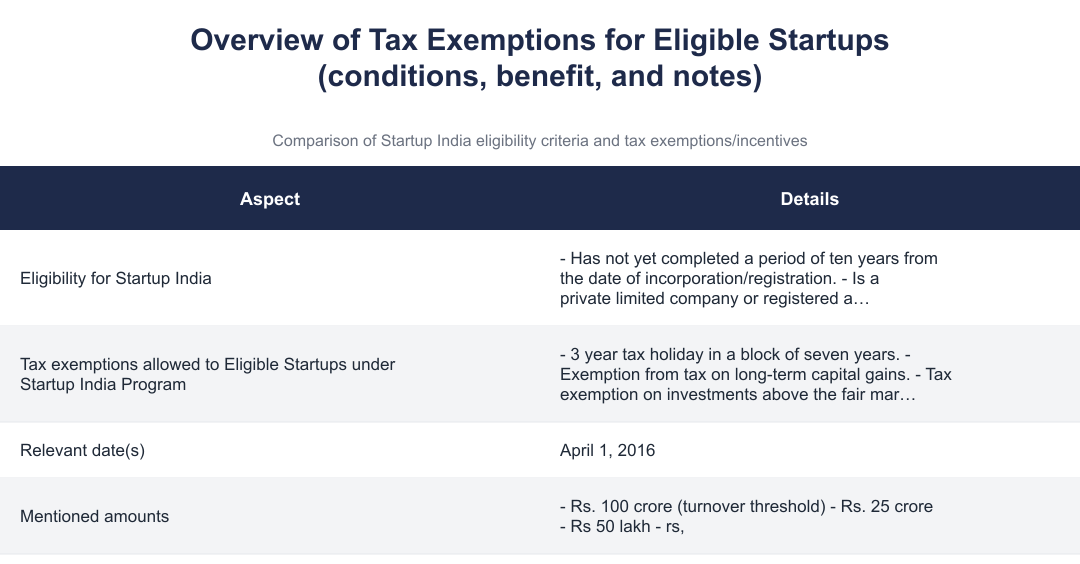
Eligibility under a startup support programme is usually determined by a set of qualitative and administrative criteria rather than a single metric. Commonly assessed factors include the nature of the entity (for example, private company or partnership form), its age since incorporation, and whether the business is pursuing innovation, development, or a scalable model that can generate employment or wealth.
Authorities typically require an applicant to demonstrate that the enterprise is not merely a reconstitution of an existing business and that it is working on a novel product, process or service, or a scalable business model. The application process often requires submission of basic incorporation documents and a statement about the business activity and future plans.
Because formal eligibility rules and documentary requirements can vary over time and by scheme, founders should consult the latest official guidance or a qualified adviser before applying. Understanding the eligibility framework helps startups plan the timing of incorporation, the choice of legal form, and the nature of early-stage activities to maximise their chances of acceptance.
Tax incentives commonly available to eligible startups
Startup support programmes often bundle multiple tax incentives to reduce early-stage cash outflow and encourage investment. These can include temporary profit-based tax holidays, exemptions linked to specific kinds of capital gains, reliefs for certain classes of investment received, and rules that ease the consequences of changes in shareholding or ownership.
The rationale behind such incentives is to remove tax impediments during the critical scaling phase, thereby allowing startups to reinvest profits into growth, attract angel and institutional capital, and make longer-term bets on R&D and market development. In practice, these incentives interact with corporate tax rules, capital gains tax rules and provisions that govern loss set-off and carry-forward.
Because each type of relief has its own eligibility conditions and documentation requirements, founders should map how an incentive affects their fundraising structures, employee share schemes and exit planning. Advisers can help model the post-incentive cash flows to determine whether the administrative effort to claim relief is justified by the tax benefit.
3-year tax holiday in a block of seven years, conceptual overview
A commonly offered incentive is a time-limited tax holiday on profits for eligible startups. Conceptually, this means that an eligible enterprise may be allowed to claim full or partial exemption from profit tax for a specified number of years within an initial multi-year period after incorporation.
Such a holiday is intended to support reinvestment of early profits into growth and to improve survival rates in the formative years. The precise window and the mechanism for claiming the holiday are normally defined by administrative rules, which also set out documentation and approval procedures.
Founders need to consider the timing of profitable years relative to the allowed holiday window. In addition, claiming a holiday may require pre-approval or certification from the relevant authority and compliance with reporting obligations during the relief period.
Other startup tax reliefs, capital gains, investments and shareholding changes
Tax policy for startups often includes targeted exemptions related to capital gains. Examples include relief from tax on long-term capital gains in specified circumstances, and special treatment when investors purchase shares at a premium over fair market value. These measures are designed to encourage investment by reducing the tax friction on both investee and investor.
There are also provisions in some regimes that allow individual investors to reinvest certain taxed gains into eligible startups and obtain tax relief, which can stimulate angel investment. Similarly, rules may provide for continued availability of loss set-off and carry-forward even when there are changes in shareholding, subject to conditions designed to prevent abusive transfers.
Each of these measures is conditioned on specific qualifying tests and documentation. Startups and investors should coordinate: investors need to understand the tax consequences of the instruments they use, and startups must maintain records and corporate governance practices that preserve the availability of reliefs through fundraising rounds and ownership changes.
Practical steps before applying for startup incentives
Before applying for any formal startup recognition or claiming tax incentives, confirm that your corporate records, incorporation documents and business description accurately reflect your current activities. Clear, contemporaneous documentation of innovation, product development and scalability plans strengthens an application and eases subsequent audits.
Engage a tax professional early to evaluate the interplay between proposed incentives and your intended fundraising and employee stock option plans. Early advice helps structure investments and shareholdings so that both investors and the company can access available tax benefits without unexpected disqualifications.
Maintain proper bookkeeping and compliance calendars. Many incentives require periodic reporting, certification renewals or conditions to be fulfilled during the relief period. Timely compliance preserves credibility with authorities and ensures the startup can continue to claim benefits.
Startup support programmes can provide meaningful tax relief that alters early-stage planning around funding, hiring and product development. Because the exact eligibility criteria, the scope of exemptions and procedural requirements change over time, founders should verify current rules with official sources or their tax adviser before relying on any particular incentive. Proper documentation, timely advice and thoughtful structuring are the best ways to realise the value of available startup incentives.
Frequently asked questions
What are the basic eligibility criteria for Startup India recognition?
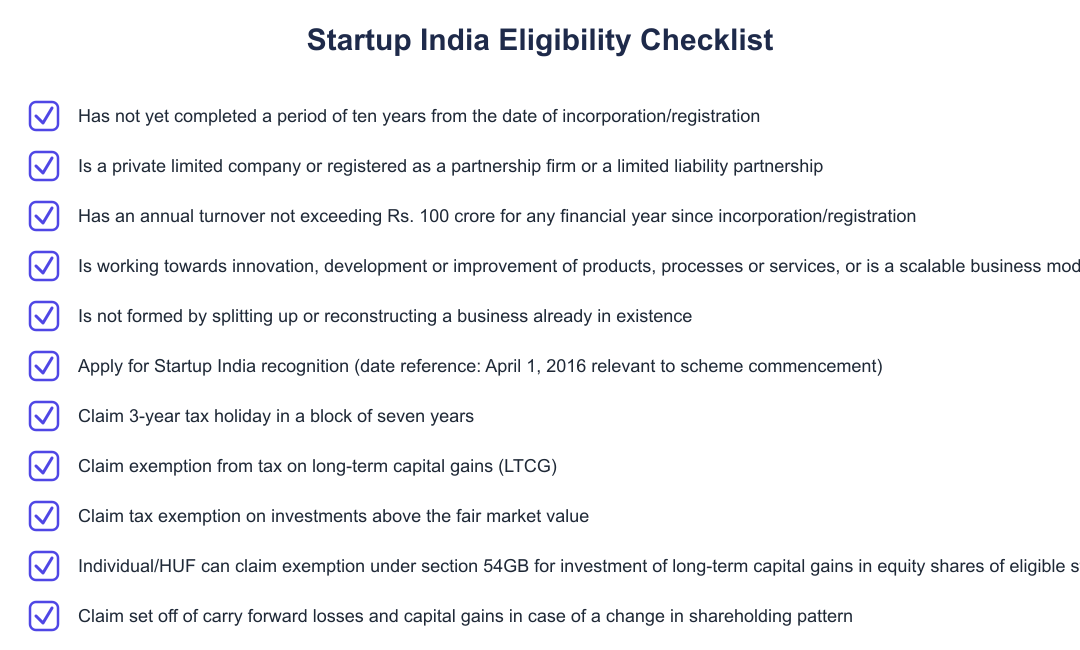
A startup must be within ten years of incorporation, be a private limited company or a partnership/limited liability partnership, have annual turnover not exceeding Rs. 100 crore in any financial year since incorporation, be working towards innovation or a scalable business model with high employment or wealth-creation potential, and not be formed by splitting up or reconstructing an existing business. These five conditions are jointly required for Startup India recognition: the ten-year timeline is counted from the date of incorporation/registration, the entity type must be one of the permitted forms, and turnover is measured per financial year with the Rs. 100 crore cap. The innovation or scalability requirement is judged on the business model and product/process development, and the “not formed by splitting” rule excludes serial reorganisations of existing businesses.
Can a partnership firm or LLP register as a startup under Startup India?
Yes, a partnership firm or a limited liability partnership (LLP) is an eligible entity type for Startup India recognition, alongside private limited companies. The startup must still meet the other conditions such as being within ten years of incorporation, having turnover up to Rs. 100 crore in any financial year, working towards innovation or scalability, and not being formed by splitting an existing business. Registration as a partnership or LLP does not by itself guarantee benefits; the firm must obtain recognition under the Startup India process to access tax exemptions and incentives.
What does the 'ten years from date of incorporation' rule mean for startup eligibility?
The startup must not have completed ten years from the date of its incorporation or registration to be eligible for Startup India benefits. This means eligibility is available only during the first ten years of the entity’s life counted from the official incorporation/registration date; after ten years the entity ceases to be eligible under this criterion. The ten-year limit applies regardless of changes in business model, though other eligibility conditions (turnover, innovation/scalability, non-reconstruction) must also continue to be met.
What is the turnover limit for Startup India eligibility?
A startup’s annual turnover must not have exceeded Rs. 100 crore in any financial year since incorporation to be eligible for Startup India recognition. This turnover cap is applied to each financial year separately, if turnover exceeds Rs. 100 crore in any year the entity becomes ineligible under this condition. Turnover is calculated as per the accounting and tax rules applicable to the entity and includes gross receipts from business operations.
What is the 3-year tax holiday in a block of seven years for eligible startups?
Eligible startups can claim a 3-year tax holiday to be availed in a block of seven years from the year of incorporation, meaning they can choose any three financial years within the first seven years to claim income-tax exemption. The block-of-seven-years structure gives flexibility to pick years when the startup incurs taxable profits, so the tax holiday covers three years of exemption within that seven-year window. Startups must have recognition and meet other statutory conditions to claim this tax holiday under the Startup India scheme.
Are long-term capital gains exempt for eligible startups?
Yes, eligible startups can get exemption from tax on long-term capital gains under the Startup India incentives subject to the specific provisions that grant this exemption. This relief typically applies when capital gains arise from transfers that meet the eligible conditions set out for startups, allowing founders or investors to reinvest or obtain preferential tax treatment on qualifying gains. Specific documentation and recognition requirements must be complied with to claim the long-term capital gains exemption.
Is investment received above fair market value taxable for startups?
Investments received by eligible startups that are in excess of the fair market value of shares can be exempt from tax under the Startup India incentives, subject to the scheme’s conditions and valuation norms. This means that amounts treated as premium or consideration above FMV on issue of shares to eligible investors may not attract immediate tax liabilities if the startup qualifies and follows prescribed procedures. Proper valuation reports and startup recognition are typically required to substantiate the exemption and to satisfy tax authorities.
How does section 54GB exemption work for individuals/HUF investing long-term capital gains in startups?
Under the Startup India incentives, an individual or Hindu Undivided Family (HUF) can claim exemption from tax on long-term capital gains by investing those gains in equity shares of eligible startups under section 54GB, subject to the section’s conditions. This allows taxpayers to defer or obtain relief on capital gains if the investment is made into an eligible startup and the startup meets the prescribed criteria, including registration and investment usage norms. The exemption is available only for investments that satisfy the timelines and holding requirements specified under the statute and requires proper documentation of both the capital gain and the subsequent investment.
Are carry forward losses and capital gains allowed if there is a change in shareholding of a startup?
Yes, eligible startups are allowed to set off carry forward losses and capital gains even if there is a change in shareholding pattern, provided the change complies with the specific conditions prescribed for such set-off under the Startup India rules. This means that usual restrictions on loss carryforwards on change of ownership may be relaxed for startups that maintain eligibility and follow the statutory requirements. Startups should maintain records of share transfers and obtain requisite certifications to ensure the carry forward claims are accepted by tax authorities.
Need help staying Company Registration compliant?
MoneyGence's AI Finance OS tracks your compliance, wallet share, and finances in one place, built for agencies and growing businesses.
Get started with MoneyGence