Standard Invoice Format: Detailed Templates & Sample Layouts
This guide explains the different formats and practical considerations for a standard invoice. You will learn why having clear, well-structured invoice formats matters for running a business, how different layouts affect readability and payment outcomes, what elements a robust invoice usually contains, and how to choose or adapt a format to suit your operational and accounting needs. The focus is on making invoices easier to create, simpler for clients to act upon, and more useful as accounting records. By the end of this guide you will have a framework for evaluating invoice templates, ideas for information to prioritise on the page, and a sense of which elements can be customised without undermining clarity or compliance. Whether you use a basic template, accounting software, or a bespoke design, the right invoice format reduces disputes, speeds up collections, and helps maintain cleaner books. This guide is practical and template-agnostic: it is intended to help you design or select invoice formats that match your business size, transaction types, and customer expectations while keeping record-keeping and payment workflows efficient.
Benefits of having formats for standard invoices
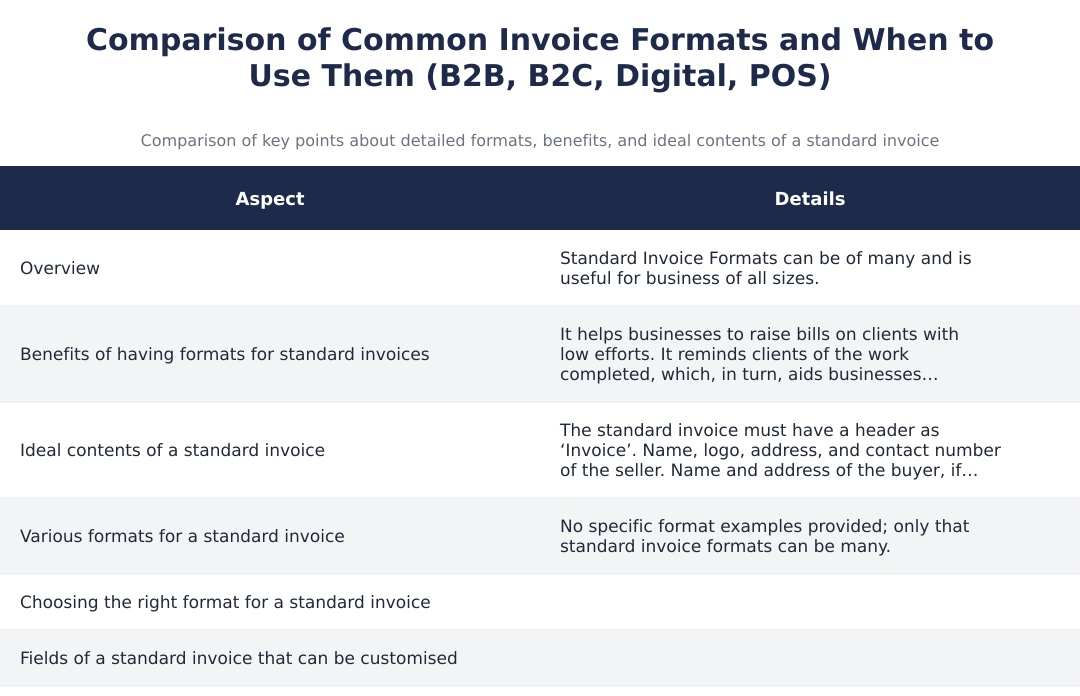
A consistent invoice format brings predictability to both the sender and the recipient. When the same layout and terminology are used across invoices, clients know where to look for the payment amount, due date, or payment instructions, which reduces back-and-forth queries and accelerates the payment cycle.
Standardised formats also make internal processes simpler. Teams responsible for billing, accounts receivable, and reconciliation can work from a repeatable structure that reduces errors in data entry and makes it easier to train staff or automate routine tasks.
From an accounting and record-keeping perspective, structured invoices are easier to file, index, and retrieve. Consistency in where information appears aids in creating summaries, extracting line-item data for reporting, and supporting audits or reviews.
Finally, a well-considered format improves professionalism and customer experience. Clear presentation of services, pricing, and payment steps reduces friction and reinforces trust between the business and its clients.
Various formats for a standard invoice
Invoice formats can range from minimal one-page templates to more detailed multi-section documents. Minimal formats focus on the essential information needed to request payment, while expanded formats include additional sections such as itemised descriptions, payment history, or supporting notes.
Design choices include single-column versus multi-column layouts, portrait versus landscape orientation, and whether to prioritise line-item detail or summary amounts. Each approach serves different needs: compact layouts are useful for simple transactions, while wider formats help present many line items or descriptive information clearly.
Digital delivery also affects format choices. Invoices intended primarily for email or PDF download should be easy to read on screen and when printed, whereas invoices produced by accounting systems may prioritise data structure for import into bookkeeping software.
The key is to align format complexity with transaction complexity: choose a format that communicates required details without overwhelming the recipient, and that integrates smoothly with your billing and accounting workflows.
Ideal contents of a standard invoice
An effective invoice balances completeness and clarity. It should present all information a payer needs to verify the bill and make payment, but it should avoid clutter. Headings, consistent typography, and logical grouping of related items help the reader locate details, such as what was provided, the amounts due, and how to pay.
Line items should be described clearly enough for the recipient to identify the goods or services supplied. When quantities, rates, or units are relevant, these should be shown alongside item descriptions so the basis for each charge is transparent.
In addition to transactional detail, invoices typically include information for accounting and communication purposes, such as references, contact details for billing queries, and any notes or terms relevant to the transaction. This supporting information reduces confusion and enables faster resolution of disputes.
Finally, consider how invoices will be stored and processed. Including consistent references and fields that match your bookkeeping or accounts-payable systems makes reconciliation and reporting simpler, whether done manually or via software.
Choosing the right format for a standard invoice
Selecting a format starts with understanding your customers and transaction types. High-volume, low-complexity transactions benefit from compact, templated invoices that can be automated. Low-volume or bespoke engagements may require richer invoices with detailed descriptions and supporting notes.
Assess how invoices will be created and processed: if you use accounting software, pick a format that maps cleanly to the software’s fields to reduce manual corrections. If invoices are shared with external stakeholders, prioritise readability and clear calls to action.
Also factor in branding and professional presentation. A consistent visual identity, logo placement, fonts, and spacing, reinforces credibility but should never impede legibility or obscure critical payment details.
Finally, test chosen formats with actual users: solicit feedback from customers and your internal finance team and iterate. Small adjustments to wording, field placement, or summarisation often yield measurable improvements in payment speed and fewer queries.
Fields of a standard invoice that can be customised
Many invoice fields can be tailored to suit operational needs without sacrificing clarity. Customisable elements often include the level of detail in item descriptions, whether to show unit prices or only totals, and how payment instructions are presented. Tailor these to the preferences of your customers and to the needs of your accounting processes.
Presentation elements such as logo size, header layout, and the order of sections are also flexible. Keep essential fields prominent, and move auxiliary information, like notes or promotional messages, to less prominent areas so they do not distract from payment details.
Some businesses create variant templates for different customer segments or transaction types. For example, recurring subscription invoices may omit certain details that one-off project invoices include, while wholesale invoices might emphasise quantity and unit pricing.
Regardless of customisation, maintain internal consistency. Use naming and reference conventions that your finance team recognises to ensure invoices remain easy to process, file, and reconcile.
Choosing and maintaining clear invoice formats pays off in faster payments, fewer queries, and smoother accounting. Use the guidance above to select or design templates that balance clarity, completeness, and workflow integration, and review them periodically based on feedback and operational needs.
Frequently asked questions
What is a standard invoice format and why should my business use one?
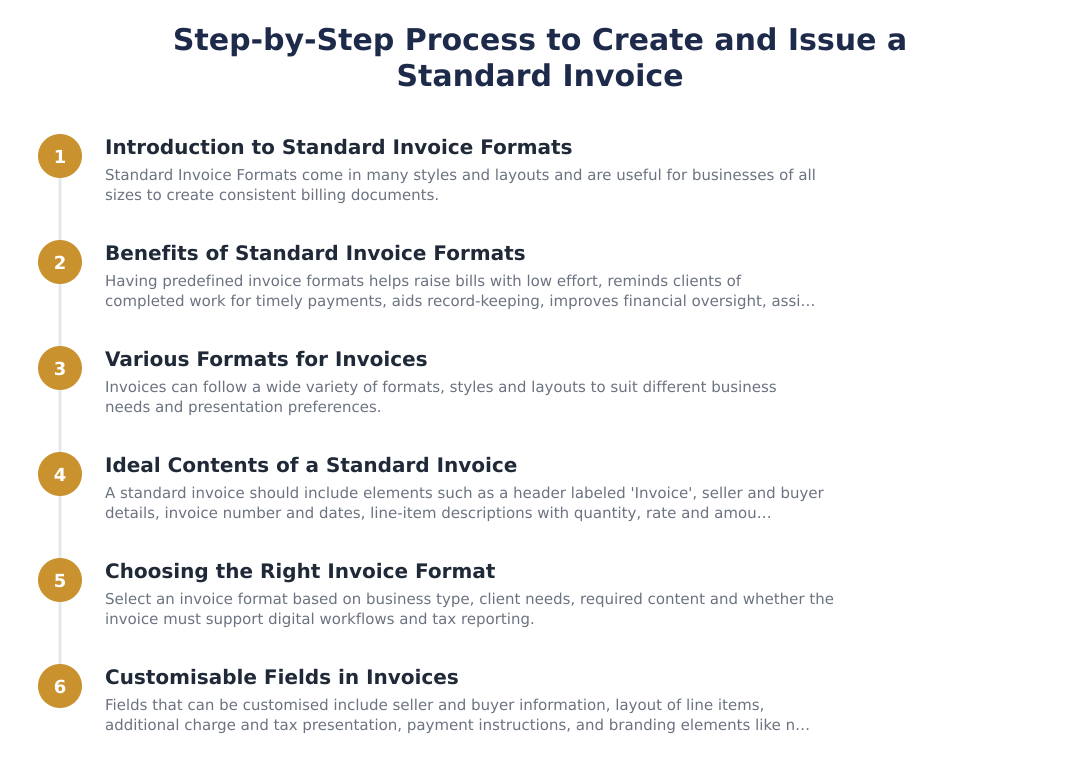
A standard invoice format is a consistent layout that lists seller and buyer details, line-item descriptions, amounts, taxes and payment terms for every sale. Using a standard format helps businesses raise bills with minimal effort, reminds clients of completed work to collect timely payments, and serves as an organised record for bookkeeping and tax reporting. It also helps manage working capital and makes it easier to switch to digital invoicing when required. Finally, a consistent invoice format projects professionalism and reduces billing disputes by presenting information clearly.
What are the essential contents that must appear on a standard invoice?
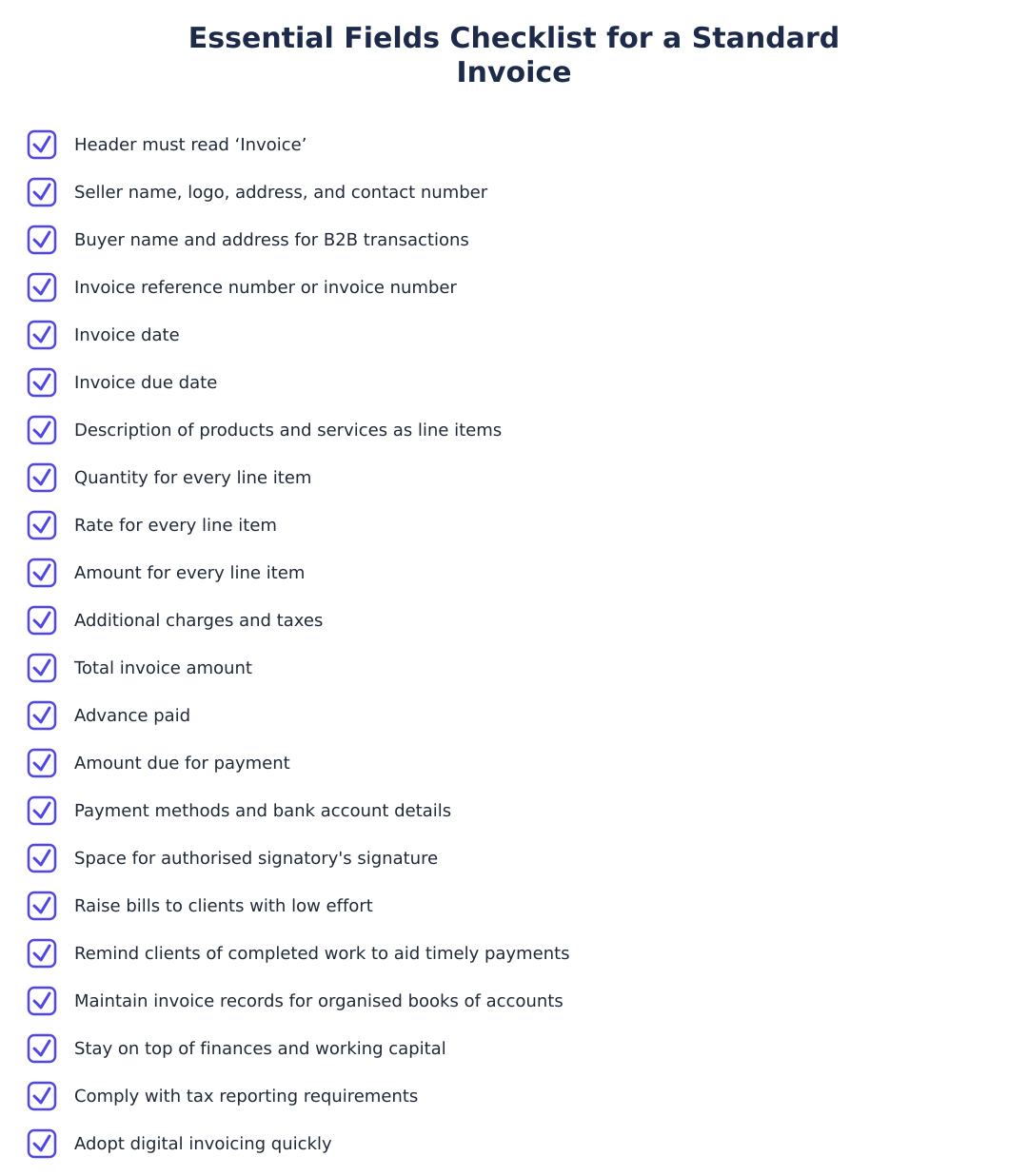
A standard invoice must include a header labelled 'Invoice', seller's name, logo, address and contact number, buyer's name and address for B2B transactions, an invoice reference or number, and invoice and due dates. It should also show a clear description of products or services as line items with quantity, rate, amount, additional charges and taxes, total invoice amount, any advance paid, and the outstanding amount due. Payment methods and bank account details along with space for the authorised signatory complete the typical required fields for legal, accounting and payment reconciliation purposes.
What different formats or layouts are commonly used for standard invoices?
Common invoice formats include simple one-page lists for single-item sales, detailed line-item tables for multi-product orders, service-based invoices that emphasise descriptions and hours, and consolidated invoices that aggregate multiple deliveries or work orders. Formats can be portrait or landscape, include company branding and logos, and vary in how prominently they display totals, taxes and payment terms, some use large summary blocks while others present detailed tax and ledger-style columns. Businesses often choose formats based on transaction complexity, volume, and whether the invoice will be printed or sent digitally.
What are the benefits of using pre-designed invoice formats or templates?
Using pre-designed invoice templates speeds up billing, reduces manual errors, and ensures each invoice contains all required fields for payment processing and tax compliance. Templates make record-keeping consistent, help businesses stay on top of finances and working capital, and streamline the transition to digital invoicing by having a reusable structure. They also improve client experience with clearer bills and help reduce disputes by consistently presenting line-item details and payment instructions.
How do I choose the right invoice format for my business?
Choose an invoice format that matches your business type, transaction complexity and volume, use simple one-line invoices for single-product sales and detailed line-item tables for multi-item or taxed transactions. Consider whether clients require tax breakups, whether you need space for terms and signatures, and if digital delivery or integration with accounting software is necessary; these needs will influence layout, columns and fields. Also weigh branding needs (logo, colours) and the ability to customise fields like payment terms or discounts to ensure the format supports both operational efficiency and compliance.
Which fields on a standard invoice can I customise for my business?
You can customise visual elements like logo, colours and header placement, and functional fields such as payment methods, bank account details, payment terms, due date format, currency, and the level of line-item detail (e.g., SKU, HSN, or service hours). You may also add or remove optional blocks like advance paid, discounts, notes, delivery references, purchase order numbers, and signature areas, while ensuring mandatory identification, numbering and tax-related fields required by law remain intact. Customisation should balance branding and client needs with legal and accounting compliance to avoid missing critical information during audits or reconciliations.
Do I need to include tax and additional charges on a standard invoice?
Yes, a standard invoice should include taxes and any additional charges so the buyer clearly sees the taxable value, tax rates and final payable amount. Taxes and additional charges must be shown as separate line items or columns (for example, GST, shipping, packing or service charges) to aid tax reporting, input credit claims and reduce disputes over the billed amount. If an advance has been paid or partial payments exist, those should also be displayed to show the net amount due.
How should invoice numbering and dating be handled in a standard invoice format?
A standard invoice should have a unique invoice reference or number and include both the invoice date and due date to establish the billing period and payment timeline. Invoice numbering should be sequential and, if needed, prefixed with client, branch or year identifiers to avoid duplication, this helps with bookkeeping and audit trails. Clear dating and numbering also facilitate payment follow-ups, reconciliation, and compliance with tax regulations that require evidence of transaction dates.
Can standard invoice formats be used for digital invoicing and what changes are needed?
Yes, standard invoice formats can and should be adapted for digital invoicing by using fillable templates, PDF generation, or invoicing software that preserves the same required fields while enabling electronic delivery and tracking. For digital use, ensure fields like invoice number, dates, line-item details, tax breakdowns, payment links and bank details are machine-readable, include metadata for accounting integration, and maintain an authorised signatory section if required for legal or client acceptance. Digital formats also allow automated reminders, recurring invoices and easier storage and retrieval compared with paper invoices.
Need help staying Finance Templates compliant?
MoneyGence's AI Finance OS tracks your compliance, wallet share, and finances in one place, built for agencies and growing businesses.
Get started with MoneyGence