Show Cause Notice GST: What It Is & How to Reply (Format + Docs)
A show cause notice under GST is a formal legal communication sent by tax authorities to a person suspected of violating provisions of the GST Act or Rules. Its primary function is not punishment at the outset but to provide the taxpayer an opportunity to explain the alleged violation before any punitive or corrective action is taken. In practice this means when the department identifies discrepancies, such as mismatches in returns or claims of input tax credit, it issues a notice to elicit the taxpayer’s version, supporting documents and, where applicable, corrective action. Understanding what triggers a notice, what the notice aims to achieve and what supporting documents to provide helps taxpayers respond effectively and avoid escalation. This guide explains what a show cause notice is, lists common situations that lead to one, clarifies the purpose of issuing such notices, outlines practical steps to prepare a reply, and lists typical documents to attach. You will learn what to expect when you receive a notice and how to present a clear, document-backed explanation so the matter can be resolved at the earliest possible stage. The guidance here is based on how show cause notices are used by GST authorities, as an opportunity for the taxpayer to explain and furnish evidence before action proceeds.
What is Show Cause Notice under GST and Types?
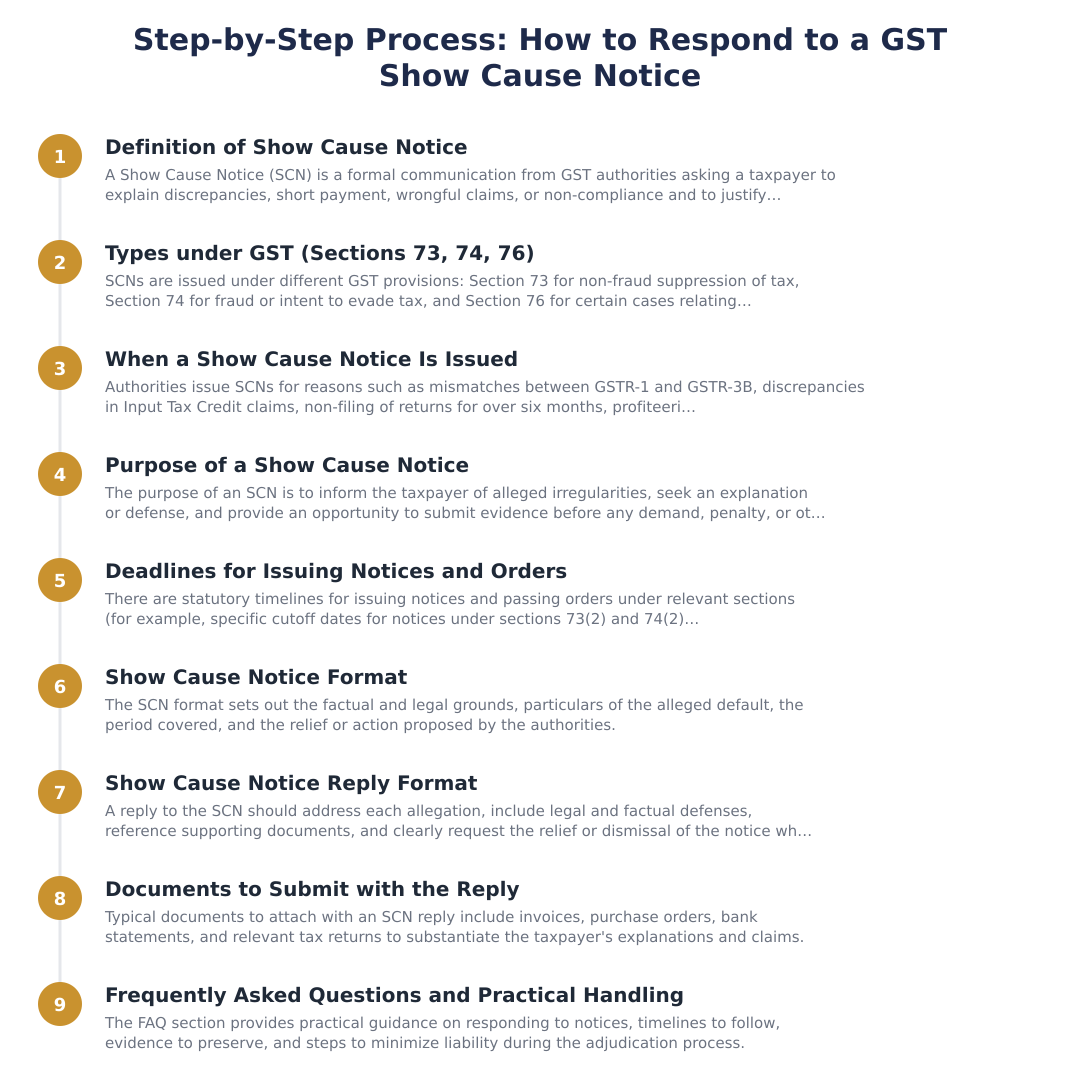
A show cause notice under GST is a legal document issued to persons violating any provision of the GST Act or Rules; authorities send it to give the taxpayer a chance to explain the violation before initiating action. Notices can vary in scope and seriousness depending on the nature of the alleged non-compliance, from routine scrutiny letters seeking clarification of return data to more serious notices where authorities believe there has been non-payment, wrongful claims or possible fraud.
Although notices take different forms and may be titled differently depending on the issue, the underlying principle remains the same: the taxpayer must be informed of the alleged irregularity and given an opportunity to respond. Because the particulars and consequences depend on the facts of each case, taxpayers should treat every notice as important and respond with relevant explanations and supporting documents.
Common situations that trigger a Show Cause Notice
| Common situations |
|---|
| Differences between GSTR-1 and GSTR-3B |
| Discrepancies in Input Tax Credit claims between GSTR-3B and GSTR-2B/2A |
| Non-filing of GSTR-1 and GSTR-3B consecutively for more than six months |
| Inconsistencies between GSTR-1 declarations and the e-way bill portal |
| Profiteering, failure to reduce prices after a GST rate reduction |
| Non-payment or short-payment of GST, with or without intent to defraud |
| Wrongful refund claims |
| Wrongful claim or utilisation of Input Tax Credit |
| Liability to be registered but failure to obtain registration |
| Inconsistencies in reporting exports vis-à-vis ICEGATE |
| Failure to provide required records or information |
| Issuance after an audit by tax authorities |
| Non-submission of required information returns |
Show cause notice under Section 73
This heading in the outline refers to a specific provision under GST law. The verified facts provided here do not include procedural details or timelines specific to any numbered sections, so readers should consult the statute or official communications for section-specific requirements.
In all cases, however, the general principle applies: a notice is intended to inform the taxpayer of an alleged violation and give the taxpayer an opportunity to present an explanation and supporting evidence before any action is taken.
Show cause notice under Section 74
As with the previous section, specific procedural or timeline details for named sections are not included in the verified facts available here. For precise section-wise obligations or limitation periods, refer to the relevant statutory text or official notifications from GST authorities.
Practically, regardless of the section cited in a notice, the taxpayer’s immediate objective should be to understand the allegations, gather supporting records and prepare a reasoned reply to the authority.
Show cause notice under Section 76
The verified facts list does not provide section-specific content for this heading. Taxpayers served with notices referencing particular sections should review the notice text carefully and seek authoritative guidance on the implications of the cited provisions.
Irrespective of the section, the notice process is intended to elicit the taxpayer’s explanation and documents before any enforcement action is finalised.
What is the Purpose of a Show Cause Notice?
The purpose of sending a show cause notice is to provide the defaulting taxpayer an opportunity to explain the reason behind the alleged violation. It is a procedural safeguard that ensures decisions are not taken without giving the affected person a chance to be heard.
For the tax administration, notices are a mechanism to obtain clarifications, request documents and, where appropriate, secure corrections or recoveries. For taxpayers, responding promptly with a clear explanation and supporting evidence can prevent escalation, reduce dispute costs and help achieve an early resolution.
How to reply to a Show Cause Notice, practical steps
Identify the alleged discrepancies, the period in question and the documents specifically requested. Note any timelines given for submission.
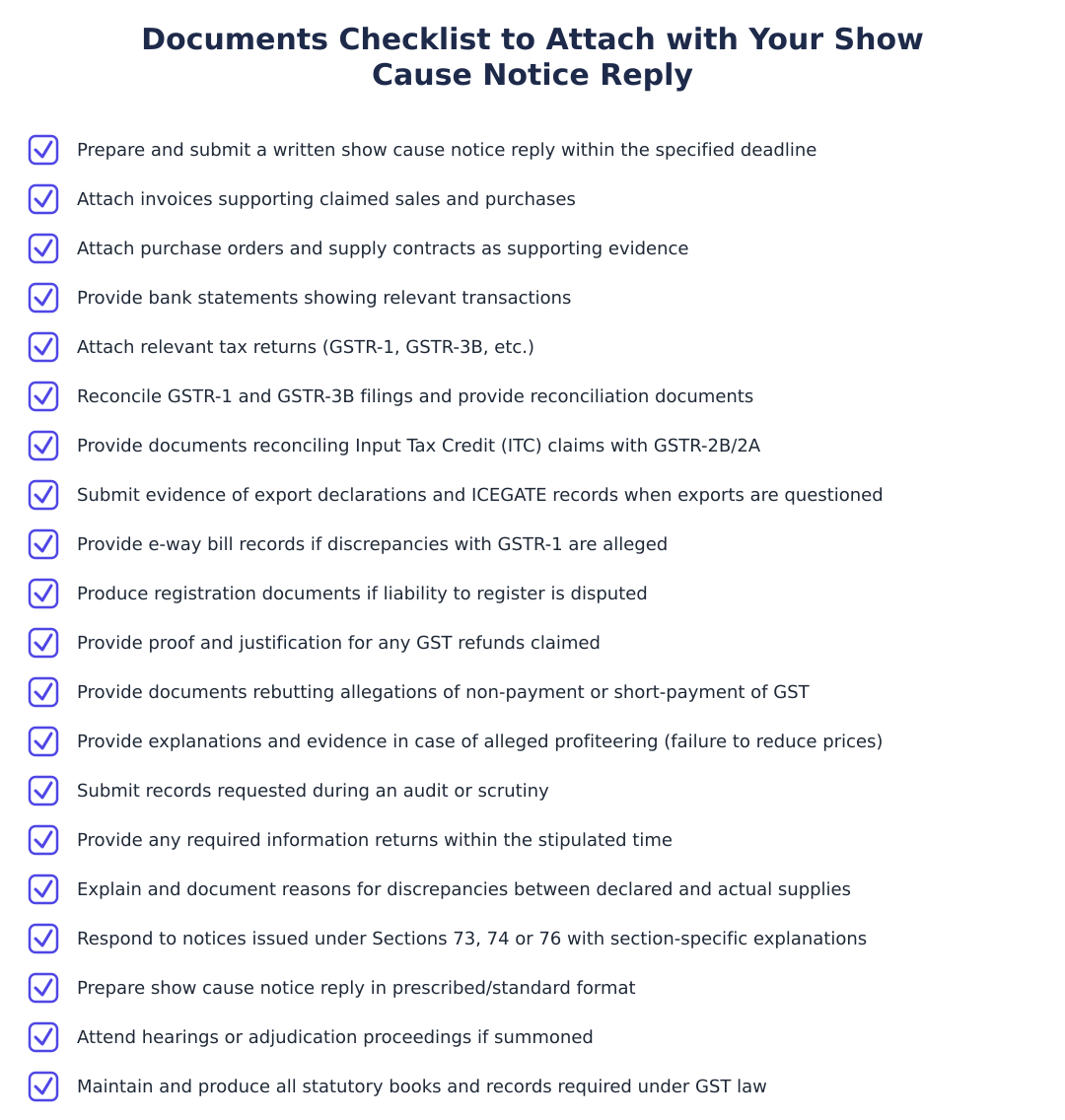
Collect invoices, purchase orders, bank statements, tax returns and any other records that address the points raised in the notice.
Explain the facts point by point, attach copies of supporting records and, where appropriate, indicate corrective steps taken or proposed.
File your reply and document submissions as directed in the notice to ensure the authorities have your explanation before taking further action.
Documents to be submitted with a Show Cause Notice reply
| Document |
|---|
| Invoices |
| Purchase orders |
| Bank statements |
| Tax returns |
Frequently Asked Questions
Q: Is a show cause notice the same as a demand order? A: A show cause notice is a pre-decisional communication giving the taxpayer an opportunity to explain alleged violations; it is not itself a final demand or order. The verified facts emphasise that notices are issued to give the taxpayer a chance to explain before initiating action.
Q: What if I don’t have the documents requested? A: The verified facts list typical documents to be submitted with a reply (invoices, purchase orders, bank statements and tax returns). If particular records are missing, explain the reasons in the reply and provide whatever alternative evidence is available; where necessary, seek professional or legal advice.
A show cause notice is an important procedural step in GST compliance aimed at eliciting the taxpayer’s explanation and supporting evidence before any action is taken. When you receive one, treat it promptly: understand the allegations, gather the listed documents (invoices, purchase orders, bank statements and tax returns) and submit a clear, factual reply. Early, well-documented responses improve the chances of resolving the matter without escalation. For section-specific rules or timelines, consult the statute or official GST notifications.
Frequently asked questions
What is a show cause notice under GST and what does it mean for my business?
A show cause notice under GST is a legal notice issued by tax authorities asking a taxpayer to explain why action (like demand, penalty or prosecution) should not be taken for alleged violations. It gives the taxpayer an opportunity to present facts, documents and legal arguments before the department passes an adverse order; failure to reply or an unsatisfactory reply can lead to orders under the GST Act, including tax demand, interest, penalties and even prosecution. Show cause notices can arise from non-payment/short-payment of tax, wrongful refund or input tax credit claims, failure to register, mismatches between GSTR-1 and GSTR-3B, or suspected fraud, and the notice will cite the relevant section (for example, sections 73, 74 or 76). Always check the notice for the specific allegations, the time allowed to reply, and the list of documents requested to build your defence promptly.
What are the main types of show cause notices under GST (Sections 73, 74 and 76)?
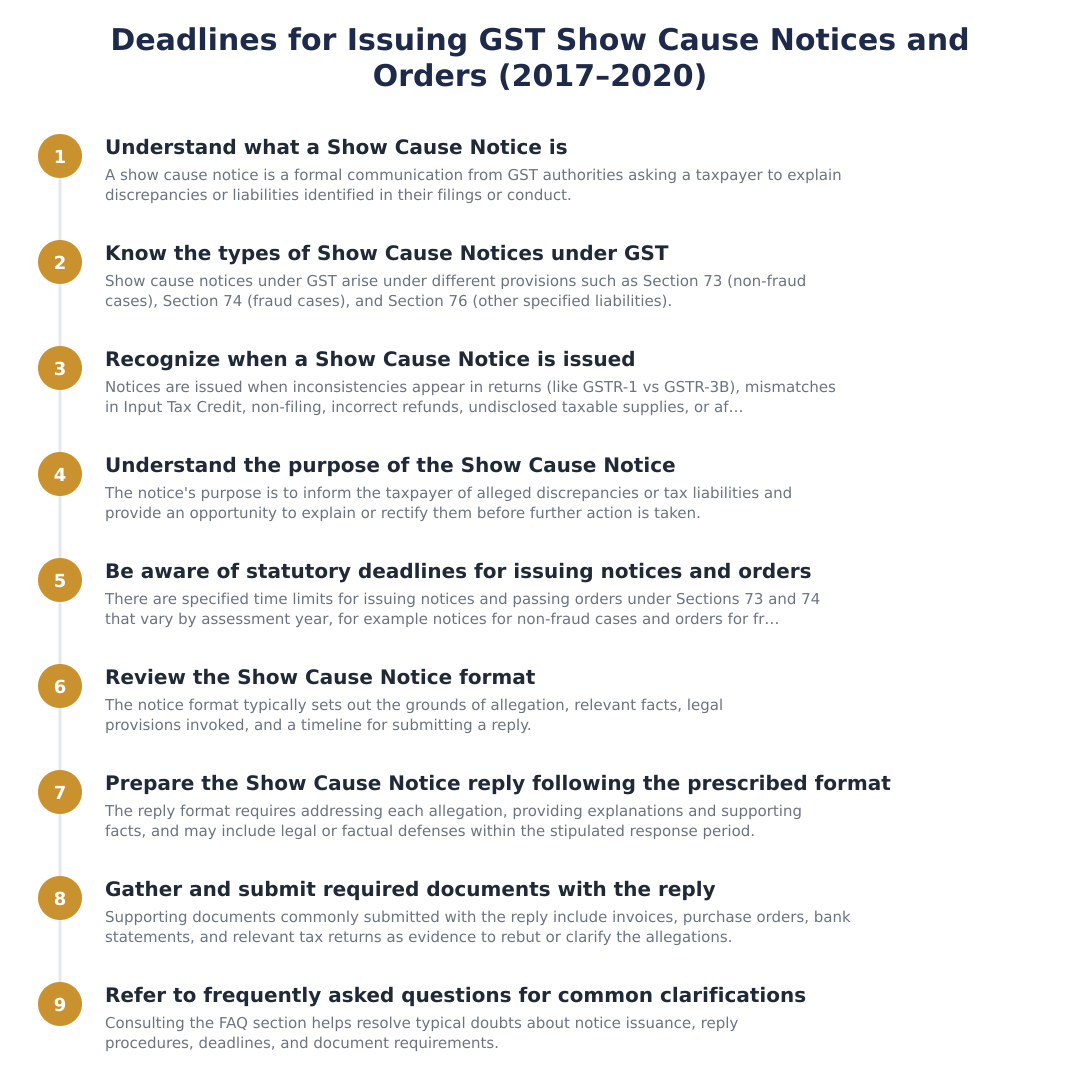
The main types are notices under Section 73 for non-fraud cases, Section 74 for fraud/intent-to-defraud cases, and Section 76 for recovery of wrongly availed input tax credit or passed on tax. Section 73 is used when there is a tax shortfall without fraud and carries demand, interest and penalties; Section 74 is used when the department alleges fraud or willful evasion and can lead to higher penalties and prosecution; Section 76 is specifically for cases where ITC was wrongly availed or utilised and aims at recovery of the same. The show cause notice will specify which section is invoked, and timelines to issue orders differ for these sections (for example, notices under section 73 for 2017‑18 had to be issued before 30 Sep 2023, whereas section 74 notices for fraud have longer limitation periods).
When will authorities issue a show cause notice, what are common triggers?
Authorities issue a show cause notice when they detect discrepancies, non‑compliance or suspected fraud, such as mismatches between GSTR‑1 and GSTR‑3B, incorrect or excess Input Tax Credit claims, delayed or missing returns for over six months, discrepancies with e‑way bill records, incorrect export reporting, wrongful refund claims, or failure to register when liable. Notices may also follow audits, scrutiny of records, or non‑submission of required information returns; profiteering (not reducing prices after a rate cut) can also prompt notices. The notice will usually list the specific discrepancies and the documentary evidence required; common requested documents include invoices, purchase orders, bank statements and returns.
What are the deadlines or limitation periods for issuing GST show cause notices and orders?
Deadlines vary by section and financial year: for non‑fraud cases under Section 73, notices and orders must be issued within prescribed limitation periods that differ year by year (for example, for FY 2017‑18 the notice u/s 73(2) had to be issued before 30 Sep 2023 and the order u/s 73(10) before 31 Dec 2023). For fraud cases under Section 74 the limitation is longer (for FY 2017‑18 the notice u/s 74(2) was due by 5 Aug 2024 and the order u/s 74(10) by 5 Feb 2025), with corresponding later cut‑offs for subsequent years (e.g., FY 2018‑19 and 2019‑20 dates extend further). You must check the specific financial year the alleged default relates to and the section invoked because missing the statutory limitation can be a valid defence against belated notices or orders.
How should I draft a reply to a show cause notice, what format and content are required?
Your reply should directly answer the allegations and is typically structured as a formal 'Show Cause Notice Reply' containing a subject line, reference to the notice, concise point‑wise admissions or denials, factual and legal arguments, and a prayer for relief; it should also attach all supporting documents. Begin by quoting the notice number and date, state whether you accept or deny each allegation, provide documentary evidence (invoices, bank statements, purchase orders, returns) and legal citations if applicable, and request personal hearing if needed; include a clear summary of relief sought (e.g., dismissal, reduction in demand). Ensure the reply is submitted within the stipulated time, in the mode prescribed (online or physical) and keep acknowledgement/ proof of submission; consider professional representation if the matter involves large tax demands or fraud allegations.
What documents should I attach with my reply to a show cause notice?
You should attach documentary evidence that directly addresses the allegations, typically invoices, purchase orders, bank statements, tax returns (GSTR‑1/GSTR‑3B), reconciliation statements (GSTR‑2B/2A comparisons), contracts, delivery challans, and communications with suppliers or customers. If the dispute is about wrongly claimed Input Tax Credit, include vendor invoices, proof of receipt of goods/services, payment proofs and ITC reconciliation; for refund or export issues include shipping bills, ICEGATE records and export documents. Attach indexed copies, provide a summary table matching documents to each allegation, and highlight key pages to make the officer’s scrutiny easier; absence of requested documents weakens the defence and may lead to an adverse order.
What happens if I do not reply to a GST show cause notice within the time given?
If you do not reply within the prescribed time, the tax authority may proceed ex parte and pass an order based on available records, which can include tax demand, interest, penalties and suspension of registration or prosecution where applicable. Ex parte orders are generally less favorable because you forgo the chance to present evidence or legal arguments; you may be able to file an appeal or seek condonation of delay later, but remedying an adverse order is costlier and uncertain. To avoid loss of rights, always file at least a provisional or seeking‑extension reply and keep proof of submission, then follow up with a full response or request for personal hearing.
Can I request a personal hearing after receiving a show cause notice and how effective is it?
Yes, you can request a personal hearing and it is often effective because it gives you a chance to explain facts, present originals and clarify complex issues face‑to‑face with the officer. The notice or the GST portal usually allows you to seek a hearing date; during the hearing bring original documents and a concise written summary of your arguments, and be prepared to rebut the department's facts point‑wise. While a hearing does not guarantee a favourable outcome, it frequently results in mitigation, withdrawal or reduction of demands if you supply satisfactory evidence or agree to rectification; always record the hearing request and its outcome in writing.
What are common defences or arguments to include in a show cause notice reply?
Common defences include demonstrating bona fide errors supported by reconciliations (e.g., GSTR‑1 vs GSTR‑3B differences), proving absence of fraud by showing payment trails and contractual evidence, establishing that ITC was legitimately due with supplier invoices and receipt proofs, or asserting limitation bar where the notice was issued beyond statutory periods. Other arguments are pointing to clerical/technical mismatches that were corrected in subsequent returns, reliance on government notifications or rate changes, and offering to rectify/ pay shortfall with interest to avoid penalties if there was no willful intent. Always back legal contentions with documentary evidence and, if relying on limitation or legal precedent, cite the specific provisions or case law in your written reply.
Need help staying GST compliant?
MoneyGence's AI Finance OS tracks your compliance, wallet share, and finances in one place, built for agencies and growing businesses.
Get started with MoneyGence