Short Term Capital Gain on Shares - STCG Rate & Calculation (Sec 111A)
This guide explains short-term capital gains (STCG) on shares and related practical points that matter to salaried taxpayers and investors. You will learn which kinds of share transactions typically generate STCG, how STCG is computed in broad terms, how such gains interact with your other income for the year, and what to watch for when reporting and planning around these gains. Understanding STCG is important because it affects annual tax liability, can change your effective tax bracket for that year, and influences decisions on timing of sale, use of losses, and portfolio management. The guide uses an illustrative taxpayer scenario to show how STCG integrates with salary and other income when arriving at total taxable income. Where specific statutory rates, sections, or date-bound compliance requirements apply, you should confirm the latest figures from official tax notifications or consult a tax professional; this article focuses on conceptual clarity and a worked illustration using the provided example.
Applicability of Section 111A
Short‑term capital gains arise when certain capital assets are sold within a short holding period defined by tax law; in practice, this typically includes many transactions in equity shares and related instruments. Whether a particular sale attracts STCG treatment depends on the nature of the asset, the holding period, and any specific statutory conditions attached to the asset class and the transaction.
For an investor, the practical test is to identify the category of the asset sold (for example, listed equity shares versus other capital assets), confirm whether statutory conditions for special short‑term treatment are met, and then compute the difference between the sale proceeds and the acquisition cost (after allowable adjustments) to arrive at STCG. Because statutory definitions and conditions can change, always verify current applicability from official tax resources before finalising tax positions.
Short Term Capital Gains Tax Rate on Shares
Tax treatment of STCG on shares can be different from long‑term capital gains and from other heads of income; jurisdictions often prescribe a specific tax rate or method of computation for STCG on equity instruments. That special treatment is intended to create a clear and uniform tax outcome for short‑holding equity transactions.
This guide does not quote a statutory rate or an exact section number here. If you need the applicable percentage rate or any special exclusions and concessions, consult the latest tax circulars or a tax advisor. The important practical point is that STCG on shares is treated separately from salary and other income for computation purposes even though it contributes to total taxable income.
Adjustment of STCG Against Basic Exemption Limit
Short‑term capital gains form part of your total income for the year and therefore affect the extent to which you can utilise basic exemption limits or slab‑based reliefs that apply to your total income. In other words, STCG is aggregated with income from other heads when arriving at total income for the assessment year.
To see how STCG interacts with other incomes, refer to the illustrative taxpayer scenario below. That example shows salary, STCG and income from other sources combined to produce a total income figure. Use such combined totals when checking whether your total income falls below an exemption threshold or when computing overall tax liability for the year.
Set Off & Carry Forward of Losses
Losses from capital transactions are an important planning consideration because, subject to statutory rules, they can often be set off against gains in the same year or carried forward to be set off in future years. The exact rules, which losses can be offset against which gains and how many years a loss can be carried forward, are determined by tax law and can vary by type of capital asset.
From a practical standpoint, keep accurate records of acquisition cost, sale consideration, and transaction costs (brokerage, fees) so that any eligible loss is correctly computed and supported. When you have capital losses, review the applicable set‑off and carry‑forward provisions or seek professional advice to ensure you claim them correctly and within the allowed timelines.
Calculation of Short Term Capital Gains - An Illustration
| Particulars | Amount |
|---|---|
| Salary Income | Rs 1 lakh |
| STCG | Rs 4 lakh |
| Income from Other Sources | Rs 0.5 lakh |
| Total income | Rs 5.5 lakh |
Frequently Asked Questions
How do I compute STCG for a specific sale? Conceptually, compute the sale consideration received, subtract acquisition cost and any allowable transaction expenses to arrive at the capital gain or loss. If the holding period qualifies it as short‑term under the law, that gain is a STCG.
Will STCG always increase my tax liability? STCG increases your total income and therefore can increase tax liability, but the final impact depends on your other incomes, available deductions and any offset of capital losses you may have. Use an accurate aggregation of all heads of income to determine the final tax outcome, and consult official rate schedules for the applicable tax computation.
Short‑term capital gains on shares are a common outcome of active trading or short‑term investing and they must be included in your total income for the year. This affects how much tax you ultimately pay and how you can utilise any losses. Use careful record‑keeping and, for precise rates, exemptions or procedural timelines, rely on current official tax sources or a qualified tax professional.
Frequently asked questions
What is the tax rate on short-term capital gains (STCG) from listed shares under Section 111A?
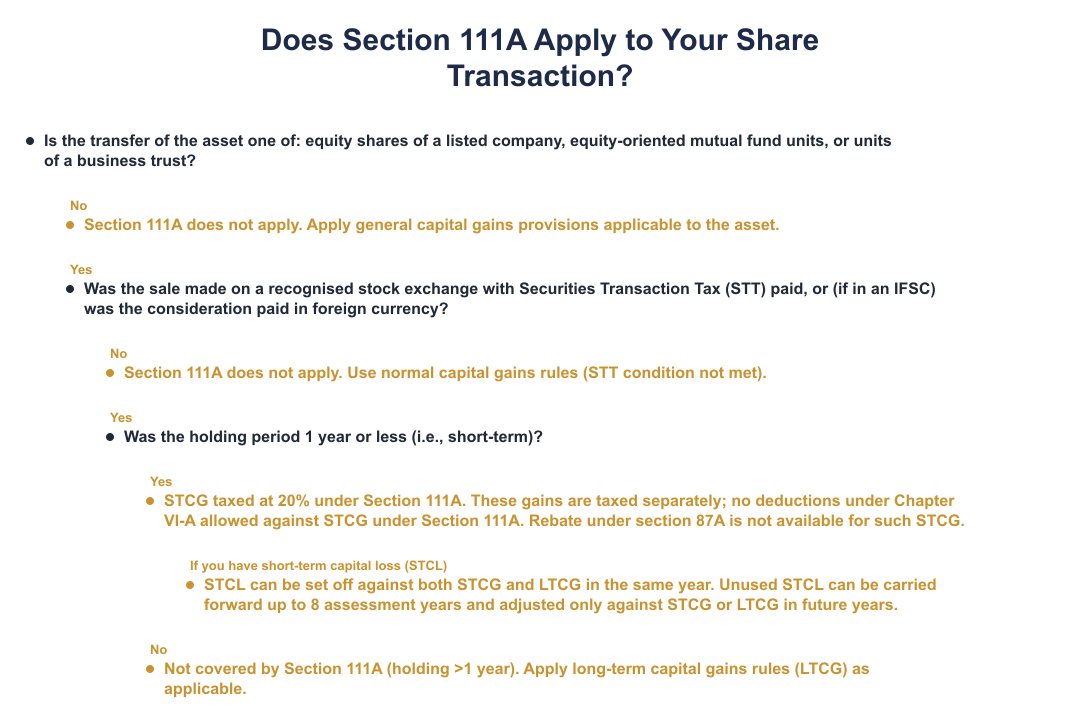
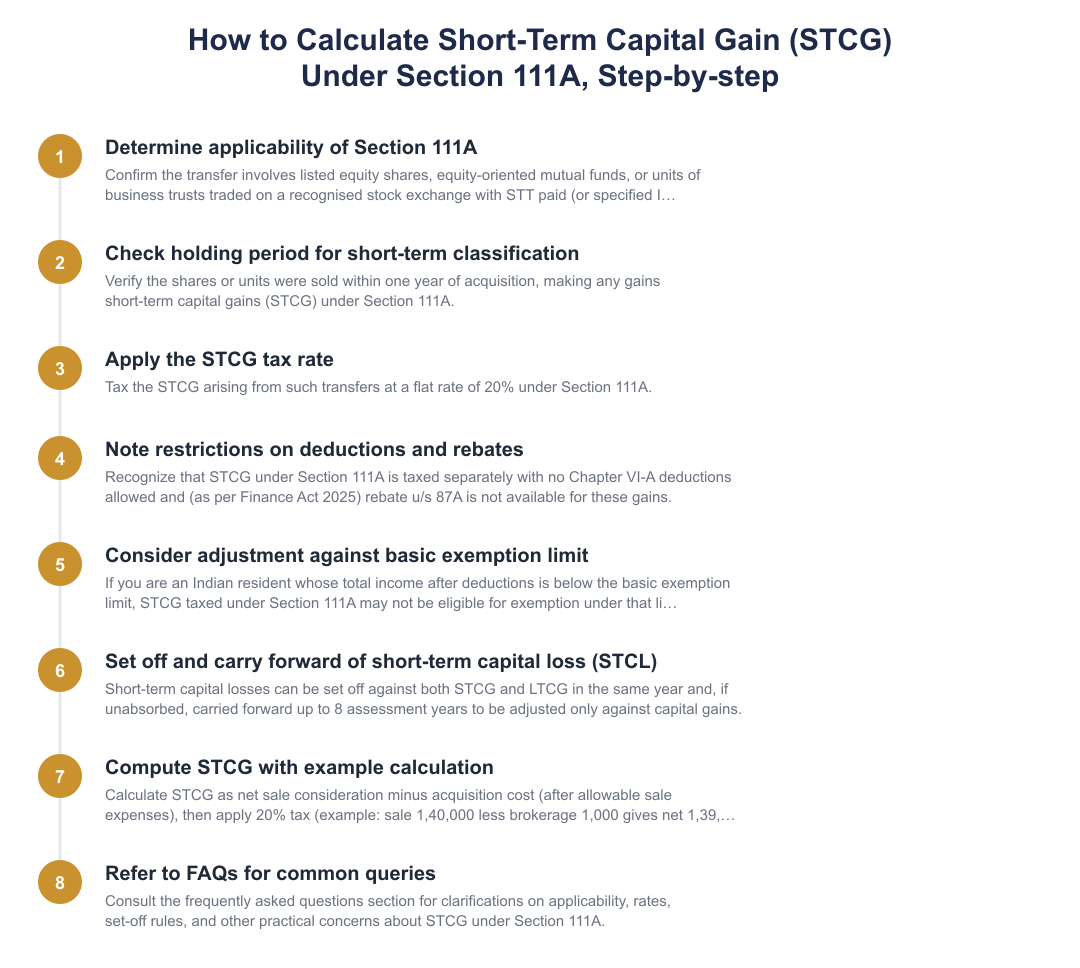
Short-term capital gains (STCG) from listed shares under Section 111A are taxed at a flat 20%. This 20% rate applies to gains arising from transfer of listed equity shares, equity-oriented mutual funds and units of business trusts where securities transaction tax (STT) is paid, and also to specified transactions in IFSC where consideration is in foreign currency. These gains are taxed separately and no Chapter VI-A deductions are allowed against them; also, as per Finance Act 2025, rebate under section 87A is not available for STCG under Section 111A.
When does Section 111A apply to gains on shares, what are the conditions?
Section 111A applies when equity shares or specified units are listed and sold through a recognised stock exchange with STT paid, or when traded on an IFSC and consideration is in foreign currency. Eligible assets include equity shares of a listed company, equity-oriented mutual funds traded on a recognised exchange with STT paid, units of a business trust, and certain IFSC transactions even if STT doesn't apply. The gains must be short-term, i.e., the asset is held for one year or less, for the 20% STCG rate under Section 111A to be applicable.
Can I adjust short-term capital gains against my basic exemption limit to reduce tax?
No, STCG taxed under Section 111A cannot be adjusted against the basic exemption limit; it is taxed separately at 20%. However, total income including STCG is relevant for determining exemptions and surcharge thresholds for other incomes, but the Section 111A amount itself is liable to the specified rate and not set off against the basic exemption. For example, if you have salary plus STCG, the STCG portion will still attract 20% under Section 111A even if your overall total income falls below the normal basic exemption limit.
Are deductions under Chapter VI-A allowed against STCG under Section 111A?
No, deductions under Chapter VI-A (like 80C, 80D etc.) are not allowed against STCG taxed under Section 111A, since these gains are taxed separately at 20%. The STCG computed under Section 111A is charged at the specified rate without permitting these specified deductions to reduce that gain. You should still claim Chapter VI-A deductions against other heads of income where permitted, but they will not reduce the Section 111A liability.
Can short-term capital losses (STCL) from shares be set off against STCG and carried forward?
Yes, short-term capital losses (STCL) can be set off against both STCG and long-term capital gains (LTCG) in the same financial year, and any unabsorbed STCL can be carried forward for up to 8 assessment years. Carried forward STCL can only be set off against capital gains (STCG or LTCG) in subsequent years and cannot be set off against income under other heads such as salary or business income. So if you incur STCL and don’t fully utilise it in the year of loss, you should carry it forward and adjust it against future capital gains within the 8-year window.
How do I calculate STCG on sale of listed shares, can you give a simple example?
STCG is calculated as net sale consideration minus cost of acquisition and allowable expenses, and taxed at 20% under Section 111A. For example, if full consideration is Rs 1,40,000 and brokerage/expenses are Rs 1,000, net sale consideration is Rs 1,39,000; if cost of acquisition was Rs 1,00,000, STCG = Rs 39,000 and tax on STCG = 39,000 x 20% = Rs 7,800. Remember to include only expenses wholly and exclusively incurred for the sale (like brokerage) when computing net sale consideration.
If my total income is below the basic exemption limit, will STCG under Section 111A be free of tax?
No, STCG under Section 111A will still be taxed at 20% even if your total income after deductions is below the basic exemption limit. While being an Indian resident with total income below the basic exemption normally entitles you to zero tax on regular slabled income, Section 111A gains are charged separately at the specified 20% rate and are not reduced by the basic exemption. Therefore, having low total income does not exempt Section 111A STCG from tax.
Does Section 111A apply to trades executed in an International Financial Services Centre (IFSC)?
Yes, Section 111A applies to equity shares, units of equity-oriented mutual funds or units of business trusts traded on a recognised stock exchange in an IFSC where the consideration is paid or payable in foreign currency, even if STT is not applicable. These IFSC transactions are specifically included so that the 20% STCG rate under Section 111A applies despite the absence of STT. Ensure the transaction is on a recognised IFSC exchange and the payment is in foreign currency to qualify.
If I have salary and STCG in the same year, how does tax get computed and shown in return?
STCG under Section 111A is computed and taxed separately at 20%, but it is still included in your total income for filing and assessment purposes; you should report salary and STCG separately in the income tax return. While Chapter VI-A deductions cannot reduce the Section 111A liability, your other incomes and deductions will determine overall tax liability, surcharges and whether any tax has been prepaid; still the STCG amount will attract the specified 20% rate and must be shown under the capital gains schedule. For instance, if you have salary of Rs 1,00,000 and STCG of Rs 4,00,000, your total income is Rs 5,00,000 and STCG portion will be taxed at 20% independently.
Need help staying Income Tax compliant?
MoneyGence's AI Finance OS tracks your compliance, wallet share, and finances in one place, built for agencies and growing businesses.
Get started with MoneyGence