Section 80IAC Deduction for Startups: Eligibility & Claim Guide
This guide explains the core eligibility requirements and a key tax interaction that founders, accountants and advisors must understand when considering the income‑tax deduction available under Section 80‑IAC for startups. You will learn which entities can claim the benefit and the mandatory recognition requirement from the Department for Promotion of Industry and Internal Trade (DPIIT). The guide also clarifies an important practical point: claiming the Section 80‑IAC deduction does not automatically eliminate other income‑tax obligations, in particular, Minimum Alternate Tax (MAT) under Section 115JB can still be triggered depending on book profits. Understanding these fundamentals matters because many startups and their advisers plan growth, fundraising and cash flow assumptions around tax breaks. Knowing who qualifies and how the deduction interacts with other provisions lets a startup set realistic expectations about immediate cash tax savings versus potential liability under the MAT regime. This article avoids procedural minutiae and instead focuses on the legal prerequisites you must satisfy and the practical consequences to watch for when taking the deduction. That helps founders and their tax teams decide when to pursue the deduction, what internal records to prioritise, and how to coordinate with auditors and tax return preparers so that claiming the benefit is defensible and aligned with overall tax planning.
What the Section 80‑IAC deduction means in practice
Section 80‑IAC provides a special income‑tax deduction intended for qualifying startups. While the provision is designed to reduce the income‑tax burden on eligible enterprises, startups need to view it within the full tax framework rather than as an isolated exemption.
Practically, the deduction reduces taxable income arising from the eligible business activity, which can free up cash for reinvestment. However, claiming any such advantage should be balanced against other tax rules and reporting obligations because the immediate reduction in taxable income does not necessarily remove all tax liabilities.
Core eligibility requirements
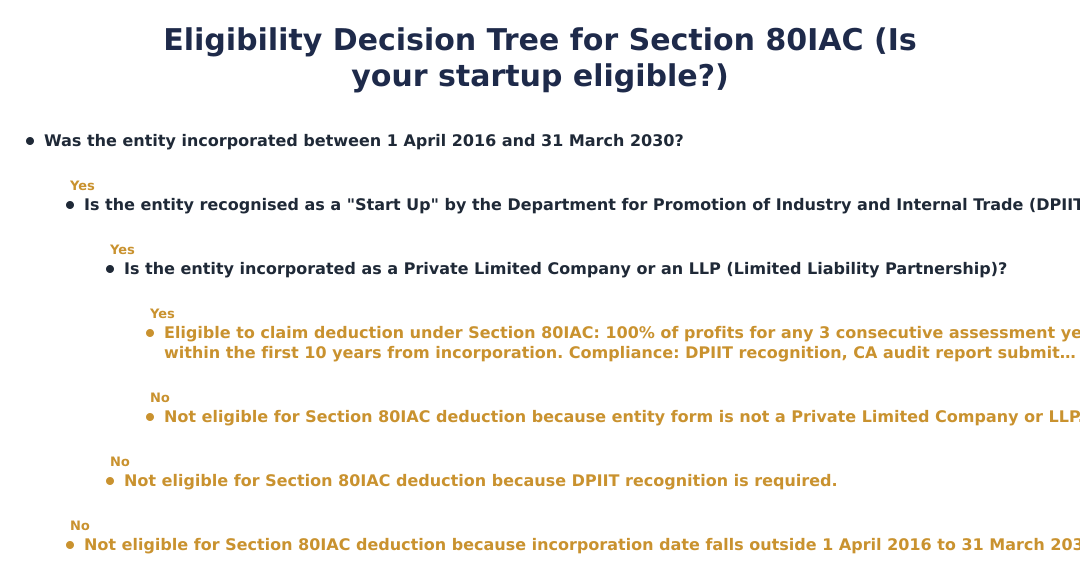
Two non‑negotiable criteria must be satisfied for a startup to be eligible under Section 80‑IAC. First, the entity must be recognised as a 'Start Up' by the Department for Promotion of Industry and Internal Trade (DPIIT). This recognition is a statutory gateway: without it, the entity is not eligible to claim the deduction under the section.
Second, the law restricts eligible legal forms to either a Private Limited Company or a Limited Liability Partnership (LLP). Other business forms are therefore not within the scope of this particular tax incentive. Startups and their advisors should confirm both DPIIT recognition and the entity type before planning around the deduction.
How Section 80‑IAC interacts with Minimum Alternate Tax (MAT)
A crucial practical point is that claiming the Section 80‑IAC deduction does not automatically exempt a startup from Minimum Alternate Tax under Section 115JB. If the startup’s book profits exceed the MAT threshold, MAT may still be payable despite the deduction under Section 80‑IAC.
For founders and finance teams this has two key implications: first, the timing of cash taxes can differ from the timing of regular tax liabilities computed after deductions; second, even when the regular tax liability is reduced by Section 80‑IAC, planning must account for potential MAT outflow. Coordinate with your auditor and tax adviser to model both regular tax and MAT impact when preparing financial forecasts and cash‑flow plans.
Practical compliance and documentation considerations
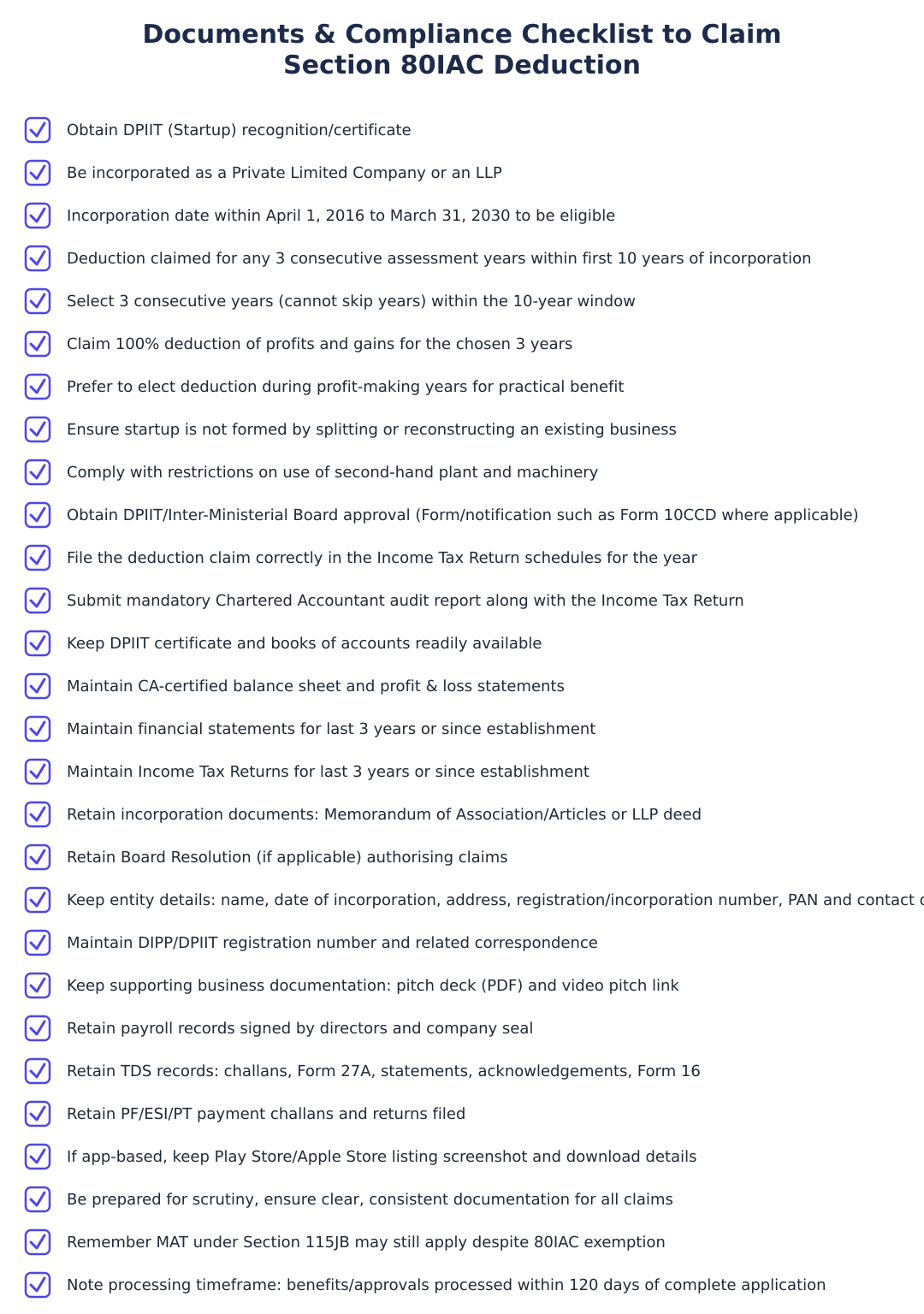
Because DPIIT recognition and entity type are the gating conditions, startups should keep evidence of their recognition certificate and legal incorporation documents readily accessible. These are the primary items examiners and auditors will want to validate when verifying a claim under Section 80‑IAC.
Beyond documents, good practice includes aligning internal accounting and audit schedules with the year(s) in which you intend to claim the deduction, and discussing the MAT consequences with your statutory auditor. Clear recordkeeping and early coordination between founders, accountants and auditors reduce the risk of compliance errors and make it easier to support the claim if the tax authorities review the return.
Section 80‑IAC can be a valuable tax benefit for qualifying startups, but its value depends on meeting the two core eligibility requirements (DPIIT recognition and being a Private Limited Company or LLP) and understanding its interaction with MAT under Section 115JB. Treat the deduction as one element of wider tax planning: keep documentation ready, involve your auditor early, and model both regular tax and MAT outcomes so your financial plans remain realistic.
Frequently asked questions
Who can claim deduction under Section 80IAC for startups in India?
Only DPIIT-recognised startups that are incorporated as a Private Limited Company or an LLP can claim deduction under Section 80IAC. The startup must hold a valid recognition from the Department for Promotion of Industry and Internal Trade (DPIIT) and must not be a reorganisation/split of an existing business; use of second‑hand plant & machinery is restricted within prescribed limits. The entity must also comply with other eligibility conditions like engaging in innovation, improvement or a scalable business model with employment potential. DPIIT recognition and proper documentation (DPIIT certificate, incorporation documents, PAN) are mandatory to support the claim.
What is the tax benefit available under Section 80IAC and how long does it last?
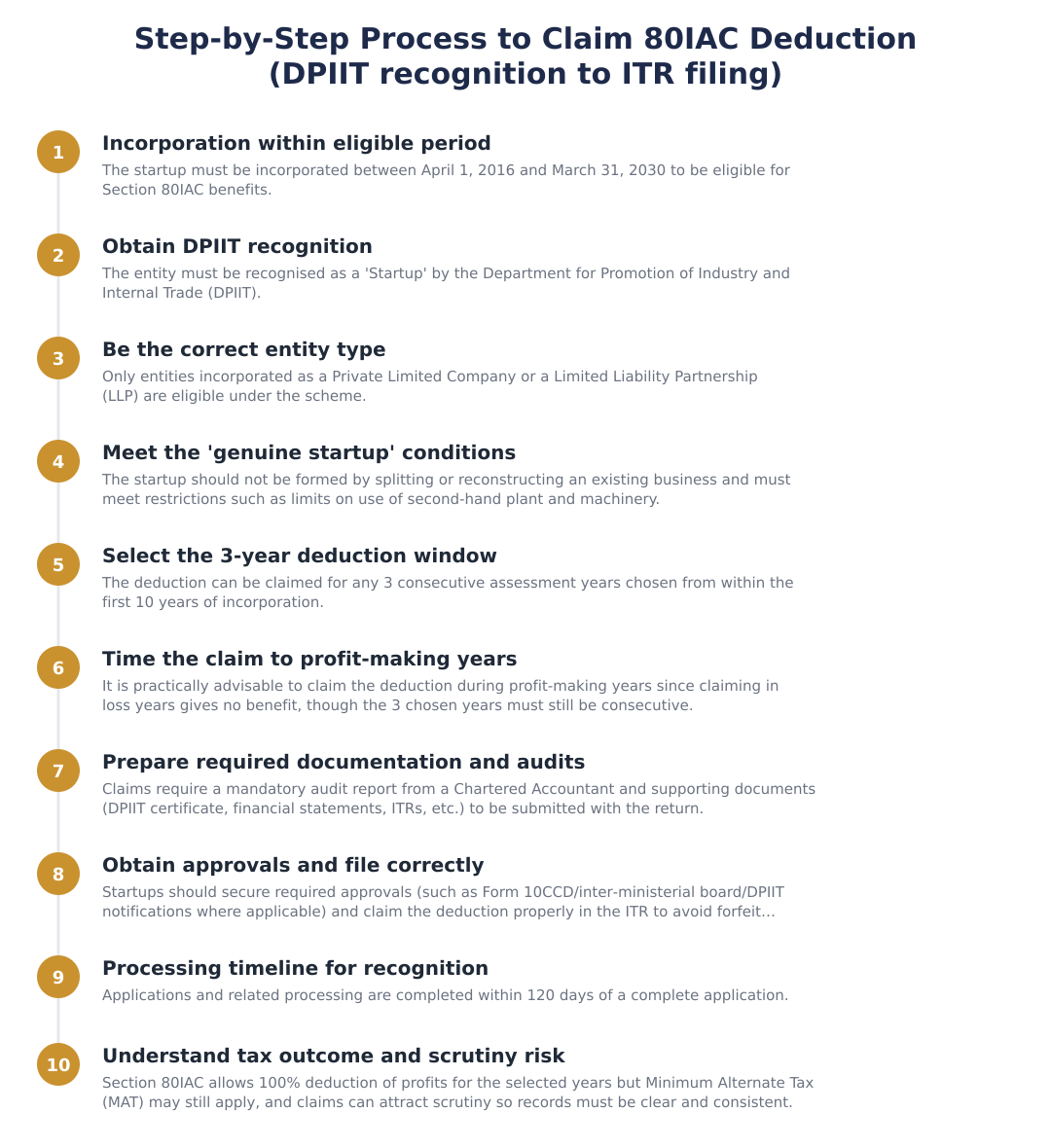
Section 80IAC provides a 100% deduction of the startup's profits and gains for any three consecutive assessment years chosen from the first ten years of incorporation. The deduction covers the entire taxable profits for each of the three selected years, effectively giving a full tax holiday during those years for regular income tax. The startup must pick three consecutive years within the ten‑year window from the date of incorporation, and the deduction cannot be spread or split into non‑consecutive years. Note that while regular tax may be fully exempt, Minimum Alternate Tax (MAT) under section 115JB can still apply where book profits exceed the MAT threshold.
What is the incorporation period eligible for Section 80IAC benefits?
Startups incorporated between April 1, 2016 and March 31, 2030 are eligible for the Section 80IAC deduction, subject to meeting the other DPIIT and compliance conditions. This extended window means companies or LLPs formed on any date in that period can pick any three consecutive assessment years within the first ten years of their incorporation to claim the 100% profit deduction. Eligibility still requires DPIIT recognition and compliance with conditions such as genuine startup activities and documentation. Processing of the DPIIT/startup certification or related application matters is expected to be completed within prescribed timelines, typically up to 120 days for a complete application.
How do I choose the three consecutive years for claiming the Section 80IAC deduction?
You must choose any three consecutive assessment years within the first ten years from the date of incorporation to claim the Section 80IAC deduction. The three years must be consecutive, you cannot skip years in between, so startups often wait until they enter profit to start the three‑year window, but the choice still must fall within the ten‑year period. For example, a company incorporated in year 1 that becomes profitable in year 6 can elect years 6, 7 and 8 as its deduction years. Careful planning is necessary because once filed without the claim the opportunity for that year may be forfeited unless corrected as per return amendment rules.
What compliance and documents are required to claim Section 80IAC in the income tax return?
To claim Section 80IAC you must include the deduction in the income tax return and attach or retain a mandatory audit report from a Chartered Accountant along with proof of DPIIT recognition (Form 10CCD or equivalent). The claim typically requires audited financial statements, CA‑certified profit & loss and balance sheet, income tax returns, DPIIT certificate/approval, and supporting documents like incorporation papers and PAN. Startups should maintain records such as payroll, TDS, PF/ESI records, pitch deck/video pitch (if requested) and other evidence of innovation/scalability, because claims under 80IAC attract scrutiny. Missing to claim the deduction in the return year or lacking the audit documentation can lead to denial of the benefit.
Does Minimum Alternate Tax (MAT) apply to startups claiming Section 80IAC?
Yes, MAT under Section 115JB can still apply even if a startup claims the 100% profit deduction under Section 80IAC; the startup may have to pay MAT at the prescribed rate on book profits. Section 80IAC reduces regular income tax but MAT is calculated on book profits as per companies law/computation rules and is payable if it exceeds the regular tax liability (which may be zero after 80IAC). Any MAT paid can usually generate MAT credit that can be claimed in future years as per the Income Tax Act rules. Startups should plan cash flow accordingly because MAT can be a significant outflow despite the regular tax holiday.
Can an LLP claim the Section 80IAC deduction or is it limited to companies?
Yes, an LLP (Limited Liability Partnership) recognised as a startup by DPIIT and meeting all other conditions is eligible to claim the Section 80IAC deduction. The eligibility specifically includes entities incorporated as Private Limited Companies or LLPs within the qualifying incorporation period and holding DPIIT recognition. LLPs must still satisfy genuine startup conditions (not formed by splitting an existing business, restrictions on second‑hand machinery, innovative/scalable activities) and comply with audit and documentation requirements when claiming the deduction. The same rules on three consecutive years within the first ten years and MAT applicability also apply to eligible LLPs.
What are common mistakes startups make when claiming deduction under Section 80IAC?
Common mistakes include not obtaining DPIIT recognition on time, failing to choose three consecutive years correctly within the ten‑year window, and poor documentation or missing the mandatory CA audit report when filing the return. Startups also sometimes assume 80IAC removes all tax obligations and overlook MAT liability, which can lead to unexpected cash outflows. Other errors are claiming the deduction in loss years (which gives no benefit), not retaining supporting evidence of innovation or scalability, and filing returns without properly declaring the deduction, which can result in forfeiture for that year. To avoid these, maintain clear records, plan the timing of the three‑year window around profitability, and consult a CA for return filing and MAT planning.
How long does it take for the startup deduction application/processing and what approvals are needed?
Processing of DPIIT/startup-related applications is generally completed within 120 days of receiving a complete application, and startups need DPIIT recognition or the Inter‑Ministerial Board approval (Form 10CCD) to substantiate the Section 80IAC claim. The startup must submit required documents such as incorporation certificate, CA‑certified financials, and a pitch deck/video if requested; once DPIIT recognition or the appropriate approval is granted, the startup includes this approval in its ITR to claim the deduction. Timely and complete submission of documents reduces delays; incomplete or inconsistent documentation can prolong processing or trigger queries. Keep copies of all communications and the DPIIT certificate because tax officers will ask for these during scrutiny.
Need help staying Income Tax compliant?
MoneyGence's AI Finance OS tracks your compliance, wallet share, and finances in one place, built for agencies and growing businesses.
Get started with MoneyGence