Section 80C: 80C Deduction List, Limit Rs.1.5L & How to Claim
This guide explains the key, verified points about Section 80C of the Income Tax Act and what taxpayers should keep in mind when planning tax-saving investments. You will learn which law governs income tax, the core purpose of Section 80C, the regime under which 80C deductions apply, and the specific lock-in characteristics of two commonly used 80C instruments: ELSS and PPF. Understanding these facts helps you align savings and investment choices with the correct tax regime and the expected liquidity profile of each instrument. Because tax planning depends on law and scheme rules, this note strictly uses verified statutory facts to avoid incorrect guidance. If you are comparing the old and new tax regimes or deciding on an investment that you expect to use for an 80C claim, knowing whether the deduction applies and how long funds are locked in is essential. Read on for clear, factual points you can rely on when discussing tax-saving options with your adviser or employer.
The legal basis: Income Tax Act 1961 and Section 80C
The governing statute for income tax in India is the Income Tax Act 1961. Section 80C of that Act provides for deductions in respect of certain investments and payments allowed to taxpayers under the law. These deductions are a statutory means to reduce taxable income for qualifying taxpayers who invest or pay into specified instruments.
Because Section 80C is a provision within the Income Tax Act 1961, any interpretation, compliance requirement or claim for deduction flows from that Act and the rules made under it. When you plan tax-saving investments relying on Section 80C, always remember that the availability and scope of the deduction are determined by the statutory provision itself.
Who can claim Section 80C deductions?
A fundamental, verified point to note is that Section 80C deductions are available only under the old tax regime. Taxpayers who choose the new tax regime are not eligible to claim Section 80C deductions. This distinction is central when you decide between the two regimes for a financial year.
Practically, this means that before making investment decisions intended to generate 80C deductions, confirm whether you will remain in the old tax regime for that year. If you opt for the new regime, investments eligible under Section 80C will not provide the tax deduction benefit even though they may still serve other financial goals.
Lock-in periods for commonly used Section 80C instruments
| Instrument | Verified lock-in period |
|---|---|
| Equity Linked Savings Scheme (ELSS) | 3 years |
| Public Provident Fund (PPF) | 15 years |
What the lock-in periods mean for planning
Lock-in periods affect liquidity and the timing of tax benefits. ELSS funds, with a three-year lock-in, are comparatively short-term among 80C-eligible instruments and are structured to restrict withdrawals for that period. This shorter lock-in may suit investors who want a combination of tax benefit and medium-term access to equity-linked investments.
PPF carries a long lock-in of fifteen years. That long horizon is designed for long-term savings and retirement-oriented planning. When you allocate funds to instruments with long lock-ins, factor in the impact on cash flow and the longer commitment before funds become freely accessible.
Practical takeaways when using Section 80C
Remember that Section 80C operates within the framework of the Income Tax Act 1961 and is only available under the old tax regime. That makes the choice of tax regime a primary consideration before relying on 80C for tax planning. If you are evaluating whether to claim 80C benefits, confirm your tax-regime choice for the year.
Also align investment choices with your liquidity needs: ELSS gives a shorter lock-in while PPF requires a long-term commitment. Use these timing characteristics to match instruments to goals (e.g., medium-term wealth creation vs. long-term retirement savings) rather than selecting them solely for the tax deduction.
Section 80C remains a key statutory route for tax deductions under the Income Tax Act 1961, but it applies only if you opt for the old tax regime. When planning, take the regime choice first, then select instruments whose lock-in periods (for example, ELSS at 3 years or PPF at 15 years) fit your financial horizon. For any detailed claim amounts, numeric limits or procedural steps, consult the statute or an authorised tax adviser because this guide contains only verified factual points.
Frequently asked questions
What is Section 80C and how much tax deduction can I claim under it for FY 2025-26?
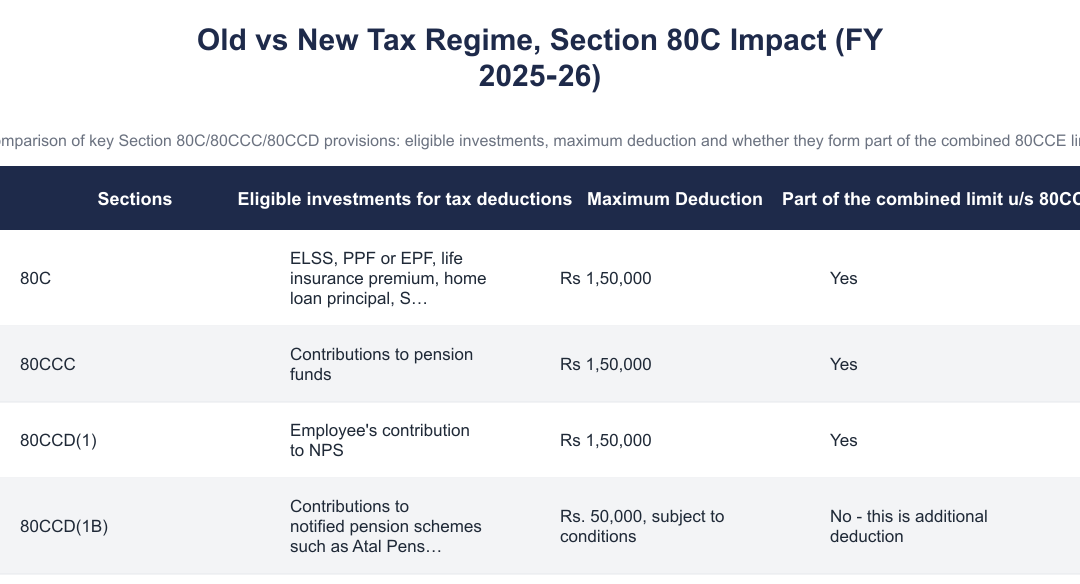
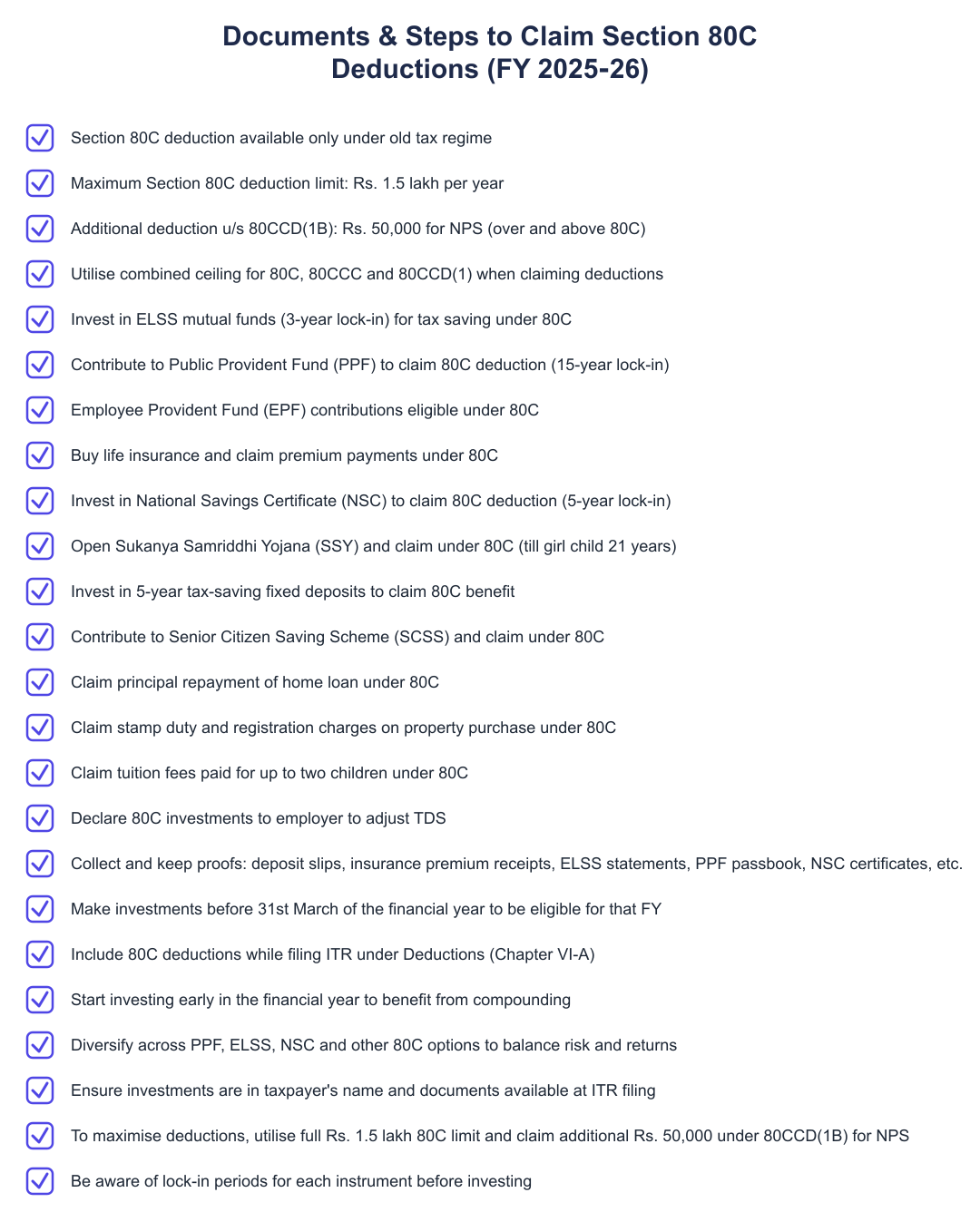
Section 80C is an income tax provision under the old tax regime that allows individuals and Hindu Undivided Families (HUFs) to claim deductions up to Rs. 1,50,000 in a financial year by investing in or paying into specified instruments and expenses. The Rs. 1.5 lakh limit is a combined ceiling for eligible investments such as PPF, EPF, ELSS, life insurance premiums, NSC, SSY, tuition fees (for up to two children), home loan principal repayment, stamp duty and registration charges, and 5-year tax-saving fixed deposits. Note that Section 80C is available only if you opt for the old tax regime; taxpayers on the new regime cannot claim these deductions. You must make the investments/payments within the financial year (by March 31) and keep proof to claim the deduction while filing your ITR or declaring to your employer for TDS adjustment.
Who is eligible to claim deductions under Section 80C?
Only individual taxpayers and Hindu Undivided Families (HUFs) are eligible to claim deductions under Section 80C. Other entities such as companies, firms, and LLPs are not eligible for these deductions. The investments and payments must be made in the name of the eligible taxpayer (individual or HUF) to qualify. Ensure you hold valid proof, like deposit slips, premium receipts, or statements, when claiming the deduction in your ITR.
What are the most popular investment options covered by Section 80C?
Popular Section 80C investments include Employee Provident Fund (EPF), Public Provident Fund (PPF), Equity Linked Savings Schemes (ELSS), life insurance premiums, National Savings Certificate (NSC), Sukanya Samriddhi Yojana (SSY), 5-year tax-saving fixed deposits, Senior Citizen Savings Scheme (SCSS), and principal repayment of home loan. These instruments vary in risk, lock-in period and returns: ELSS has a 3-year lock-in and higher return potential (12–15% historically), PPF has a 15-year lock-in with guaranteed returns and tax-free interest, and SSY locks funds till the girl child turns 21 with tax-free returns. You can combine different instruments but the aggregate claim across all qualifying investments cannot exceed Rs. 1.5 lakh in a year. Keep receipts and account statements as proof to substantiate your claim at the time of filing ITR.
Is there any additional deduction beyond the Rs. 1.5 lakh limit under pension schemes?
Yes, you can claim an additional deduction of up to Rs. 50,000 under Section 80CCD(1B) for contributions to notified pension schemes such as the National Pension System (NPS), which is over and above the Rs. 1.5 lakh limit under Section 80C. This makes it possible to get total deductions up to Rs. 2,00,000 in a financial year (Rs. 1.5 lakh under 80C plus Rs. 50,000 under 80CCD(1B)). Note that the standard combined ceiling rule (previously known as section 80CCE) still means 80C, 80CCC and 80CCD(1) are capped at Rs. 1.5 lakh together, but 80CCD(1B) is specifically additional. Ensure your NPS contribution qualifies and retain contribution receipts to claim 80CCD(1B) when filing ITR.
How do I claim Section 80C deductions when filing my income tax return?
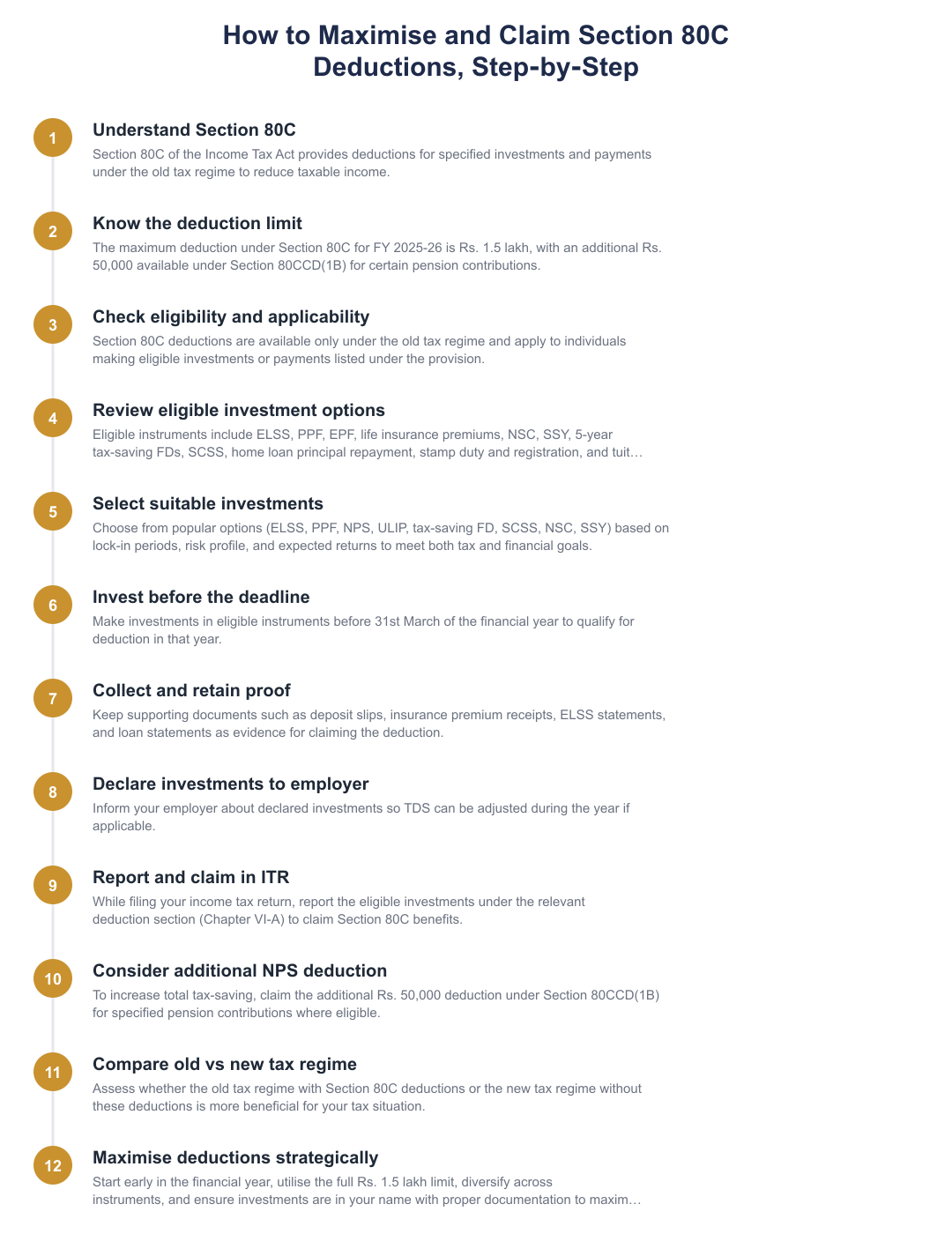
To claim Section 80C deductions you must invest or make eligible payments within the financial year, retain proof such as deposit slips, insurance premium receipts, ELSS statements and tuition fee receipts, and declare these investments in your ITR under deductions (Chapter VI-A) or to your employer for TDS adjustment. While filing the ITR, report each qualifying instrument under the appropriate schedule and enter the total deduction up to Rs. 1.5 lakh; for additional NPS claims use the 80CCD(1B) field. If you miss declaring to the employer, you can still claim the deduction when filing your ITR by uploading/keeping supporting documents in case of scrutiny. Follow the due dates for ITR filing and keep physical or digital receipts ready for verification if the tax department asks for proof.
What are the specific features of ELSS under Section 80C?
ELSS (Equity Linked Savings Scheme) is a mutual fund eligible under Section 80C that offers tax deduction up to the Rs. 1.5 lakh limit and has the shortest lock-in period of 3 years among 80C instruments. ELSS is equity‑oriented and therefore carries higher risk and higher return potential (historical averages around 12–15%); long-term capital gains (LTCG) tax applies on gains above Rs. 1.25 lakh in a financial year. ELSS suits investors looking for tax-efficient long-term wealth creation and who can tolerate market volatility; SIPs (Systematic Investment Plans) can be used to spread investments over the year. Keep your mutual fund statements and capital gains statements to substantiate claims and for tax reporting when you redeem units.
What are the key details of PPF, NSC, EPF and SSY under Section 80C?
PPF (Public Provident Fund) qualifies for 80C with a 15-year lock-in, guaranteed returns (7.90% as per the table), and tax-free interest; NSC (National Savings Certificate) qualifies with a 5-year lock-in and taxable interest (7.90% in the table); EPF (Employee Provident Fund) contributions by employee are eligible within the 80C limit and accumulate till retirement with tax treatment depending on conditions; Sukanya Samriddhi Yojana (SSY) is eligible with deposits until the girl child attains majority (partial withdrawal rules apply) and offers tax-free returns (8.50% in the table). Each instrument has different liquidity and tax treatment on returns: PPF and SSY interest is tax-free, while NSC interest is taxable and ELSS/market instruments may attract LTCG. Choose instruments based on your risk profile, lock-in preference and liquidity needs and keep account statements as proof for claims.
How does choosing the old tax regime vs the new tax regime affect my Section 80C benefits?
Section 80C deductions are available only under the old tax regime, so if you opt for the new tax regime you will forgo the Rs. 1.5 lakh deduction (and related Chapter VI-A deductions) but may benefit from lower tax rates and fewer exemptions. Taxpayers should compare their total taxable income after claiming 80C (and other applicable deductions) under the old regime against the straight-line rates under the new regime to determine which yields lower tax liability. Note that the additional Rs. 50,000 80CCD(1B) NPS deduction is also available only when relevant rules allow, plan accordingly if you rely on pension contributions for extra deduction. Use an income-tax calculator or run both scenarios before deciding each financial year because the better option depends on your deductions, exemptions and income level.
What practical steps can I take to maximise my Section 80C deduction every year?
To maximise Section 80C, start investing early in the financial year to benefit from compounding and avoid last-minute decisions, diversify across instruments (PPF, ELSS, NSC, SSY) to balance risk and returns, and plan to utilise the entire Rs. 1.5 lakh limit each year while also considering the additional Rs. 50,000 80CCD(1B) for NPS. Time investments before March 31 to ensure eligibility in that financial year, declare your investments to the employer for TDS adjustment if you want lower monthly tax, and maintain receipts and statements for ITR filing and potential scrutiny. Also match investments to your liquidity needs, for example use ELSS for shorter lock-in and higher return potential, and PPF or SSY for long-term, low-risk goals, so tax saving does not compromise financial objectives.
Need help staying Income Tax compliant?
MoneyGence's AI Finance OS tracks your compliance, wallet share, and finances in one place, built for agencies and growing businesses.
Get started with MoneyGence