Section 8 Company Registration in India: How to Register NGO
This guide explains how to register an NGO in India as a Section 8 Company under the Companies Act, 2013. You will learn which laws apply, what a Section 8 Company means in practice, the basic eligibility and governance touchpoints you must meet, the core forms used in incorporation, and the ongoing compliance that follows once the company is formed. Registering as a Section 8 Company is a popular route for not-for-profit organisations that want the legal status and corporate governance framework of a company while pursuing charitable, educational, scientific or social objectives. The process is primarily online, and understanding the required documents, the sequence of filings, and the recurring statutory obligations (like preparing audited financial statements and filing annual returns) helps founders avoid delays and maintain good standing. This article distils the essential steps and forms you will encounter, highlights the key restrictions that distinguish Section 8 Companies from for-profit entities, and summarises the routine compliance tasks you must plan for once registration is complete.
Laws in India applicable to an NGO
In India, not-for-profit organisations can be formed under several statutory frameworks. The principal options include trusts created under the Indian Trusts Act, societies registered under the Societies Registration Act, and Section 8 Companies governed by the Companies Act, 2013. Each route has its own legal characteristics, administrative processes and governance implications.
Section 8 Companies are specifically governed by the Companies Act, 2013 and are treated as corporate entities that operate for charitable or not-for-profit objectives. The choice between a trust, society or Section 8 Company depends on factors such as governance preferences, compliance appetite and the long-term plans of the organisation.
Purpose of NGO – Section 8 Company Meaning
A Section 8 Company is a company formed under the Companies Act, 2013 to promote objects such as charity, education, science, art, social welfare or similar purposes. The structure combines the corporate formality of a company with the not-for-profit objective, making it a common choice for NGOs that prefer a company governance model.
Practically, a Section 8 Company operates with restrictions that preserve its not-for-profit character. For example, profits are not to be distributed among members or directors; instead, any surplus must be applied to further the company’s stated objects. This central restriction is a defining feature that separates Section 8 Companies from commercial companies.
Section 8 Company Registration Eligibility
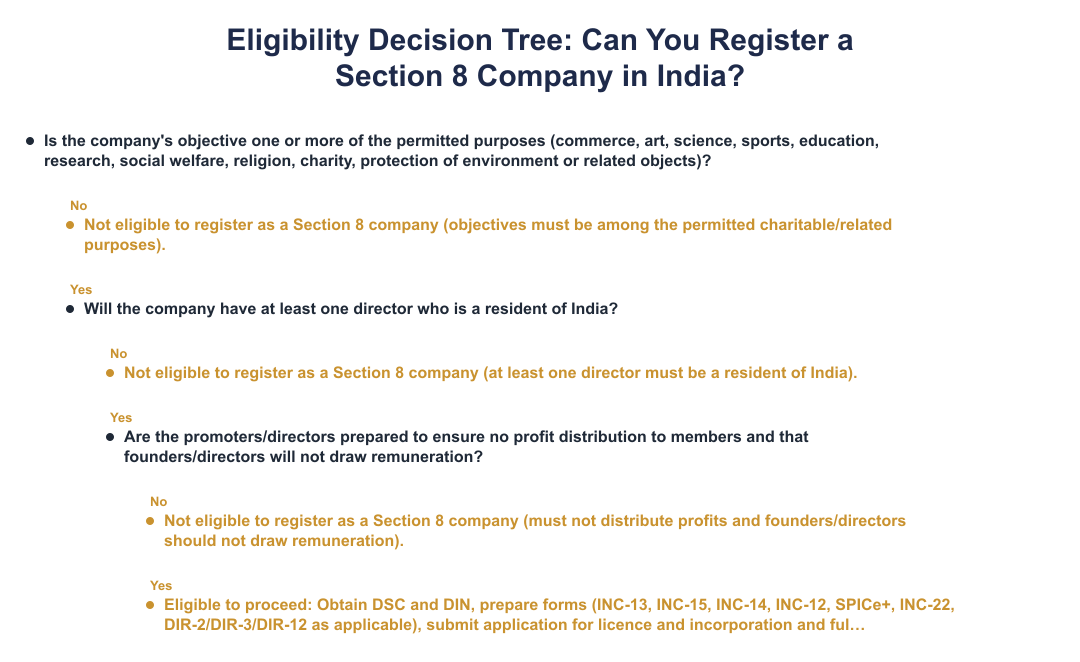
Founders need to satisfy certain basic eligibility conditions when proposing to form a Section 8 Company. One statutory requirement is that there must be at least one director who is a resident of India. This ensures an Indian resident is responsible for statutory compliance and communications with regulators.
Another fundamental eligibility constraint is the not-for-profit principle: no profit should be distributed among the members and directors directly or indirectly. This requirement governs the company’s financial policy and must be reflected in its constitutional documents and management decisions.
Forms required for Section 8 Company registration
| Name of the form | Purpose of the form |
|---|---|
| SPICe+ | Application for Incorporation of Company |
| INC-12 | Application for License (for Section 8 companies) |
| INC-13 | Memorandum of Association |
| INC-22 | Situation of Registered Office |
| DIR-2 | Consent of Directors |
| DIR-12 | Appointment of Directors |
Procedure for incorporation of a Section 8 company
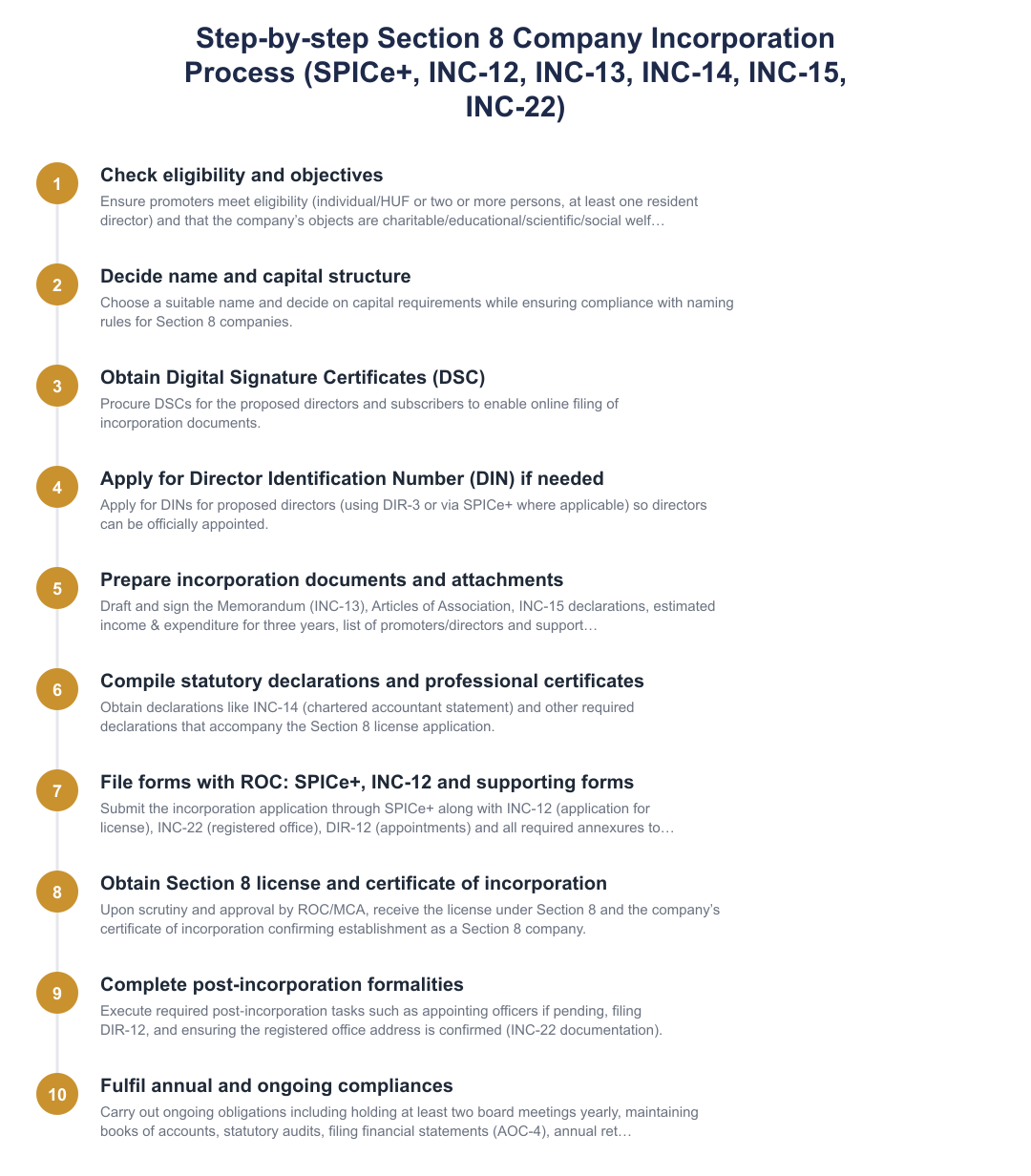
Secure DSCs for proposed directors, digital signatures are required for online incorporation filings.
Proposed directors must apply for or obtain a DIN before or during the incorporation process as required for director filings.
File SPICe+ as the application for incorporation, and include the necessary Section 8 licence application components such as INC-12 and the Memorandum of Association (INC-13).
Submit the registered office information in INC-22 and capture director consents and appointments through DIR-2 and DIR-12 as part of the incorporation filing.
Annual compliances of Section 8 Company
Once incorporated, Section 8 Companies are subject to ongoing statutory compliance that follows the corporate model. They must maintain books of account and prepare financial statements in accordance with applicable law. These records form the basis for audits and annual filings.
Mandatory audit reports must be prepared, and financial statements are required to be filed in form AOC-4. Additionally, an annual return must be filed each year along with other e-filing forms like MGT-7. Section 8 Companies are also required to file income tax returns as part of their statutory obligations.
Registering as a Section 8 Company gives an NGO a corporate structure suited to not-for-profit objectives, but it also brings clear statutory requirements: an Indian resident director, an absolute prohibition on profit distribution to members or directors, specific incorporation forms and ongoing corporate and tax compliances. Planning the incorporation sequence, gathering the required director documentation and preparing for annual filing and audit obligations will help ensure a smooth registration and sustainable compliance.
Frequently asked questions
What is a Section 8 Company (NGO) in India and what can it do?
A Section 8 Company is a not-for-profit entity incorporated under Section 8 of the Companies Act, 2013 to promote charitable objects such as education, art, science, social welfare, sports, religion or environmental protection. It operates like a company but is prohibited from distributing profits to members or directors; all income must be applied to the company’s objectives. It can carry out activities such as running schools, research institutes, charities or social enterprises and can receive grants, donations, and foreign funding subject to applicable laws. Unlike trusts or societies, it is regulated by the Companies Act and requires a license from the Registrar of Companies (ROC) before incorporation.
What are the main benefits of registering as a Section 8 Company?
The main benefits of registering as a Section 8 Company include limited liability for members, a formal corporate structure under the Companies Act, enhanced credibility with donors and grant-makers, and eligibility for certain tax exemptions and registrations like 12AA or 80G. It also allows easier access to foreign and institutional funding compared with informal structures and provides perpetual succession and transferability of membership as per company law. However, it must comply with stricter statutory filings, audits, and corporate governance requirements under the Companies Act. Establishing credibility and regulatory acceptance often makes Section 8 companies preferred for larger NGOs and foundations.
Who is eligible to incorporate a Section 8 Company in India?
An individual, Hindu Undivided Family (HUF) or two or more persons can incorporate a Section 8 Company provided they meet minimum director requirements and the objective is charitable or philanthropic in nature. There must be at least two persons subscribing to the memorandum (and at least one director who is a resident of India). The objects must relate to promotion of commerce, arts, science, sports, education, research, social welfare, religion, charity, or environmental protection, and no profits can be distributed to members or directors. Founders, directors and members cannot receive profit distributions, and they must meet the statutory compliances for incorporation.
What principal documents and information are required to apply for Section 8 Company registration?
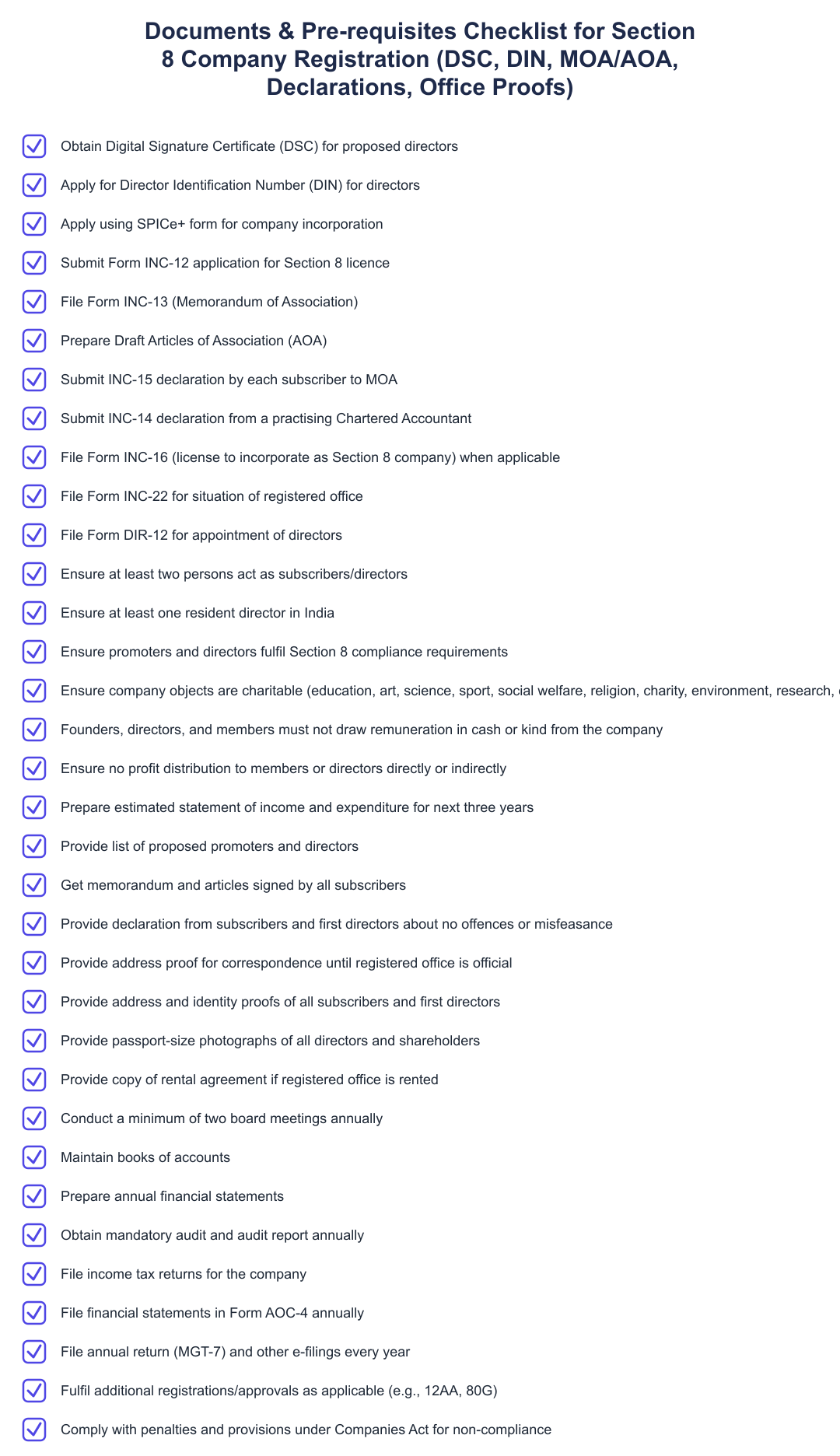
You need the Memorandum (INC-13) and Articles of Association (draft), INC-15 declaration by each subscriber, an estimated statement of income and expenditure for three years, list of proposed promoters and directors, identity and address proofs, photographs, and address proof of the registered office (or rental agreement). The incorporation package should also include declarations from first directors (DIR-2/DIR-12), INC-14 declaration from a Chartered Accountant, and proof of correspondence address until the registered office is confirmed. Missing or incorrect documents can delay the ROC licensing process, so ensure all subscriber signatures and statutory declarations are properly executed before submission.
Which statutory forms are used to register a Section 8 Company and what are they for?
Key forms include SPICe+ (application for incorporation), INC-12 (application for license under Section 8), INC-13 (Memorandum of Association), INC-14 (declaration by a practising Chartered Accountant), INC-15 (declaration by each subscriber), INC-16 (license grant), INC-22 (registered office) and DIR forms like DIR-3/DIR-2/DIR-12 for DIN and director consents. SPICe+ streamlines company incorporation while INC-12 specifically seeks the ROC’s license to form a Section 8 company; on grant of INC-16 the company can be incorporated. Proper completion of these forms along with attachments such as MOA/AOA and financial projections is mandatory for approval.
What is the step-by-step procedure to incorporate a Section 8 Company online?
First obtain Digital Signature Certificates (DSC) for subscribers and proposed directors and then apply for Director Identification Numbers (DIN) if needed; next prepare and file SPICe+ with INC-12, INC-13, INC-14, INC-15, INC-22 and supporting attachments to the ROC for the Section 8 license. After the ROC issues the license (INC-16), the Registrar will incorporate the company and issue a Certificate of Incorporation on successful verification; you must also file dir forms for director appointments (DIR-12) and update the registered office (INC-22). Ensure you submit financial projections, signed MOA/AOA, declarations from subscribers and Chartered Accountant certifications to avoid rejections. The whole process is online through the MCA portal and timelines depend on ROC scrutiny and completeness of documents.
Do directors of a Section 8 Company need Digital Signatures and DINs?
Yes, proposed directors and subscribers must have Digital Signature Certificates (DSC) to sign electronic filings and Director Identification Numbers (DIN) obtained via DIR-3 or generated through SPICe+ as part of the incorporation process. At least one director must be a resident in India. The DSC and DIN facilitate filing forms such as SPICe+, DIR-12 and other statutory submissions; without valid DSCs and DINs the ROC will not accept the electronic application. You can obtain DIN by filing DIR-3 or request DIN allotment through SPICe+ when incorporating the company.
What are the annual compliances and reporting requirements for a Section 8 Company?
A Section 8 Company must hold at least two board meetings per year, maintain books of accounts, prepare annual financial statements, have them audited, file audited financial statements in Form AOC-4, and file an annual return (MGT-7) with the ROC. It must also file income tax returns and may pursue additional registrations like 12AA and 80G for tax exemptions and donor benefits; failure to file statutory returns can attract penalties. These corporate and tax compliances are ongoing and mandatory even though the entity is non-profit, and timely filings are required to maintain license status and legal standing.
What penalties can a Section 8 Company face for non-compliance under the Companies Act?
A Section 8 Company can face monetary penalties, prosecution, and restrictions on management for non-compliance with the Companies Act, including late filing fines for AOC-4 and MGT-7 and penalties for failing to hold required board meetings or maintain statutory records. Persistent or serious violations may invite actions by the Registrar of Companies, including suspension of directors, prosecution of officers, and even winding up in extreme cases. Additionally, loss of tax exemptions and disallowance of charitable status (like 12AA/80G benefits) can occur if tax filings or specified conditions are not met. Prompt rectification, late filing with condonation where available, and professional advice can mitigate adverse consequences.
Need help staying Company Registration compliant?
MoneyGence's AI Finance OS tracks your compliance, wallet share, and finances in one place, built for agencies and growing businesses.
Get started with MoneyGence