Section 44AD - Presumptive Taxation for Small Businesses
This guide explains Section 44AD, the presumptive taxation scheme designed for small businesses. You will learn what the scheme is, who can opt for it, the practical benefits of choosing presumptive taxation, and the key conditions and compliance implications to keep in mind. The aim is to help small business owners, resident partners and HUFs understand whether the scheme fits their situation and what they should expect in terms of recordkeeping, tax computation simplicity and interactions with other tax provisions. Knowing the broad contours of Section 44AD can save time and compliance effort for eligible taxpayers and help them take an informed call on whether to adopt presumptive taxation. This guide sticks to the authoritative scope of the provision: how the scheme works in principle and which classes of taxpayers are eligible, so you can quickly decide if you should dig deeper into the finer numeric thresholds and procedural steps with your tax advisor.
What is Section 44AD?
Section 44AD is a statutory presumptive taxation framework aimed at simplifying tax compliance for small business undertakings. Under this scheme, an eligible taxpayer reports a prescribed proportion of their turnover or gross receipts as taxable business income, instead of computing profits on the basis of regular books and detailed adjustments. The essence of the provision is to reduce compliance burden by permitting a straightforward method of determining taxable income.
Practically, the scheme allows qualifying businesses to avoid preparing exhaustive accounting records and complex profit computations that would otherwise be required under normal business income assessment. This tends to appeal to smaller taxpayers who transact in relatively simple business activities and prefer predictability and simplicity over detailed accounting-driven tax calculations.
Who is Eligible to Opt for Presumptive Taxation Under Section 44AD?
Eligibility for Section 44AD is limited to specific categories of resident taxpayers. The statute explicitly permits individuals who are residents, resident partnership firms (but not Limited Liability Partnership firms), and resident Hindu Undivided Families to opt for the presumptive regime. This means a taxpayer must fall within one of these residential and entity-type categories to consider the scheme.
Entities excluded by the eligibility wording, notably certain corporate forms and non-resident taxpayers, are not covered by this provision. Because eligibility is defined by residence status and entity type, it is important for taxpayers to confirm their status before attempting to adopt the presumptive method.
Benefits of Presumptive Taxation Scheme
The main benefit of the presumptive framework is simplified compliance. Eligible taxpayers can compute business income based on a prescribed percentage of turnover or gross receipts, which eliminates the need for a detailed profit-and-loss computation and often reduces the necessity to maintain exhaustive accounting records.
This simplification typically reduces the time and professional fees spent on tax compliance, eases the process of filing returns and can make recordkeeping and tax forecasting more straightforward for small business operators. For many small taxpayers, the predictable basis for income determination helps with cashflow planning and reduces disputes around book adjustments.
Conditions for Section 44AD
Section 44AD operates subject to certain conditions laid down in the statute. One of the primary features is that taxable business income is determined on a presumptive basis, a defined proportion of turnover or gross receipts is treated as profit for tax purposes. The provision is intended to be straightforward in operation so long as the taxpayer satisfies the eligibility and other statutory conditions.
Because the scheme replaces standard profit computation, taxpayers should ensure they genuinely meet the criteria before opting in. Opting into the presumptive regime can have implications for other tax provisions and compliance responsibilities, so taxpayers should weigh the benefits against any restrictions that might apply in their particular case.
Maintenance of Books of Accounts and Tax Audit
One of the attractions of the presumptive regime is the reduced emphasis on maintaining full-fledged books of account. Because income is computed by applying a statutory percentage to turnover or receipts, the statutory scheme is structured to ease the recordkeeping burden for eligible taxpayers, compared with the detailed accounting required under regular assessment.
However, adopting the presumptive basis does not automatically free a taxpayer from all other compliance obligations under the tax law. Whether a tax audit or other detailed compliance becomes necessary will depend on the interaction of Section 44AD with other statutory provisions, the taxpayer's total income, and any exceptions or conditions specified by law. It is therefore prudent to consult a tax adviser to understand how the presumptive choice affects potential audit exposure and other compliance responsibilities.
Frequently Asked Questions
Q: Can any business opt for Section 44AD? A: No, only specified resident taxpayers (individual residents, resident partnership firms excluding LLPs, and resident HUFs) can opt for the presumptive scheme. Businesses structured outside these categories are not eligible under this provision.
Q: Does opting for the presumptive scheme eliminate all compliance? A: Opting for presumptive taxation simplifies computation and recordkeeping for many taxpayers, but it does not automatically remove all compliance obligations. Certain situations may still trigger more detailed scrutiny or additional requirements under other tax provisions, so taxpayers should assess these interactions before opting in.
Section 44AD offers a practical, simplified route for certain resident small taxpayers to compute business income on a presumptive basis. It reduces compliance effort by allowing income determination without elaborate accounting, but it is available only to specific resident individuals, resident partnership firms (excluding LLPs) and resident HUFs. Before opting in, assess how the presumptive approach interacts with other tax provisions and consult a tax professional to confirm that the scheme aligns with your overall tax position.
Frequently asked questions
What is Section 44AD in simple terms?
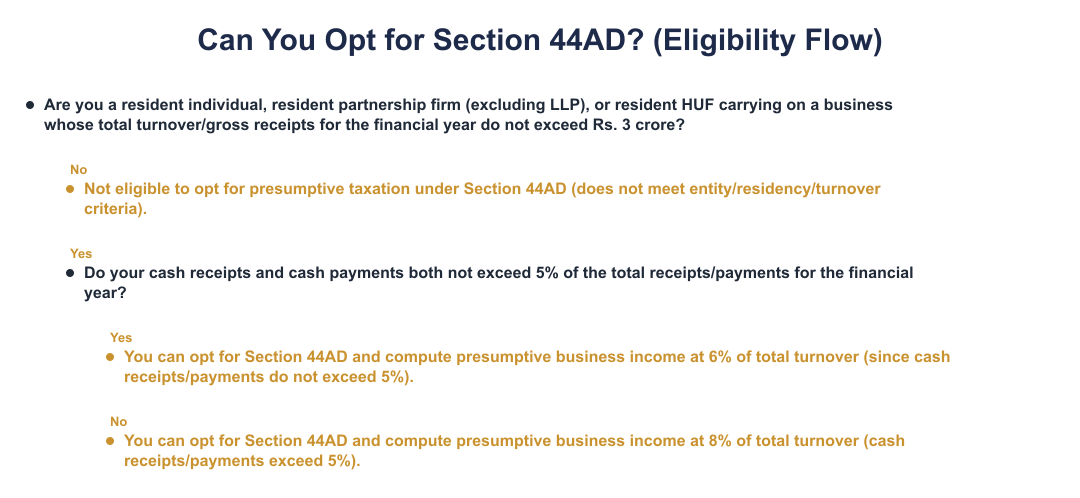
Section 44AD is a presumptive taxation scheme that lets eligible small businesses declare income as a fixed percentage of turnover instead of maintaining detailed books. Under this scheme businesses compute profits at prescribed rates (generally 8% of turnover or 6% when certain cash limits are met), pay tax on that presumed profit, and avoid routine bookkeeping and audits if limits are respected. It applies only to specified assesses (individuals, resident partnership firms except LLPs, and HUFs) with turnover within threshold limits and simplifies tax compliance by allowing filing in ITR-4. The scheme also carries conditions and exceptions, such as special rules if cash receipts/payments exceed 5% of total receipts/payments and limits for opting in future years if certain assessments have been done.
Who can opt for presumptive taxation under Section 44AD?
Any resident individual, resident partnership firm (except LLPs) and resident HUF carrying on a business can opt for Section 44AD if their turnover or gross receipts do not exceed the prescribed limit for the previous financial year. The scheme excludes professionals (who fall under Section 44ADA) and certain businesses specified under the Income Tax Act; it also excludes Limited Liability Partnerships (LLPs). Eligibility depends on turnover thresholds (for example Rs. 2 crore or Rs. 3 crore depending on cash receipt ratios) and other statutory restrictions such as having not been penalised by certain assessments.
What are the turnover thresholds to use Section 44AD?
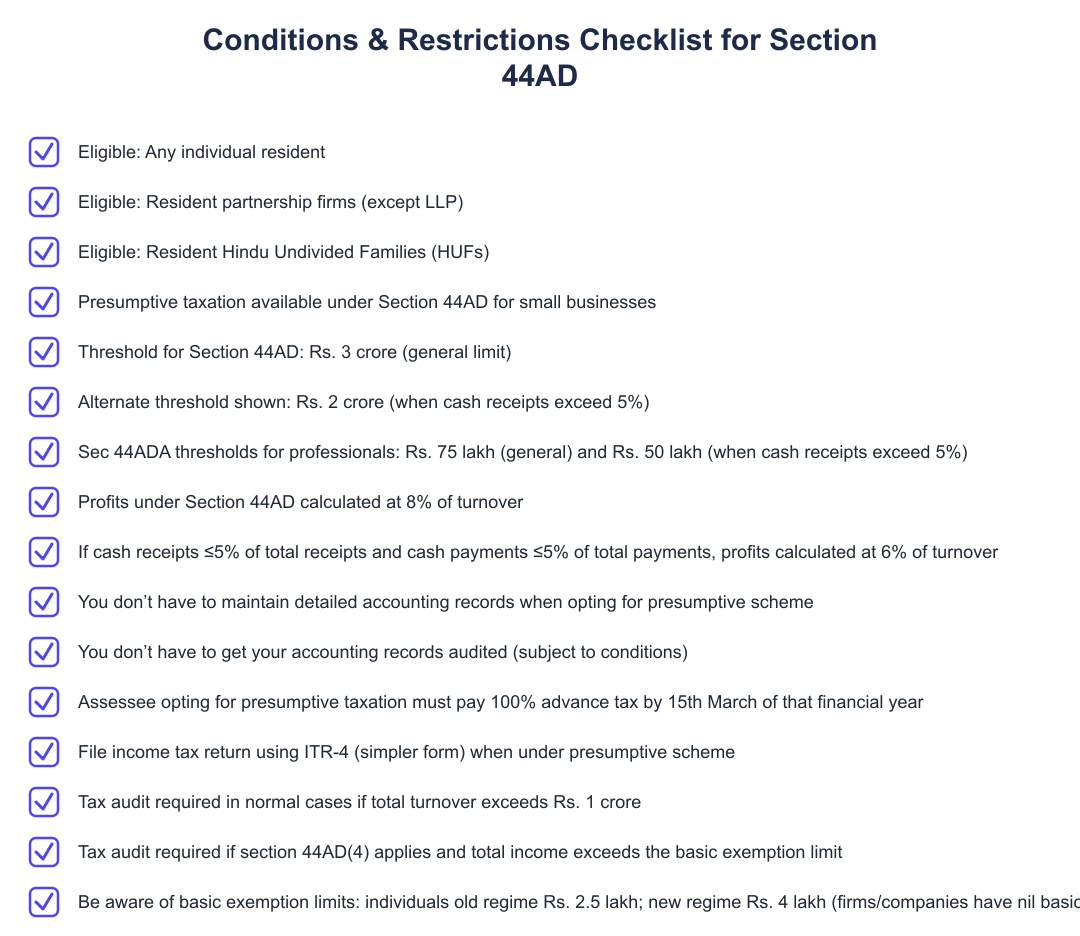
You can opt for Section 44AD only if your business turnover/gross receipts in the previous financial year do not exceed the prescribed limit, generally Rs. 3 crore when cash receipts do not exceed 5% of total receipts, and Rs. 2 crore when cash receipts exceed 5% of total receipts. The table of limits also shows analogous thresholds for professionals under Section 44ADA (Rs. 75 lakh or Rs. 50 lakh depending on cash limits). These thresholds are applied per financial year and determine whether the presumptive scheme is available to you for that year. If your turnover exceeds the applicable threshold, you must compute income under normal provisions and may be subject to tax audit rules.
How much profit is presumed under Section 44AD?
Under Section 44AD the profits are presumed to be 8% of the total turnover, but if cash receipts do not exceed 5% of total receipts and cash payments do not exceed 5% of total payments, the presumed profit is 6% of turnover. The taxpayer will be taxed on this computed profit as business income, subject to normal income tax rates and applicable surcharge/cess. These rates simplify tax computation by removing the need to prove actual expenses; however, if actual profits are higher, you may still declare higher income but must then comply with other rules. The lower 6% rate is a relief for businesses with minimal cash transactions and adequate electronic/computerized trails.
What are the main benefits of opting for Section 44AD?
The main benefits of Section 44AD are simplified compliance: you are not required to maintain detailed books of accounts, you generally avoid a tax audit, you can file using the simpler ITR-4 form, and you compute income as a fixed percentage of turnover. Additionally, the scheme reduces compliance burden for small businesses and speeds up tax filing since presumptive income computation is straightforward. However, you must still pay 100% of advance tax by 15th March of the financial year, and you must meet conditions and limits to retain these benefits. There are also limitations, for instance, if certain assessments or previous departures from the scheme happened, eligibility in subsequent years may be affected.
What conditions and restrictions apply when opting for Section 44AD?
Key conditions for Section 44AD include being a resident individual, HUF or eligible partnership (not LLP), having turnover within prescribed limits, and not being engaged in excluded businesses; special restrictions may apply if you have claimed the benefit in earlier years and later had your income determined otherwise by the tax department. You should also note that if you opt for the scheme and your income is assessed otherwise (for example during scrutiny), special provisions (Section 44AD(4)) may apply and could trigger audit liability if total income exceeds basic exemption limits. The scheme also imposes a higher compliance standard regarding cash receipts/payments (the 5% tests) which can change the presumptive rate from 8% to 6%.
Do I have to maintain books of accounts or get a tax audit under Section 44AD?
If you opt for Section 44AD and meet its conditions, you are generally not required to maintain detailed books of accounts and you are not liable for tax audit under section 44AB solely because you chose presumptive taxation. However, you could still face audit liability in two situations: under normal business rules if your turnover exceeds Rs. 1 crore (for regular computation) or if section 44AD(4) applies and your total income exceeds the basic exemption limit after an assessment determines income differently. Also, if the tax department disputes your presumptive computation and reassesses income, audit or record-keeping obligations may be invoked for the relevant year.
How and when do I pay advance tax under Section 44AD?
An assessee opting for Section 44AD must pay 100% of the advance tax liability by 15th March of the financial year for which the presumptive income is declared. This rule differs from pre-FY 2016-17 practice when advance tax was not required for presumptive taxpayers; the current rule requires full payment before the year-end to avoid interest and penalties. You should compute advance tax on the presumptive income (6% or 8% of turnover, as applicable) and deposit it by the due date; failure to do so may attract interest under sections 234B/234C. Keep proof of advance tax payments when filing ITR-4 to support compliance.
What happens if my turnover exceeds limits or I don't meet 44AD conditions during the year?
If your turnover exceeds the prescribed threshold for Section 44AD in a financial year, you cannot opt for presumptive taxation for that year and must compute income under regular provisions, which may include maintaining books and getting a tax audit if turnover crosses Rs. 1 crore. If you fail to meet other conditions (for example excluded business activity or prior assessment triggers), Section 44AD benefits may be denied and the tax officer can assess income under normal rules, potentially leading to additional tax, interest or audit. Continuing on the scheme after an adverse assessment in a previous year can also restrict future use under Section 44AD(4), so it's important to monitor turnover and compliance during the year. In practice, businesses should track cash receipt ratios and turnover to know which presumptive rate applies or whether to switch to regular computation timely.
Need help staying Income Tax compliant?
MoneyGence's AI Finance OS tracks your compliance, wallet share, and finances in one place, built for agencies and growing businesses.
Get started with MoneyGence