Section 263 Income Tax Act 2025 – Complete Return of Income Guide
This guide explains the return-of-income rules framed around Section 263 of the Income Tax Act 2025 and what those rules mean for taxpayers and tax professionals. You will learn who is typically required to file returns, the different kinds of returns that can be submitted (original, belated, revised and updated), how defective returns are dealt with, and the scope for any exemptions. The objective is practical: to help you recognise when a filing obligation arises, avoid common procedural mistakes, understand the consequences of late or incorrect filing, and know when to seek professional help. The guide is written for salaried individuals, business owners, professionals, financial officers and tax advisors who want a clear, conceptual walkthrough of filing obligations and remedial options under the return framework. It focuses on process, compliance risks, and sensible next steps so you can put robust filing practices in place and reduce the likelihood of notices or disputes with tax authorities.
What is Section 263 of the Income Tax Act 2025?
Section 263 in the 2025 Act sets out the legal framework for filing a return of income and the ancillary rules that govern electronic filing and special filing pathways. Conceptually, it consolidates the taxpayer’s duty to furnish a statement of income and tax, together with procedures that regulate when and how returns may be corrected or supplemented.
From a practical perspective, this provision defines who should prepare and submit a return, what kinds of returns are recognised under the law, and provides the authority for tax administration to prescribe forms, verification requirements, and procedural steps. For taxpayers this means clarity on filing obligations and on the permissible routes to correct an earlier submission.
Who must file a Return of Income under Section 263?
The return obligation under the framework applies to a wide range of persons and entities. This includes business entities, companies, professional practitioners, owners of certain types of assets, and specific classes of residents and non-residents as identified by the statute or by rules made under it. The law also contemplates additional categories that can be prescribed by the tax authority.
In practice, the obligation to file is informed both by the nature of the taxpayer (for example, company or individual) and by particular features of the taxpayer’s affairs, such as whether they maintain audited accounts, hold foreign assets, or claim carry-forward of losses. It is therefore important to review both the statutory criteria and any administrative guidance that clarifies scope for different taxpayer types.
What Types of Returns Can Be Filed
The statutory framework recognises several kinds of returns to accommodate normal filing, late filing, corrections and voluntary disclosures. An original return is the primary statement of income and tax for a tax year. If that original return is not submitted within the applicable timeframe, statutes typically provide for a belated return to be filed with certain consequences attached.
For mistakes or omissions discovered after submission, taxpayers may seek to file a revised return to correct errors. Separately, there is usually a mechanism for filing an updated or voluntary disclosure return to report previously omitted income or to make a fresh disclosure after the statutory period for revision has passed. Each route has its own procedural rules and limitations, including restrictions on claims such as loss carry-forwards or on seeking refunds in specific situations.
What happens if your ITR is treated as Defective?
A return may be treated as defective where required information, attachments or declarations are missing, or the return is filed using an incorrect form. When a return is declared defective, the tax authority generally provides an opportunity to rectify the defects within a specified period; failure to remedy the defects can lead to the return being treated as not properly filed or to further administrative consequences.
Practically, a taxpayer who receives a notice of defect should respond promptly, supplying the missing schedules, corrected form details or any omitted challan information as required. Timely correction avoids escalation and helps preserve rights such as carrying forward losses or claiming certain deductions that may be impacted by defective filing.
Can the Government Exempt You from Filing?
The statute includes provisions by which the government or tax authority can exempt specific categories of persons from the filing obligation. These exemptions are typically targeted, for example, to reduce compliance burden for defined groups, and are granted by notification or rule-making power provided in the law.
Even where an exemption is available, taxpayers must ensure they satisfy all conditions attached to the exemption. Relying on an exemption without proper verification or beyond its scope can invite notices or assessments, so professional advice or confirmation from the tax authority is advisable before deciding not to file on exemption grounds.
Frequently Asked Questions
Q: If I miss the due date for filing, can I still file? A: Most frameworks provide a belated filing route but it usually comes with restrictions and potential consequences. Timely filing remains the best practice to preserve all benefits and minimise compliance costs.
Q: Can I correct a mistake after filing? A: There are usually provisions for revision and for voluntary disclosure; however, these different remedies have distinct eligibility criteria and consequences. It is important to choose the correct remedy based on whether you want to amend an already-filed return or make a first-time disclosure of omitted income.
Q: What should I do if I get a notice about a defective return? A: Respond promptly, gather the required documents and consult a tax professional if necessary. Early rectification often prevents escalation into assessments or penalties.
Filing a return under the statutory return framework requires attention to who is in scope, which type of return is appropriate, and the procedural steps for correction or voluntary disclosure. When in doubt, consult a tax professional or the tax authority’s guidance to confirm filing obligations and remedy routes, prompt action reduces compliance risk and protects entitlements such as loss carry-forwards and refunds.
Frequently asked questions
What does Section 263 of the Income Tax Act 2025 cover about filing income tax returns?
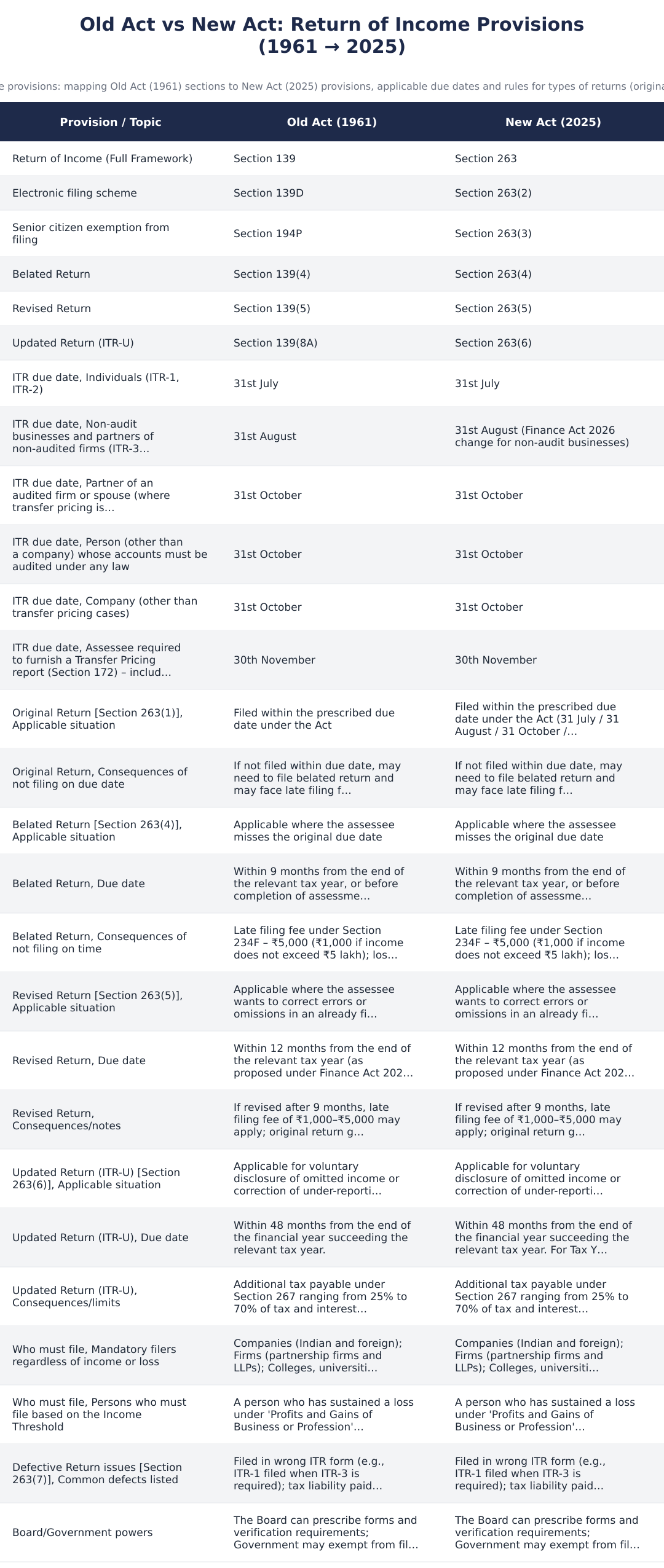
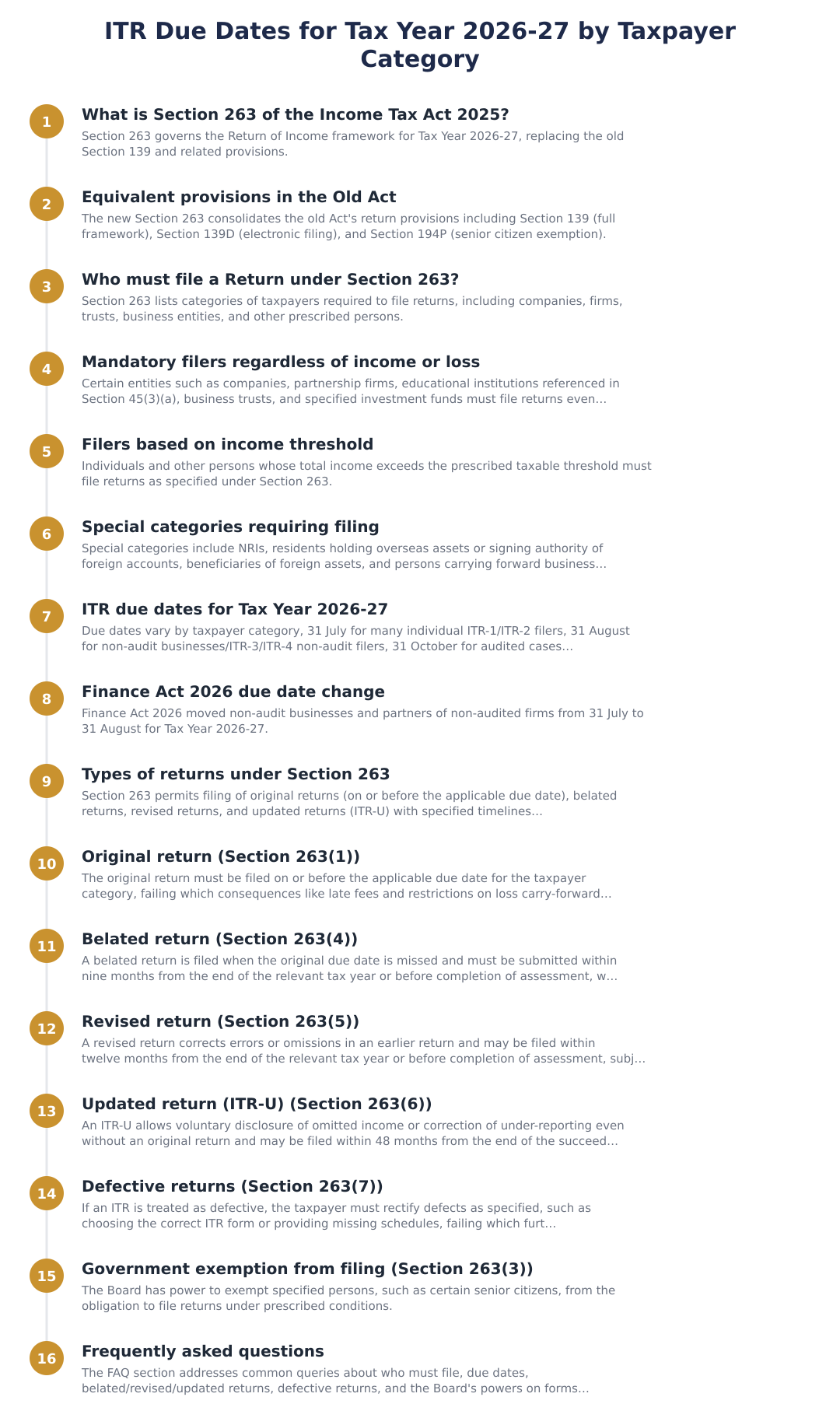
Section 263 of the Income Tax Act 2025 governs the entire framework for filing Income Tax Returns (ITR) in India, replacing the old Section 139 regime. It specifies who must file, the different types of returns (original, belated, revised and updated/ITR-U), due dates by category of taxpayer, rules for defective returns under Section 263(7), and the Board's power to prescribe forms and verification. The section also incorporates the electronic filing scheme previously in Section 139D and senior citizen exemptions previously in Section 194P, consolidating return rules in one place for Tax Year 2026-27 and beyond. Key consequences such as late filing fees, loss carry-forward restrictions, and additional taxes for updated returns are defined within its sub-sections.
Who is required to file a return of income under Section 263 even if they have no taxable income?
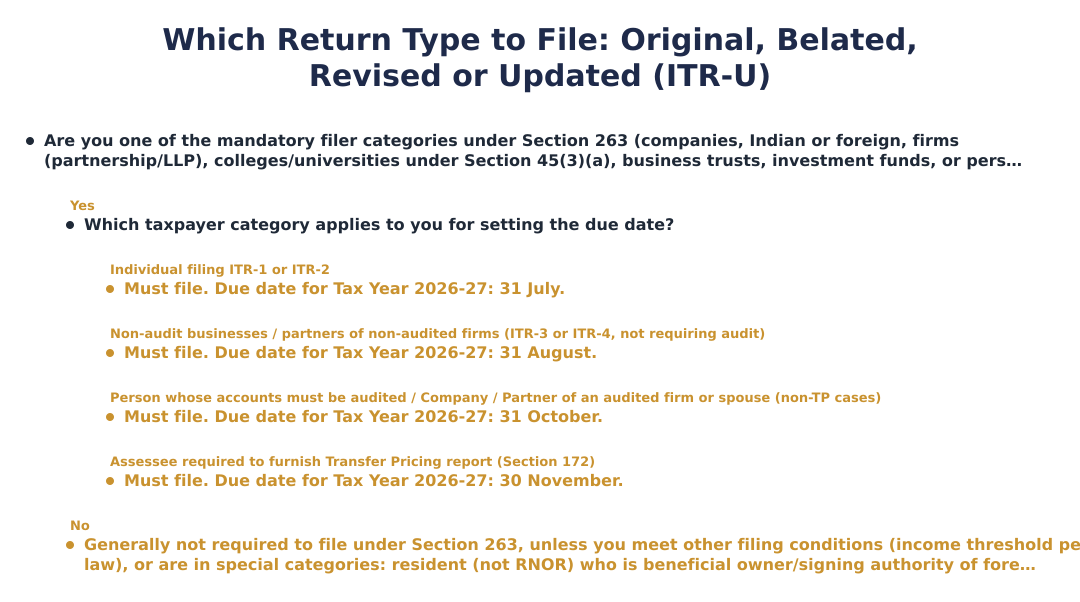
Certain categories must file a return under Section 263 regardless of whether they have taxable income or a loss; this includes companies (Indian and foreign), firms (partnerships and LLPs), business trusts, specified investment funds, colleges and universities covered under the Act, and any person required to submit a transfer pricing report under Section 172. Additionally, persons prescribed by the Board and those wanting to carry forward business or capital losses must file to preserve loss carry-forward claims. Non-resident Indians who are beneficial owners of assets outside India or signing authorities of foreign accounts also fall within special filing obligations. Failure to file can prevent carry forward of many losses and attract late fees and interest where applicable.
What are the ITR due dates under Section 263 for Tax Year 2026-27?
For Tax Year 2026-27, Section 263 sets different due dates by category: ITR-1 and ITR-2 individual filers, 31 July; non-audit businesses and partners of non-audited firms (ITR-3, ITR-4 where audit not required), 31 August; audited persons and most companies and partners of audited firms, 31 October; and assessees required to furnish a transfer pricing report under Section 172, 30 November. These dates were updated by the Finance Act 2026 which moved non-audit businesses to 31 August. Missing the original due date can force an assessee to file a belated return with additional fees and restrictions such as loss carry-forward limits.
What is a belated return under Section 263 and when must it be filed for Tax Year 2026-27?
A belated return under Section 263(4) is filed when the assessee misses the original due date and must be submitted within nine months from the end of the relevant tax year or before completion of assessment, whichever is earlier; for Tax Year 2026-27 this means the belated return due date is 31 December 2027. Filing a belated return attracts the late filing fee under Section 234F of up to ₹5,000 (₹1,000 if total income does not exceed ₹5 lakh), interest under Sections 234A/234B/234C where applicable, and generally prevents carry forward of losses except house property loss and unabsorbed depreciation. A belated return can still regularize tax liabilities but comes with these financial and claim limitations. It cannot substitute for an updated return (ITR-U) which has its own timeline and higher penalties for omitted income.
How is a revised return different and what is the deadline under Section 263 for Tax Year 2026-27?
A revised return under Section 263(5) lets an assessee correct errors or omissions in an already filed original or belated return, and must be filed within 12 months from the end of the relevant tax year or before completion of assessment, whichever is earlier (as proposed under Finance Act 2026). If the revised return is filed after nine months from the end of the year, a late filing fee between ₹1,000 and ₹5,000 may apply, and the revised return replaces the original for tax assessment purposes. Revising a return adjusts tax liability, schedules and attachments; failure to revise when needed can lead to notices, additional tax demands or incorrect reporting remaining on record. The revised return timeline is stricter than the belated timeline in some respects and should be used only to correct bona fide mistakes.
What is an Updated Return (ITR-U) under Section 263(6) and when can I file one?
An Updated Return (ITR-U) under Section 263(6) allows voluntary disclosure of omitted income or correction of under-reporting even if an original return was not filed, and it must be filed within 48 months from the end of the financial year succeeding the relevant tax year, for Tax Year 2026-27 the due date is 31 March 2032. Filing an ITR-U carries additional tax under Section 267 ranging from 25% to 70% of the tax and interest due depending on delay; it cannot be used to claim or increase a refund, cannot reduce previously declared total tax liability, and only one ITR-U is allowed per tax year. The ITR-U is intended for voluntary compliance and has stricter monetary consequences than belated or revised returns, so taxpayers should compute additional tax and interest before filing. Use of ITR-U preserves legal compliance but is not a tool for profitably amending returns for refunds.
What happens if my ITR is treated as defective under Section 263(7)?
If an ITR is treated as defective under Section 263(7), the income tax authority will issue a notice specifying defects and provide an opportunity to rectify them within a stipulated time; common defects include filing the wrong ITR form, missing challan or schedules, or not attaching mandatory balance sheet/P&L where required. The assessee must rectify the defects by submitting corrected information or attachments as directed; failure to do so can lead to the return being treated as invalid, assessment consequences, or disallowance of claims such as deductions and loss carry-forwards. The defective-return process is procedural and intended to ensure complete, accurate filings, but taxpayers should respond promptly to avoid adverse outcomes. Rectification does not automatically extend statutory deadlines unless specifically allowed by the assessing authority.
Can the government exempt someone from filing a return under Section 263(3)?
Yes, Section 263(3) permits the government to exempt specified classes of persons from the obligation to file a return of income, and this power mirrors the senior citizen exemption previously under Section 194P of the old Act. Such exemptions are granted by notification and may apply to categories like very senior citizens with prescribed sources of income or other groups identified by the Board, subject to conditions and verification requirements. Exempted persons should confirm the exact notification details and any verification/formalities because exemptions may carry conditions (for example, reliance on tax deducted at source) and can be withdrawn or limited. Even if exempt, persons with obligations like foreign asset disclosure or loss carry-forward claims may still be required to file under other provisions.
What are the financial consequences if I miss the original ITR due date under Section 263?
Missing the original due date under Section 263 triggers several financial consequences: you may have to file a belated return with a late filing fee under Section 234F (up to ₹5,000, or ₹1,000 if total income ≤ ₹5 lakh), incur interest under Sections 234A/234B/234C for delays in tax payment, and lose the ability to carry forward most losses (except house property loss and unabsorbed depreciation). Additionally, if you later use an ITR-U for omitted income the additional tax under Section 267 (25%–70% of tax and interest) can apply, and revised returns after nine months may attract a ₹1,000–₹5,000 fee. These penalties and restrictions make timely original filing, by the applicable due date (31 July / 31 August / 31 October / 30 November depending on category), far preferable to belated compliance.
Need help staying Income Tax compliant?
MoneyGence's AI Finance OS tracks your compliance, wallet share, and finances in one place, built for agencies and growing businesses.
Get started with MoneyGence