Section 194N: TDS on Cash Withdrawals Above ₹1 Crore
This guide explains Section 194N, the provision introduced in the Union Budget 2019 that requires deduction of tax at source (TDS) on cash withdrawals exceeding Rs 1 crore. You will learn what the provision is, why it was introduced, who it affects, and what practical steps businesses and individuals should consider to remain compliant. Understanding Section 194N matters because it changes how large cash movements are treated for tax withholding purposes and can affect cash flow, banking behaviour and record-keeping for high-value cash users. While this guide does not provide exhaustive legal advice, it highlights the operational implications of the provision so taxpayers, banks and businesses can plan withdrawals, review internal controls and coordinate with their financial service providers to avoid surprises at the time of cash payments.
What is Section 194N?
Section 194N is a legislative measure introduced by the Union Budget 2019 that mandates deduction of tax at source on certain cash withdrawals. The primary policy intent behind such provisions is to discourage very large cash transactions, promote digital payments and improve tax compliance by creating a paper trail for sizable cash movements.
For taxpayers and payers, the notable feature of Section 194N is that it links withholding obligations directly to cash withdrawals, so banks and other specified payers may be required to deduct tax at the time of making high-value cash payments. This changes the compliance landscape for persons who habitually withdraw large amounts of cash from their accounts.
Who is affected and who deducts TDS?
The provision targets situations where substantial cash is withdrawn from bank or similar accounts. While the law itself specifies which entities are required to deduct TDS, in practice these are typically institutions that make cash payments, for example, banks, post offices and other regulated payers. These payers must be aware of their withholding obligations and put in place systems to track cumulative withdrawals.
Individuals and entities that frequently handle large cash amounts, such as businesses with cash-intensive operations, high net-worth individuals, and certain payees in agricultural or trade contexts, should take note because withholding at source could affect net cash received. Payers and payees should coordinate so that tax is deducted and remitted correctly and reflected in appropriate tax statements.
Practical implications for cash management
Because the provision applies to cash withdrawals above a specified threshold, it changes how taxpayers may plan withdrawals during a financial year. Payers required to deduct TDS will likely need to aggregate withdrawals made from accounts to determine withholding liability, so maintaining clear records of each withdrawal becomes essential.
From an operational perspective, businesses should review internal cash policies, update bank mandates and ensure accounting systems flag high-value withdrawals so that the bank or other payer can apply the required withholding. Advance communication with bankers or payment service providers can prevent unexpected deductions and cash shortfalls.
Compliance and record-keeping considerations
Entities that are responsible for deducting TDS under Section 194N need systems to track cumulative cash payments to each payee during the financial year and to account for tax deducted. Accurate record-keeping helps reconcile bank statements with withholding records and supports timely reporting and remittance obligations where applicable.
For payees, retaining proofs of tax deducted at source, such as bank certificates or entries in tax credit statements, is important for claiming credit while filing income tax returns. If tax is deducted, the payee should verify that the deduction has been properly deposited and reflected in the tax credit statement issued by the tax department.
Points to remember
Section 194N was introduced in the Union Budget 2019 and applies to cash withdrawals above a legislated monetary limit. Both payers (institutions making cash payments) and payees (those receiving cash) should be aware that high-value cash withdrawals may attract withholding at source and plan accordingly.
To minimise disruption, stakeholders should maintain robust banking records, communicate with their banks about expected cash needs, and ensure that any tax deducted is properly evidenced and reconciled so that payees can claim credit when filing returns.
Section 194N, introduced by the Union Budget 2019, establishes withholding obligations on high-value cash withdrawals. While the provision aims to promote transparency and reduce large cash transactions, its practical impact depends on accurate tracking of withdrawals and coordination between payers and payees. Review your cash procedures, liaise with your bank, and keep thorough records to manage any withholding and claim appropriate tax credit.
Frequently asked questions
What is Section 194N and when does it apply?
Section 194N requires deduction of TDS on cash withdrawals from a bank or post office account when the aggregate withdrawals from that bank in a financial year exceed the prescribed threshold (generally Rs 1 crore). The provision applies to cash payments or aggregate sums withdrawn from a particular bank or post office in a financial year by any taxpayer, individuals, HUFs, companies, firms, LLPs, AOPs/BOIs, but excludes payments by or to specified persons notified by the government. The section was introduced in Budget 2019 to discourage large cash transactions and the threshold and rates vary if the payee has not filed income tax returns for the preceding three years. Banks and other specified payers must track cumulative withdrawals from all accounts maintained with the same bank to determine when TDS becomes applicable.
Who is required to deduct TDS under Section 194N?
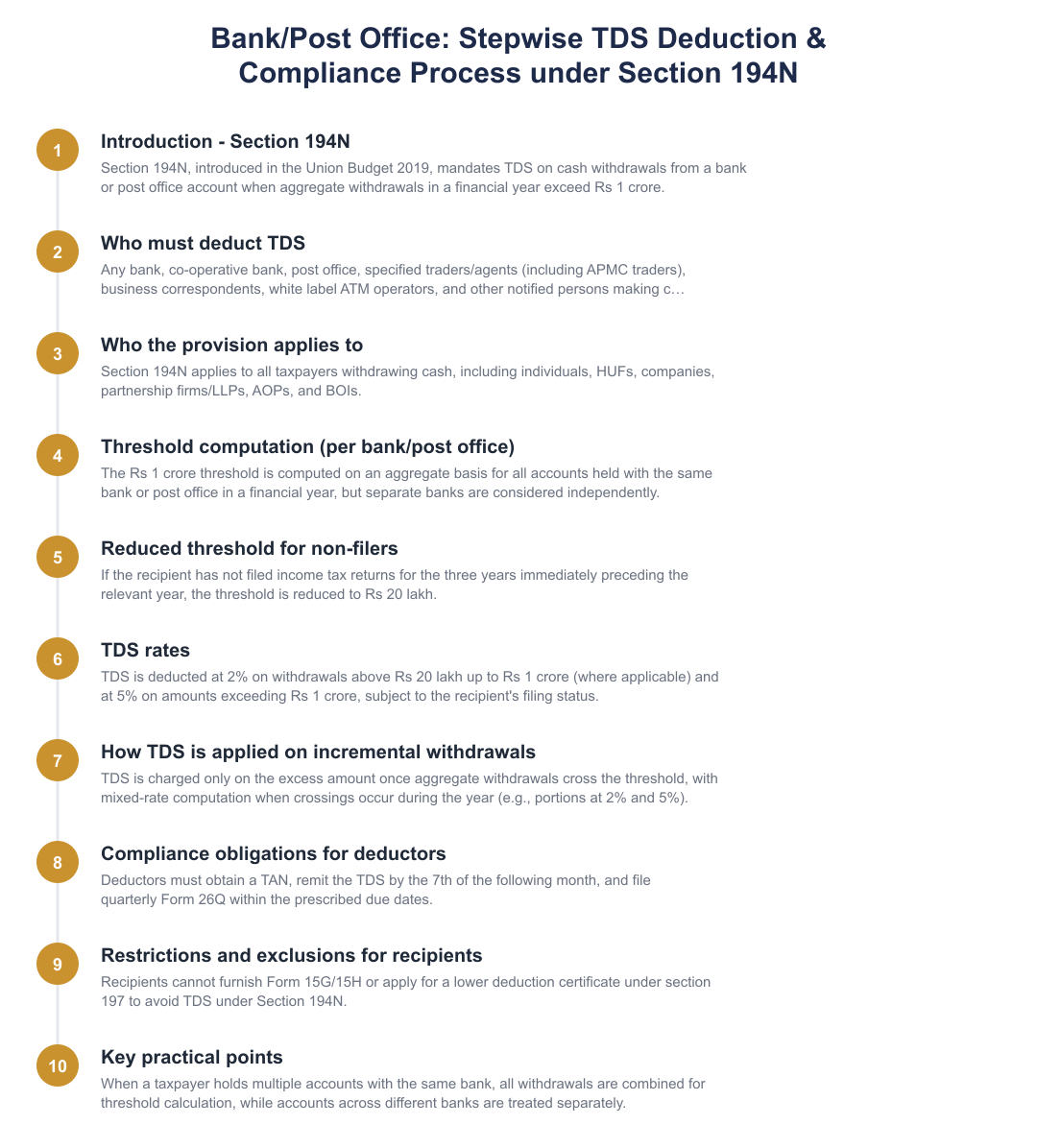
Any bank, cooperative bank, post office or other person making the cash payment (as notified by the government) is required to deduct TDS under Section 194N when the withdrawal threshold is crossed. This includes private/public sector banks, cooperative banks, post offices, business correspondents, white label ATM operators, APMC traders paying farmers (where notified), authorized dealers and notified money-changers, subject to specific notifications. The deductor must obtain a TAN, deduct TDS at the prescribed rate, deposit the tax by the 7th of the next month and file Form 26Q quarterly with the government.
Who is covered by Section 194N and who is exempt?
Section 194N covers withdrawals by any taxpayer, individuals, HUFs, companies, firms/LLPs, associations of persons or bodies of individuals, but does not apply to withdrawals made to or by certain exempt entities notified by the Government. Exempt categories include the Government, banks (including cooperative banks), post offices, business correspondents, white label ATM operators, certain APMC traders, authorized dealers/agents and RBI-licensed full‑fledged money changers, along with any other person the government notifies. Even where an entity is normally liable, specific notifications may carve out or include additional payers or payees, so check the relevant government notifications for final applicability.
What are the TDS rates under Section 194N and how does non-filing of returns affect them?
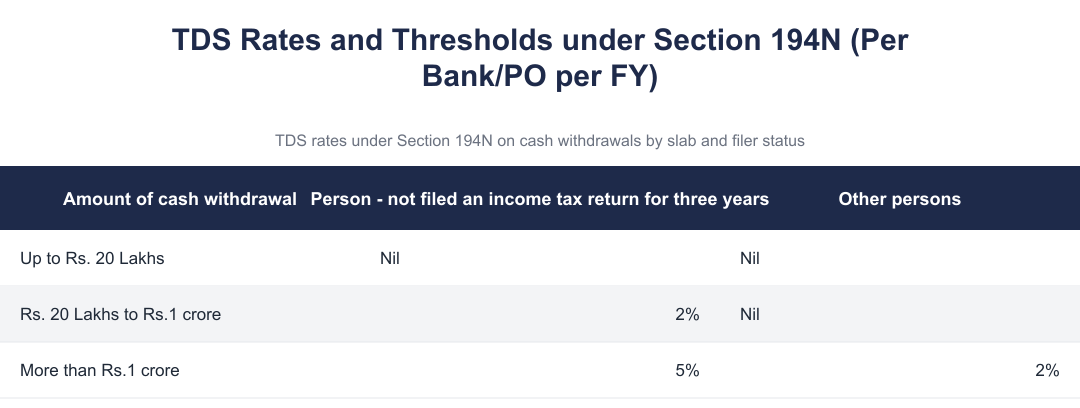
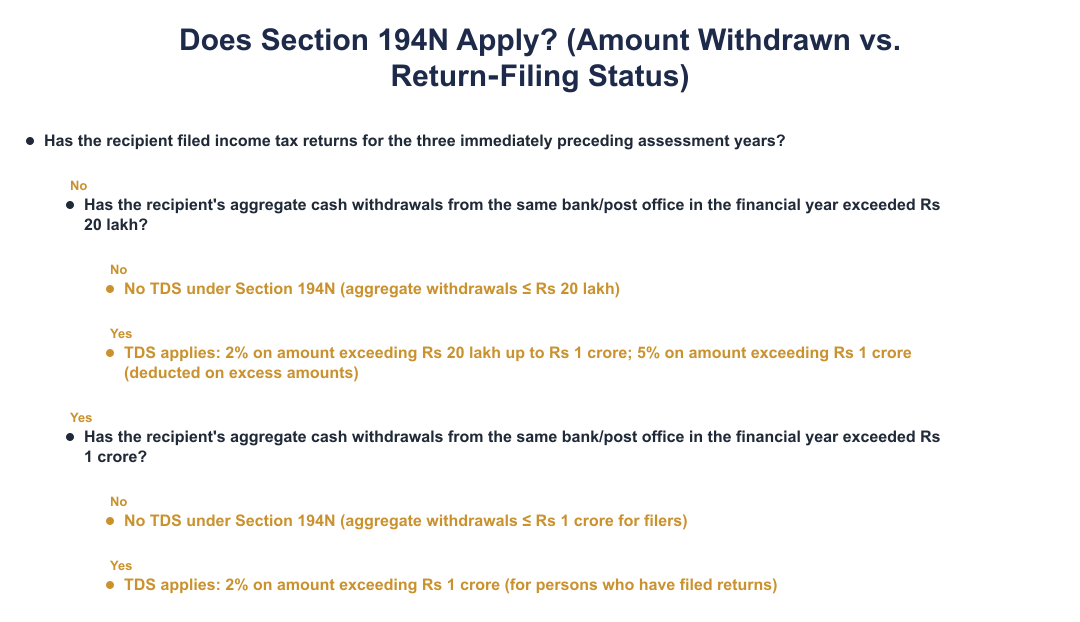
TDS under Section 194N is generally levied at 2% on aggregate cash withdrawals above Rs 20 lakh up to Rs 1 crore, and 5% on the amount exceeding Rs 1 crore; however, if the payee has not filed income-tax returns for the three immediately preceding years, the threshold lowers and rates change. For a person who hasn’t filed returns for the previous three years, withdrawals up to Rs 20 lakh are nil rated, withdrawals between Rs 20 lakh and Rs 1 crore attract 2% TDS, and amounts above Rs 1 crore attract 5% TDS. The non-filer status is determined by checking ITR filings for the three assessment years immediately preceding the relevant year, excluding a year where the due date for filing u/s 139(1) has not yet expired.
How do banks calculate the threshold limit for TDS under Section 194N across multiple accounts?
Banks calculate the threshold limit cumulatively across all accounts maintained by the same person with that particular bank, withdrawals from saving and current accounts at the same bank are aggregated to decide if the threshold is exceeded. The Rs 1 crore (or lowered Rs 20 lakh threshold for non‑filers) applies per bank/post office in a financial year, not per taxpayer across different banks; therefore, a person can withdraw up to Rs 1 crore from each bank without TDS if accounts are with different banks. Once the cumulative withdrawals at a specific bank exceed the threshold, TDS is deducted only on the excess amount withdrawn beyond the threshold, not on earlier withdrawals.
Can a payee submit Form 15G/15H or apply for a lower deduction certificate under Section 194N?
No, the recipient of cash cannot furnish Form 15G/15H and cannot obtain a certificate for lower deduction under section 197 to avoid TDS under Section 194N. The statute expressly disallows submission of 15G/15H and lower deduction certificates for cash withdrawal TDS, so the bank must deduct tax as per the law once the threshold is crossed regardless of the payee’s declaration. The payee may, however, claim any excess TDS deducted as a refund when filing his income-tax return if applicable.
What are the compliance steps banks must follow when deducting TDS under Section 194N?
Banks and other deductors must obtain a Tax Deduction and Collection Account Number (TAN), deduct TDS at the prescribed rates when the withdrawal threshold is exceeded, remit the deducted tax by the 7th day of the following month, and file Form 26Q quarterly within the statutory due dates. They must also issue required TDS certificates and report the particulars in their TDS returns so that the deducted tax reflects in the payee’s Form 26AS. Failure to comply with deposit and filing timelines can attract interest, penalties and disallowance of TDS credit for the payee until corrected.
Can you give a simple illustration of how TDS under Section 194N is computed during a financial year?
Yes, compute cumulative withdrawals from the same bank during the financial year and apply the rates only on the excess beyond thresholds: for example, if withdrawals total Rs 1.10 crore, the first Rs 1 crore is free of TDS (unless non-filer rules lower thresholds), the next Rs 10 lakh attracts 5% (i.e., Rs 50,000). Another example: if cumulative withdrawals are Rs 40 lakh and the person is a non-filer (three years no ITR), the first Rs 20 lakh is nil, the next Rs 20 lakh (up to Rs 1 crore) attracts 2% i.e., Rs 40,000. Where withdrawals cross both slabs, apply 2% on amounts between Rs 20 lakh–1 crore and 5% on amounts above Rs 1 crore, summing both components.
What should a taxpayer do if TDS under Section 194N is wrongly deducted or excess deducted?
If excess or incorrect TDS is deducted under Section 194N, the taxpayer should claim the excess as a refund by filing the income-tax return for the relevant assessment year and ensure the TDS shows in Form 26AS; where necessary, the payer (bank) can also correct TDS returns and issue revised certificates. The taxpayer should collect the TDS certificate from the deductor, check Form 26AS for credit, reconcile with bank statements showing withdrawals, and if paperwork or TDS details are incorrect request correction from the bank which can deposit and report the proper amount through revised filings. If the bank does not rectify, the taxpayer may raise a grievance with the bank, escalate to banking ombudsman, or approach income‑tax authorities for rectification and refund.
Need help staying TDS compliant?
MoneyGence's AI Finance OS tracks your compliance, wallet share, and finances in one place, built for agencies and growing businesses.
Get started with MoneyGence