Section 194M: TDS on Payments to Contractors & Professionals
This guide explains Section 194M of the Income-tax Act in clear, practice-oriented language so you can understand when and how TDS obligations arise on payments to resident contractors and professionals. You will learn which payments fall under the section in a broad sense, who it applies to, the precise moment when tax must be deducted, and practical compliance implications for businesses and payers. Knowing these points helps organisations avoid inadvertent non-compliance, interest or penalties, and supports correct bookkeeping and cash-flow planning. The guide also points out limits of scope, for example, who is outside this section, and helps you identify where to look for rates, deposit windows and certificates, which are determined by tax rules and notifications beyond this summary. Read on to get a clear procedural picture and to know which parts require confirmation from the Income Tax Department or a tax advisor.
What Is Section 194M?
Section 194M relates to deduction of tax at source on certain payments made to resident contractors and professionals. Conceptually, it places the onus on the payer to withhold tax when making payment for specified services or contracts, so that tax is collected at the point of payment rather than waiting for assessment.
Understanding whether a payment falls under this provision is important because the payer must account for and deposit the withheld tax with the government and typically issue the relevant TDS certificate to the payee. This affects cash flows for both payer and payee: the payer needs funds to deposit the TDS, and the payee receives a net amount after withholding which must be reflected in their books.
Reason For Introduction Of Section 194M
The general policy reason for such provisions is to improve tax collection efficiency and widen the tax base by ensuring tax is collected at source on payments that might otherwise be difficult to track. TDS provisions function as a mechanism to secure revenue and create a trail of transactions through which taxpayers’ receipts are documented.
For payers, the requirement to withhold tax encourages better record-keeping and compliance with tax rules. For payees, being subject to withholding can affect short-term liquidity but also ensures credits for taxes already paid when they file returns.
What Is Meaning Of ‘Work’, ‘Contract’, And ‘Professional Services’ In Section 194M?
In practice, terms like ‘work’, ‘contract’, and ‘professional services’ are used to delineate the kinds of payments that could attract withholding under this section. These terms are interpreted with reference to contractual relationships and the nature of services rendered, for example, supply of labour, execution of projects, or provision of professional expertise.
Because judicial decisions and notifications can refine these meanings over time, payers and payees should evaluate each payment against the specific statutory language and any official clarifications issued by tax authorities or consult a tax advisor to determine whether the payment falls within the ambit of Section 194M.
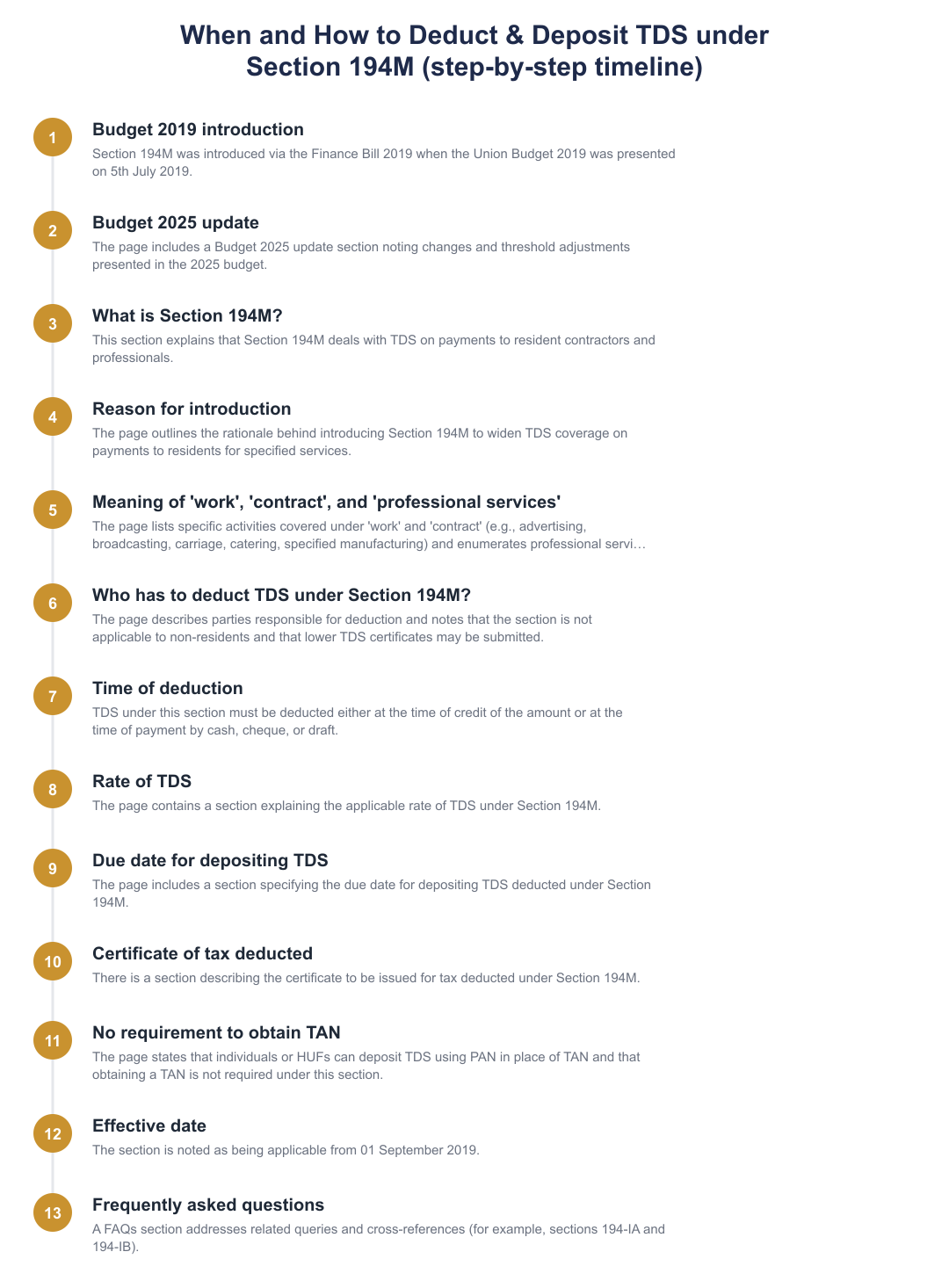
Time Of Deduction Section 194M
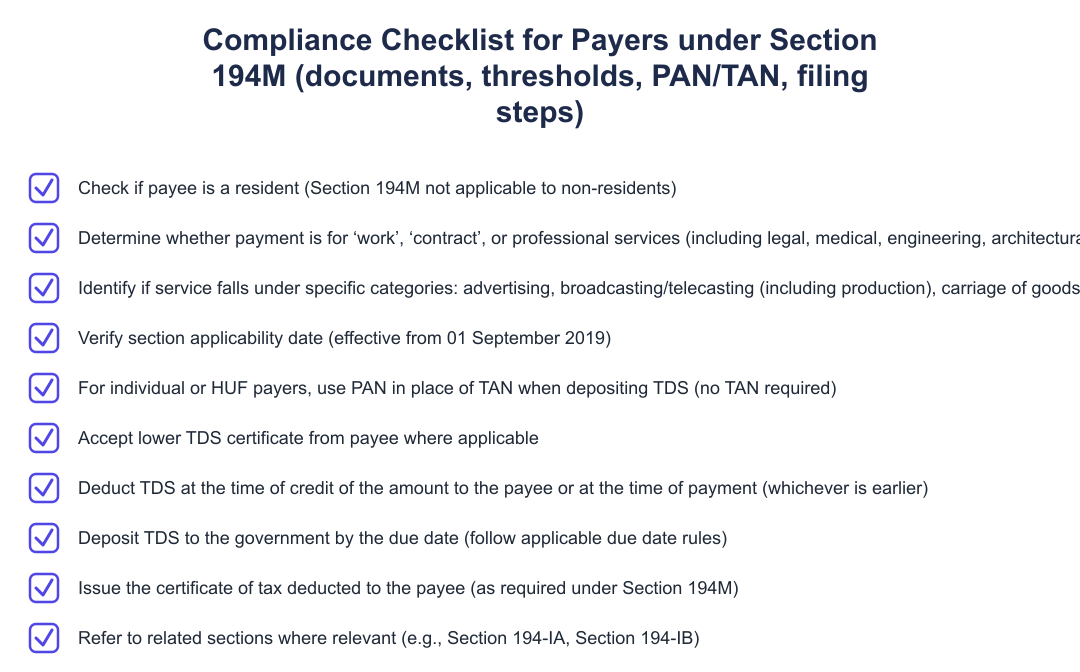
If the payer credits the payment to the account of the resident contractor or professional, tax must be deducted at that time.
If payment is made before crediting, by cash, cheque, or draft, tax must be deducted at the time of payment.
Who Has To Deduct TDS Section 194M?
Broadly, the person or entity making covered payments is responsible for deducting tax at source under Section 194M. That means the payer must be aware of its withholding obligations on any qualifying payments to residents.
This section does not apply to payments made to non-residents; it is limited to payments to resident contractors and professionals. Where cross-border elements are present, different TDS provisions or withholding rules may be relevant instead of Section 194M.
Rates, Due Dates and Certificates, Practical Notes
Section 194M requires the payer to deduct tax, but specific rates, due dates for depositing tax, and formats or timelines for issuing certificates are prescribed by the Income Tax Department and related rules. These operational details may change through notifications or budgetary updates, so it is important to consult the latest official circulars or a tax professional for current rates and timelines.
Practically, maintain clear records of amounts credited and payments made, the tax deducted, and the dates of deduction and deposit. This documentation will support correct filing, claiming of TDS credits by payees, and defence in case of enquiries or notices from tax authorities.
Section 194M places withholding responsibility on the payer for certain payments to resident contractors and professionals, and the precise moment of deduction is either on credit of the amount or on payment (including by cheque or draft). Because this section applies only to residents, cross-border payments will be governed by different rules. For rate, deposit deadlines and certificate procedures, check current official notifications or consult a tax advisor to ensure compliance.
Frequently asked questions
What is Section 194M and who does it apply to?
Section 194M is a TDS provision that requires certain resident individual or Hindu Undivided Family (HUF) payers to deduct tax when they make payments for contract work or professional services exceeding Rs 50,00,000 in a financial year. It applies only to resident payers who are individuals or HUFs and is not applicable to non-residents; the provision became effective from 1 September 2019. Where the payer is already required to deduct under sections 194C, 194H or 194J (because they carry on business/profession and exceed turnover limits), those earlier sections continue to apply and Section 194M targets payers who otherwise would not deduct TDS. A lower deduction certificate can be obtained to reduce or avoid deduction under this section subject to tax authorities' approval.
When must a payer deduct TDS under Section 194M, on credit or on payment?
Under Section 194M the payer must deduct TDS at the earlier of the time the amount is credited to the payee’s account or the time of payment (by cash, cheque or draft). This means if you credit the contractor or professional in your books before actually paying, you must deduct TDS at that credit date; similarly, if you pay before credit, deduction must be made on payment. The rule prevents deferral of TDS by timing payments, and applies every time cumulative payments in the financial year to that resident exceed the Rs 50,00,000 threshold. Keep records of credit and payment dates to determine the correct point of deduction and avoid interest or penalties for late deduction.
What payments are covered by Section 194M, what is meant by ‘work’, ‘contract’ and ‘professional services’?
Section 194M covers payments for 'work' (including advertising, broadcasting, carriage of goods and passengers except railways, catering and specified manufacturing under customer-supplied material), 'contract' (including sub-contracts) and 'professional services' (such as legal, medical, engineering, architectural, accountancy, technical consultancy, interior decoration and other notified services). In short, fees paid to residents for carrying out contractual work or providing professional services fall within the scope of Section 194M if payments to a payee exceed Rs 50,00,000 in a financial year. Certain specific activities are enumerated (for example advertising and catering) and the government may notify additional professional services, so check the exact activity against the list before applying TDS. The section does not extend to non-residents and does not cover insurance commission (which is governed separately).
Who is required to deduct TDS under Section 194M, are individuals and HUFs always liable?
Individuals and HUFs who make payments to resident contractors or professionals and whose total payments to a particular resident exceed Rs 50,00,000 in a financial year are required to deduct TDS under Section 194M. However, if the individual or HUF is already required to deduct under sections like 194C (contract), 194H (commission/brokerage) or 194J (professional fees) because they carry on business/profession and exceed prescribed turnover limits, those sections will apply instead and Section 194M is targeted at payers not otherwise covered. The provision is not applicable to non-resident payees and the threshold and deduction obligation are assessed on a per-payee, per-financial-year basis. Payers can also submit a certificate for lower deduction from the tax authorities to reduce or avoid deduction if eligible.
What is the rate of TDS under Section 194M and have there been changes recently?
The standard rate of TDS under Section 194M was introduced at 5% on the amount payable to the resident contractor or professional, but the rate has been proposed to be reduced to 2% with effect from 1 October 2024 for certain cases. The higher TDS rate provision (applicable in general tax law) will apply only where the payee fails to provide PAN; in such cases a higher rate may be charged. Always check the date of payment and the payee's PAN status because the applicable rate can differ (5% or reduced 2% for the specified period, and higher rates where PAN is not furnished).
Do I need a TAN to deposit TDS under Section 194M or can I use PAN?
You do not need to obtain a TAN to deposit TDS under Section 194M if you are an individual or HUF, the government has allowed deposit of TDS using PAN in place of TAN for these payers. This relaxation applies specifically to individuals and HUFs deducting under Section 194M, so you can quote your PAN while filing the TDS return and depositing tax. Despite this relaxation, you must comply with other TDS return filing and certificate issuance requirements and ensure accurate PAN details of the payee to avoid higher TDS rates or processing issues. If you are an entity other than an individual or HUF, normal TAN requirements continue to apply.
When and how do I provide a certificate for tax deducted under Section 194M to the payee?
After deducting tax under Section 194M you must issue a TDS certificate to the payee, the certificate of tax deducted should be provided in the prescribed form and timeframe as required by TDS rules. The payer needs to furnish the certificate containing deduction particulars so the payee can claim credit in their tax return; failure to provide the certificate can cause problems for the payee in claiming credit. The certificate issuance and the format follow standard TDS provisions (Form 16A or other specified formats) and must reflect PAN details and the date and amount of deduction; retain copies for compliance and audit purposes. If you deposited TDS using PAN in lieu of TAN (allowed for individuals/HUFs under 194M), ensure the certificate still contains correct PAN information to match the deposit.
Is Section 194M applicable to non-resident payees or insurance commission payments?
No, Section 194M is not applicable to non-resident payees and it does not cover insurance commission payments (insurance commission is governed by separate TDS provisions). Section 194M specifically targets payments to resident individuals for contractual work or professional services; non-residents are covered under other sections of the Income-tax Act relating to payments to non-residents. For insurance commission and other specially governed incomes, you should refer to the specific TDS sections like those dealing with insurance commission or non-resident taxation. Always verify the residential status of the payee before applying Section 194M to avoid incorrect deductions.
What are the consequences of not deducting or delaying deposit of TDS under Section 194M?
If you fail to deduct TDS under Section 194M or delay depositing the deducted tax, you may be liable for interest, penalties and disallowance consequences under the Income-tax Act. Interest for late deduction or late deposit and penal charges under relevant sections can apply, and the payee may face difficulty claiming credit for tax not properly deducted or deposited. To avoid liabilities, deduct at the prescribed time (earlier of credit or payment), deposit the tax within the due dates under TDS rules, and file the required TDS returns and certificates; maintain documentation showing dates and amounts to support compliance. If in doubt, obtain a lower deduction certificate from tax authorities before payment to legally reduce or avoid deduction.
Need help staying TDS compliant?
MoneyGence's AI Finance OS tracks your compliance, wallet share, and finances in one place, built for agencies and growing businesses.
Get started with MoneyGence