Section 143(2) Notice: How to Respond to Income Tax Scrutiny
This guide explains how to respond to an income tax scrutiny notice issued under Section 143(2). You will learn why such notices are issued, what the tax department looks for when selecting returns for scrutiny, practical steps you can take after receiving a notice, who can represent you, and the possible consequences of not responding properly. Responding correctly matters because scrutiny notices are triggered by data mismatches and high-value transactions identified through modern analytics; an appropriate and timely response helps avoid adverse outcomes such as assessments made on best judgment or higher tax and penalties. The guide draws on how notices are issued and communicated today, including the faceless assessment process and electronic delivery methods, and explains the interaction between notices under Section 143(2) and follow-up actions like requests for information under Section 142(1). Whether you are an individual taxpayer, a professional, or a business owner, this article will help you understand the scrutiny notice, what the assessing officer may expect, and the limited but important choices available to you on the tax portal.
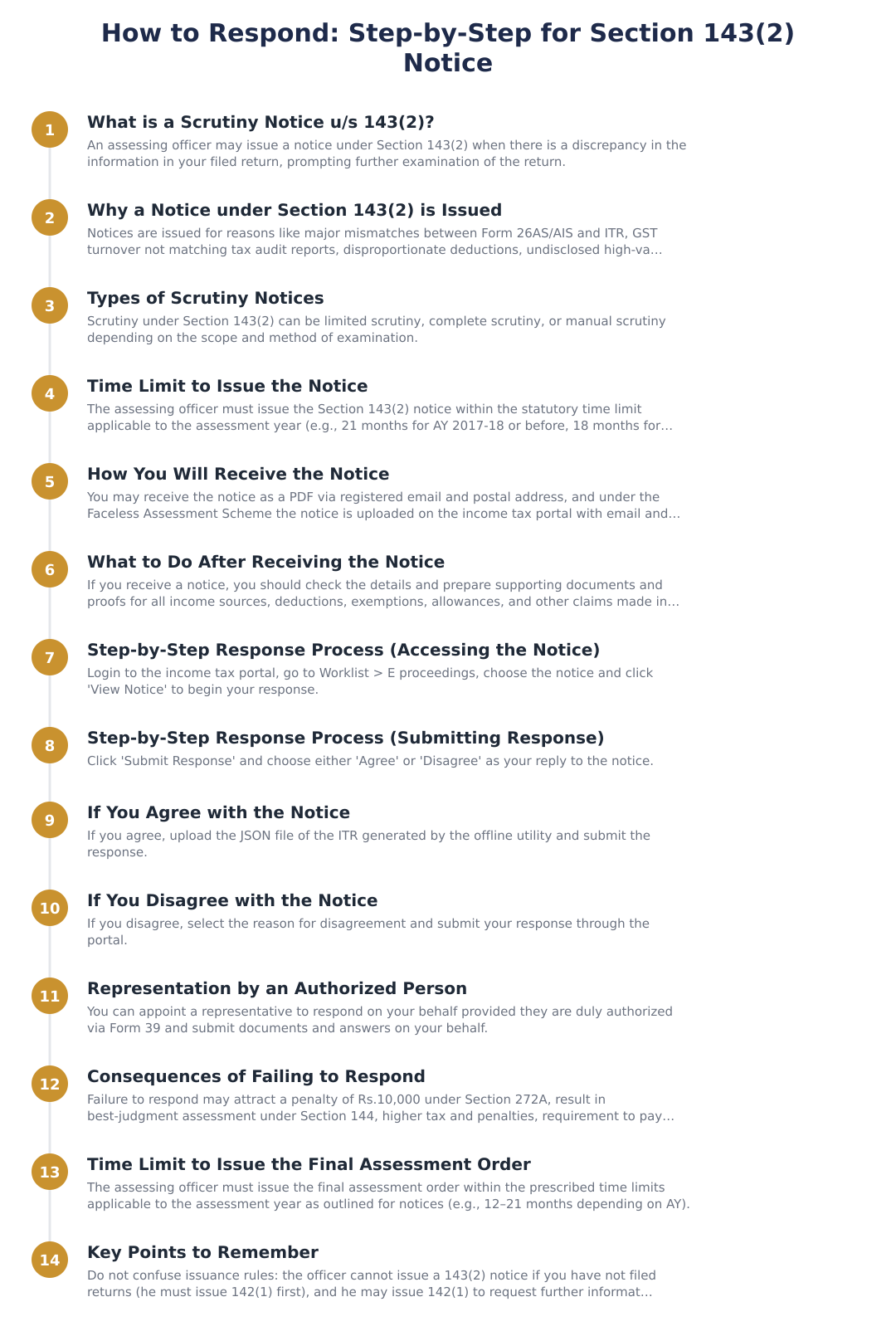
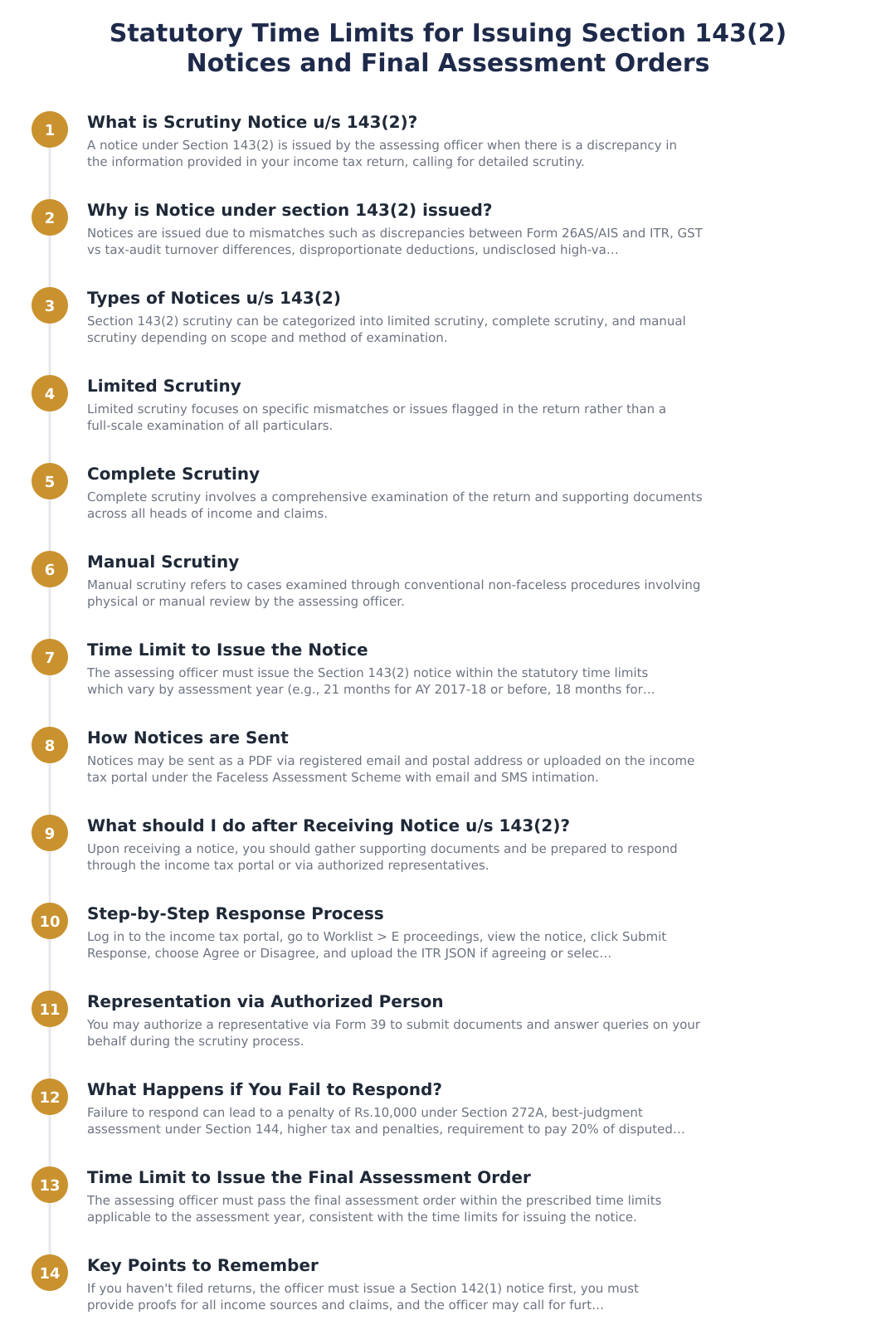
What is Scrutiny Notice u/s 143(2)?
A scrutiny notice under Section 143(2) is an official communication from the assessing officer indicating that your return has been selected for closer examination. Selection is not arbitrary; it is typically based on identified discrepancies between the information you filed and other data available with the tax department.
The department now uses advanced data analytics and artificial intelligence to flag suspicious returns for scrutiny. When these systems detect inconsistencies or unexplained items, the assessing officer issues the Section 143(2) notice to seek clarification and supporting evidence for the entries in your return.
Why is Notice under section 143(2) issued?
Notices under Section 143(2) are raised when there are specific discrepancies between the return and third‑party information. Common triggers include a major mismatch between Form 26AS (or AIS) and the ITR filed, claims of deductions that appear disproportionate to your reported income, or high‑value transactions shown in Form 26AS that do not appear in your return.
Another important trigger is non‑reporting of property sale transactions that are visible in registrar records but absent from the return. These data points prompt the assessing officer to ask for explanations and documentary proof to reconcile the differences before completing the assessment.
How notices are delivered and the faceless assessment route
You may receive a scrutiny notice as a PDF sent to your registered email address; a physical copy is also typically sent to the postal address on record. Under the Faceless Assessment Scheme, notices and related communications are uploaded on the income tax portal instead of being handled solely through local assessing officers.
When notices are uploaded on the portal, taxpayers receive intimations by email and SMS to their registered contact details. This digital-first approach aims to speed up communication and provide a centralised place to view and respond to notices.
Step-by-Step Response Process
Check your registered email and postal mail, and log in to the income tax portal to view the uploaded notice so you fully understand the discrepancies identified.
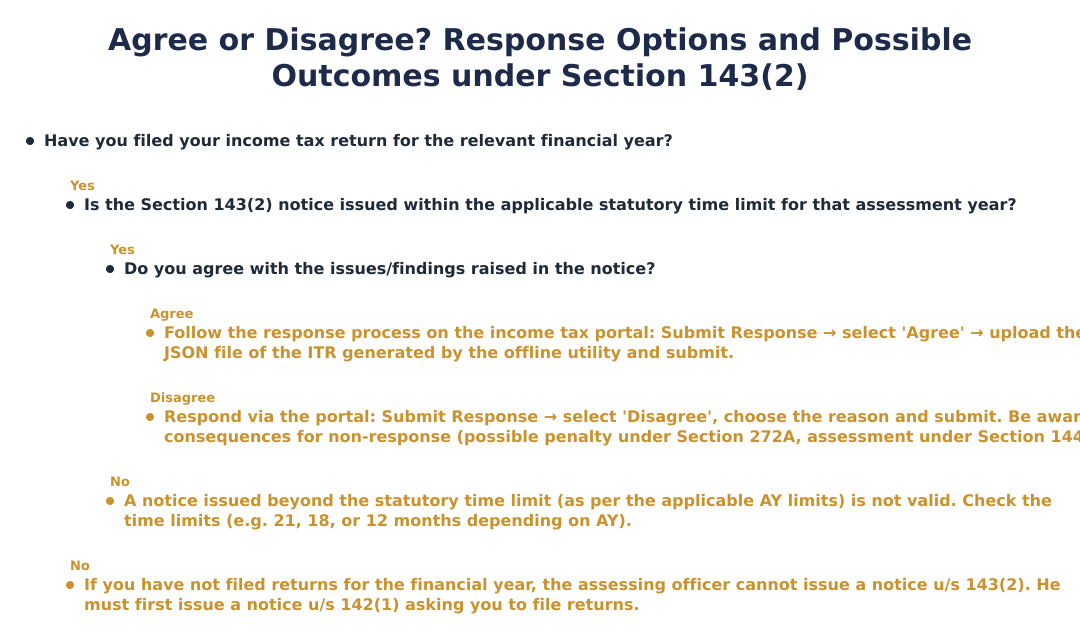
On the portal you can select whether you agree with the observations or disagree; if you disagree you must choose a reason and submit that response through the portal.
Compile documents that substantiate your return, such as bank statements, invoices, or property records, to address the specific discrepancies raised in the notice.
If you want someone else to act on your behalf, ensure they are duly authorised using Form 39 so they can submit documents and answer queries for you.
Upload the explanations and supporting documents via the portal in accordance with the options shown in the notice; the portal flow lets you submit your reasoned response electronically.
The assessing officer conducts a detailed enquiry during scrutiny assessment and may ask for additional clarification or documents after your initial reply.
What happens if you fail to respond?
Failure to respond to a Section 143(2) notice can have adverse consequences. The assessing officer can proceed on the basis of the information available and may assess a higher taxable income, which leads to increased tax and penalties.
In the absence of a satisfactory response, the officer also has the power to close the assessment using the best judgment under Section 144. These outcomes make it important to engage with the notice and provide clear documentary support or an authorised representative to respond on your behalf.
Interaction between Section 142(1) and Section 143(2)
For taxpayers who have already filed their return, the assessing officer may issue a notice under Section 142(1) calling for further information supporting the deductions, exemptions, allowances, reliefs and other claims made in the return. This step often supplements the scrutiny process initiated by Section 143(2).
The issuance of a 142(1) notice is part of the detailed enquiry: it allows the officer to request specific documents and clarifications that will aid in resolving the discrepancies flagged in the scrutiny notice.
A notice under Section 143(2) signals that the income tax department requires clarification on specific items in your return. Because notices are driven by data analytics and third‑party information, provide clear explanations and documentary proof, or authorise a representative via Form 39 to act for you. Use the income tax portal to view the notice and submit an agreement or reasoned disagreement with supporting evidence; failure to engage can lead to assessments under best judgment or higher tax and penalties. If unsure, consider professional help to prepare a focused, factual response.
Frequently asked questions
What is a scrutiny notice under Section 143(2) of the Income Tax Act?
A scrutiny notice under Section 143(2) is a formal notice from the assessing officer asking for a detailed examination of your filed income tax return due to detected discrepancies. It is issued when the department’s checks (like Form 26AS, AIS, GST data or property records) show mismatches, under‑reported income, excessive deductions or unexplained high‑value transactions, and it requires you to provide evidence or clarification. Receiving the notice does not mean guilt; it simply starts a detailed enquiry where you must submit supporting documents or explanations. The notice may be issued under the faceless assessment scheme (uploaded on the income tax portal) or sent by email/post to your registered contacts.
Why would the income tax department issue a notice under section 143(2) to me?
The department issues a notice under section 143(2) when it detects discrepancies or triggers in your return compared to third‑party data and analytics. Common triggers include mismatches between Form 26AS/AIS and your ITR, GST turnover not matching tax audit figures, disproportionate deductions relative to income, undisclosed high‑value transactions, or property sales not reported in the return. Modern analytics and data linkages have increased selections for scrutiny, so even small mismatches can prompt a notice. The notice seeks clarification and supporting evidence for the items flagged by the department.
What are the different types of scrutiny under Section 143(2)?
There are three main types: limited scrutiny, complete scrutiny, and manual scrutiny, each differing by scope and process. Limited scrutiny focuses only on specific issues listed in the notice (for example, a particular mismatch), complete scrutiny is a full, detailed examination of the whole return, and manual scrutiny is carried out physically (though most assessments now follow the faceless electronic process). Under the faceless assessment scheme, notices and responses are handled online, but the nature of scrutiny (limited or complete) determines how many documents and how detailed your replies must be. Knowing the type helps you decide whether to submit selective documents or the full set of records.
What is the time limit within which a notice under Section 143(2) can be issued?
A notice under Section 143(2) must generally be issued within three months from the end of the financial year in which the return was filed. For example, if you file a return on 31 July 2025 for financial year 2024‑25, the assessing officer can issue the 143(2) notice only up to 30 June 2026 because that is three months after the end of that financial year. This limit prevents indefinite issuance of scrutiny notices and is different from time limits for completing final assessment orders. The three‑month limit applies to the issuance of the notice, not to the subsequent assessment time limits.
What should I do immediately after receiving a Section 143(2) notice?
You should promptly log in to the income tax portal, view the notice, and prepare a structured response with supporting documents, because ignoring it can lead to penalties and adverse assessment. Under the faceless scheme the notice will appear in Worklist > E‑proceedings; click ‘View Notice’ then ‘Submit Response’ and choose ‘Agree’ (upload ITR JSON) or ‘Disagree’ (select reason and attach evidence). If you received a physical/PDF notice, mail or digital submission per the notice instructions is required; keep copies of all documents, reconcile Form 26AS/AIS and GST records, and be ready to furnish proofs for income, deductions and bank/property transactions. Timely and complete responses reduce the risk of a best‑judgment assessment under Section 144 or penalties such as Rs.10,000 under Section 272A for failure to respond.
What is the step‑by‑step process to respond to a 143(2) notice on the income tax portal?
To respond, first log in to the income tax portal, go to Worklist > E‑proceedings, open the notice and click ‘Submit Response’, then choose ‘Agree’ or ‘Disagree’ and upload the required files. If you select ‘Agree’, upload the JSON ITR file generated by the offline utility and submit; if you choose ‘Disagree’, select the reason for disagreement, attach supporting documents and submit your rebuttal. Keep digital copies of all documents you upload and note the submission reference/acknowledgement for future follow up. If you prefer representation, ensure your authorised representative is appointed via Form 39 before they act on your behalf.
What happens if I fail to respond to a 143(2) notice?
If you fail to respond to a 143(2) notice, the assessing officer may proceed to make an assessment under Section 144 using best judgment, you may face penalties up to Rs.10,000 under Section 272A for each failure, and you could be assessed for higher taxable income and tax demand. Non‑response can also force you to deposit at least 20% of the tax demand to pursue appeals, increase the risk of prosecution in serious cases, and lead to loss of legitimate deductions or reliefs you claimed. Therefore it is important to respond timely with supporting evidence or authorised representation to avoid these adverse consequences. Even if you disagree, a proper rebuttal reduces the likelihood of punitive outcomes and preserves appeal rights.
What are the time limits for the assessing officer to issue the final assessment order after a 143(2) notice?
The time limit to complete the final assessment after issuing a notice varies by assessment year: for AY 2017‑18 or earlier it is 21 months from the end of the assessment year, for AY 2018‑19 it is 18 months, and for AY 2019‑20 onwards it is 12 months. These limits mean the assessing officer must pass the final order within the specified months counted from the end of the assessment year to which the return relates, subject to statutory exceptions like prosecution or required approvals. If the officer misses this timeline, you may be able to question the validity of the belated order in appeals or writs, although exceptions sometimes apply. Keep copies of all notices and orders with dates to track and challenge any delay.
Can someone represent me before the assessing officer for a 143(2) notice and how?
Yes, you can appoint an authorised representative to act on your behalf by filing Form 39, which authorises them to submit documents and answer queries during proceedings. The authorised representative can upload responses, attend hearings (if any), and manage correspondence with the assessing officer provided Form 39 is duly signed and filed on the income tax portal or in the prescribed manner. Ensure you give clear instructions and share all relevant documents because the representative’s submissions bind you; keep a copy of Form 39 and any authorisation evidence for records. Using a qualified tax professional is common to ensure accurate replies and to avoid procedural mistakes that could lead to penalties.
Need help staying Income Tax compliant?
MoneyGence's AI Finance OS tracks your compliance, wallet share, and finances in one place, built for agencies and growing businesses.
Get started with MoneyGence