Section 123 Income Tax Act 2025: Deductions, Limit ₹1.5L & Schedule XV
This guide explains how the deduction provisions in the revised income-tax framework work, who is typically eligible, what kinds of investments and payments are usually covered under a dedicated deduction schedule, and practical steps to claim those deductions when filing returns. You will learn how to determine eligibility, the types of instruments commonly included in a government‑notified schedule of eligible investments, how these deductions interact with alternate tax regimes, and common filing mistakes to avoid. The aim is to give salaried taxpayers, professionals, business owners and HUFs a clear, practical roadmap for organising proofs, deciding whether to opt for a particular tax regime, and ensuring you claim allowable deductions correctly on your return. Because tax rules are regularly updated by the government, this guide focuses on the practical implications of claiming deduction(s) under a statutory schedule, what documents to collect, how to calculate aggregate eligible amounts in principle, and the filing steps you will likely follow, rather than quoting specific monetary thresholds or statutory cross‑references. Read on to get a structured, actionable understanding so you can prepare paperwork, make informed investment decisions for tax planning, and avoid common pitfalls when claiming deductions at year‑end.
What is the deduction provision in the revised Income Tax framework?
In many tax systems, the legislature groups certain incentivised savings, insurance and retirement investments under a dedicated deduction provision to encourage long‑term financial planning. That provision typically allows eligible taxpayers to reduce their taxable income by the aggregate amount invested in or paid towards specified instruments during the year, subject to limits and conditions defined in law.
Practically, such a provision acts as a policy tool: by offering a tax benefit for prescribed investments, the state nudges individuals toward savings, insurance cover and pension accumulation. For a taxpayer, it means that certain outflows, for example, premiums, specified deposits, contributions to notified pension products, or repayment of principal on housing loans, may reduce taxable income if they satisfy documentary and statutory requirements.
How the new provision generally differs from older deduction rules
When tax codes are updated, the new provision may reorganise which instruments qualify, alter documentation norms, or change whether the deduction is available under a particular tax regime. The intent behind such changes is usually simplification, alignment with policy objectives, or rationalising incentives across multiple products.
For taxpayers this can mean re‑evaluating their portfolio of tax‑saver investments. Even if the substance of the incentive remains similar, promoting savings and insurance, administrative changes can affect eligibility criteria, the treatment of employer contributions, or the year in which a claim can be made. Always check official notifications to confirm whether transitional rules apply when a new provision replaces an earlier one.
Who can typically claim the deduction?
Deduction provisions of this nature are commonly available to individual taxpayers and family entities recognised in the tax code, such as Hindu Undivided Families (HUFs). The aim is to provide relief to taxpayers who make prescribed investments or payments for themselves or specified family members.
Entities that are normally excluded include corporate entities, partnership firms, limited‑liability partnerships and collective bodies, because the policy objective is individual savings and social security rather than business expenses. That said, eligibility rules can vary in detail, for example, whether employers’ contributions count or whether a taxpayer can claim for investments made in family members’ accounts, so verify the statute and guidance for precise coverage.
What kinds of investments and payments are usually listed in the eligible schedule?
A government‑notified schedule that supports a tax deduction commonly includes long‑term savings instruments, life and pension products, certain notified fixed‑term deposits, public savings certificates, children’s savings schemes, and principal repayments on home loans. These instruments are chosen because they promote retirement security, home ownership, and long‑term savings behaviour.
In practical terms, the schedule will specify the nature of the instrument, any conditions (for example, lock‑in periods or limits tied to sums assured), and whether contributions for relatives qualify. When planning investments for tax purposes, consider both the financial suitability of the product and the documentary requirements needed to substantiate a claim under the schedule.
Interaction with alternative tax regimes
Many tax systems offer optional tax regimes with different rates and fewer deductions. When a taxpayer considers an alternate regime, the availability of deductions under the dedicated schedule is a crucial factor in the decision. If the deduction is not available under the alternative regime, the taxpayer should compare post‑tax liability under both regimes before deciding.
A practical approach is to estimate tax liability under each regime including the deduction benefit (where applicable), then choose the regime that results in the lower tax outgo while aligning with your long‑term financial objectives. Keep in mind that switching regimes may have procedural deadlines and consequences for subsequent years, so plan before filing.
How to claim the deduction while filing your income‑tax return
Decide whether you are filing under the regime that permits the deduction; if not available under an alternative regime, you must opt for the regime that allows such claims.
Gather receipts, account statements, premium certificates, loan principal certificates and other proof for each eligible instrument to substantiate the claim.
Add up all qualifying investments and payments in the relevant assessment year, applying any statutory caps or exclusions that the law prescribes.
Enter the total eligible deduction in the appropriate schedule/field of your income‑tax return and attach or retain supporting documents as required by the filing process.
Complete filing before the statutory due date and verify the return using the available verification methods to ensure timely processing.
Common mistakes to avoid
One frequent error is assuming that simply investing more will increase your tax deduction without checking whether the law caps the permissible claim or excludes certain amounts. Another is trying to claim the deduction under a tax regime that does not permit it.
Other common pitfalls include not retaining adequate proof, claiming contributions that are made by an employer rather than by the employee (when employer contributions are excluded), and claiming deductions in the wrong assessment year. Maintain organised records and reconcile amounts against Form 16 or payroll statements to reduce errors.
Frequently asked questions
Q: Can corporate entities claim this individual‑oriented deduction? A: Typically, no; such deductions are aimed at individuals and family units, not companies or firms. Check the legislation to confirm excluded entities.
Q: Do I need to submit proofs at the time of filing? A: Filing systems may not require uploading every document, but you should retain original receipts and certificates, as the tax authority or your employer might request them later for verification.
To claim deductions under any statutory schedule effectively, understand who is eligible, which instruments are covered, and how the deduction interacts with different tax regimes. Keep complete documentary evidence, compute totals carefully with reference to statutory conditions, and choose the tax regime that yields the best after‑tax outcome. For precise numeric limits, section references and current procedural details, consult the latest official notifications or a tax professional before filing.
Frequently asked questions
What is Section 123 of the Income Tax Act, 2025?
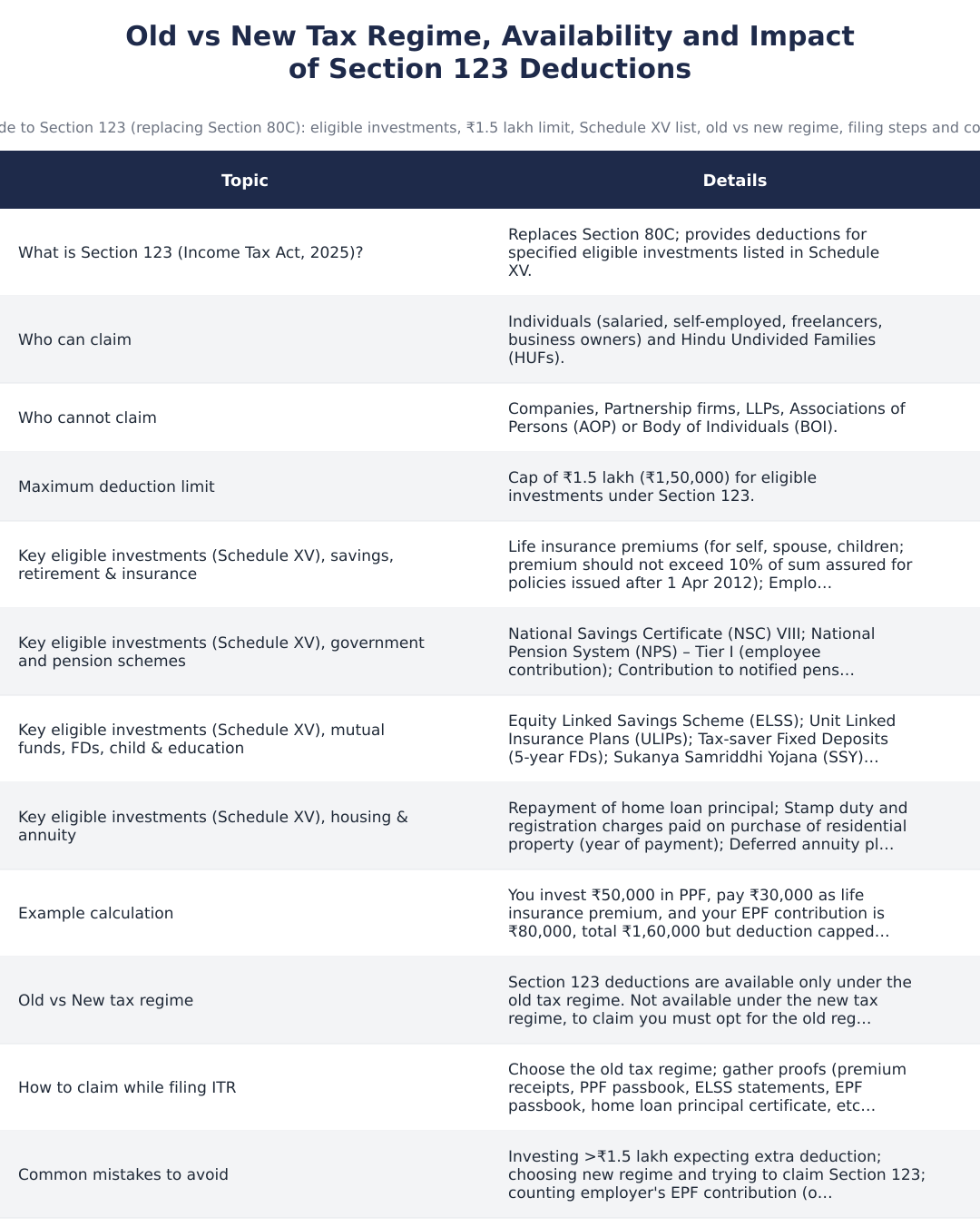
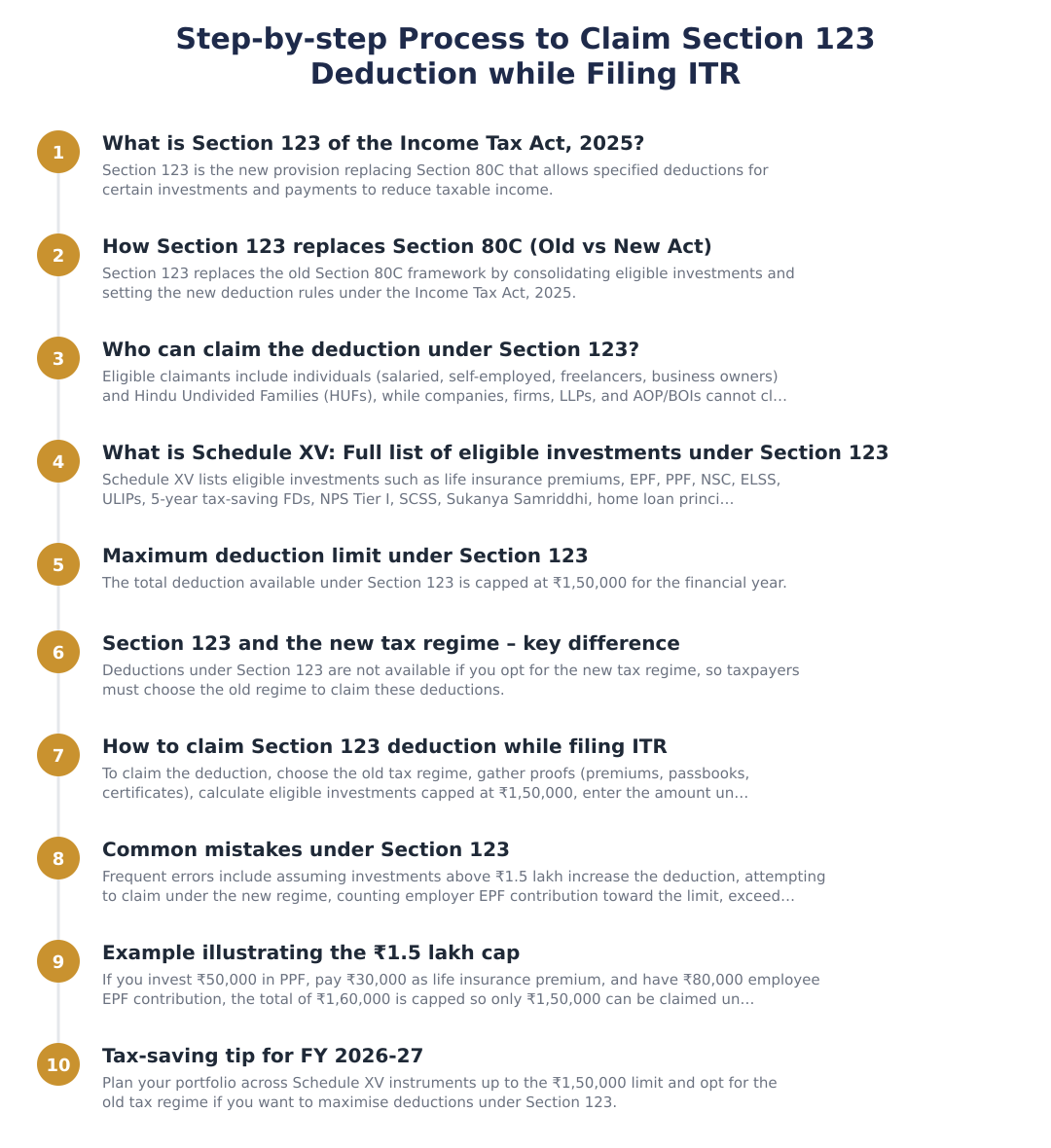
Section 123 is a deduction provision that allows individual taxpayers and Hindu Undivided Families (HUFs) to claim up to ₹1,50,000 per tax year on specified investments and payments listed in Schedule XV. It replaced the earlier Section 80C and is effective from 1 April 2026 for the tax year 2026-27 onward. The deduction covers a broad list of instruments such as PPF, EPF (employee contribution), life insurance premiums, ELSS, NSC, home loan principal repayment and certain pension and savings schemes. Only payments/investments made during the relevant financial year qualify and documentation like receipts or passbooks should be kept as proof.
Who is eligible to claim deduction under Section 123?
Individuals (including salaried, self-employed and freelancers) and Hindu Undivided Families (HUFs) are eligible to claim the Section 123 deduction. Corporate entities such as companies, partnership firms, LLPs, AOPs or BOIs are not eligible for this deduction. Note that Section 123 deductions can be claimed only if you opt for the old tax regime; taxpayers who choose the new tax regime under Section 202 cannot claim Section 123. If eligible, you must ensure the investments/payments are made in the taxpayer’s name (or spouse/children where specified) to qualify.
What is the maximum deduction limit under Section 123?
The maximum deduction limit under Section 123 is ₹1,50,000 in a financial year. All eligible investments and payments listed under Schedule XV are aggregated and the total eligible amount is capped at ₹1.5 lakh; investing more than this limit does not increase your deduction. For example, if you invest ₹50,000 in PPF, pay ₹30,000 as life insurance premium and contribute ₹80,000 to your EPF (employee share), the total of ₹1,60,000 will be restricted to ₹1,50,000 as the deductible amount. Remember employer contributions to EPF are not included in this cap, only your own employee contribution counts.
What kinds of investments and payments are included in Schedule XV under Section 123?
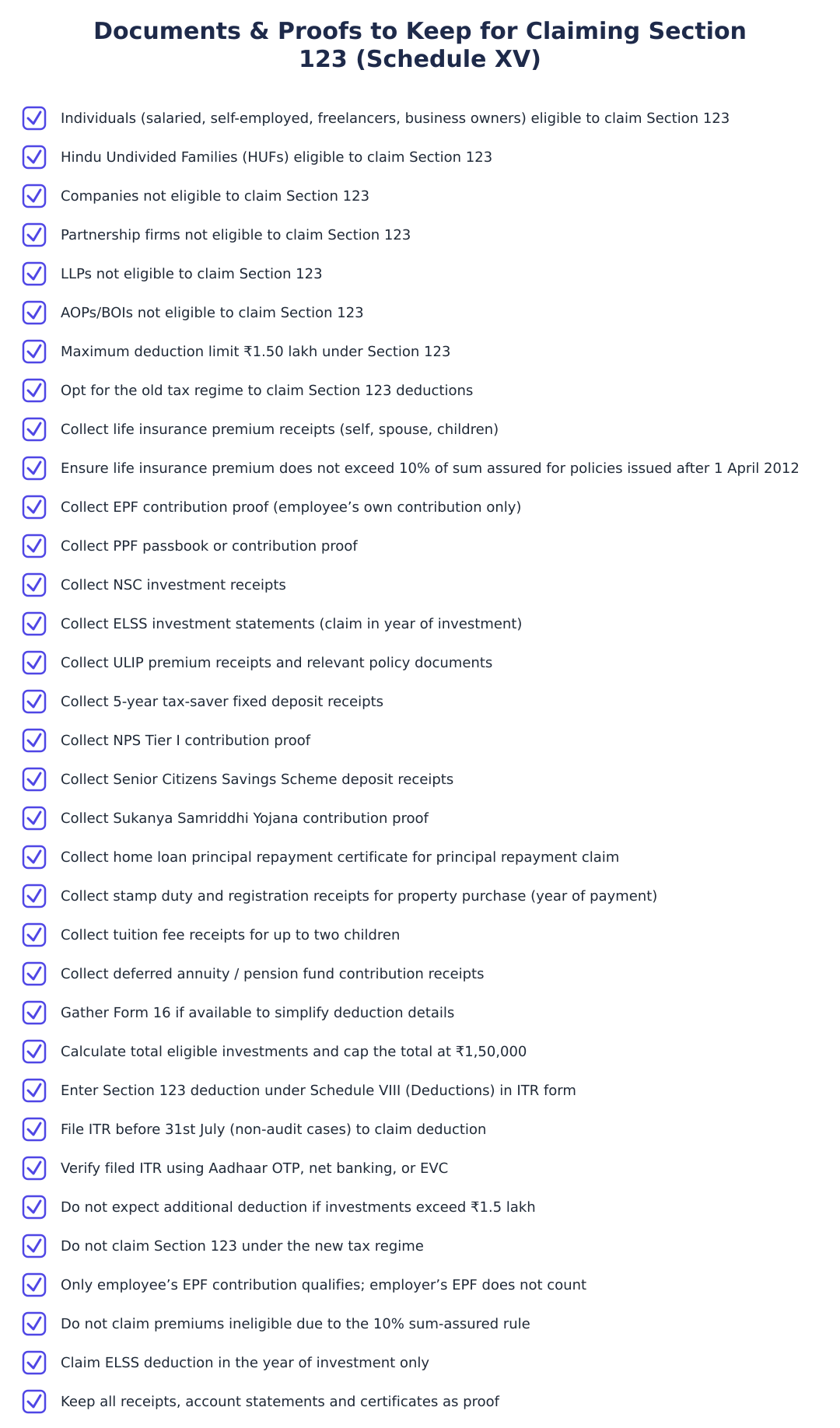
Schedule XV lists specific eligible instruments such as life insurance premiums (for self, spouse, children subject to limits), employee contribution to EPF, Public Provident Fund (PPF), National Savings Certificate (NSC), ELSS mutual funds, ULIPs, 5-year tax-saving fixed deposits, NPS Tier I contributions, Senior Citizens Savings Scheme (SCSS), Sukanya Samriddhi Yojana (SSY), repayment of home loan principal, stamp duty and registration charges on purchase of residential property, tuition fees for up to two children, deferred annuity plans and contributions to notified pension funds. Some items have conditions, for example, life insurance premiums for policies issued after 1 April 2012 are eligible only up to 10% of the sum assured, and ELSS investments have a 3-year lock-in. Use the year of actual investment/payment to claim the deduction; redemption or later events do not change the year of claim.
How does Section 123 differ between the old and new tax regimes?
Section 123 deductions are available only under the old tax regime and are not allowed if you opt for the new tax regime under Section 202 of the Income Tax Act, 2025. That means to claim the ₹1.5 lakh deduction under Schedule XV you must choose the old regime at the time of filing your Income Tax Return. The new tax regime provides lower tax rates with fewer deductions and exemptions, so taxpayers need to compute tax both ways to decide which regime is more beneficial before filing. Once you select the regime for the year (and if not eligible to switch mid-year as per rules), you must follow its deduction allowances accordingly.
How do I claim Section 123 deduction while filing my ITR?
To claim Section 123, opt for the old tax regime while filing your ITR, add up eligible investments/payments and enter the deduction amount (capped at ₹1,50,000) under the Deductions schedule (Schedule VIII or the relevant deductions section) of the ITR form. Gather documentary proof such as PPF passbook, life insurance receipts, ELSS statements, EPF contribution details or home loan principal certificate, these may be required by your employer for Form 16 or by the Income Tax Department during scrutiny. File the ITR before the due date (generally 31 July for non-audit cases) and verify it using Aadhaar OTP, net banking or EVC; keep the supporting documents safely for at least the statutory period in case notices arrive.
What are the common mistakes taxpayers make under Section 123 and how to avoid them?
Common mistakes include investing more than the ₹1.5 lakh limit expecting extra deduction, trying to claim Section 123 while on the new tax regime, including employer EPF contribution when only the employee's share qualifies, and paying life insurance premiums exceeding 10% of sum assured (for policies issued after 1 April 2012). Taxpayers also sometimes claim ELSS in the wrong year, the deduction is available only in the year of investment, not on redemption. Avoid these errors by totaling investments correctly, choosing the old regime if you want the deduction, retaining proofs (receipts, passbooks, certificates) and checking instrument-specific conditions before claiming.
Can you give a simple example showing how Section 123 deduction is calculated?
Yes, the Section 123 deduction is the total of eligible investments/payments in Schedule XV capped at ₹1,50,000 for the financial year. For example, if you invest ₹50,000 in PPF, pay ₹30,000 as life insurance premium and contribute ₹80,000 as employee EPF, the aggregate is ₹1,60,000 but the deductible amount allowed under Section 123 will be limited to ₹1,50,000. Only your employee EPF contribution counts (not the employer's), and each item must meet its specific eligibility conditions (such as premium limits or lock-ins) to be included in the total.
Need help staying Income Tax compliant?
MoneyGence's AI Finance OS tracks your compliance, wallet share, and finances in one place, built for agencies and growing businesses.
Get started with MoneyGence