Secretarial Audit Guide India: Process, Duties & Compliance (PCS)
Secretarial audit is a specialised compliance exercise that examines whether a company has followed applicable corporate laws, rules, procedures and good governance practices. For company managements and practising company secretaries, understanding the scope and practical elements of a secretarial audit matters because it helps identify compliance gaps, strengthens internal controls, and enhances stakeholder confidence. This guide explains what a secretarial audit covers in practical terms, what a practising company secretary should prepare before taking up an assignment, how to plan and carry out the audit efficiently, what documentation to retain as audit evidence, and how to prepare a clear, defensible audit report. You will learn how to structure the audit work, from scoping and risk assessment to sample selection and verification, and how to maintain professional conduct and independence throughout. The guide also outlines pragmatic methods for interacting with management and in-house legal or compliance teams, handling documentation and third-party verifications, and preparing audit working papers that support conclusions. Whether you are a company secretary in practice taking on new clients or an in-house compliance officer coordinating the audit, this guide gives practical, process-oriented advice to make the secretarial audit actionable and useful for governance, not just a compliance exercise.
What a Secretarial Audit Covers (Conceptual)
A secretarial audit is focused on verifying compliance with the set of corporate and regulatory requirements that apply to a company and its governance processes. Rather than being a line-by-line legal opinion, the audit evaluates whether systems, processes and filings are in place and operating effectively to meet the company’s statutory obligations. It looks at corporate governance practices, board procedures, registers and minutes maintenance, statutory filings, and other areas where procedural compliance affects legal standing and stakeholder trust.
The objective is to provide an independent check on whether the company is maintaining necessary records and following internal procedures that ensure lawful conduct. The auditor assesses adequacy of internal controls over compliance, identifies areas of potential risk or repeated non-compliance, and recommends remedial measures. The output should help management prioritise corrective actions and strengthen governance frameworks going forward.
Role and Professional Responsibilities of the Practising Company Secretary
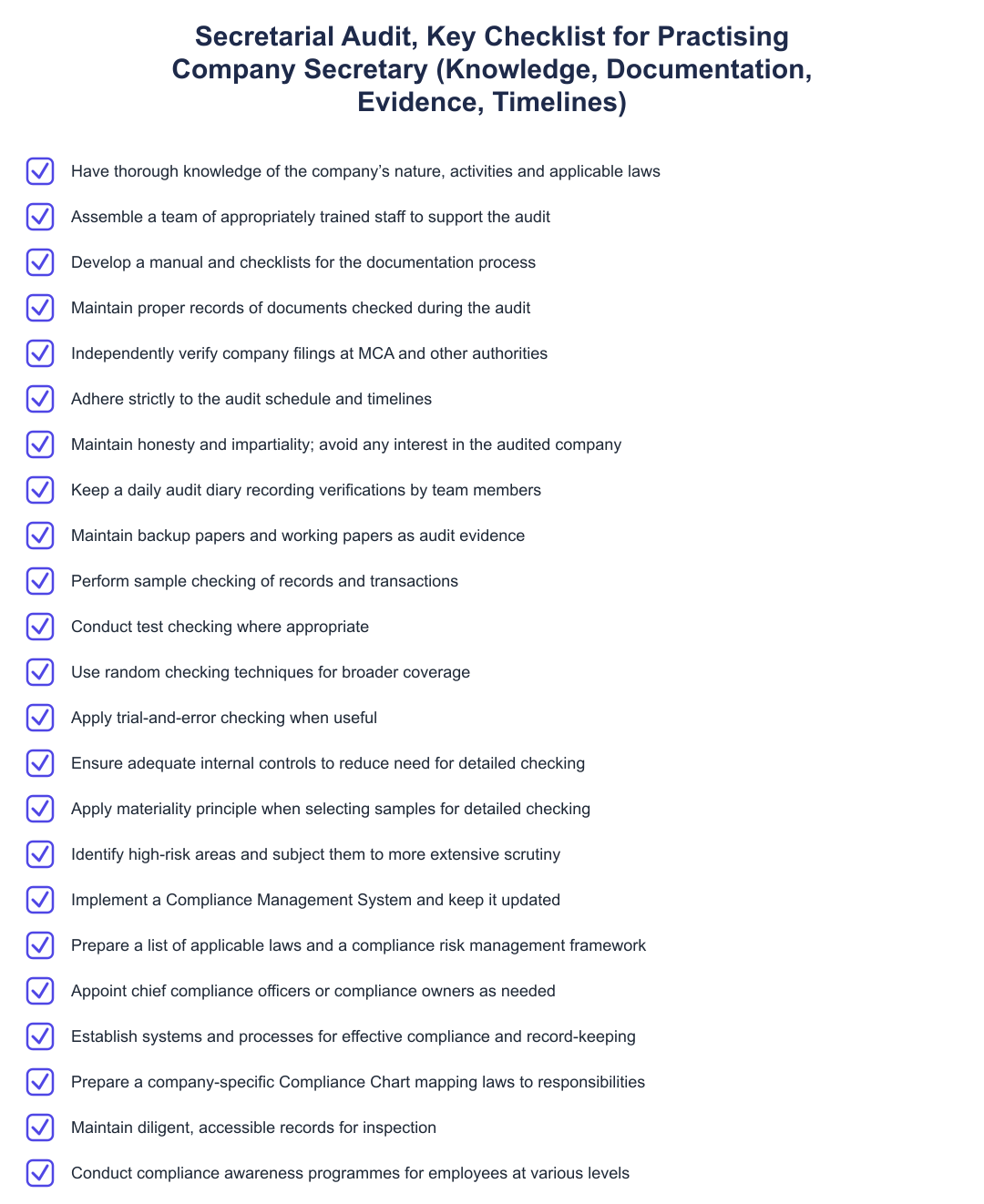
A practising company secretary undertaking a secretarial audit must approach the assignment with objectivity, professional scepticism and independence. Their role is to examine evidence, test processes and report findings transparently while avoiding conflicts of interest. This includes ensuring the engagement letter clearly defines scope, deliverables, timelines and responsibilities of both auditor and client.
Practitioners must build a capable team with suitable skills and allocate tasks so that specialised areas (like regulatory filings, board governance, or sector-specific compliances) are handled by staff with the right knowledge. Maintaining professional ethics, keeping client confidentiality, and documenting the basis for all conclusions are integral to a defensible and high-quality audit.
Planning and Execution of the Audit
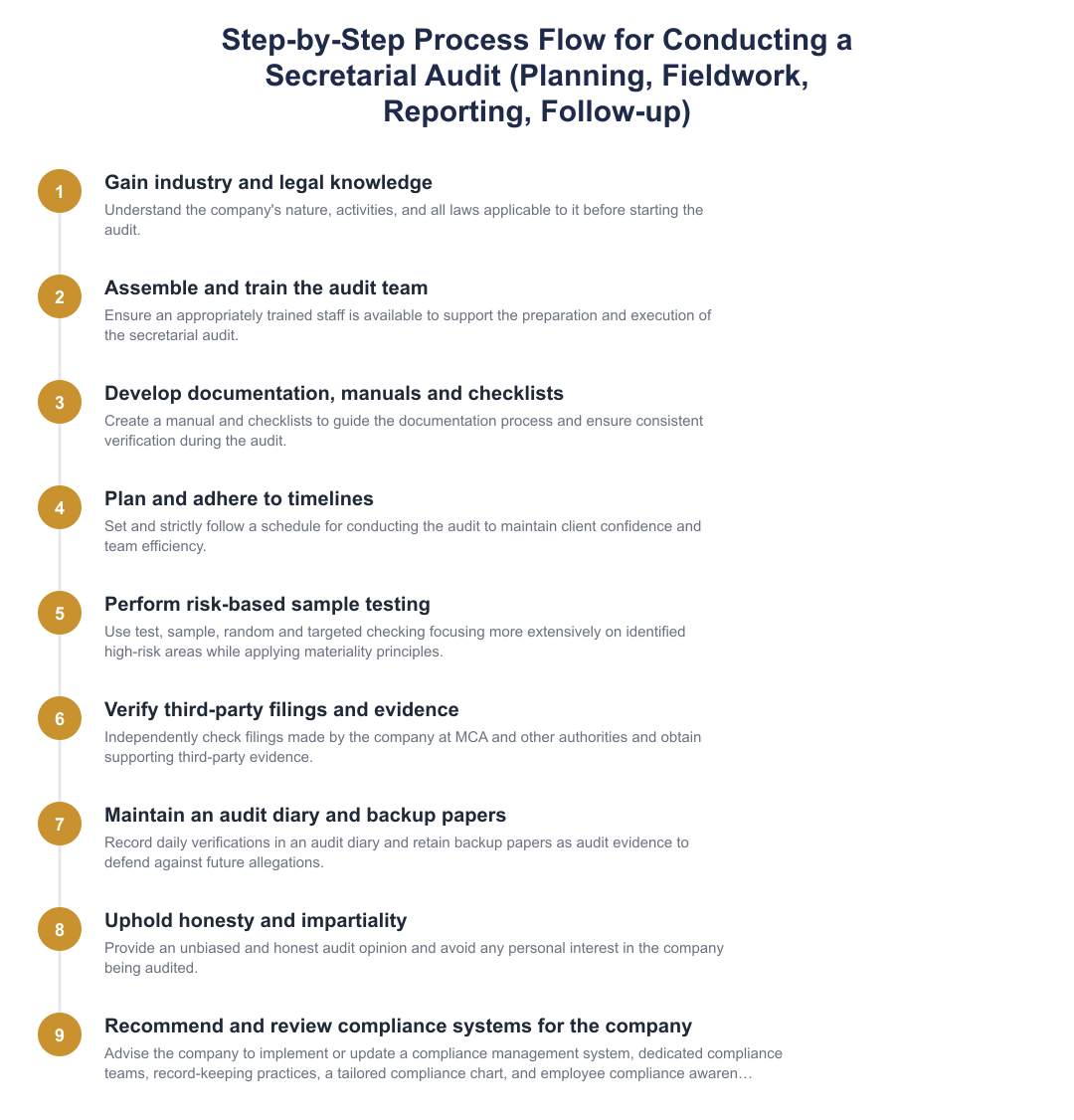
Effective planning begins with scoping: understand the company’s business activities, identify applicable compliance domains, and map the critical processes and timelines. A risk-based approach helps concentrate verification on higher-risk areas, while reducing time spent on routine items where controls are strong. Planning should set out sample sizes for transactional testing, timeline for on-site work, and responsibility matrix for the audit team.
Execution involves a mix of document review, sample testing and independent verification. Maintain an audit diary or workpapers recording every verification, the documents inspected, the personnel interviewed and the conclusions reached. Where third-party confirmations or regulatory portal checks are useful, the auditor should note these in workpapers as corroborative evidence. Test-checking, sample-checking and targeted substantive checks are practical techniques to obtain reasonable assurance within available time.
Documentation, Evidence and Working Papers
Good documentation is the backbone of a secretarial audit. Keep a structured set of working papers that link factual evidence to each assertion in the audit: checklists of statute-wise compliance, copies or extracts of filings, minutes, registers, correspondence and confirmations obtained during the audit. An indexed workpaper system saves time during reviews and provides a ready defence if findings are challenged.
The auditor should also retain an audit diary recording daily activities and observations, and record any limitations or scope restrictions encountered. Where sampling is used, document the sampling method and rationale so that reviewers can understand why those items were chosen and how they represent the population. Clear cross-references between the audit report, findings and supporting documents make the output transparent and actionable for management.
Reporting, Follow-up and Practical Best Practices
The audit report should be structured, highlighting the scope, methodology, key findings, areas of non-compliance, and practical recommendations for remediation. Separate matters of material concern from procedural observations, and where appropriate, suggest timelines and responsible owners for corrective actions. Clear presentation helps boards and management prioritise responses and reduces ambiguity about required steps.
Beyond the report, good practice includes discussing draft findings with management to ensure factual accuracy and to understand any remedial steps already in progress. Establish a follow-up mechanism so that the auditor can assess whether recommendations have been implemented. Maintaining independence, documenting all interactions, and preserving backup papers will protect the practitioner and add credibility to the process.
A well-executed secretarial audit adds value by strengthening compliance frameworks, improving governance practices and reducing legal and regulatory risk. For practising company secretaries, rigorous planning, disciplined documentation and clear reporting are the pillars of a defensible and useful audit. For companies, treating the audit as a tool for continuous improvement rather than a one-time checklist will yield better internal controls and greater stakeholder confidence over time.
Frequently asked questions
What is a secretarial audit and who must get it done?
A secretarial audit is an independent verification of a company's compliance with applicable laws, rules, and regulations, carried out by a Practising Company Secretary (PCS). It is mandatory for certain classes of companies under the Companies Act (for example, listed companies and those meeting prescribed thresholds), and is useful for others to demonstrate governance and regulatory compliance. The audit examines records, filings (including MCA filings), minutes, statutory registers and compliance systems, and results in a Secretarial Audit Report that highlights non-compliances, risks and recommendations. Companies should check the specific thresholds and statutory provisions to determine if they are required to appoint a PCS for this audit.
What are the main duties of a Practising Company Secretary during a secretarial audit?
The PCS must plan and perform the audit with professional independence, honesty and impartiality while documenting verifications and maintaining backup papers. Duties include gaining knowledge of the company’s activities and applicable laws, assembling a trained support team, developing manuals and checklists, checking MCA and other statutory filings independently, maintaining an audit diary and preserving supporting evidence. The PCS should adhere to audit timelines, ensure sample and risk-based checks, and record findings and recommendations in the Secretarial Audit Report for the board and stakeholders.
How should a secretarial auditor plan sampling and checking during the audit?
A secretarial auditor should use a risk-based approach combining sample checking, test checking, random checking and targeted checks for high-risk areas rather than exhaustively checking every transaction. The auditor should consider the company’s internal controls and materiality when choosing samples, increasing scrutiny where controls are weak or risks are high, and reducing detailed checks where robust controls exist. Properly representative samples, documented rationale and more extensive checks for high-risk processes ensure efficient yet effective coverage and defensible conclusions.
What documentation and evidence should be maintained during a secretarial audit?
The secretarial auditor should maintain an audit diary, backup papers, copies of documents inspected, checklists, and independent verification evidence such as MCA filings and correspondence. These records serve as audit evidence to support findings and to defend the auditor in case of future allegations of misconduct. Documentation should be organised by audit area, dated, and signed-off by the responsible team member to ensure traceability and reliability of the audit trail.
What is a compliance programme and how does it relate to secretarial audit?
A compliance programme is an organised system that lists applicable laws, defines compliance objectives, sets up a compliance risk management framework, assigns ownership and establishes processes for monitoring and reporting. During a secretarial audit, the auditor reviews the company’s compliance programme to evaluate whether laws are identified, responsibilities are allocated (such as a chief compliance officer), processes are documented, and compliance awareness exists across the organisation. A robust compliance programme reduces the need for detailed transactional checks and demonstrates proactive governance to stakeholders and regulators.
How should companies prepare for a secretarial audit to make it efficient?
Companies should prepare by maintaining accurate records and statutory registers, implementing a compliance chart, forming a dedicated compliance team, and making documents readily accessible for inspection. Conducting internal compliance reviews, organizing compliance awareness programmes, and ensuring timely MCA and other statutory filings will speed up the auditor’s verification and reduce findings. Providing an organised set of documents, a point of contact, and access to internal policies and minutes helps the PCS complete the audit within the scheduled timelines.
What are examples of high-risk areas a secretarial auditor focuses on?
High-risk areas include non-compliance with statutory filings (MCA and regulator filings), corporate governance failures (board minutes, related-party transactions), deficiencies in internal controls, non-maintenance of statutory registers, and breaches under sector-specific laws. The auditor will subject these areas to more extensive scrutiny, larger sample sizes or full verification depending on materiality and risk. Identifying and documenting weaknesses in these areas allows the auditor to provide targeted recommendations to the board for remediation and improved compliance.
What should be included in the Secretarial Audit Report issued by the PCS?
The Secretarial Audit Report should state the scope of the audit, the laws examined, methodology (including sampling approach), key findings of non-compliance, risk areas, supporting observations and specific recommendations for corrective action. It must also include the auditor’s opinion on the company’s compliance status, relevant documentary evidence relied upon (such as MCA filings), and annexures like checklists or schedules of non-compliances. The report should be factual, balanced, and provide sufficient detail for the board and regulators to understand issues and track remediation.
What professional conduct and timelines must a secretarial auditor adhere to?
A secretarial auditor must act with honesty, impartiality and professional competence, avoiding any interest in the audited company, and must adhere strictly to scheduled timelines for planning, fieldwork and reporting. Timely completion and delivery of the audit report builds client confidence and enables the board to act on recommendations; delayed audits can undermine compliance efforts and may attract regulatory scrutiny. The PCS is expected to have trained staff, documented procedures, and an audit schedule to ensure audits are completed within agreed timeframes while maintaining quality and adequate documentation.
Need help staying Compliance compliant?
MoneyGence's AI Finance OS tracks your compliance, wallet share, and finances in one place, built for agencies and growing businesses.
Get started with MoneyGence