ROC Compliance Calendar 2025-2026 - Key ROC Filing Dates
This guide explains how to approach ROC (Registrar of Companies) compliance for the 2025–2026 year and what a practical compliance calendar should cover. You will learn which recurring compliance areas every company or LLP must track, how to sequence routine filings through the financial year, and how to set up systems so deadlines are not missed. The goal is to help company secretaries, finance teams, founders and small-business owners convert statutory requirements into a simple, repeatable calendar that reduces the risk of late filings and costly follow-up actions. Because ROC compliance involves multiple return types, board-level events, and statutory records, a compliance calendar is indispensable: it turns scattered obligations into a manageable timetable, helps prioritise work around annual general meetings and board meetings, and makes it easier to coordinate auditors, statutory advisors and registrars. This guide does not list specific filing dates or form codes; instead it focuses on the compliance categories you must track, the sequence of activities through a financial year, practical steps to build a calendar and common questions companies ask when planning ROC compliance for a new compliance year.
What ROC compliance covers (high level)
ROC compliance broadly covers the statutory filings and confirmations a company or limited liability partnership must submit to the Registrar of Companies. Typical compliance areas include annual financial statements, annual returns, filings related to board and general meeting outcomes, and periodic returns that certain classes of companies must submit. These filings exist to keep the public register accurate and to provide transparency about a company’s financial health and governance.
Understanding these categories helps you design a calendar: some filings are annual and tied to the financial year-end and the annual general meeting (AGM), while others are periodic (for example, half-yearly) or event-driven (for example, appointment of auditors or change in directors). Knowing which filings are recurring and which are triggered by corporate events reduces last-minute rushes and ensures documents are reviewed and approved before submission.
How to build an annual ROC compliance calendar
Start by mapping the company’s financial year and key governance dates such as the date of the AGM, board meeting cycles and audit timelines. Many statutory filings are linked to these milestones: preparing financial statements, board resolutions and auditors’ reports usually happens in the weeks before the AGM, while other returns may be periodic across the year. A calendar built around these anchor points ensures preparatory tasks are scheduled in the proper sequence.
Next, list recurring filing categories relevant to your entity type (private company, public company, unlisted company, LLP, etc.). For each category, note the internal deadlines you will use, these should allow time for account finalisation, board approval, signatures and digital submission. Assign responsibilities (finance, company secretary, auditor, external consultant) and include reminders well ahead of each internal deadline to allow time for resolving queries.
Practical steps to maintain compliance throughout the year
Keep share registers, director/partner registers and minutes up to date so filings can be prepared quickly when needed.
Coordinate with auditors early to set audit dates, provide books in time and get auditor’s reports before board approvals.
Fix meeting dates sufficiently in advance and circulate agendas and documents to ensure resolutions are passed on time for any filings.
Designate who prepares, reviews and uploads each statutory return and provide alternate contacts to avoid single points of failure.
Establish a simple review checklist and escalation path for discrepancies that the finance team or company secretary cannot resolve.
Common pitfalls and how to avoid them
A frequent issue is last-minute preparation of accounts and board papers which leads to rushed approvals and errors. Avoid this by creating backward timelines from your AGM and filing milestones, work backwards to determine when draft accounts, audit, and board sign-offs must be completed. This gives material time for review and correction.
Another common pitfall is unclear responsibility for filings. If ownership is not assigned, tasks slip. Use your calendar to assign explicit owners and include reminders. Periodic cross-checks between finance, secretarial and audit teams reduce the risk of inconsistent information being filed. Finally, keep digital copies of all filed documents and receipts of submission; these are essential if you need to respond to notices from the Registrar.
Frequently asked questions
Q: How often should I review and update the compliance calendar? A: Treat the calendar as a live document, review it at least once per quarter or whenever there is a significant corporate event (for example, change of directors, major fundraising, or a merger). Regular review ensures deadlines remain aligned with the company’s operational timeline and that any new statutory obligations are added promptly.
Q: Who should own ROC compliance in a small company? A: Ideally, the company secretary or the head of finance owns the compliance calendar with support from external advisors where required. Assign clear responsibilities for preparing documents, obtaining approvals, and filing them on the registry portal; escalation routes should be set up for unresolved issues.
A well-constructed ROC compliance calendar turns a complex set of statutory obligations into a predictable workflow. Focus on mapping your financial year, anchoring filings to board and AGM events, assigning clear responsibilities, and building time buffers for audit and approvals. With these elements in place you reduce the risk of missed filings and create a repeatable process that scales as the business grows.
Frequently asked questions
What are the key ROC filing due dates for the 2025-2026 year I should note now?
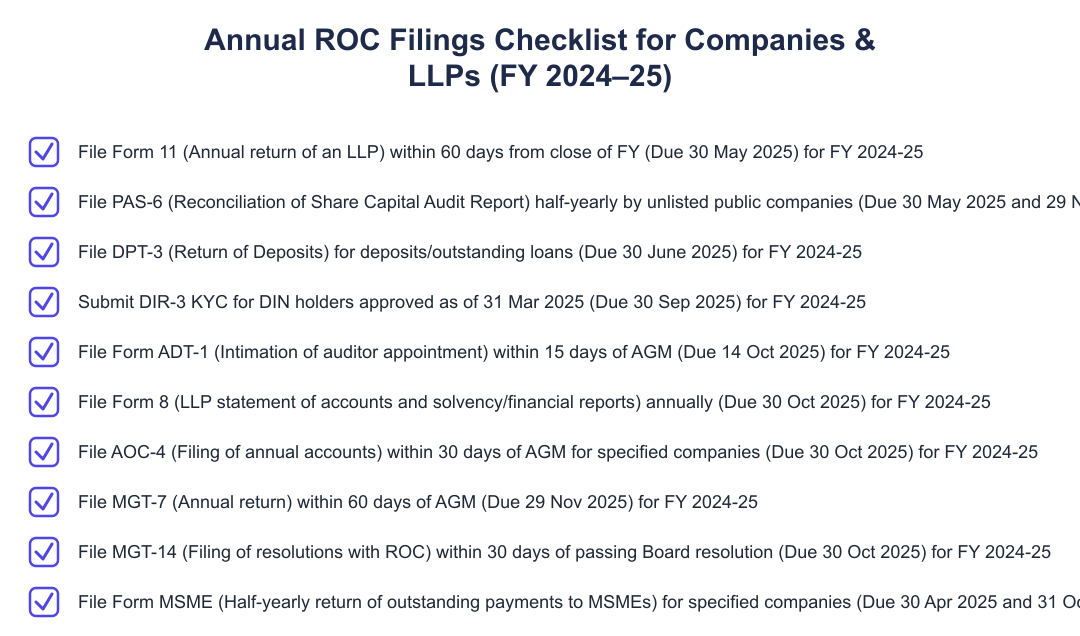
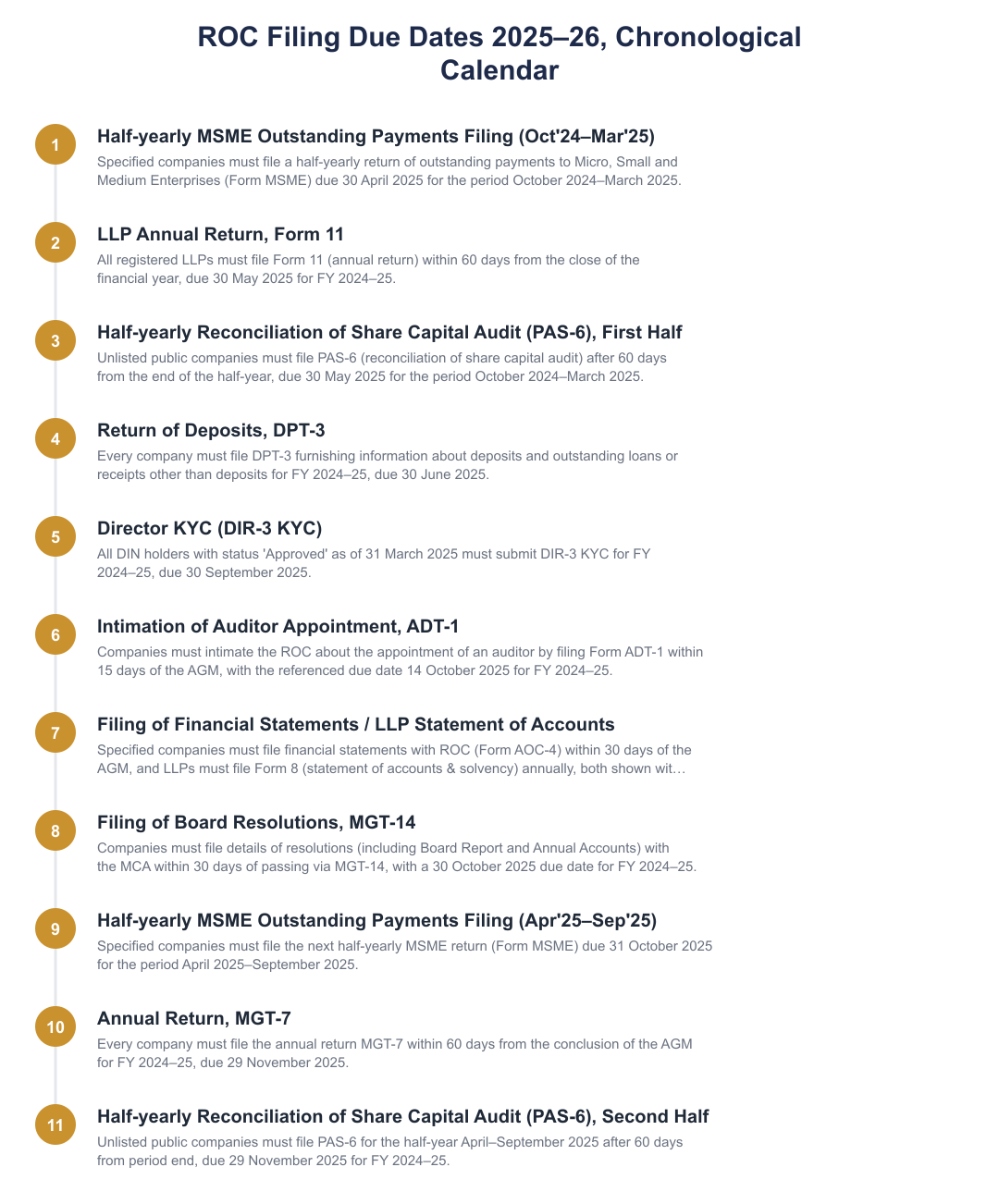
Key ROC filing due dates for 2025-26 include: Form 11 (LLP annual return), 30 May 2025 for FY 2024-25; PAS-6 (reconciliation of share capital audit), 30 May 2025 and 29 November 2025 for respective half-years; DPT-3 (return of deposits), 30 June 2025 for FY 2024-25; DIR-3 KYC (director KYC for DINs active as on 31 March 2025), 30 September 2025; ADT-1 (appointment of auditor), 14 October 2025; AOC-4 (annual accounts) and MGT-14 (board resolutions filing), 30 October 2025; Form 8 (LLP financial statements), 30 October 2025; MGT-7 (annual return), 29 November 2025; and MSME half-yearly returns, 30 April 2025 and 31 October 2025. These dates apply to companies and LLPs registered in India and correspond to filings required under the Companies Act, 2013 and LLP Act, 2008 for FY 2024-25 and the relevant half-year periods. Missing these statutory dates may lead to late filing consequences under MCA rules, so plan filings against each specific form and period.
When does an LLP need to file Form 11 and what does it contain?
An LLP must file Form 11 (Annual returns of an LLP) within 60 days from the close of the financial year, which for FY 2024-25 is due on 30 May 2025. Form 11 is an annual statement that submits details of the LLP’s business activities and partner particulars, and it is compulsory for every registered LLP. Ensure the form covers the financial year’s information accurately, the time limit is calculated from the end of the financial year, so for a usual year ending 31 March, the 60-day window places the due date in late May. Failure to file on time can attract penalties under the Limited Liability Partnership Act, 2008.
What is PAS-6 and when must unlisted public companies file it in 2025?
PAS-6 is a half-yearly Reconciliation of Share Capital Audit Report that unlisted public companies must file to reconcile share capital details, and it must be filed after 60 days from the end of each half-year. For the 2025 calendar in respect of FY 2024-25 and FY 2025-26, the due dates are 30 May 2025 for the period October 2024–March 2025 and 29 November 2025 for the period April 2025–September 2025. This filing is required specifically for unlisted public companies to ensure share capital records match registrar and company books, and it is typically prepared by a practicing professional. Keep the half-year cut-offs in mind so reconciliations reflect the correct period ending before the 60-day filing window.
When is DPT-3 due and what information must a company provide in it?
DPT-3 (Return of Deposits) is due on 30 June 2025 for FY 2024-25 and must be filed by every company to furnish information about deposits and/or outstanding receipt of loans or money other than deposits. The form requires details of amounts accepted as deposits (if any), loans or outstanding receipts other than deposits, and prescribed particulars of lenders and balances as at the financial year end. All companies need to check the definitions and exemptions under the Companies Act, 2013 to determine whether particular receipts qualify as deposits requiring disclosure in DPT-3. Accurate reconciliation with company books and supporting schedules is important to avoid subsequent queries from the ROC.
Who must file DIR-3 KYC and what is the deadline for 2025?
Every person with a Director Identification Number (DIN) whose DIN status is ‘Approved’ as of 31 March 2025 must file DIR-3 KYC by 30 September 2025. DIR-3 KYC is the director KYC submission required annually to update or confirm personal and professional details of directors, and the deadline follows the financial year end. The filing is mandatory for all approved DIN holders irrespective of directorship status in the year, and non-filing can lead to deactivation of the DIN and other compliance actions. Directors should prepare their PAN, Aadhaar (if applicable), and current contact details to complete the form on MCA’s portal.
When must a company file ADT-1 for appointment of an auditor after its AGM?
A company must file Form ADT-1 intimating the appointment of an auditor within 15 days from the conclusion of the Annual General Meeting (AGM), and for FY 2024-25 filings this corresponds to a due date of 14 October 2025. ADT-1 is required whenever an auditor is appointed or re-appointed at the AGM and the 15-day clock runs from the AGM conclusion date, not the financial year end. The form must be filed with the ROC to record the auditor’s appointment and term, and it should be prepared promptly after the board or shareholders resolve the appointment. Ensure the filing contains the auditor’s consent and relevant details to avoid queries from the registrar.
What are the deadlines for filing annual accounts, annual return and related board resolution forms?
For FY 2024-25, specified companies must file AOC-4 (annual accounts) and MGT-14 (board resolutions) by 30 October 2025, file Form 8 (LLP financial reports) also by 30 October 2025 for LLPs, and file MGT-7 (annual return) by 29 November 2025. AOC-4 is to be filed within 30 days of the conclusion of the AGM for companies required to file their financial statements, MGT-14 must be filed within 30 days of passing the relevant board resolutions, and MGT-7 must be filed within 60 days of the AGM for annual return details. These filings capture the company’s financial statements, solvency, auditor reports and annual return particulars, so coordinate AGM timing and board resolutions to meet the statutory windows.
When do specified companies need to file MSME outstanding payments returns and which periods do the 2025 dates cover?
Specified companies must file half-yearly MSME outstanding payments returns, with due dates on 30 April 2025 for the period October 2024–March 2025 and 31 October 2025 for the period April 2025–September 2025. These filings report outstanding payments to Micro, Small and Medium Enterprises and are required from companies specified under the relevant MCA circulars and rules to ensure transparency of dues to MSME suppliers. Prepare the outstanding payables as at the half-year end and supporting invoices to populate the form accurately. Timely filing helps companies demonstrate compliance with statutory disclosure requirements regarding MSME payments.
Need help staying Compliance compliant?
MoneyGence's AI Finance OS tracks your compliance, wallet share, and finances in one place, built for agencies and growing businesses.
Get started with MoneyGence