Rent Receipt Format: How to Fill House Rent Receipt for HRA
A rent receipt is the documentary proof a tenant receives from a landlord confirming payment of rent for a specified period. For individuals and businesses that pay or receive rent, knowing what a proper rent receipt contains and how to fill it matters for record-keeping, resolving disputes, and for taxation or compliance purposes where documentary evidence of rent payments may be required. This guide explains what a rent receipt is, the typical contents you should expect in one, the common format used on rent receipts (including the standard template heading used on many Indian receipts), and a practical, step-by-step approach to filling a house rent receipt correctly. You will learn what information is essential on a receipt, why each piece of information matters (for example, linking a payment to a period or property), and how to avoid common mistakes when issuing or accepting a receipt. The guidance here is focused on clarity and usability, aimed at landlords, tenants, property managers and accountants who need a reliable method to document rent receipts for everyday transactions and longer-term records. By the end of the article you will be able to recognise a valid rent receipt and prepare one that serves as clear evidence of payment.
Rent receipt and meaning thereof –
A rent receipt is a written acknowledgement from the landlord to the tenant confirming that rent was received. It links a specific payment to a defined rental period and property address, helping both parties keep a transparent payment trail. For tenants, a receipt is evidence that the obligation to pay rent for a given period has been met; for landlords, it documents income and helps maintain organised financial records.
Beyond the immediate proof of payment, a properly prepared receipt reduces the risk of disputes about amounts or periods covered and supports routine accounting. When multiple payments are made over time, consistent receipts provide a clear chronological record that can be relied upon for reconciliation, budgeting, and any compliance needs that may arise.
Contents and format of rent receipt –
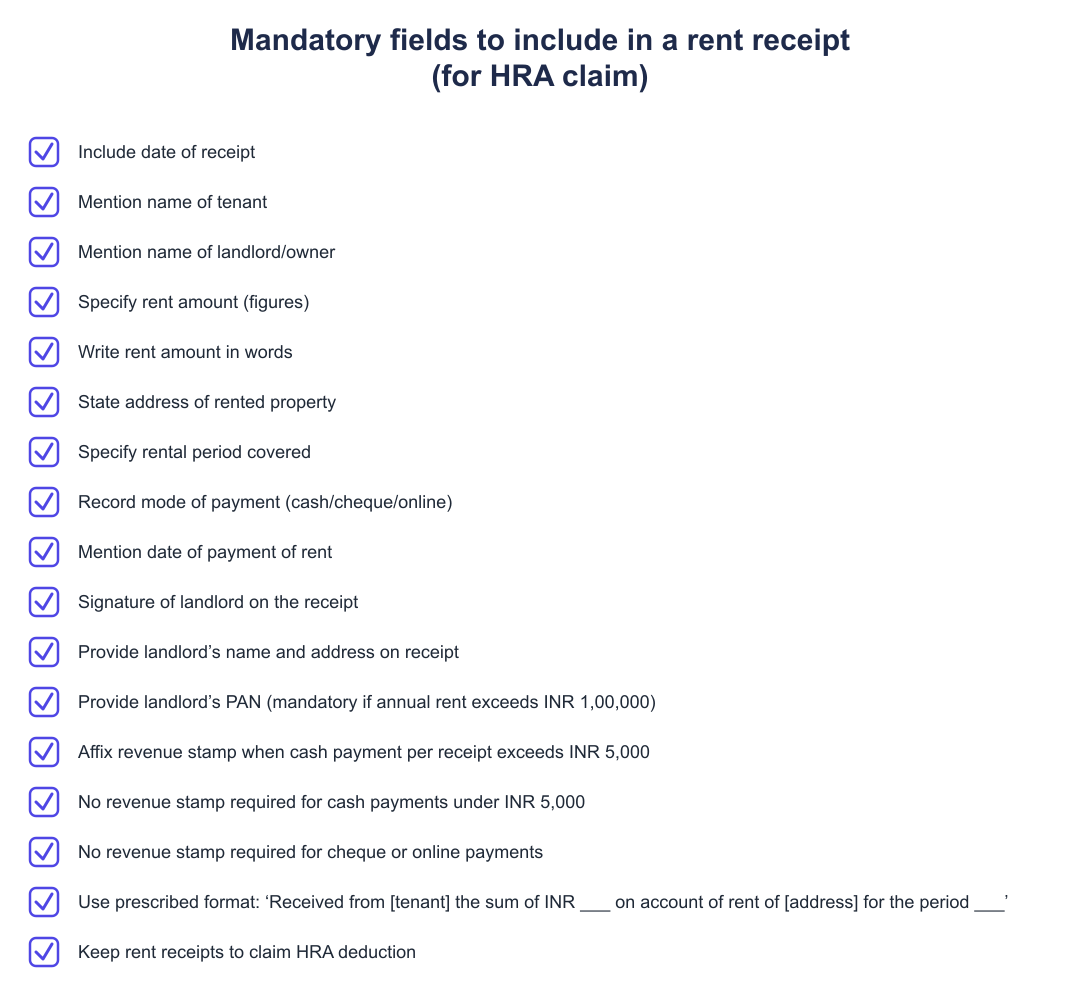
A practical rent receipt contains a set of core data points that together identify the parties, the property, the amount paid and the period for which the payment applies. These items make the receipt useful both as short-term proof of payment and as a long-term record for accounting or reference. Clear labelling of each element (for example, "Rent for the period") avoids ambiguity.
In addition to the core fields, receipts sometimes include details such as the mode of payment and the signature (or authorised signatory) of the landlord. The presence of an identifiable signature or stamp lends authenticity to a receipt, while indicating the payment mode provides a reconciliation trail to bank records or cash books.
Format of rent receipt –
There are many layouts in use, but one commonly seen heading used on Indian rent receipts is: 'RENT RECEIPT (Under Section 10(13A of Income Tax Act, 1961)'. That template heading signals an intention to align the receipt with recognized formats used for documenting house rent.
Typical formatting places the heading at the top, followed by fields for tenant name, owner/landlord name, amount (both in words and figures), property address, rental period, date of payment, mode of payment, and signature of the landlord or authorised representative. The layout should be legible, with enough space to write full addresses and clear dates so that future readers can interpret the receipt without clarification.
How to fill a house rent receipt
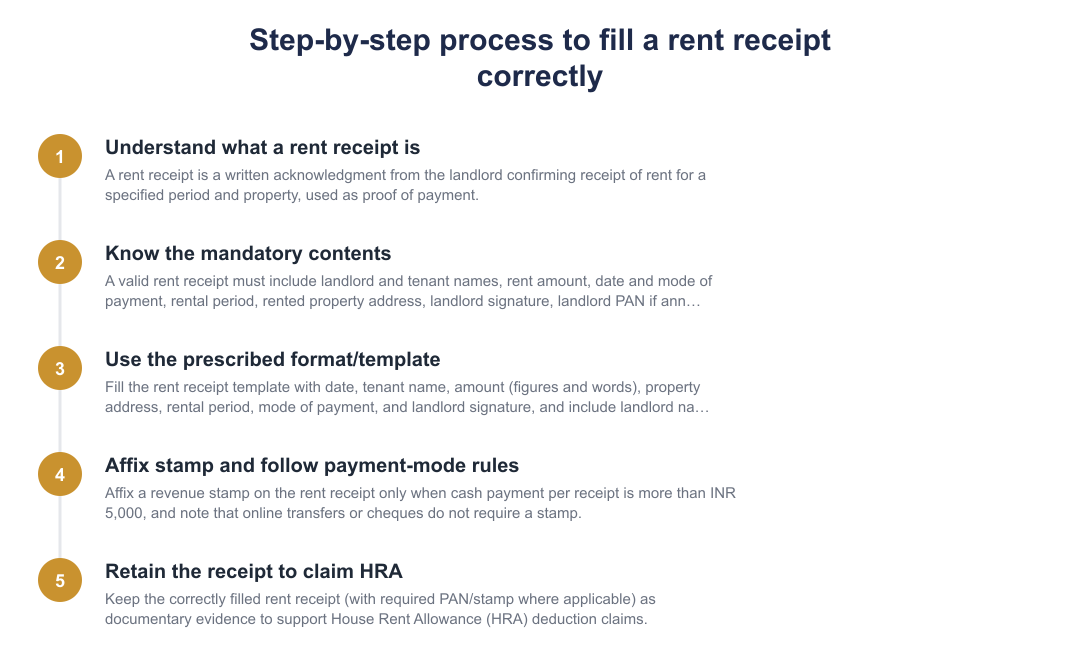
Begin with an identifiable heading and clearly write the date on which the rent was received so the receipt can be placed accurately in chronological records.
Record the full names of the tenant (payer) and the landlord (receiver) to avoid confusion later; include any authorised signatory name if a manager or agent issued the receipt.
Specify the address of the rented premises and the rental period that the payment covers to make the link between payment and tenancy clear.
State the rent amount both numerically and in words to reduce the risk of misreading or tampering.
Indicate how the payment was made (for reconciliation) and have the landlord or authorised signatory sign the receipt to authenticate it.
A correct rent receipt is a simple but powerful document: it proves payment, supports record-keeping, and reduces disputes. Using a clear format, such as the widely used template heading referenced above, and including the essential elements described will ensure receipts serve their purpose for both tenants and landlords.
Frequently asked questions
What is a rent receipt and why do I need it to claim HRA?
A rent receipt is a written document issued by a landlord showing that rent has been received, and you need it as evidence to claim House Rent Allowance (HRA) from your employer or for IT returns. It should state the tenant and landlord names, amount paid (both figures and words), rental period, property address, date, mode of payment and landlord's signature; PAN of the owner is required if annual rent paid exceeds INR 1,00,000. Employers typically ask for rent receipts to compute HRA exemption under Section 10(13A), and the same receipt helps substantiate your claim in case of tax inquiries. Keep original receipts or scanned copies for tax records and proof of payment (bank transfers, cheques) to match the mode stated on the receipt.
What are the mandatory contents of a rent receipt?
A valid rent receipt must include landlord and tenant names, rent amount (figures and words), date of payment, rental period, address of the rented property, mode of payment and landlord's signature. Additionally, the landlord's PAN must be mentioned if the total rent paid to that landlord exceeds INR 1,00,000 in a financial year. If cash payment in a single receipt exceeds INR 5,000, a revenue stamp must be affixed on the rent receipt; for cheque or online transfers no stamp is required. Including the owner's address on the receipt is also standard practice to avoid disputes and to satisfy employer or IT requirements.
Do I have to affix a revenue stamp on a rent receipt?
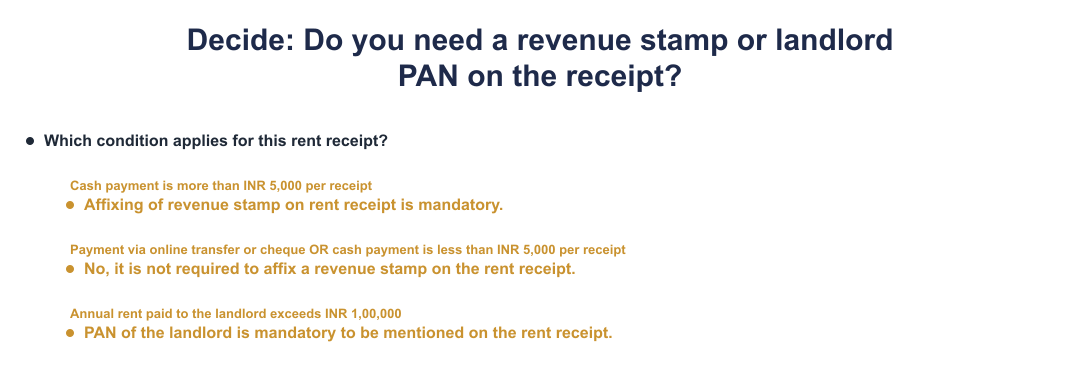
You must affix a revenue stamp on the rent receipt only when the payment in cash for that receipt is more than INR 5,000. For cash payments below INR 5,000 or payments made by cheque, bank transfer or other non-cash modes, affixing a revenue stamp is not required. Note that this requirement concerns the mode and amount per receipt, multiple smaller cash receipts may each escape stamping but large single cash receipts trigger the stamp need. Using non-cash modes avoids stamp complications and provides clearer bank evidence for HRA claims.
When is the landlord's PAN required on rent receipts?
The landlord's PAN is required on rent receipts when the total rent paid to that landlord in a financial year exceeds INR 1,00,000. This is mandatory for the tenant to claim HRA exemption and for compliance under income tax rules to track high-value rents. If the PAN is missing while rent exceeds the threshold, employers or tax authorities may disallow the deduction or ask for other corroborative evidence and the tenant may be liable to furnish Alternate documents. Tenants should request the landlord's PAN in writing or provide landlord's PAN to the employer when submitting rent proofs.
How should I format and fill a rent receipt to make it valid for tax/HRA?
Fill rent receipts clearly with date, tenant and landlord full names, exact rent amount in numbers and words, address of the rented property, rent period covered, mode of payment and landlord's signature; include owner's PAN and address where applicable. Use a standard template (for example: ‘Received from [tenant] the sum of INR [amount] for rent of [address] for the period [dates] by [mode]’) and ensure amounts match bank statements if payment was non-cash. If cash payment exceeds INR 5,000 affix the prescribed revenue stamp and avoid handwritten ambiguities, typed or printed receipts are preferable. Keep a counter-signed or duplicate copy for your records and submit copies to your employer when claiming HRA.
Can I use rent receipts for multiple months in one document or separate receipts each month?
You can use a single rent receipt that clearly states the period covered (for example, quarterly or yearly) provided it mentions the specific period and payment details, or provide separate monthly receipts, both are acceptable if they include all mandatory particulars. For HRA claims employers often accept consolidated receipts if they show the exact months and total paid, but some employers prefer monthly receipts matching monthly salary/HRA disbursement. Ensure the landlord's signature, PAN (if annual rent > INR 1,00,000), and the payment mode evidence correspond to the stated amounts regardless of frequency. Keep consistent records (e.g., monthly bank entries) to avoid discrepancies during verification.
Is a handwritten rent receipt valid for tax and HRA purposes?
Yes, a handwritten rent receipt is valid for tax and HRA purposes as long as it contains all mandatory details: tenant and landlord names, rent amount in words and figures, rental period, address, date, mode of payment and the landlord's signature. However, typed or printed receipts are preferable because they reduce ambiguity and are easier to verify against bank records; employers may request clearer formats. Handwritten receipts must be legible and, if required, accompanied by bank transfer or cheque evidence to strengthen the claim. Remember to include the landlord's PAN if annual rent exceeds INR 1,00,000 even on handwritten receipts.
What proof of rent payment should I keep along with rent receipts for income tax?
Along with rent receipts, keep bank transfer records, cancelled cheques, cheque images or bank statements showing the rent debits as proof of payment, since non-cash evidence strengthens HRA claims and tax compliance. If payment was in cash, retain signed rent receipts (with revenue stamp if cash > INR 5,000) and any ledger or written acknowledgements from the landlord; large cash payments may invite scrutiny so non-cash modes are safer. Retain these documents for at least the statutory assessment period (normally six years) as tax authorities can request them during assessments. If landlord’s PAN is required (rent > INR 1,00,000/year), keep a copy of the PAN or a declaration from the landlord as supporting evidence.
What happens if my rent receipt is missing PAN or other required fields?
If a rent receipt is missing the landlord's PAN when annual rent exceeds INR 1,00,000 or lacks other mandatory details, employers or tax authorities may disallow the HRA exemption or ask for alternate evidence, and you should obtain a corrected receipt. You can ask the landlord to reissue a proper receipt including PAN, or provide additional proofs such as rent agreement, bank transfer records and a sworn declaration from the landlord to support your claim. For small deficiencies (e.g., missing landlord address) you may still be able to substantiate the claim with corroborative documents, but rectifying the receipt is the safest option to avoid rejection. Maintain clear communication and get amended receipts promptly to prevent issues during salary processing or tax assessments.
Need help staying Finance Templates compliant?
MoneyGence's AI Finance OS tracks your compliance, wallet share, and finances in one place, built for agencies and growing businesses.
Get started with MoneyGence