Profit and Loss Statement: What it is & How to Prepare (Format)
A Profit & Loss Statement (P&L) is a core financial document that tells you whether a business made money or incurred a loss during a defined period, typically a quarter or a year. This guide explains what a P&L does, the step-by-step way it is prepared from daybook entries through to the final statement, and the practical meaning of each component on the report. You will learn the simple arithmetic used to compute profit or loss, the bookkeeping sequence that leads to a reliable P&L, and how the common categories of revenue and expense fit together. For business owners, accountants and students, understanding the P&L is essential: it helps evaluate profitability, supports decision-making, and provides a concise picture of operating performance over time. This article focuses on the core concepts and the standard preparation workflow so you can prepare or review a P&L with confidence.
What is Profit & Loss Statement?
The Profit & Loss Statement summarises costs, revenues and expenses incurred by a business during a specific period (usually a quarter or year) to arrive at net profit or loss. It collects all income earned and all expenditures incurred in that interval and brings them together in one place so the bottom-line result, profit or loss, is clear.
Because it aggregates flows over a period rather than showing a point-in-time position, the P&L is used to assess performance: whether core activities are generating enough revenue to cover costs, how expense patterns change, and whether profitability is improving or deteriorating over successive periods.
How to prepare Profit & Loss Statement?
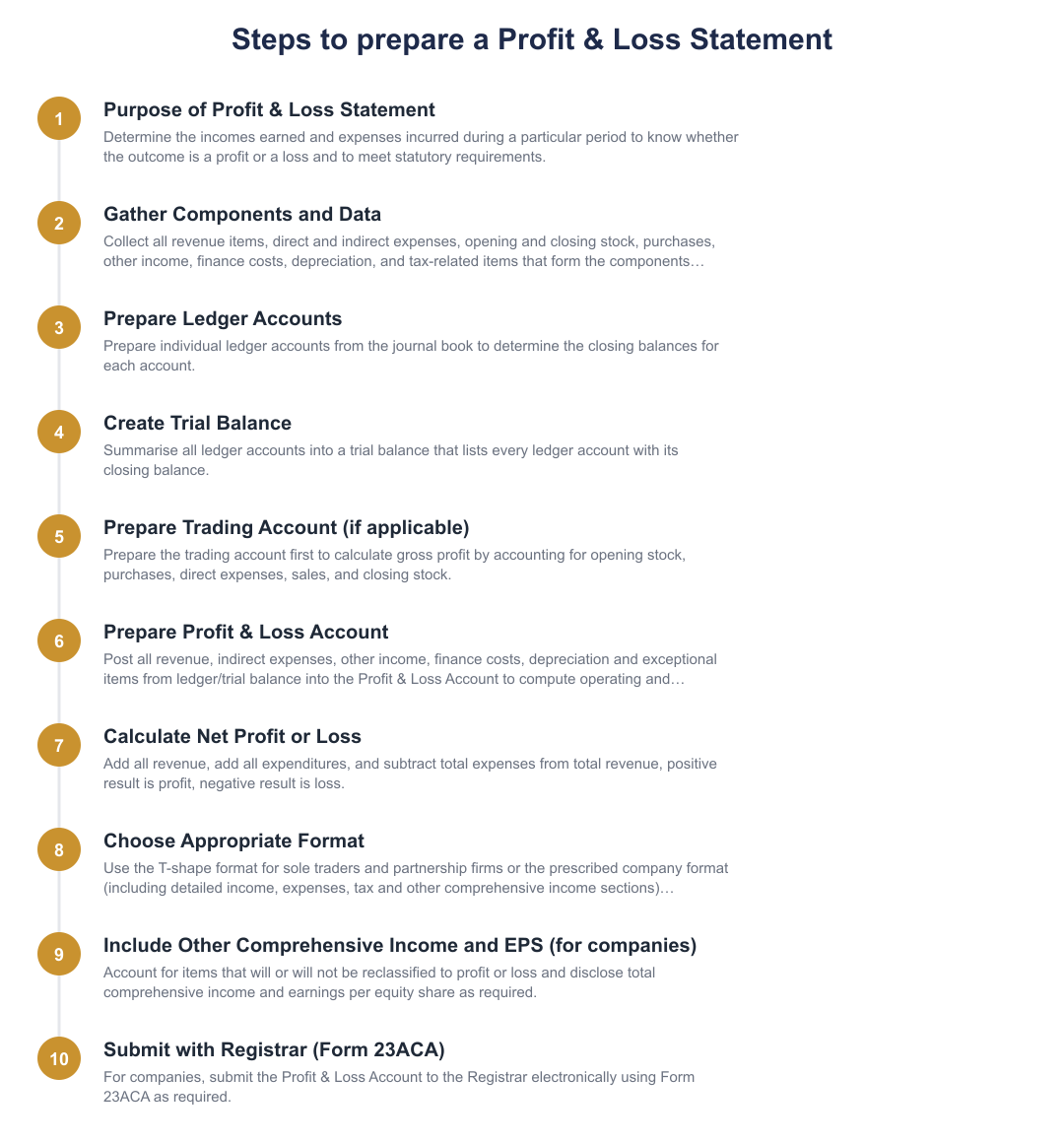
Post each journal entry into its respective ledger account to determine the closing balance for every account. This organises individual transactions by account so balances are ready for summarisation.
Summarise the closing balances of all ledger accounts into a trial balance. The trial balance lists every ledger account and its balance, which serves as the working base for preparing financial statements.
Post ledger balances that represent sales, purchases, direct expenses, indirect expenses and incomes to the trading and P&L statements. These postings convert ledger balances into the structured P&L format that shows gross and net results.
Components of Profit & Loss Statements
A P&L groups together different categories so users can see how revenues and expenses contribute to the outcome. Typical groupings include revenue (sales and other income), direct costs associated with generating sales, and operating or indirect expenses. Bringing these together yields intermediate subtotals such as gross profit and ultimately the net profit or loss for the period.
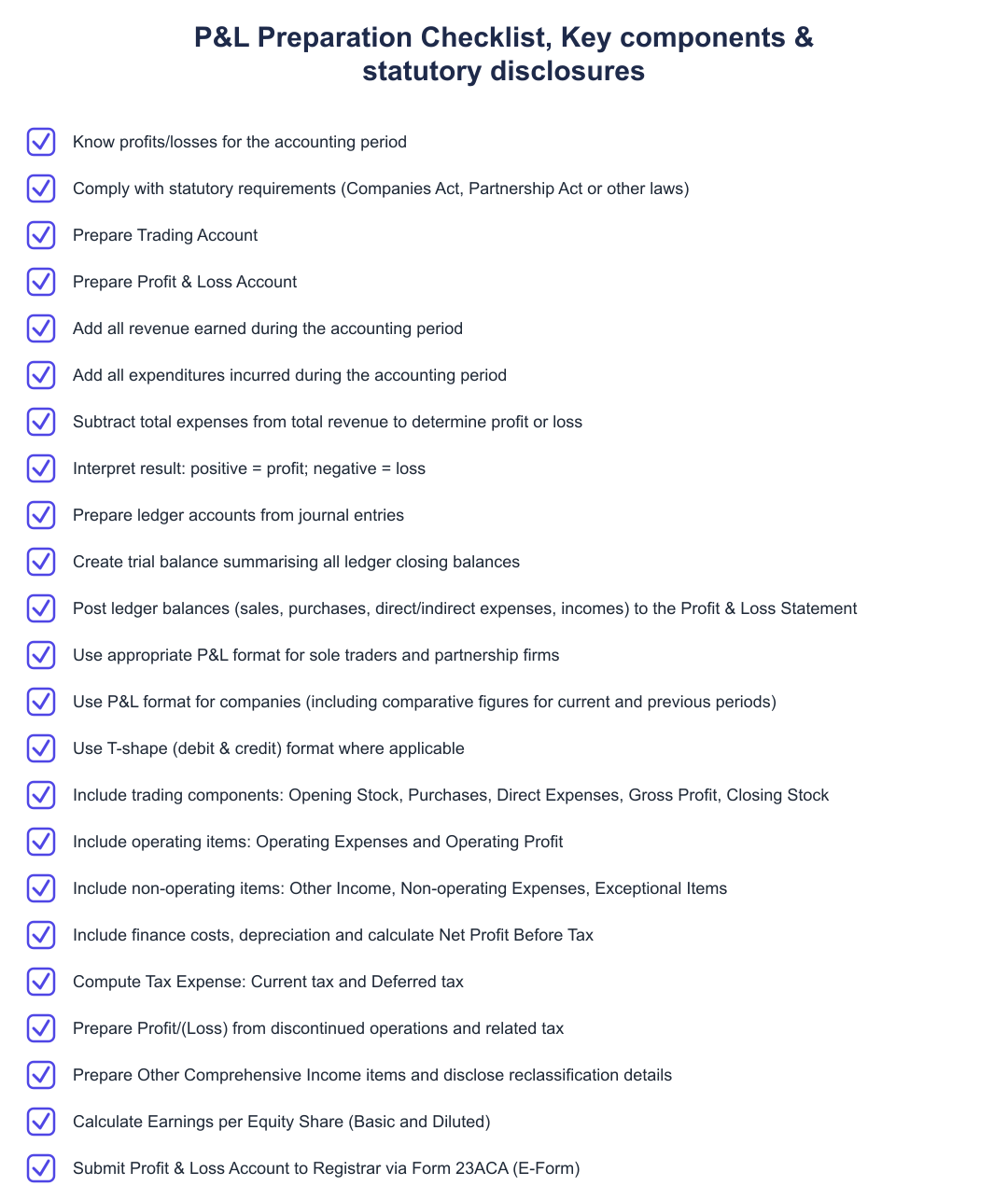
The basic arithmetic to compute the final figure is straightforward: add all revenue earned during the accounting period, add all expenditures made during the same period, and subtract total expenses from total revenue. If the result is positive, it is reported as profit; if negative, it is reported as loss. Understanding these components helps management identify which costs or revenue streams are driving performance.
Different formats of the Profit & Loss Account
While presentation can vary by business type and reporting preferences, the underlying information in any P&L remains the same: records of income and expenditure for the period and the arithmetic that produces profit or loss. Some formats emphasise a sequential trading-to-operating-to-net layout, while others present consolidated headings such as total income and total expenses with line items beneath each.
Choosing a format is largely practical: smaller businesses often use simpler layouts that clearly separate direct costs from other expenses, whereas larger entities adopt more detailed schedules to show subtotals and additional disclosures. Regardless of format, the preparatory bookkeeping steps, ledger posting, trial balance and then allocation to trading/P&L lines, remain the established workflow to ensure accuracy.
Practical tips when using the Profit & Loss Statement
Treat the P&L as a performance report rather than a cash statement. It records revenues and expenses when they are earned or incurred, not necessarily when cash changes hands; this helps assess profitability but should be considered alongside cash-flow information for liquidity analysis.
Use consistent classification and the standard preparation sequence (journals → ledgers → trial balance → trading/P&L) so period-to-period comparisons are meaningful. Consistency in grouping revenue and expense items makes it easier to spot trends and take informed management actions.
A Profit & Loss Statement distils a period’s business activity into a single, actionable result: profit or loss. By following the standard preparation process, ledger posting, trial balance and then preparing trading and P&L statements, you ensure the statement is accurate and useful. Keeping classifications consistent and understanding the simple computation behind the bottom line will help you read the P&L effectively and take better financial decisions.
Frequently asked questions
What is a Profit & Loss Statement and what does it show?
A Profit & Loss Statement (P&L) is a financial statement that summarises a business’s revenues, expenses and resulting profit or loss for a specific period (usually a quarter or a year). It records all revenue from operations and other income, deducts cost of goods sold, operating and non‑operating expenses (including finance cost and depreciation) to arrive at net profit before and after tax. For companies the P&L also shows exceptional items, tax expense (current and deferred), profit from discontinued operations, other comprehensive income (OCI) and earnings per equity share (basic and diluted). Preparing the P&L helps owners and stakeholders assess operational performance and comply with statutory reporting requirements like the Companies Act or Partnership Act.
Why do businesses prepare a Profit & Loss Account?
Businesses prepare a Profit & Loss Account primarily to determine whether they earned a profit or incurred a loss during the accounting period and to meet statutory reporting requirements. It provides management with insight into revenue, direct and indirect expenses, gross and net profit, and highlights items such as exceptional gains/losses and finance costs that affect net earnings. Statutory reasons include compliance with laws like the Companies Act or Partnership Act and filing requirements when submitting accounts to the Registrar of Companies. Many decisions, pricing, cost control, tax planning, are made based on the results in the P&L.
What are the main components of a Profit & Loss Statement?
The main components of a Profit & Loss Statement are revenue (revenue from operations and other income), expenses (cost of materials, purchases, employee benefits, finance costs, depreciation and other expenses), and measures of profit at different levels (gross profit, operating profit, profit before tax, and profit after tax). For companies, it also includes exceptional items, tax expense broken into current and deferred tax, profit/loss from discontinued operations, other comprehensive income (items that will or will not be reclassified to profit or loss), and earnings per equity share (basic and diluted). Each component helps identify where income is generated and which costs most affect profitability, such as finance cost or depreciation reducing net profit.
What is the step-by-step process to prepare a Profit & Loss Statement?
To prepare a Profit & Loss Statement, first prepare ledger accounts for each journal entry to determine closing balances, then create a trial balance summarising those ledger balances, and finally post revenue, direct and indirect expenses from the trial balance into the trading account (if used) and the P&L statement. The trading account (for traders/manufacturers) determines gross profit by matching sales, opening and closing stock, purchases and direct expenses; the P&L then records operating and non‑operating expenses, other income and exceptional items to arrive at net profit. This sequence ensures accuracy because each ledger’s closing balance is verified in the trial balance before being included in the P&L. Many businesses follow this three‑step routine every accounting period to produce reliable financial results.
How is profit calculated from the figures in a Profit & Loss Statement?
Profit is calculated by adding up all revenues (sales and other income) for the period and then subtracting all expenses (direct costs, operating expenses, finance costs, depreciation and tax) to arrive at net profit or loss. Practically, you first compute gross profit (Sales + Closing Stock − Opening Stock − Purchases − Direct Expenses), then subtract operating expenses to get operating profit, deduct non‑operating expenses, exceptional items and finance cost, and finally subtract tax (current and deferred) to determine profit after tax. A positive resulting figure indicates profit; a negative figure indicates loss. The company P&L also separates continuing and discontinued operations when applicable and reports earnings per share (basic and diluted).
What format is used for Profit & Loss Accounts of sole proprietors and partnership firms?
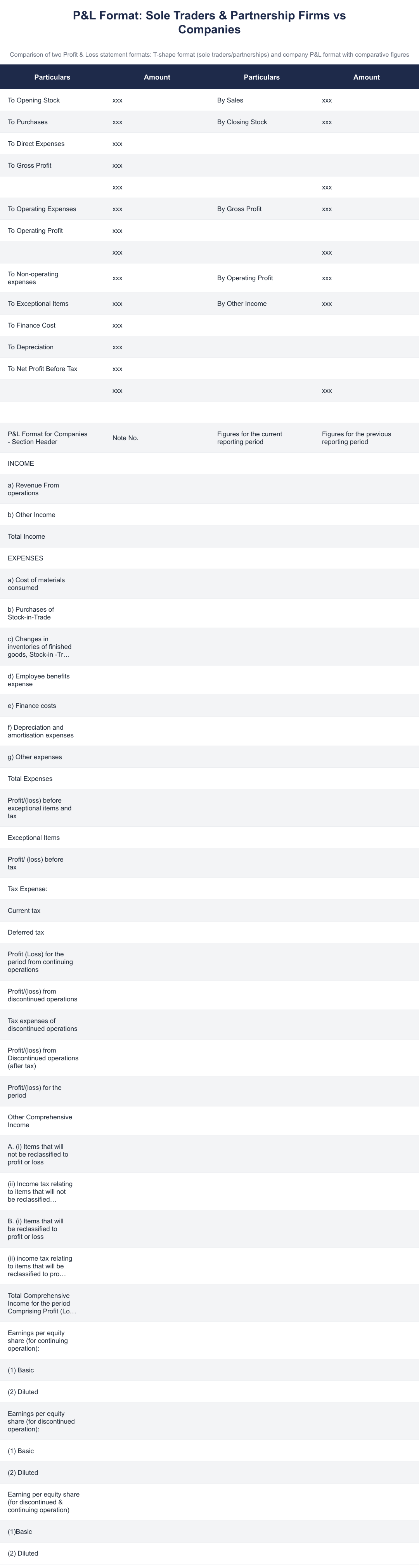
Sole proprietors and partnership firms often use the traditional T‑shape format (debit and credit sides) where the trading account is prepared first to find gross profit, followed by the Profit & Loss Account to arrive at net profit. In this format, the debit side typically shows opening stock, purchases and direct expenses while the credit side shows sales and closing stock; gross profit is transferred to the P&L to offset indirect expenses and record other income. This simple two‑column layout is common for small businesses and makes it easy to visualise debits and credits for each accounting period. The same logic applies whether monthly, quarterly or yearly P&Ls are prepared.
What is the Profit & Loss format used by companies (vertical format) and what items does it contain?
Companies typically use a vertical or schedule‑based Profit & Loss format that lists Income (revenue from operations and other income), Total Income, then Expenses (cost of materials, purchases, changes in inventories, employee benefits, finance costs, depreciation, other expenses) and Total Expenses to arrive at Profit/(loss) before exceptional items and tax. The statement then shows Exceptional Items, Profit before tax, Tax Expense (current and deferred), Profit for the period (including discontinued operations), Other Comprehensive Income with its sub‑components, Total Comprehensive Income and Earnings Per Share (basic and diluted) for continuing and discontinued operations. This format aligns with accounting standards and statutory disclosure requirements and presents comparative figures for the current and previous reporting periods in separate columns. It is the standard presentation for company financial statements filed with the Registrar and used by auditors and investors.
What is included under Other Comprehensive Income (OCI) in the P&L of a company?
Other Comprehensive Income (OCI) includes items of income and expense that are not recognised in profit or loss and are instead presented outside the main profit figure; examples include changes in revaluation surplus, remeasurements of defined benefit plans, equity instruments through OCI, and fair value changes relating to own credit risk on certain financial liabilities. OCI is shown in two groups: items that will not be reclassified to profit or loss and items that may be reclassified later (like exchange differences on foreign operations or effective portion of cash‑flow hedges), each with related tax effects. Companies must disclose OCI components separately and include them in the Total Comprehensive Income for the period. This ensures users see both profit for the period and other significant gains or losses that affect equity but not the profit number.
What is Form 23ACA and when do companies need to submit Profit & Loss Account with the Registrar?
Form 23ACA is the e‑form used to submit a company’s Profit & Loss Account (and balance sheet) with the Registrar of Companies as part of statutory filing requirements. Companies prepare their financial statements, including the P&L in the prescribed format with notes and comparative figures, and file them electronically using Form 23ACA (and related forms) within the timelines set under the Companies Act and MCA rules. Filing ensures statutory compliance and public record of financial statements; non‑compliance can lead to penalties or notices from the Registrar. Small companies and certain classes may have specific exemptions or different filing thresholds, so check the Companies Act or MCA notifications for applicable timelines and exemptions.
Need help staying Accounting compliant?
MoneyGence's AI Finance OS tracks your compliance, wallet share, and finances in one place, built for agencies and growing businesses.
Get started with MoneyGence