Presumptive Taxation Section 44AD, 44ADA, 44AE, Guide for Businesses
This guide explains the presumptive taxation framework under Sections 44AD, 44AE and 44ADA of the Income-tax Act and what it means for small businesses and professionals. You will learn which provisions exist, how the presumptive approach simplifies compliance, the limited situations where specific prescribed rates apply (including the 50% rule under Section 44ADA), and the practical consequences of claiming income below prescribed amounts or opting out of the scheme. Understanding these basics helps taxpayers decide whether presumptive taxation suits their business or professional practice and what compliance trade-offs are involved. The core purpose of presumptive taxation is to reduce bookkeeping and audit burden for smaller taxpayers by allowing them to declare income at a prescribed rate instead of computing actual profits. This guide distils the essential features and practical implications of Sections 44AD, 44AE and 44ADA so you can assess fitment to your situation and avoid common pitfalls.
What is Presumptive Taxation?
Presumptive taxation is a simplified manner of computing taxable income for eligible small taxpayers. Under the scheme, taxpayers are allowed to declare taxable income at prescribed rates rather than compute actual profits and losses from detailed books. The main intended benefit is to relieve eligible taxpayers from maintaining extensive books of account and from undergoing audit procedures that apply to regular businesses.
The scheme is statutory, provided by the Income-tax Act, and is aimed at reducing compliance cost and complexity for smaller businesses and professionals. By allowing a prescribed rate to stand in for actual profit computation, the regime reduces scope for routine bookkeeping and simplifies return filing for qualifying taxpayers.
Presumptive Taxation provisions under Sections 44AD, 44AE and 44ADA
Presumptive taxation provisions are contained in three separate sections of the Income-tax Act: Section 44AD, Section 44AE and Section 44ADA. Each section targets different kinds of taxpayers and activities, but they share the common objective of reducing compliance for smaller taxpayers by allowing the use of prescribed presumptive amounts.
While the specific prescribed rates and the eligibility contours differ across these sections, the fundamental mechanics are similar: a taxpayer declares income as per the statutory presumptive amount and is relieved from maintaining regular books and the audit requirement that would otherwise apply. Section 44ADA specifically applies to certain professionals and prescribes a presumptive income equal to 50% of total gross receipts in a year.
Consequences of claiming profit lower than prescribed under Sections 44AD, 44AE and 44ADA
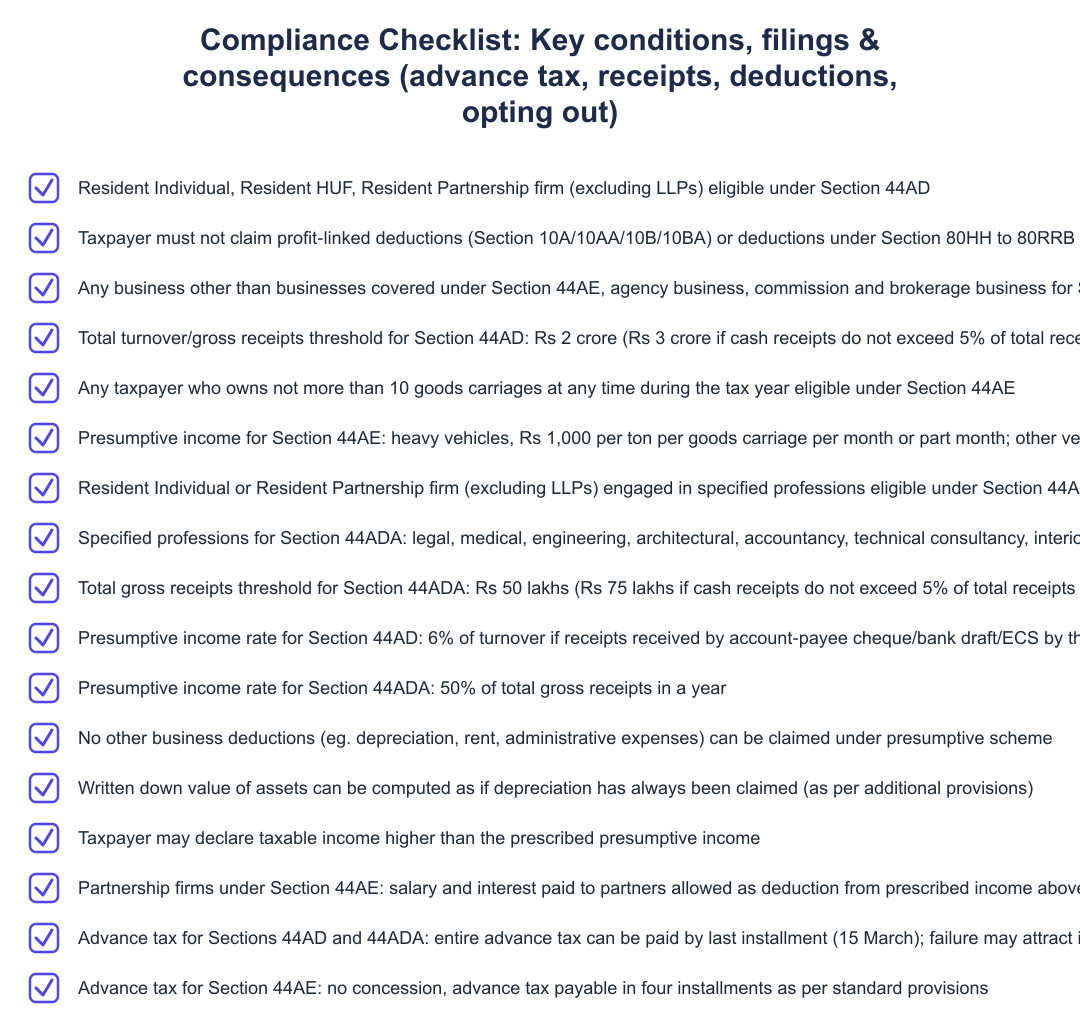
Under the presumptive taxation provisions a taxpayer is required to adhere to the prescribed presumptive amount for declaring taxable income. One important consequence is that usual business deductions, such as depreciation, rent or administrative expenses that would otherwise be available when computing actual profits, are not available against the prescribed presumptive income. This means attempting to claim a lower profit through such deductions is not consistent with the design of the presumptive scheme.
Taxpayers always retain the option to declare taxable income higher than the prescribed presumptive amount. However, declaring income lower than the prescribed amount by relying on regular deductions is not aligned with the presumptive framework and undermines the simplification intent. The scheme is therefore a trade-off: simplified compliance in exchange for fixed presumptive computation rules.
Consequences of opting out of Presumptive Taxation under Section 44AD
A taxpayer who does not use the presumptive taxation option under Section 44AD will not avail of the simplified compliance benefits that the scheme offers. The key reliefs of the presumptive regime are the reduced need for detailed bookkeeping and exemption from audit; opting out effectively means that these reliefs cease to apply and the taxpayer will follow regular provisions for income computation and compliance.
Because the presumptive scheme is designed to relieve small taxpayers from maintaining regular books and getting them audited, stepping out of it brings back those compliance requirements. Taxpayers should weigh the administrative burden of full compliance against the potential tax impact of the two approaches before deciding whether to opt out.
Frequently Asked Questions
Who should consider presumptive taxation? Small taxpayers and professionals who wish to avoid regular bookkeeping and audit procedures may find presumptive taxation useful because it allows them to declare taxable income at a prescribed rate and simplifies compliance.
Can a taxpayer declare more than the prescribed amount? Yes. The provisions allow taxpayers to declare taxable income higher than the prescribed presumptive amount if they choose to do so. This gives some flexibility to those who want to show higher taxable income for commercial or compliance reasons.
Does presumptive taxation mean no deductions at all? Under the presumptive regime, the common business deductions that are usually available for computing actual profits (for example depreciation, rent and administrative expenses) are not available against the prescribed presumptive income. This is part of the trade-off for simplified compliance.
Presumptive taxation under Sections 44AD, 44AE and 44ADA offers a compliance-light route for eligible small taxpayers by allowing taxable income to be declared at prescribed rates and removing the need for routine books and audit. Section 44ADA prescribes a taxable income of 50% of gross receipts for eligible professionals. The scheme disallows normal business deductions against the presumptive amount, though taxpayers may always declare income higher than the prescribed figure. Choose the presumptive route only after comparing its simplified compliance benefits with the potential tax impact for your business or profession.
Frequently asked questions
Who can opt for presumptive taxation under Section 44AD, 44AE and 44ADA?
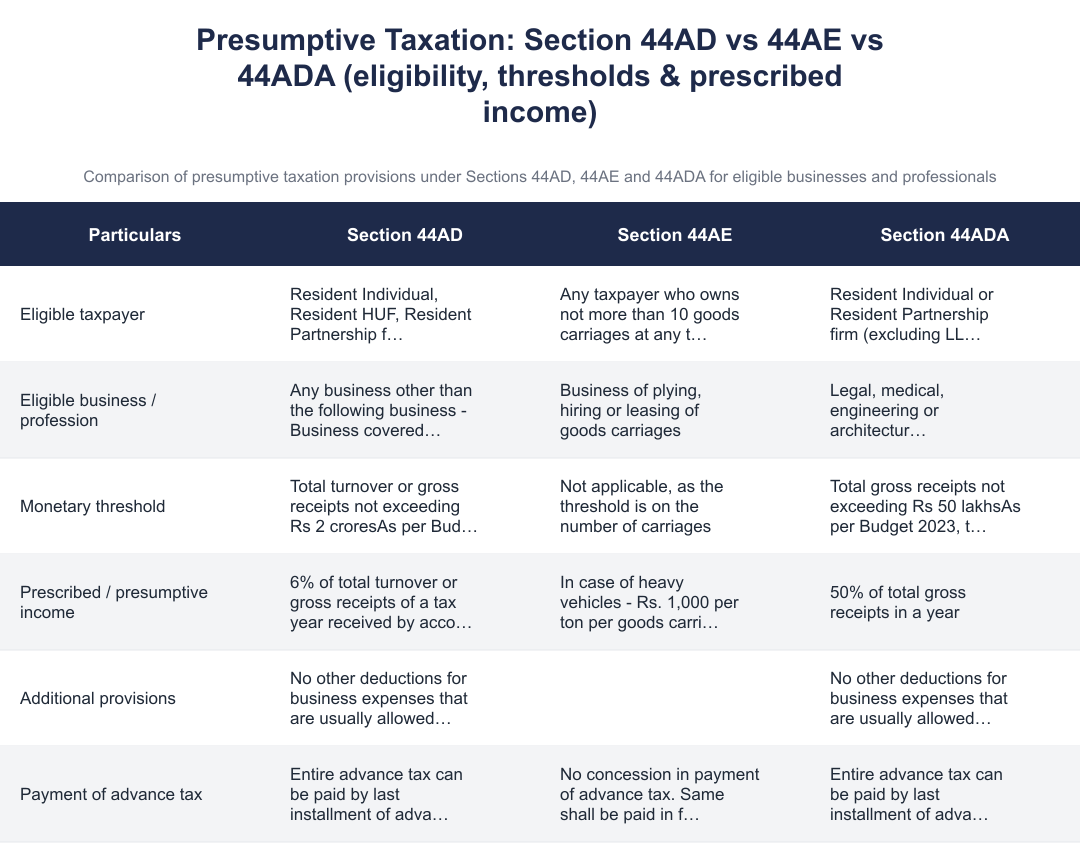
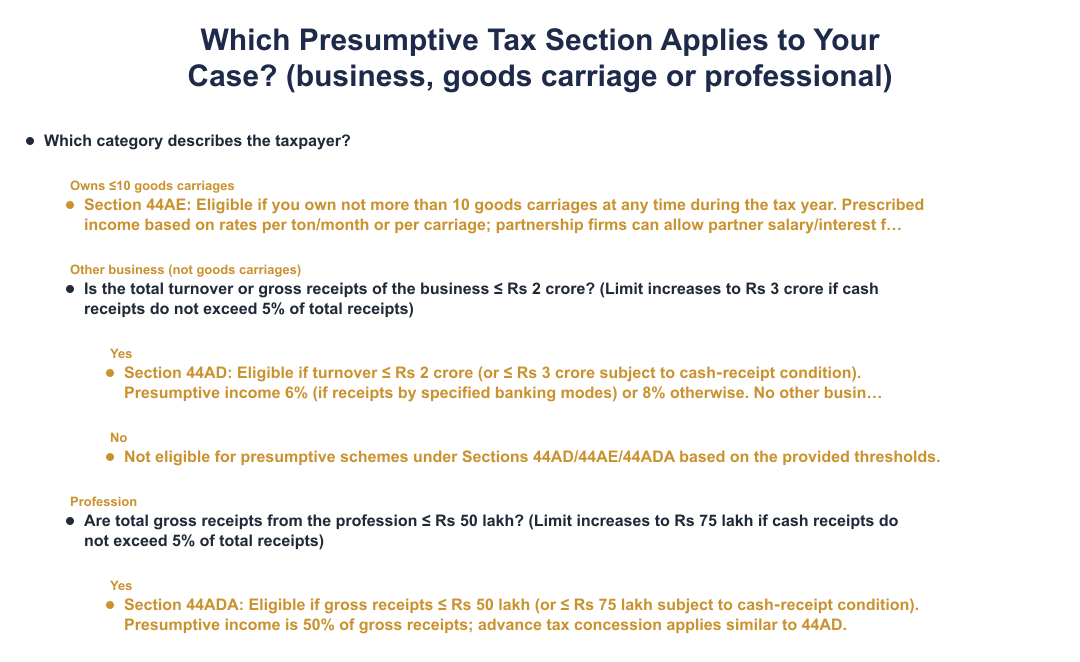
Eligible taxpayers are resident individuals, resident HUFs and resident partnership firms (excluding LLPs) for Sections 44AD and 44ADA, and any taxpayer who owns not more than 10 goods carriages for Section 44AE. Section 44AD applies to small businesses (excluding certain businesses like agency, commission/brokerage and those claiming specified profit-linked deductions), Section 44AE applies to transport operators owning up to 10 goods carriages, and Section 44ADA applies to specified professionals (legal, medical, engineering, accountancy, technical consultancy, interior decoration or other notified professions). Each scheme also requires that the taxpayer meet monetary or ownership thresholds: turnover limits for 44AD and 44ADA and number-of-vehicles limit for 44AE.
What income limits or turnover thresholds apply under Section 44AD and 44ADA?
Under Section 44AD the general turnover threshold is Rs 2 crore, which is increased to Rs 3 crore if cash receipts do not exceed 5% of total receipts; under Section 44ADA the general gross receipts threshold is Rs 50 lakh, increased to Rs 75 lakh if cash receipts do not exceed 5% of total receipts. These higher limits were introduced in Budget 2023 to benefit small taxpayers who keep low cash receipts. If cash receipts exceed 5% of total receipts, the lower thresholds (Rs 2 crore for 44AD and Rs 50 lakh for 44ADA) continue to apply.
What are the prescribed presumptive profit rates under Sections 44AD, 44AE and 44ADA?
Under Section 44AD the presumptive profit is 6% of total turnover or gross receipts if receipts are deposited by account payee cheque/bank draft/ECS on or before the return due date, and 8% in all other cases; under Section 44ADA the presumptive income is 50% of total gross receipts; under Section 44AE the presumptive income is computed vehicle-wise, heavy vehicles at Rs 1,000 per ton per goods carriage per month (or part month) and other vehicles at Rs 7,500 per goods carriage per month (or part month). These rates are the taxable income presumptions and taxpayers may declare higher income if they wish.
Can I claim normal business expenses like depreciation, rent or salaries if I opt for presumptive taxation?
No, if you opt for presumptive taxation the usual business deductions (like depreciation, rent, administrative expenses) cannot be claimed against the presumptive income under Sections 44AD and 44ADA; however, under Section 44AE a partnership firm can deduct salary and interest paid to partners from the prescribed income above the presumptive calculation. Also, for asset treatment under 44AD/44ADA, written down value can be computed as if depreciation has always been claimed, but you still cannot separately claim those deductions while following the presumptive scheme. Taxpayers are free to declare taxable income higher than the prescribed presumptive income if that is beneficial.
What happens if I declare profit lower than the prescribed presumptive income under these sections?
If you declare taxable income lower than the prescribed presumptive income under Sections 44AD, 44AE or 44ADA, the Income Tax Department may disallow the lower claim and treat your income as the prescribed presumptive income for assessment purposes. Declaring less invites scrutiny and potential additions during assessment, because the law presumes the specified percentage or vehicle-based amounts as minimum taxable income. Therefore, to legitimately report lower income you would need to opt out of the scheme following the rules for opting out or maintain full books and get them audited when required.
What are the consequences if I opt out of presumptive taxation under Section 44AD?
If you opt out of Section 44AD and claim profits lower than the presumptive rate, you will be required to maintain regular books of account and get them audited if your income exceeds the audit threshold, and you cannot opt back into Section 44AD for the next five assessment years. Specifically, once you opt out and the total income exceeds the basic exemption or audit limits, normal accounting, audit and compliance rules apply and the restriction prevents re-entry into presumptive taxation for five years. This lock-out is intended to discourage frequent switching and to ensure proper compliance for businesses that need detailed records.
How does advance tax payment work for taxpayers under these presumptive schemes?
Taxpayers under Sections 44AD and 44ADA are allowed to pay their entire advance tax by the last installment (15 March) of the financial year, while Section 44AE taxpayers have no such concession and must pay advance tax in four installments as per standard rules. If you fail to pay the required advance tax by the due date under 44AD/44ADA, interest under Section 234C at 1% may apply on the shortfall. So businesses using 44AD or professionals using 44ADA get a single-installment concession, but transport operators under 44AE must follow the usual quarterly advance tax schedule.
Does the 6% versus 8% rate under Section 44AD depend solely on mode of receipt?
Yes, the difference between 6% and 8% under Section 44AD depends on whether receipts are collected through banking channels: 6% applies when turnover/gross receipts are received by account payee cheque/bank draft or ECS credited to bank on or before the filing due date, while 8% applies in all other cases. The lower 6% rate is available only if the prescribed portion of receipts is realized through specified banking methods timely; failure to meet this condition means the higher 8% presumptive rate applies. This rule incentivizes banked receipts and can materially change the taxable presumptive income calculation.
How is prescribed income computed for goods carriage owners under Section 44AE?
For goods carriage owners under Section 44AE prescribed income is computed on a per-vehicle and per-month basis: heavy vehicles are taxed at Rs 1,000 per ton per goods carriage for every month or part of a month, while other vehicles are taxed at Rs 7,500 per goods carriage for every month or part of a month. This vehicle-wise computation applies for the period during which each goods carriage is owned in the tax year, and ownership includes vehicles taken on hire or installment where payments are still due. If the taxpayer is a partnership firm, salary and interest paid to partners can be deducted from the prescribed income above this calculation.
Need help staying Income Tax compliant?
MoneyGence's AI Finance OS tracks your compliance, wallet share, and finances in one place, built for agencies and growing businesses.
Get started with MoneyGence