POSH Act Compliance Checklist for Indian Businesses
This guide explains practical compliance requirements under the Prevention of Sexual Harassment (POSH) framework, with a focus on constituting and running Internal Complaints Committees (ICCs), mandatory reporting fields for annual disclosure, and recent government instructions to strengthen implementation. You will learn who should sit on an ICC, what the committee must do when a complaint is received, how long members may serve, and what employers and public authorities are expected to publish and verify. The guide also covers administrative expectations such as training, awareness programs and payment of fees to external members. Understanding these points matters because properly constituted ICCs, transparent reporting and regular capacity-building are the foundation of an effective workplace response to sexual harassment. Following the items below will help HR teams, compliance officers and leaders ensure their policies and practices meet statutory design and operational expectations and that complaints are handled fairly and promptly.
Who must be on an ICC (committee composition)
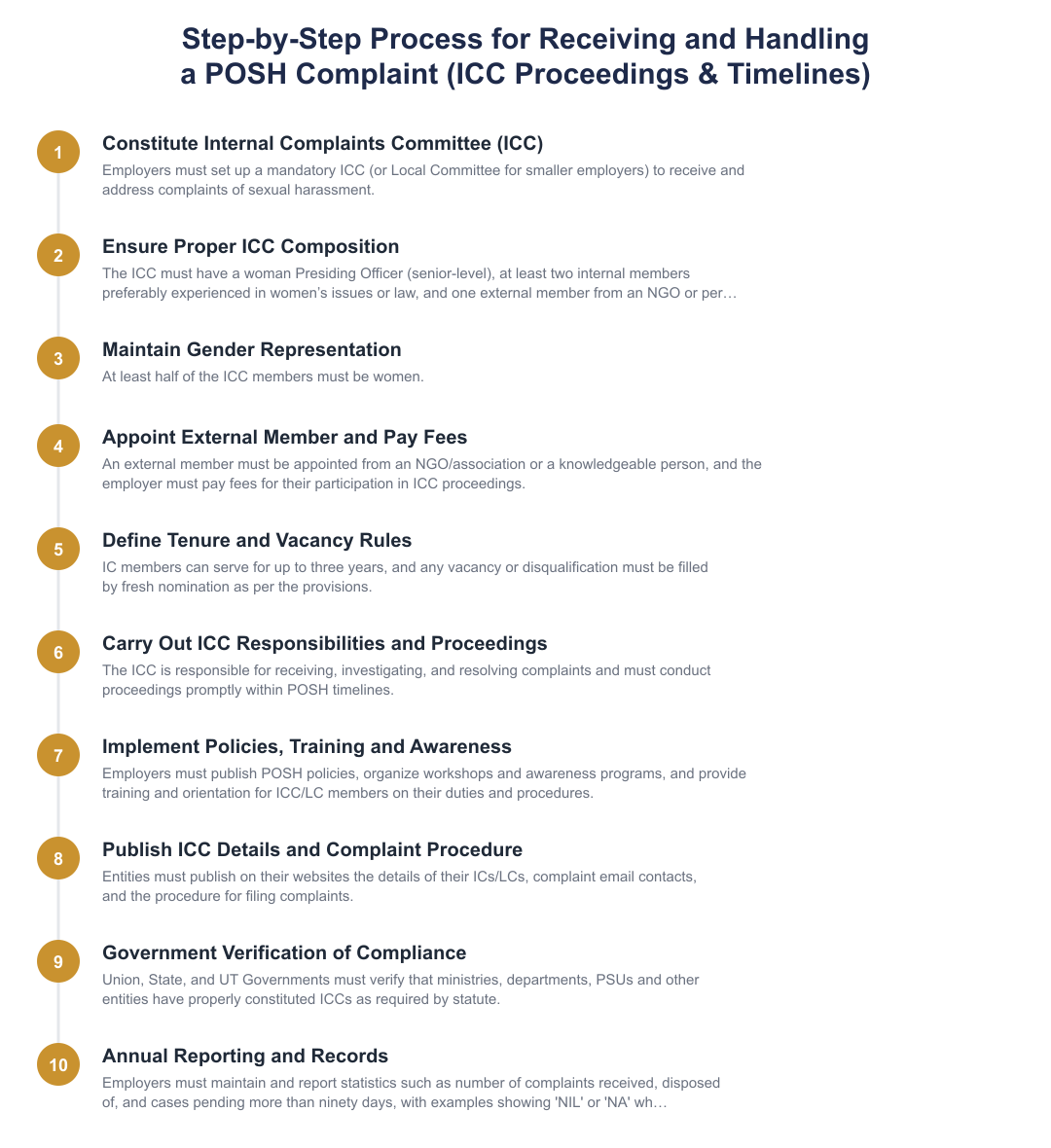
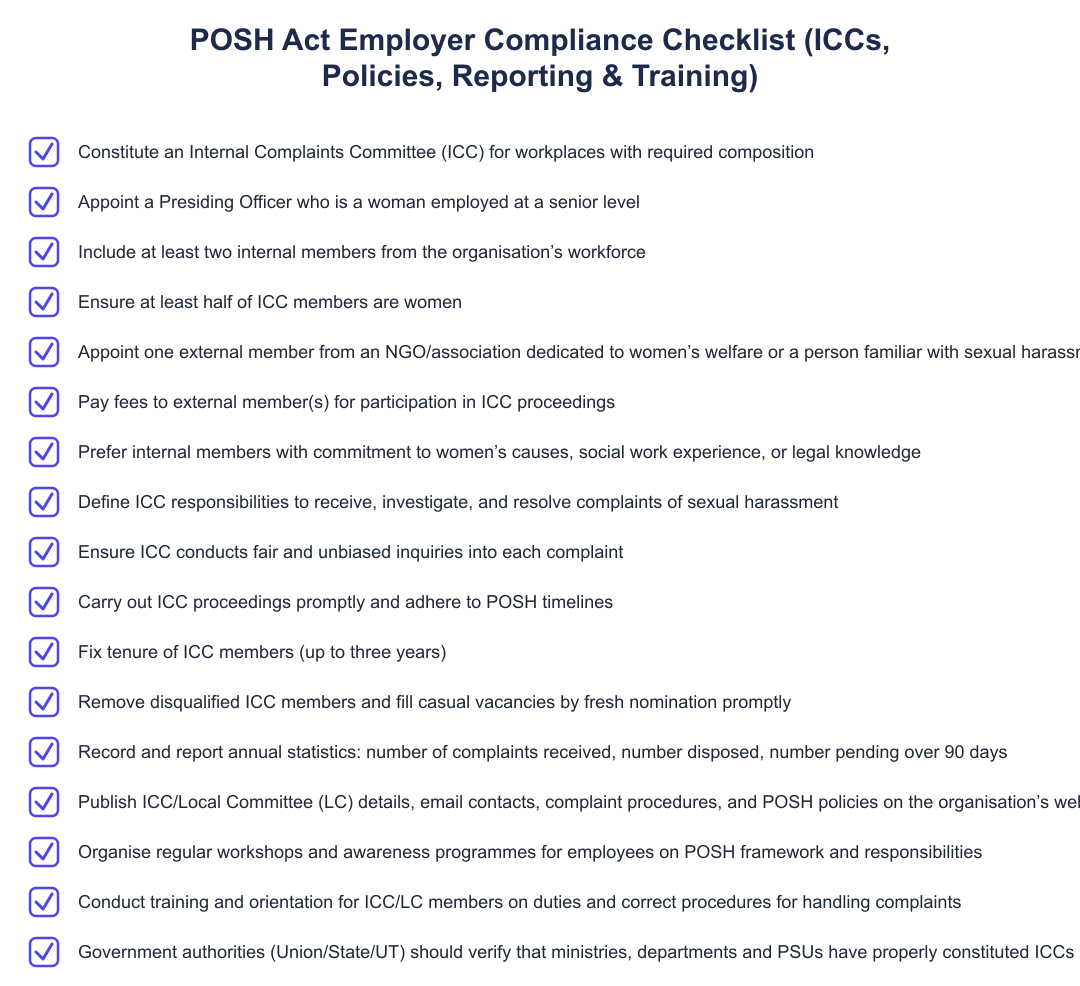
The POSH framework prescribes a specific composition for Internal Complaints Committees. The presiding officer must be a woman employed at a senior level, and at least half of the committee members should be women. This gender composition is intended to ensure women’s perspectives are represented in the committee’s leadership and decision-making.
ICCs must include at least two internal members drawn from the organization’s workforce. These internal members are preferably those committed to women’s causes, experienced in social work, or possessing legal knowledge, qualities that help the committee evaluate complaints sensitively and fairly. In addition, an external member is required: someone from a non-governmental organization or association dedicated to the welfare of women or a person familiar with issues relating to sexual harassment.
Employers are also required to remunerate external members for their participation in ICC proceedings. This acknowledges the specialist contribution external members provide and supports their independent, professional engagement in inquiries.
Duties and procedural expectations of the ICC
The ICC’s core responsibility is to receive, investigate and resolve complaints of sexual harassment. The statute emphasises fair and unbiased inquiry processes: when a complaint is filed, the committee must handle it impartially, ensuring procedural fairness to all parties involved.
Proceedings must be carried out promptly and in accordance with the timelines stipulated under the POSH Act. While the Act sets procedural timetables, the practical implication for employers is to ensure responsive intake, timely investigation and resolution so that complainants and respondents are not subject to unnecessary delay.
Maintaining confidentiality, documenting each stage of the inquiry and following a transparent process are essential practices that support fairness and reduce the risk of procedural challenges. Having internal members with social work or legal experience helps the ICC apply these principles consistently.
Practical steps to constitute and operate an ICC
Ensure the presiding officer is a woman employed at a senior level in the organisation.
Select at least two internal members from the workforce, preferably those committed to women’s causes, experienced in social work, or with legal knowledge.
Appoint an external member from an NGO or a person familiar with sexual harassment issues, and make arrangements to pay their participation fees.
Confirm that at least half of the ICC members are women to meet the statutory condition.
Set member terms so that ICC members serve for up to three years in accordance with tenure provisions.
Carry out proceedings promptly and adhere to the timelines stipulated under the POSH Act when investigating and resolving complaints.
Reporting, publishing and government verification
There are standard reporting fields that organisations should include in their annual disclosures about POSH compliance. These template fields include: number of complaints received in the year; number of complaints disposed of during the year; and number of cases pending for more than ninety days. Including these items helps boards and regulators track how effectively complaints are being handled.
Government authorities have directed that Union, State and UT governments must verify whether ministries, departments, public sector undertakings and similar entities have properly constituted Internal Committees as required. For employers, this means that compliance is subject to external verification and that maintaining up-to-date records and committee details is important.
Entities are also required to publish on their websites details of their Internal Committees or Local Committees, including email contacts, complaint procedures and relevant policies. Public visibility of committee details and complaint mechanisms increases accessibility for employees and demonstrates organisational commitment to a safe workplace.
Training, awareness and employer responsibilities
Authorities have indicated that training and orientation for IC/LC members on their duties and the correct procedures for handling complaints is essential. Regular orientation sessions help committee members understand procedural requirements and apply them consistently during complaints handling.
Employers should also organise workshops and awareness programmes to sensitise both committee members and employees about the POSH framework and responsibilities. Such capacity-building promotes a culture where issues are reported early and addressed through established channels.
Taken together, training, transparent publishing of committee details, and routine awareness activities support an accountable and responsive complaints ecosystem, which is the central objective of the POSH framework.
Implementing POSH obligations requires attention to committee composition, documented procedures, transparent reporting and ongoing capacity-building. Make sure your ICC has the mandated officers and members, that external members are engaged and paid, that proceedings are prompt and fair, and that annual reporting fields are maintained and published. Regular training and government verification efforts mean organisations should treat POSH compliance as an active, ongoing process rather than a one-time formality.
Frequently asked questions
What is the required composition of an Internal Complaints Committee (ICC) under the POSH Act?
The ICC must have a woman presiding officer at senior level, at least two internal members from the workforce, and one external member from an NGO or person familiar with women's welfare. At least half of the committee members should be women, internal members are preferably those committed to women’s causes or experienced in social work or law, and the employer must pay fees to the external member for participation. This composition ensures independence and sensitivity in handling complaints and meets the statutory requirement for balanced representation and expertise.
What are the primary responsibilities of the ICC when a sexual harassment complaint is received?
The ICC is responsible for receiving, investigating, and resolving complaints of sexual harassment and ensuring a fair, unbiased inquiry into each case. It must carry out proceedings promptly while adhering to the timelines stipulated under the POSH Act and follow prescribed procedures for recording evidence, conducting hearings, and issuing recommendations. The ICC also maintains confidentiality and is tasked with ensuring corrective measures and follow-up as required by the inquiry outcomes.
What are the tenure and removal rules for ICC members?
ICC members can serve for up to three years as their tenure on the committee. A member shall be removed from the committee and the resulting vacancy filled by fresh nomination if they meet any disqualification grounds as provided under the POSH provisions. Employers should maintain records of appointments and reappointments to ensure continuity and compliance with tenure norms.
What must employers publish on their website to comply with POSH requirements?
Employers must publish details of their ICCs or Local Committees, email contact information, complaint procedures, and relevant POSH policies on their websites. This publication should include how to make a complaint, committee member details, and any guidance on timelines and confidentiality to ensure accessibility and transparency for employees. Public posting helps in accountability and assists authorities during verification and audits.
What information must be included in the annual POSH report?
The annual POSH report should include the number of complaints of sexual harassment received during the year, the number of complaints disposed of during the year, and the number of cases pending for more than ninety days. Typical template entries may show 'Number of complaints received in the year: NIL; Number of complaints disposed of during the year: NA; Number pending for more than ninety days: NA' when there are no complaints. Employers should maintain accurate records to populate these fields for compliance and audit by authorities.
What training and awareness steps must employers take under POSH compliance?
Employers must conduct training and orientation for ICC/Local Committee members on their duties and correct procedures for handling complaints and regularly organize workshops and awareness programs to sensitize employees about the POSH framework. These initiatives should cover complaint mechanisms, confidentiality, timelines, and preventive measures, and be documented to show compliance during inspections or audits. Regular refreshers help ensure the committee and workforce remain informed about evolving best practices and statutory obligations.
What role do Union, State and UT Governments have in ensuring POSH compliance?
Union, State and UT Governments are required to verify that their ministries, departments, PSUs and other entities have properly constituted Internal Committees as per statutory requirements and are complying with POSH rules. Authorities must also ensure that entities publish ICC details and complaint procedures, and that training and awareness activities are being conducted for committee members and employees. These verification steps form part of oversight to enforce uniform implementation across government bodies.
What procedural standards must the ICC follow while conducting enquiries?
The ICC must carry out its proceedings promptly, adhere to the timelines stipulated under the POSH Act, and ensure fair, unbiased inquiry procedures including recording evidence, providing both parties an opportunity to be heard, and maintaining confidentiality. Proceedings should follow prescribed formats for documentation and ensure impartiality by avoiding conflicts of interest among members, with external members assisting to enhance neutrality. Proper procedure and timely action are essential both for justice to the parties and for employer compliance records.
What directions have courts, including the Supreme Court, given regarding POSH compliance?
Courts, including the Supreme Court, have directed strict adherence to POSH requirements such as constitution of ICCs, publication of committee details and complaint procedures, timely training, and maintenance of records, emphasizing that institutions must implement these measures in letter and spirit. Judicial directions often require authorities to verify compliance across ministries, departments and PSUs and to take corrective action where lapses are found, reinforcing transparency and accountability. These judicial pronouncements underscore that POSH compliance is a continuing obligation and not merely a paperwork exercise.
Need help staying Compliance compliant?
MoneyGence's AI Finance OS tracks your compliance, wallet share, and finances in one place, built for agencies and growing businesses.
Get started with MoneyGence