OSH Rules 2026 Mines: Mine Safety, Medical Fitness & Rescue Compliance
The Occupational Safety, Health and Working Conditions Rules 2026 (OSH Rules, 2026) recast mine safety around four practical pillars: competent management, medical fitness of the workforce, robust rescue and emergency preparedness, and structured vocational competence. This guide explains what the Rules require in each area and what mine operators must do to remain compliant. You will learn who must be appointed before a mine can operate, which small excavations the Code exempts, how medical examinations and records must be managed, the institutional role of safety committees and officers, detailed expectations for mine-rescue preparedness and equipment, and the new emphasis on pre-deployment and refresher vocational training. Understanding these provisions matters because they shift many implicit responsibilities into explicit duties for employers and managers. Compliance is not only about avoiding regulatory action; it reduces accident risk, builds workforce resilience, and preserves operational continuity after incidents. The Rules also make clear that selection for rescue duties must be transparent and competency-based, that medical fitness decisions carry appeal rights, and that training and medical records must follow the worker. Read on for practical explanations of each requirement and an action checklist operators can deploy immediately to align policies, people, processes and records with the 2026 Rules.
Managerial accountability and the scope of applicability
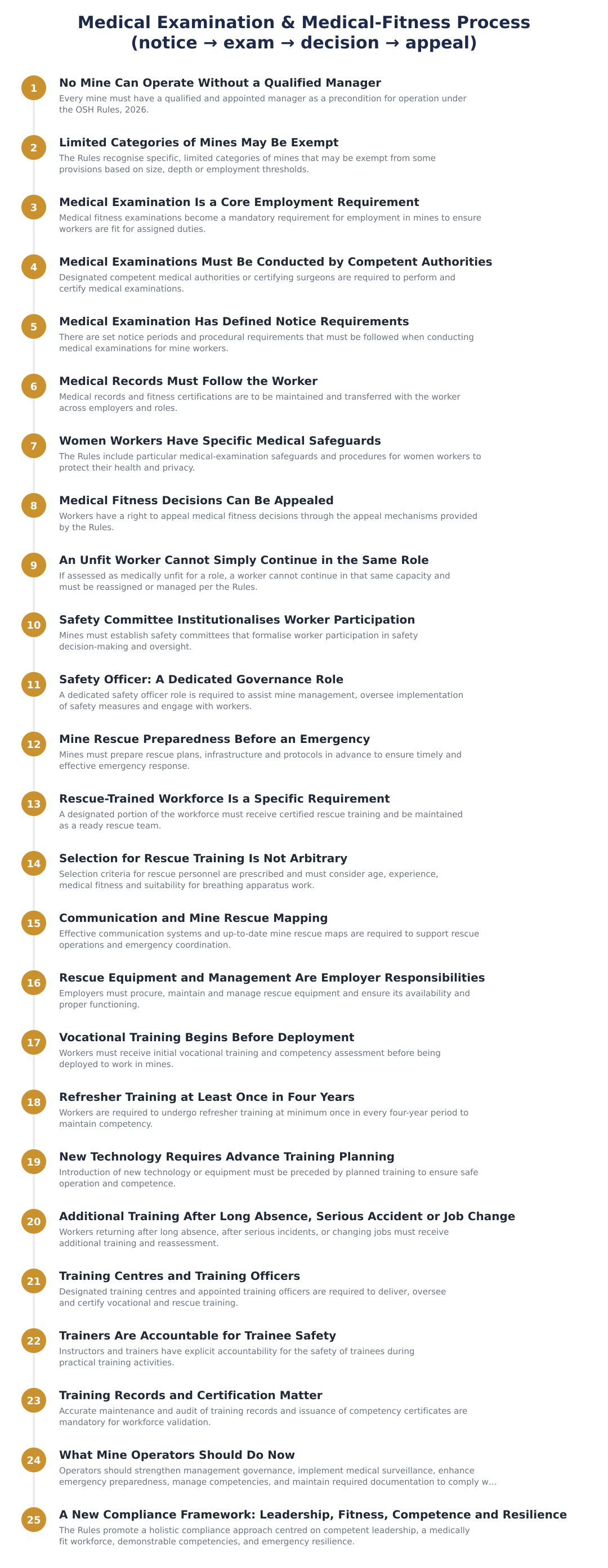
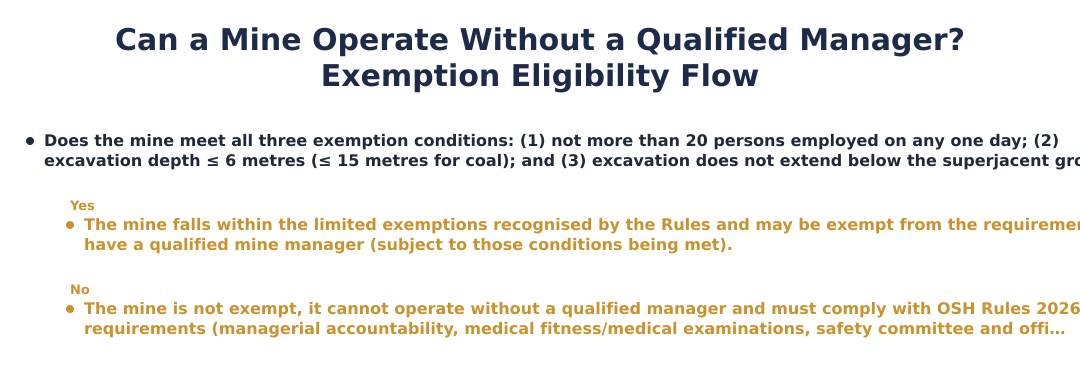
The Rules make managerial competence non-negotiable: no mine can lawfully operate without a qualified manager in place. That requirement elevates the appointment and qualification of mine managers to a primary compliance checkpoint for every operator. Managers are the pivot for implementing the Safety Management Plan and for ensuring statutory duties, from training and medical surveillance to emergency preparedness, are executed across shifts and workings.
Not every small excavation is brought into the same regulatory orbit. The Rules recognise limited categories of mines for exemption: excavations where not more than 20 persons are employed on any one day; where the excavation does not exceed six metres in depth or fifteen metres in the case of coal; and where the excavation does not extend below the superjacent ground. Operators of such small workings should still assess whether other provisions of the Code or local rules apply, but the exemption clarifies the threshold for several OSH obligations.
Medical fitness and occupational health
Medical examination becomes a core employment requirement under the Rules. Mines must put in place initial and periodic (including annual) medical examinations and dust-exposure monitoring as part of routine medical surveillance. Medical fitness is thus embedded in both hiring decisions and ongoing fitness-for-duty assessments.
Examinations must be conducted by competent authorities and follow defined notice requirements. Medical records travel with the worker: certified medical records are to be maintained so a worker’s occupational health history is available across employments. Where women workers are involved, the Rules provide specific safeguards in how medical examinations are conducted to protect privacy and dignity.
If a worker is declared unfit for a role, they cannot simply continue in the same job; the employer must manage re-deployment or remedial measures. There is also an appeals mechanism: a medical fitness decision can be appealed, giving workers a formal route to challenge findings and seek reassessment.
Safety governance and worker participation
Worker participation in safety becomes institutionalised through Safety Committees. Committees are expected to offer a forum for occupational safety communication, discuss unsafe conditions and practices, consider safety measures before new works begin, review accident and dangerous-occurrence investigations, develop safety campaigns, and review the Safety Management Plan. This turns workplace dialogue into a documented and recurring governance activity rather than an ad hoc conversation.
The Rules also set out a dedicated Safety Officer role to assist the mine manager on safety matters. Duties include ensuring implementation of the emergency plan, visiting different parts of the mine, engaging with workers on safety issues, investigating accidents and dangerous occurrences, analysing accident statistics and identifying sources of danger, conducting safety education, supporting vocational training, checking compliance with the Code and Rules, and promoting safe practices. Together, an engaged Safety Committee and a designated Safety Officer create layered oversight and a clear line of accountability for routine and exceptional safety tasks.
Mine rescue and emergency preparedness
The Rules require preparedness before an emergency arises. Operators must plan for mine rescue infrastructure such as rescue stations or rescue rooms, maintain rescue equipment, and keep effective communication systems and rescue tracings or mine-mapping that help rescue teams navigate underground. Key mine features to be kept under scrutiny for rescue planning include ventilation systems, air currents and ventilation controls, fire-fighting equipment, water dams and pumping stations, telephone and ambulance stations, storage of inflammable materials, and haulage and travelling roadways.
A rescue-trained workforce is a specific requirement and selection for rescue duties is not arbitrary. Candidate criteria include being between 21 and 40 years of age, possessing a valid first-aid certificate, having sufficient underground experience, being medically fit for rescue work, and being considered suitable for work with breathing apparatus. Employers are responsible for ensuring rescue equipment and its management are in place and that communication and mine rescue mapping aid rapid response.
Vocational training and competency management
Training is front-loaded and continuous: initial vocational training must occur before deployment, and refresher training is required at least once in four years. Refresher training restores and updates essential skills, while initial training ensures workers start work with a baseline competency in hazards, safe working practices, escape routes and emergency response procedures.
The Rules also require planning for training when new technology or equipment is introduced, particularly automation, advanced machinery, digital monitoring, remote operations and new safety systems. Additional training must be provided after long absences (returns after an absence exceeding one year), after involvement in a serious accident or dangerous occurrence that could have threatened life or safety, or when a worker is re-employed in a different job.
Training centres and Training Officers must organise and supervise training, recognise current competency and prior learning, ensure delivery against prescribed modules, maintain training and practical-training records, and report progress to the mine manager. Instructors and trainers are held to account for trainee safety during practical training, and training records and certification matter operationally and for regulatory audits.
What should mine operators do now?
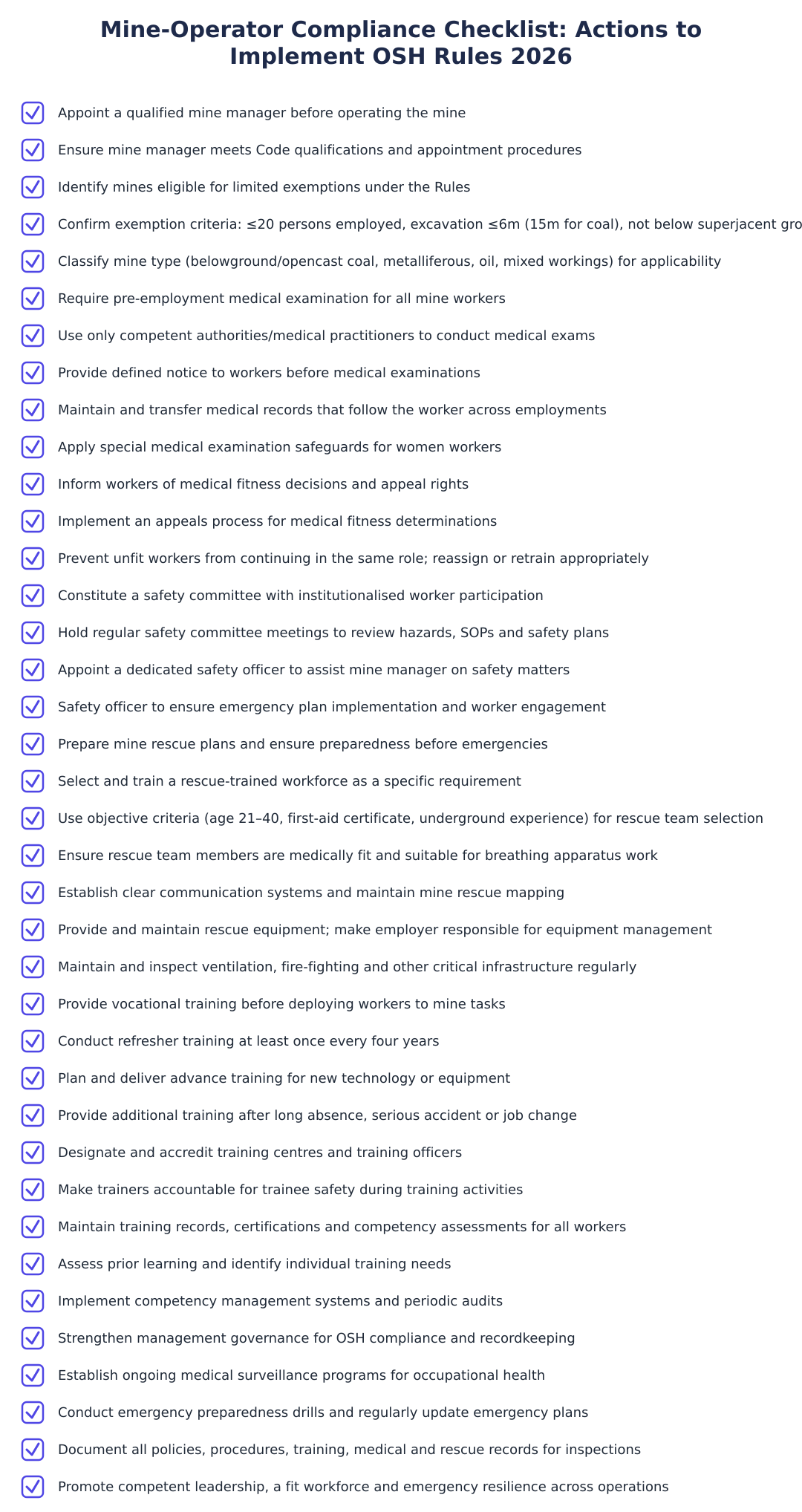
Management governance: confirm that a qualified manager is appointed and that Safety Committees and a Safety Officer are constituted with clear terms of reference. Update the Safety Management Plan so it explicitly addresses the Rules’ expectations and make sure the plan is reviewed in Safety Committee meetings.
Medical surveillance: establish processes for initial and annual medical examinations by competent medical authorities, set up notice procedures for examinations, and create a system so medical records follow the worker. Define a clear, fair appeals route for medical fitness decisions and procedures for re-deployment when workers are unfit for specific roles.
Emergency preparedness and rescue capability: set up or audit rescue stations/rooms, maintain rescue equipment and communications, ensure mine-mapping/rescue tracings are current, and select rescue candidates using objective criteria including age, first-aid certification, underground experience and medical fitness for breathing-apparatus work.
Competency management and training: schedule pre-deployment training, plan refresher training at least once in four years, create advance training plans for new technology and ensure additional training after long absences, serious accidents or job changes. Empower Training Officers and maintain practical training records and certification.
Documentation and records: maintain up-to-date training records, medical certificates, rescue records, Safety Committee minutes, accident and dangerous-occurrence records, and competency assessments so the mine can demonstrate compliance during internal audits and regulatory inspections.
The OSH Rules, 2026 create a clearer, more prescriptive framework for mine safety by linking managerial accountability, medical surveillance, rescue readiness and structured training. Operators who align governance, medical processes, emergency systems and competency records will improve compliance and, more importantly, reduce the human and operational cost of incidents. Start with the appointment of the right manager, formalise safety governance, set up medical and training systems, and ensure rescue readiness is documented and practised.
Frequently asked questions
Can a mine operate without a qualified mine manager under the OSH Rules 2026?
No, under the OSH Rules 2026 a mine cannot operate without a qualified manager appointed in accordance with the Rules. The Rules make managerial accountability central, requiring mines to have managers who meet prescribed qualifications and appointments; only a limited set of small or shallow excavations may be exempt. Operating without such a manager would breach the Rules and expose the owner to enforcement action, so operators must verify qualifications and documentation before continuing operations.
Which mines are exempt from some OSH Rules 2026 requirements?
Only limited categories of small or shallow mines are recognised for exemption under OSH Rules 2026. Exemptions typically apply where not more than 20 persons are employed on any day, excavation depth does not exceed six metres (or fifteen metres for coal), and excavation does not extend below superjacent ground; specific legal text should be checked for exact thresholds. Even where exempted from some managerial or procedural requirements, operators must still comply with other core safety obligations and any conditions specified in the exemptions.
Is medical examination mandatory for mine employment under the OSH Rules 2026?
Yes, medical examination is a core requirement for employment in mines under the OSH Rules 2026. The Rules require pre-employment and periodic medical examinations by competent authorities to establish fitness for specific mine duties and job categories, with records maintained and transferred with the worker. There are defined notice periods and appeal routes for medical fitness decisions, and special safeguards for women workers are included in the Rules.
Who can conduct the medical examinations and what notice is required?
Medical examinations must be conducted by designated competent authorities as specified in the OSH Rules 2026 and employers must give prescribed notice before arranging them. The Rules set out which medical officers or institutions qualify as competent authorities and require employers to inform workers and the authority within defined timeframes so examinations can be scheduled. Employers must also ensure medical records follow the worker and that appropriate confidentiality and record-keeping protocols are observed.
What special protections do women workers have in medical examinations under OSH Rules 2026?
The OSH Rules 2026 include specific safeguards for women by mandating respectful conduct, privacy and appropriate female medical examiners where required. Women workers must be examined in a manner that protects dignity and confidentiality, and the Rules may require female medical staff or chaperones for sensitive examinations. These safeguards complement the broader medical fitness framework and are intended to prevent discrimination while ensuring occupational health is properly assessed.
Can a worker appeal a medical fitness decision under the OSH Rules 2026?
Yes, a worker can appeal a medical fitness decision under the OSH Rules 2026 through the appeal mechanism provided in the Rules. The process allows workers to seek review by another competent medical authority or an appellate body within defined time limits, and employers must follow interim guidance while the appeal is pending. Appeals are an important safeguard because an adverse fitness finding can affect employment and redeployment options, and the Rules also prevent an unfit worker from simply continuing in the same role without reassessment.
Are safety committees and safety officers mandatory in mines under the new rules?
Yes, the OSH Rules 2026 institutionalise worker participation through mandatory safety committees and require appointment of dedicated safety officers in mines. Safety committees must include worker representatives and discuss unsafe conditions, review accident investigations, plan safety campaigns and review the Safety Management Plan, while safety officers assist the mine manager with safety governance and emergency plan implementation. These measures aim to strengthen on-site worker engagement and formalise regular safety oversight and reporting.
What are the OSH Rules 2026 requirements for mine rescue preparedness and rescue-trained workforce?
The OSH Rules 2026 require mines to have rescue preparedness before any emergency, including trained rescue personnel, specified rescue equipment, communication systems and mine rescue mapping. Rescue team members must meet age, fitness and first-aid criteria (generally 21–40 years, valid first-aid certificate, sufficient underground experience and fitness for breathing apparatus), selection must follow objective criteria, and employers are responsible for maintaining equipment and training. The Rules also mandate regular drills, clear communication protocols and that rescue-ready staff receive advance and refresher training.
What vocational training and refresher training obligations do employers have under OSH Rules 2026?
Employers must provide competency-based vocational training before deployment and refresher training at least once every four years under the OSH Rules 2026. Additional training is required when new technology is introduced, after long absences, serious accidents or job changes, and training must be delivered by appointed training officers at accredited centres with proper records and certifications. Trainers are accountable for trainee safety during training, and employers must maintain auditable training records and certificates to demonstrate compliance and competency.
What immediate steps should mine operators take to comply with OSH Rules 2026?
Mine operators should immediately strengthen management governance, establish medical surveillance systems, enhance emergency preparedness, implement competency management and maintain comprehensive documentation to comply with OSH Rules 2026. Concretely, this means appointing qualified managers and safety officers, scheduling pre-employment and periodic medical exams by competent authorities, forming safety committees, equipping and training rescue teams, developing training plans (initial and refresher), and keeping up-to-date auditable records. Proactive gap assessments and documented action plans will reduce regulatory risk and improve worker safety and operational resilience.
Need help staying Compliance compliant?
MoneyGence's AI Finance OS tracks your compliance, wallet share, and finances in one place, built for agencies and growing businesses.
Get started with MoneyGence