One Person Company (OPC) Registration in India, Procedure & FAQs
This guide explains the One Person Company (OPC) registration procedure in India and what a small business owner needs to know before incorporating. You will learn the standard incorporation steps, the core documents required, key naming and office-proof rules, and the primary ongoing compliances an OPC must observe. Understanding these essentials helps a sole entrepreneur decide whether OPC is the right vehicle, and ensures a smoother interaction with the Ministry of Corporate Affairs (MCA) during incorporation and post‑incorporation compliance. The content below focuses on practical steps, from obtaining a Digital Signature Certificate (DSC) for the proposed director to filing incorporation forms, and highlights mandatory recordkeeping and meeting requirements that continue after registration. Where a question cannot be answered from the official points available, the guide clearly indicates that the fact is not specified in the verified sources, so you can follow up with a practitioner or the MCA for those details.
Advantages of choosing an OPC
An OPC offers the benefit of limited company status while keeping ownership concentrated in one person. Because an OPC is a private company incorporated by one person, it provides a single entrepreneur the structure and legal identity of a company without needing multiple members at incorporation.
Practically, this structure can simplify decision-making and governance because there is only one member. The formalities of a private company apply, but the ownership and control remain with a single individual, which suits many small proprietors looking for a corporate identity while retaining operational control.
Disadvantages and limitations to consider
Because an OPC is formed by a single person, it is inherently tailored to small-scale entrepreneurial ventures rather than larger or multi-owner businesses. The one‑member structure means certain corporate mechanisms that rely on multiple members are not applicable in the same way as in multi-member companies.
There are also regulatory constraints tied to the OPC model, for example, the company name must comply with the Companies (Incorporation) Rules, 2014, and ongoing compliance responsibilities remain the same as other companies, which can create administrative overhead for a single owner.
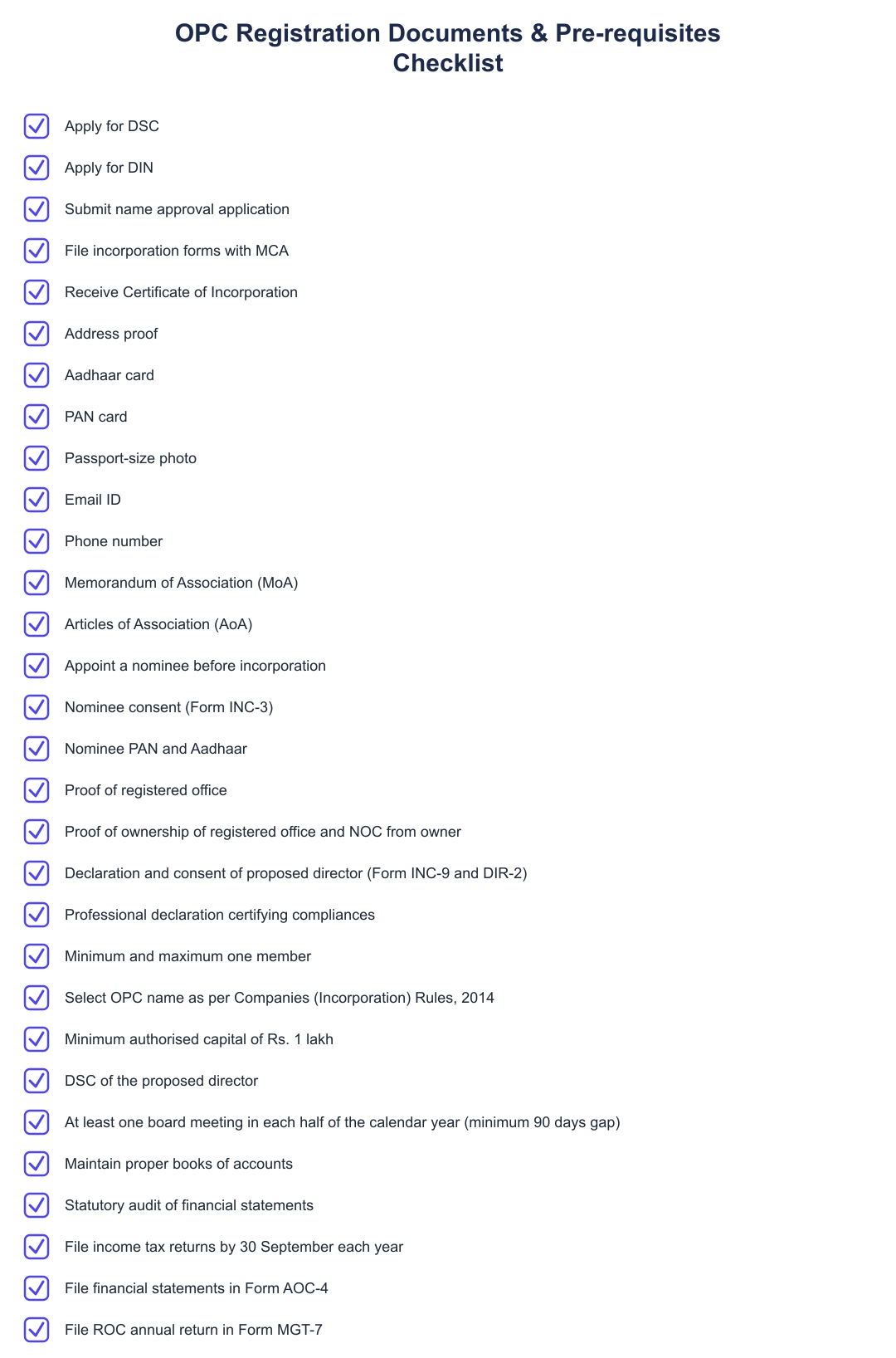
Documents and checklist for OPC registration
| Requirement | Notes (as per verified facts) |
|---|---|
| Membership | Minimum and Maximum of one member for an OPC |
| Memorandum and Articles | MoA and AoA are required documents for incorporation |
| Digital Signature Certificate (DSC) | DSC of the proposed director is required for OPC incorporation |
| Proof of Registered Office | Proof of registered office of the OPC is required for registration |
| Name | The name of the OPC must be selected as per the provisions of the Companies (Incorporation) Rules 2014 |
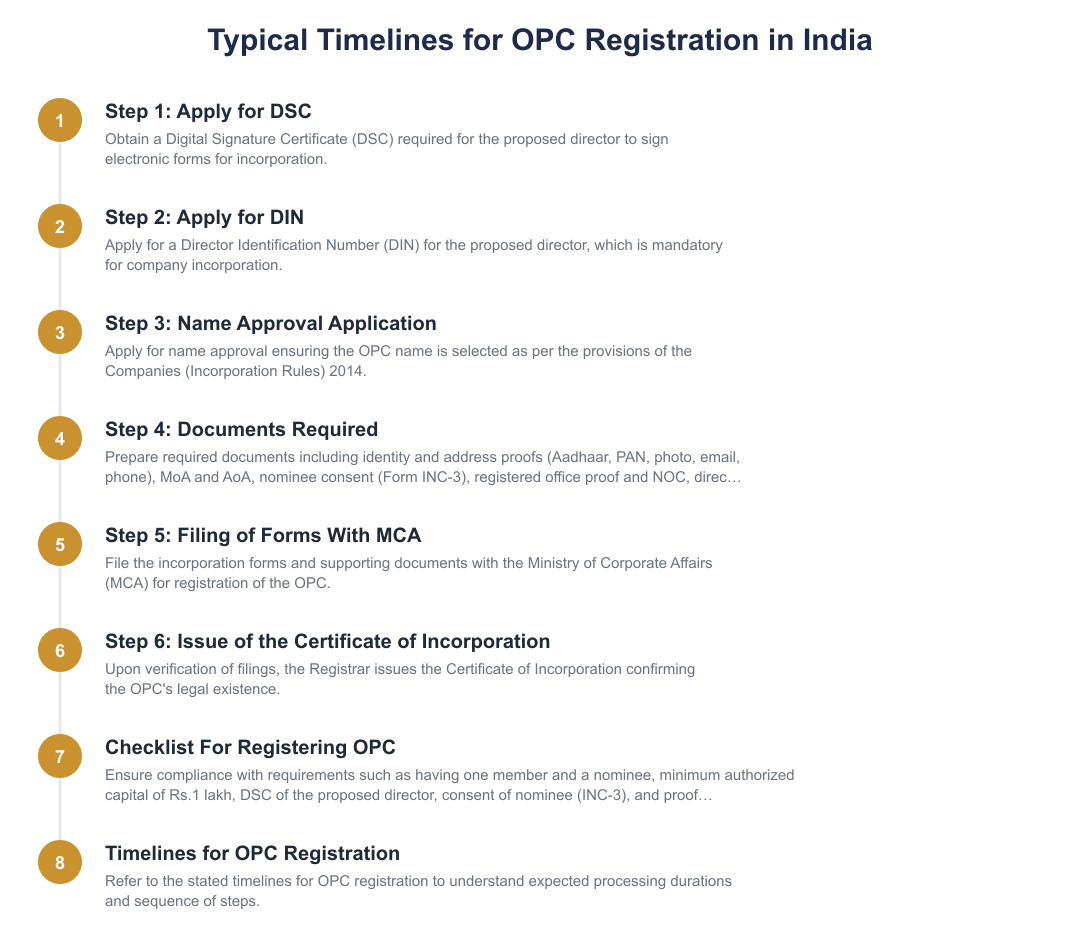
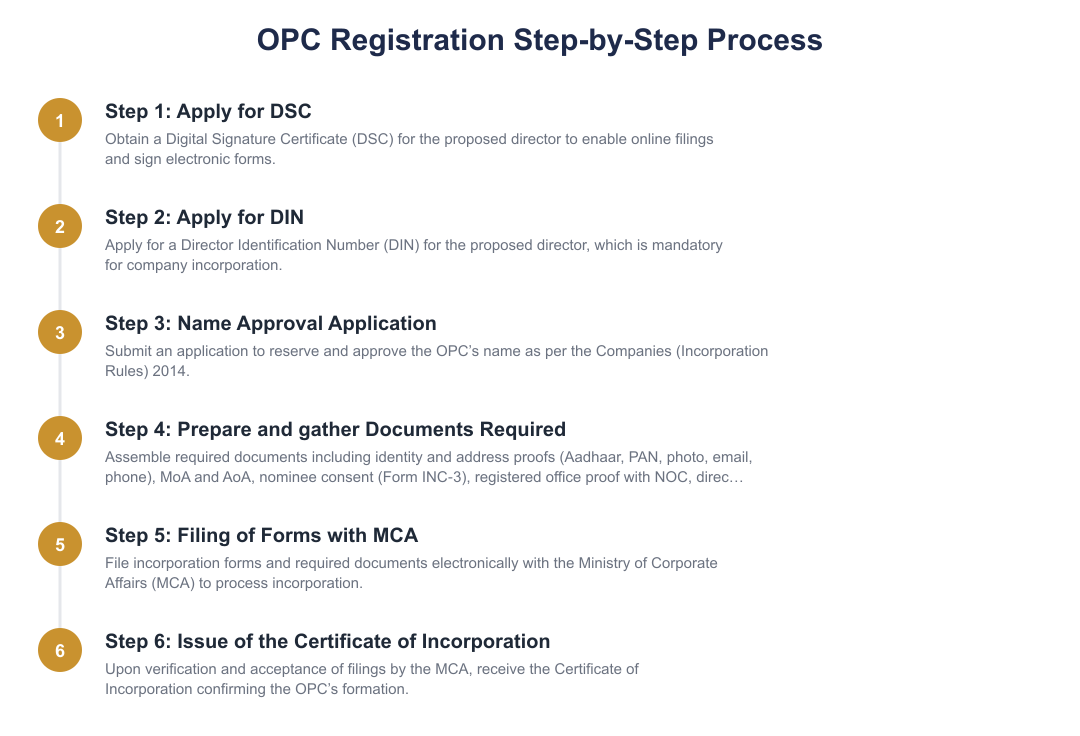
One Person Company (OPC) registration process, step by step
Obtain a Digital Signature Certificate for the proposed director; DSC is a required part of the incorporation process.
Apply for the Director Identification Number (DIN) for the proposed director as part of the incorporation formalities.
Submit the proposed company name ensuring compliance with the Companies (Incorporation) Rules, 2014.
Prepare required incorporation documents including the MoA and AoA, and proof of the registered office.
File the prescribed incorporation forms with the Ministry of Corporate Affairs along with the required documents.
After approvals and verification by the MCA, the Certificate of Incorporation is issued.
Timelines and ongoing compliances after incorporation
After incorporation, an OPC must meet recurring compliance obligations. A key requirement is that at least one Board Meeting must be held in each half of the calendar year, and the time gap between the two Board Meetings should not be less than 90 days. This ensures periodic board-level oversight even in a single‑member company.
In addition to meeting schedules, OPCs must maintain proper books of accounts and are subject to a statutory audit of their financial statements. These recordkeeping and audit obligations are mandatory and continue year after year, forming the backbone of corporate compliance for an OPC.
Frequently asked questions
Who is eligible to be a member of an OPC? An OPC is a private company incorporated by one person; the minimum and maximum membership is one member.
Is there any tax advantage on forming an OPC? The verified facts do not specify any tax advantages for forming an OPC. Consult a tax professional or the tax authority for tax-specific guidance.
Is there any threshold that mandates conversion of an OPC into a private or public company? The verified facts provided do not state any threshold limits or mandatory conversion criteria. For conversion rules, refer to the Companies Act and official MCA notifications or consult a company law practitioner.
Forming an OPC gives a sole entrepreneur a corporate legal form while concentrating ownership in one individual. The incorporation journey follows clear steps, from obtaining a DSC to filing forms with the MCA, and the post‑incorporation regime requires regular board meetings, maintenance of books, and statutory audits. Use this guide as a checklist of the verified requirements, and consult a qualified professional for questions not covered by the verified facts above or for help with filings and tax implications.
Frequently asked questions
What is a One Person Company (OPC) and who can form it in India?
A One Person Company (OPC) is a private company incorporated by a single natural person who is an Indian citizen and resident in India. The member must have stayed in India for at least 182 days in the preceding financial year; minors, foreign citizens, non-residents and persons incapacitated by contract cannot form an OPC. An OPC must appoint a nominee (with consent in Form INC‑3) who will take over if the sole member becomes incapacitated or dies. The company must also meet minimum authorised capital requirements (at least Rs. 1 lakh) and follow naming rules under the Companies (Incorporation) Rules, 2014.
What are the main advantages of starting an OPC instead of a sole proprietorship?
The main advantages of an OPC are limited liability and separate legal status, making the owner distinct from the business for legal and tax purposes. It is easier to obtain funds than a sole proprietorship, has fewer compliances compared with larger companies, and is simple to incorporate and manage with just one director/member. OPCs also enjoy perpetual succession, meaning the company continues even if the sole member changes or passes away because of the nominated successor.
What is the step-by-step process to register an OPC in India?
To register an OPC you must: (1) obtain a Digital Signature Certificate (DSC) for the proposed director, (2) apply for a Director Identification Number (DIN) if not already held, (3) file a name approval application with the MCA choosing an OPC‑compliant name, (4) prepare and submit incorporation documents (MoA, AoA, nominee consent Form INC‑3, proof of registered office, director declarations Form INC‑9 and DIR‑2, and professional declaration), (5) file required forms with the Ministry of Corporate Affairs (MCA), and (6) receive the Certificate of Incorporation from MCA. Ensure minimum authorised capital of Rs. 1 lakh, appointment of a nominee before incorporation, and DSC of the proposed director as prerequisites.
What documents are required to incorporate an OPC?
You need identity and address proof of the member and nominee (PAN, Aadhaar, photo, email, phone), Memorandum of Association (MoA) and Articles of Association (AoA), nominee consent in Form INC‑3, proof of registered office with ownership evidence and NOC if applicable, director declarations (Form INC‑9 and DIR‑2), and a professional's declaration certifying compliance. Additionally you must provide DSC for the proposed director and ensure the nominee’s PAN and Aadhaar are attached. These documents are filed with MCA during the incorporation process.
How long does OPC registration usually take in India?
OPC registration timelines vary but typically take between 7 to 15 working days after submission of complete documents and correct forms to the MCA. Delays usually arise from incorrect or incomplete documents, name approval rejections, or pending verification of DSC/DIN; rectifying these can add several weeks. Applying for DSC and DIN beforehand and ensuring nominee documents and MoA/AoA are accurate helps speed up the process.
What are the mandatory annual compliances for an OPC?
An OPC must hold at least one Board meeting in each half of the calendar year with at least a 90‑day gap between the two meetings, maintain proper books of accounts, get statutory audit of financial statements, file income tax returns by September 30 annually, and file financial statements (Form AOC‑4) and the ROC annual return (Form MGT‑7). These are basic statutory requirements irrespective of the company’s size and must be observed to remain compliant. Failure to comply can attract penalties and prosecution under the Companies Act.
Can one person be a member of more than one OPC or hold multiple OPCs?
No, a person cannot be a member of more than one OPC at the same time; the law allows a minimum and maximum of only one member per OPC. Each individual is therefore limited to being the sole member of a single OPC, although they may be a director in other companies subject to director limits. This restriction prevents accumulation of multiple OPC ownerships by the same person.
What activities or people are restricted from forming an OPC?
OPCs cannot be formed by minors, foreign citizens, non‑residents, or persons disqualified or incapacitated by contract from acting as members; only a natural person who is an Indian citizen and resident (stayed ≥182 days in past year) is eligible. Certain business activities may be restricted under sectoral laws or require additional approvals, so OPCs must ensure compliance with industry‑specific regulations. Always check whether the intended business needs licences (for example, FDI‑sensitive sectors) before incorporating as an OPC.
How do I convert an OPC into a private limited company and when is conversion required?
An OPC can be voluntarily converted into a private limited company by passing a special resolution and increasing the number of members and directors to at least two, along with obtaining No Objection Certificates (NOCs) from creditors; there is no mandatory conversion threshold currently. The Companies (Incorporation) Second Amendment Rules, 2021 removed the earlier compulsory conversion on exceeding paid‑up capital or turnover limits, so conversion is optional unless you seek it for business reasons. File the necessary forms with MCA to record the conversion and update MoA/AoA and company particulars.
Need help staying Company Registration compliant?
MoneyGence's AI Finance OS tracks your compliance, wallet share, and finances in one place, built for agencies and growing businesses.
Get started with MoneyGence