MSMED Amendment Bill 2026: Key Changes to Strengthen MSME Framework
This guide explains what businesses, advisers and compliance teams should consider when a legislative amendment to the MSME (Micro, Small and Medium Enterprises) framework is introduced. You will learn how amendments typically affect classification, registration, dispute-resolution pathways, procurement entitlements, credit access and compliance obligations for micro, small and medium enterprises. Understanding these areas helps MSMEs and their advisors anticipate operational changes, update internal policies, and plan tax, accounting and legal responses. The guide also highlights practical steps businesses can take when a new MSME amendment is notified, so stakeholders can align contracts, supplier arrangements and funding strategies with the changed regulatory environment. Whether you advise MSMEs, manage a small business or work in corporate procurement, the issues covered here will help you interpret the likely significance of any legislative revision to the MSME law and prepare for next steps.
Why amendments to MSME law matter for businesses
Changes to the MSME legal framework can ripple across a business’s operations because they often alter the criteria used to classify enterprises, the entitlements available to registered units and the mechanisms for grievance redressal. For a small or micro business, an amendment may influence eligibility for government schemes, priority in public procurement or access to dispute resolution forums. For larger firms that buy from MSMEs, amendments can modify sourcing obligations, payment timelines and contractual risk allocation.
Practically, businesses need to review how their existing registrations, vendor contracts and financing arrangements align with the new legal text. Even amendments that look technical on their face can create compliance obligations, such as altered reporting, new record-keeping requirements, or changes to statutory timelines, that require updates to internal processes and accounting systems. Early assessment and planning reduce operational disruption and the risk of penalties or missed opportunities.
Key themes to look for in any MSME amendment
When analysing an amendment, focus first on any redefinition of enterprise categories. Changes to turnover, investment thresholds or sectoral carve-outs affect who qualifies as micro, small or medium. Such redefinitions influence eligibility for benefits and may require a business to update its registration or declare a different status in filings and bids.
Second, examine dispute-resolution and enforcement provisions. Amendments often tweak the procedures for claims, timelines for adjudication and remedies available to suppliers. These elements determine how quickly and effectively an MSME can seek relief for delayed payments or contractual breaches. Third, review provisions that affect procurement and payment terms, these can impose obligations on buyers to pay within set timelines or to adopt specific mechanisms for complaint resolution.
Practical steps for MSMEs and buyers after an amendment is notified
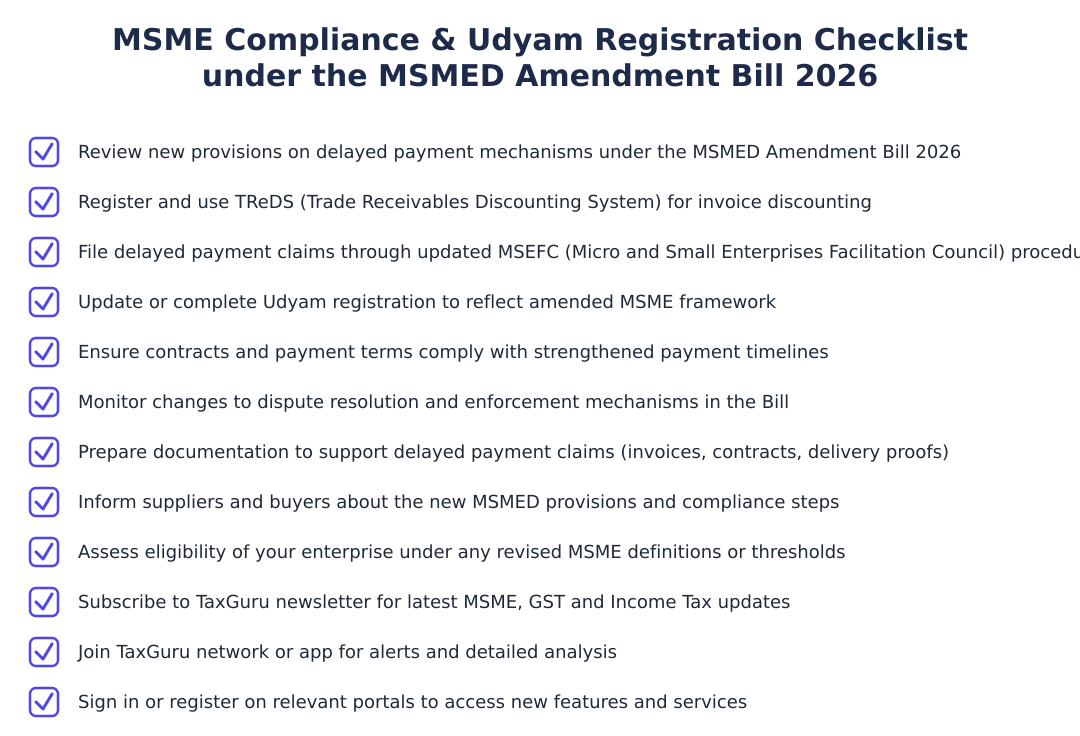
Start with a gap analysis: compare your current status, registrations and contracts with the provisions of the amended law to identify immediate compliance tasks and opportunities for relief or benefits. This helps prioritise actions such as renewing registrations, updating invoices, or amending standard terms with customers and suppliers.
Engage stakeholders: communicate the potential impact to lenders, investors, key clients and suppliers. Where procurement relationships are affected, negotiate transitional arrangements and document any agreed changes. Also, involve your tax and legal advisers early to interpret ambiguous provisions and to design compliant procedures for record-keeping and reporting.
How advisors and compliance teams should prepare
Advisors should prepare template notices, contract clauses and board resolutions that can be rapidly adapted when the practical implications of the amendment become clear. Preparing advisory notes for clients on common scenarios, such as reclassification, payment disputes, or financing covenants, reduces turnaround time and helps businesses take informed decisions quickly.
Compliance teams ought to map internal systems to the new obligations, updating accounting entries, invoice formats and ERP fields where necessary. Training relevant staff on any changed submission deadlines, documentation standards and escalation procedures ensures the organisation meets new obligations and benefits from any statutory protections.
What to watch for in related rules and notifications
Legislative amendments are frequently followed by government rules, notifications and clarifications that fill in operational detail. Stakeholders should monitor official issuances to understand application timelines, transitional arrangements and the administrative process for registration or dispute resolution. These secondary instruments often contain crucial compliance dates, forms and procedural steps.
Also pay attention to judicial interpretations and industry guidance that may emerge after an amendment. Courts and tribunals can clarify ambiguous provisions, and industry bodies often issue FAQs or best-practice checklists that help businesses implement changes consistently.
When an amendment to the MSME framework is introduced, the key to a smooth transition is rapid assessment, stakeholder engagement and updating of internal systems. By focusing on classification criteria, dispute-resolution mechanics, procurement and compliance processes, and by monitoring subsequent rules and guidance, MSMEs, buyers and advisers can reduce disruption and capture any new benefits the amendment provides.
Frequently asked questions
What is the Micro, Small and Medium Enterprises Development (Amendment) Bill, 2026 that Parliament passed?
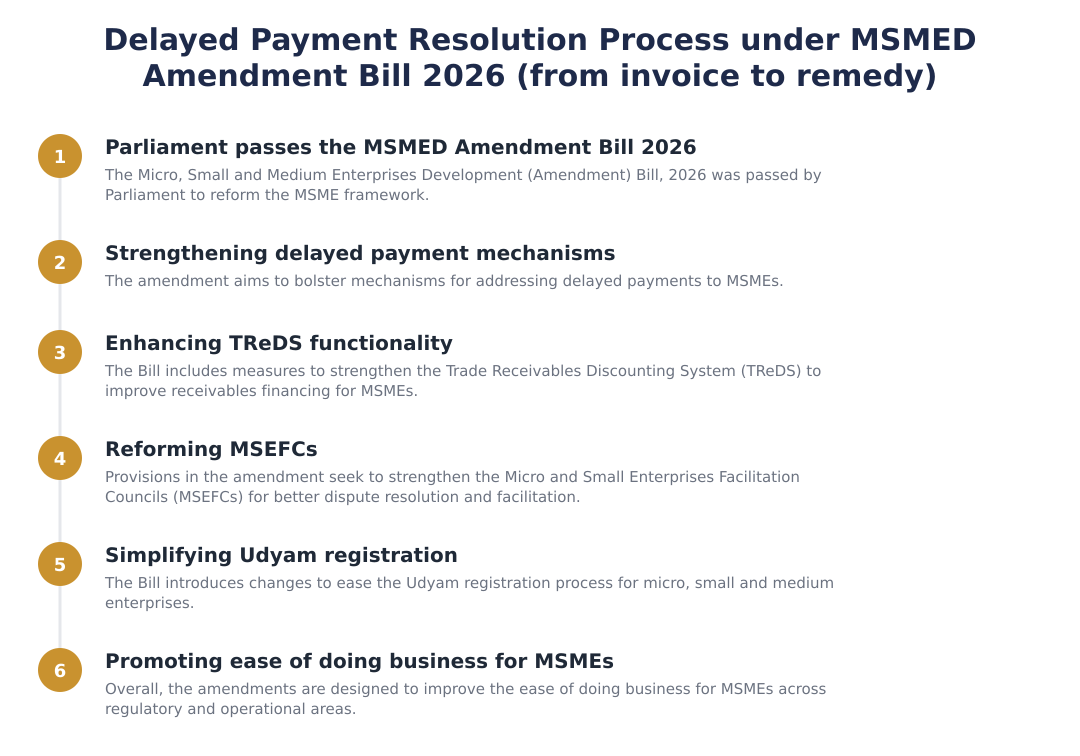
The Micro, Small and Medium Enterprises Development (Amendment) Bill, 2026 is a law passed by Parliament in 2026 to strengthen the MSME framework across India. It amends existing MSME legislation to improve statutory mechanisms for delayed payments, bolster electronic trade receivables platforms (TReDS), strengthen Micro and Small Enterprises Facilitation Councils (MSEFCs), streamline Udyam registration and generally ease doing business for micro, small and medium enterprises. The Bill seeks to provide faster remedies for payment disputes and better institutional support for MSMEs while promoting digital onboarding and dispute resolution. It is intended to make compliance and access to redressal more efficient for MSME sellers and vendors dealing with larger buyers.
How does the 2026 amendment strengthen mechanisms for delayed payments to MSMEs?
The 2026 amendment strengthens delayed payment mechanisms by creating clearer statutory routes and institutional support for quicker recovery of dues owed to MSMEs. It enhances the role of enforcement and facilitation bodies so MSMEs can seek timely remedies for overdue invoices, and links these mechanisms with digital platforms like TReDS to expedite settlement. The change aims to reduce dependence on long court battles and to enforce timelines for payment between buyers and MSME suppliers, thereby improving cash flow for small businesses. This applies to contractual and supply-chain payments where MSMEs have been facing persistent delays.
What changes does the Bill make to TReDS (Trade Receivables Discounting System)?
The Bill strengthens TReDS by promoting it as a primary digital platform for discounting and settling MSME receivables to accelerate cash flow. It aims to increase adoption by improving linkages between TReDS, enforcement mechanisms and Udyam-registered MSMEs, helping more small suppliers access financing against invoices. By integrating statutory support, the amendment encourages buyers and financiers to use TReDS for timely settlement, reducing the incidence of prolonged receivable cycles. This should make receivables financing cheaper and faster for eligible micro, small and medium enterprises.
How are MSEFCs (Micro and Small Enterprises Facilitation Councils) strengthened by the amendment?
The amendment bolsters MSEFCs by expanding their mandate and operational support to resolve MSME payment disputes more effectively and rapidly. It provides a stronger statutory basis for MSEFCs to adjudicate disputes, coordinate with enforcement agencies and implement decisions with less procedural delay, improving resolution timelines for small claimants. The change is intended to make MSEFCs more accessible and pragmatic first‑line dispute forums for MSMEs, reducing backlog in formal courts. This enhancement complements digital platforms and registration reforms to offer a multi-pronged remedy for payment and contract issues faced by small enterprises.
What does the Bill change about Udyam registration for MSMEs?
The Bill streamlines and eases Udyam registration procedures to make it simpler for micro, small and medium enterprises to register and access government benefits. It focuses on digital onboarding, reducing paperwork and improving interoperability between Udyam records, TReDS platforms and facilitation councils so verified MSMEs can quickly prove status for payments and schemes. Faster and clearer registration is expected to expand coverage of statutory protections and financial access for small businesses. The amendment targets both new registrants and existing enterprises that need quicker updates to their registration status.
Will the amendment make it easier to do business for MSMEs overall?
Yes, the amendment is designed to ease doing business for MSMEs by simplifying registration, strengthening payment enforcement, supporting receivables financing (TReDS) and empowering facilitation councils. Together these measures reduce administrative friction, speed up access to working capital and shorten dispute resolution timelines, which lowers operating risk for small firms. The combined reforms aim to improve predictability in supply‑chain relationships with larger buyers and enhance MSMEs' ability to scale. However, specific administrative rules and implementation timelines will determine the practical ease‑of‑doing‑business gains on the ground.
Does the amendment affect remedies or penalties for buyers who delay payments to MSMEs?
The amendment strengthens remedies against buyers who delay payments by improving statutory enforcement avenues and supporting faster adjudication through MSEFCs and linked digital platforms. While the Bill increases the effectiveness of recovery mechanisms and may enable quicker imposition of sanctions or enforcement steps, the exact nature of penalties and procedural details are to be specified in implementation rules. The practical effect is to raise the cost and risk for buyers who routinely delay payments, thereby incentivizing on‑time settlement. MSMEs will have clearer and faster options to pursue overdue amounts without prolonged litigation.
How will these amendments affect access to finance for MSMEs?
These amendments improve access to finance by promoting digital receivables financing through TReDS and by making Udyam registration and dispute resolution more reliable and transparent, which reduces lender risk. Easier verification and faster settlement of receivables increase cash‑flow certainty, enabling more MSMEs to obtain invoice discounting, loans and factoring at better terms. Enhanced enforcement for delayed payments also reassures financiers that receivables are more readily collectible, potentially lowering borrowing costs. As a result, MSMEs with verified registrations and TReDS‑eligible invoices should find finance more accessible.
When will the MSMED Amendment Bill, 2026 measures start applying and who will implement them?
The MSMED Amendment Bill, 2026 will come into force as per the commencement date notified by the central government and will be implemented through rules and guidelines issued by the relevant ministries and enforcement bodies. Implementation responsibility will typically rest with ministries overseeing MSME policy, the agencies running TReDS platforms, and state/national bodies that administer MSEFCs and Udyam registration, with phased rollouts likely for different provisions. Practical timelines, operational details and any transitional arrangements will be set out in subordinate legislation and notifications after enactment. MSMEs should monitor official gazette notifications and agency circulars for exact effective dates and compliance steps.
Need help staying MSME compliant?
MoneyGence's AI Finance OS tracks your compliance, wallet share, and finances in one place, built for agencies and growing businesses.
Get started with MoneyGence