MSME Loan Scheme 2026: Interest Rates, Eligibility & Apply Online
This guide explains MSME loan options in 2026: who can apply, what documents you need, common purposes for borrowing, and how to go about applying. MSME loans are vital for small and medium enterprises to start, expand, buy equipment, meet working capital needs, or launch products. Knowing eligibility criteria, the typical documentation checklist, and the central features of prominent schemes (including collateral-free options under CGTMSE) helps business owners make faster, better-informed credit decisions. In the sections that follow you will learn: the basic concept of an MSME loan and why it matters for manufacturing, trading and service enterprises; how interest and terms typically vary by lender and scheme (and what that means practically); a step-by-step outline of the application flow you can follow; who is eligible; the exact documents usually required (identity, address, financials and business proofs); and the types of loans and schemes commonly available. This guide sticks to the verified, commonly used facts so you can prepare accurately for an application and discuss requirements confidently with your banker or NBFC.
What is MSME Loan?
An MSME loan is financing provided to micro, small and medium enterprises to support business needs such as setting up operations, purchasing machinery, meeting day‑to‑day working capital requirements, or expanding existing activities. These loans are designed to serve manufacturing, trading and service sector enterprises and are offered by banks, NBFCs and specialised institutions.
MSME loans can be structured in different forms, short‑term credit for working capital, medium‑ or long‑term term loans for asset purchases or expansion, and specialised schemes that include credit guarantees or interest support. For many borrowers, MSME loans are an essential tool to bridge cash flow gaps and invest in growth without diluting ownership.
MSME Loan Interest Rate 2026
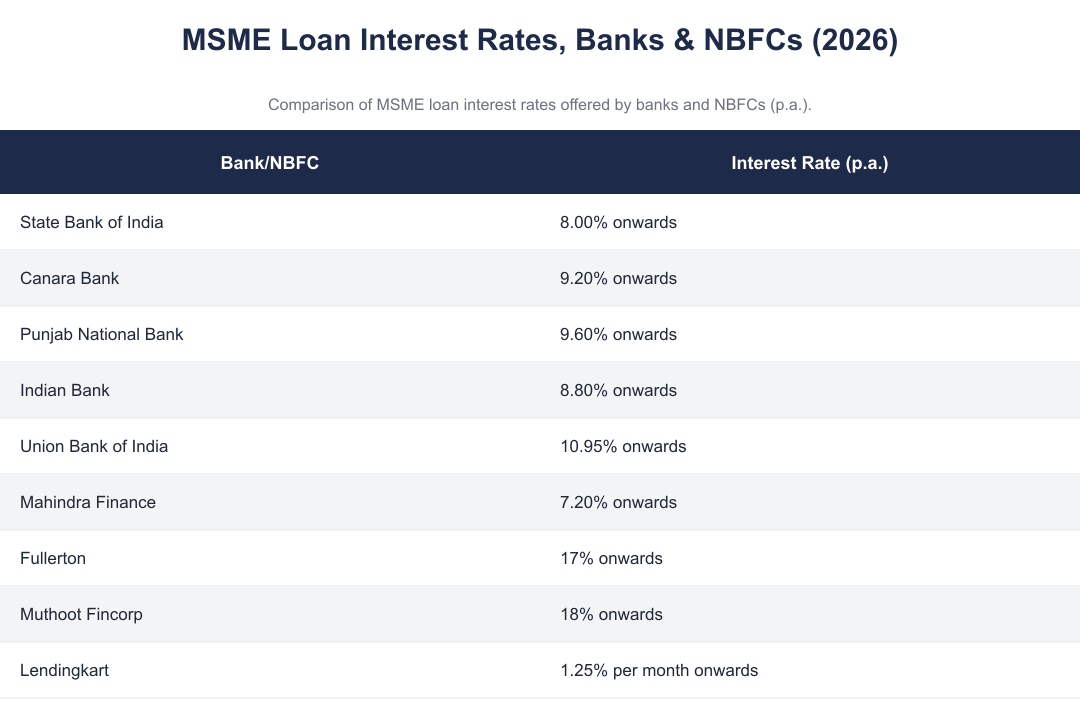
Interest rates for MSME loans vary widely depending on the lender, the borrower’s credit profile, the specific loan product and whether the loan is covered by a guarantee or subsidy scheme. Public sector banks, private banks and NBFCs each price their MSME products differently, and special government‑linked schemes can alter the effective cost.
Because rates are not uniform, business owners should compare offers on the basis of the headline rate, any processing fees, the structure of repayments and whether the facility carries a credit guarantee (for example under schemes that can make loans collateral‑free). Discussing options with multiple lenders and understanding how a guarantee or subsidy affects the overall cost will help you pick the most suitable financing.
How to Apply for MSME Loans?
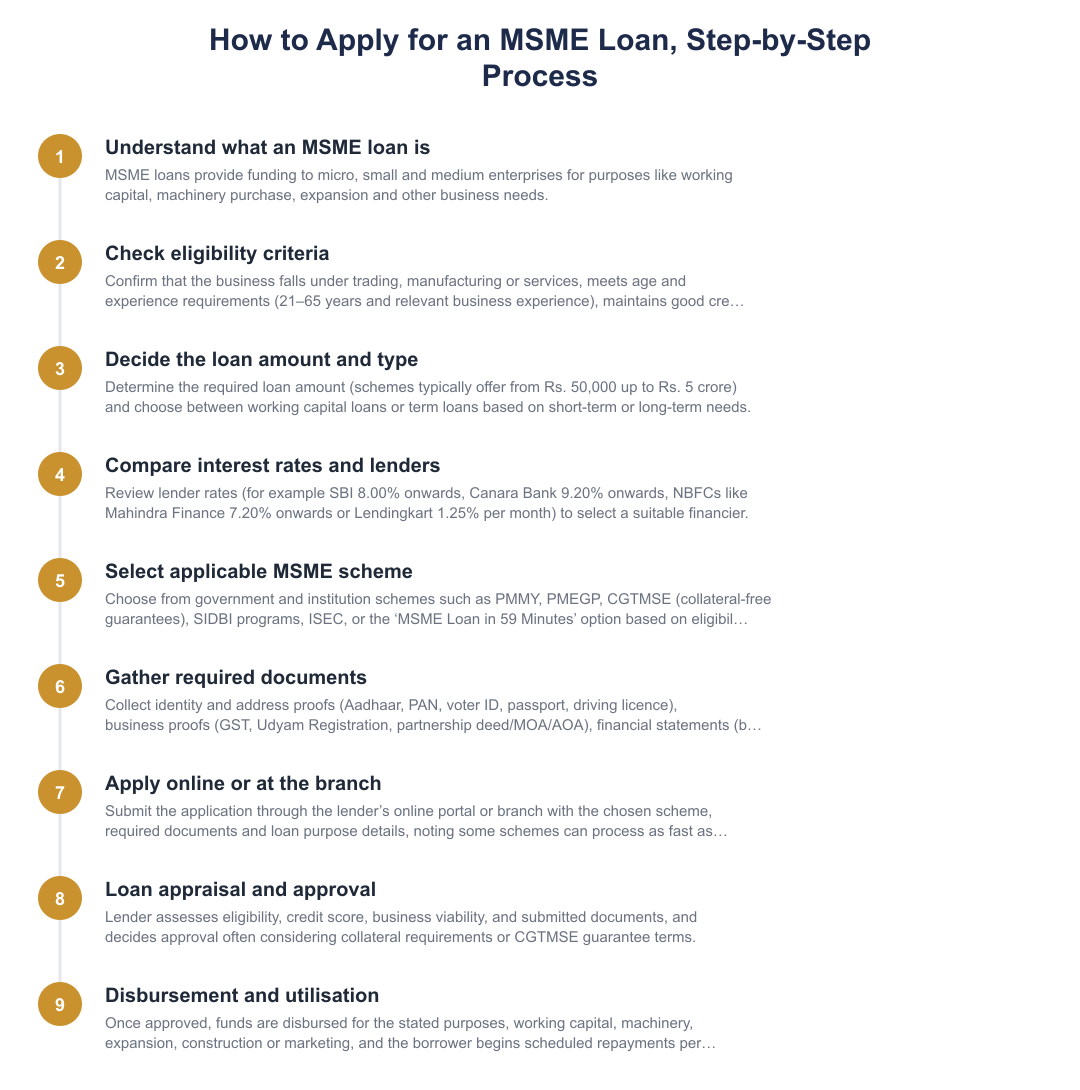
Confirm your business falls in the manufacturing, trading or services sector and that the entity type (private limited, public limited, sole proprietor, partnership firm or LLP) is eligible; ensure repayment history is sound and there are no past defaults.
Assemble identity proofs, address proofs and financial documents (bank statements, ITR, audited accounts) and business proofs such as GST/Udyam registration or incorporation documents; include quotations or project reports if the loan is for machinery or a specific project.
Compare product features across banks, NBFCs and government‑linked schemes, note options that offer collateral‑free lending under credit guarantee arrangements and any scheme‑specific benefits.
Submit the completed application with supporting documents to the chosen lender or through the scheme portal; stay responsive to requests for clarifications or additional papers to expedite processing.
Eligibility for MSME Loans
All MSMEs engaged in the trading, manufacturing and service sectors are eligible to apply for MSME loans. Eligible legal forms include private limited companies, public limited companies, sole proprietorships, partnership firms and limited liability partnerships (LLPs).
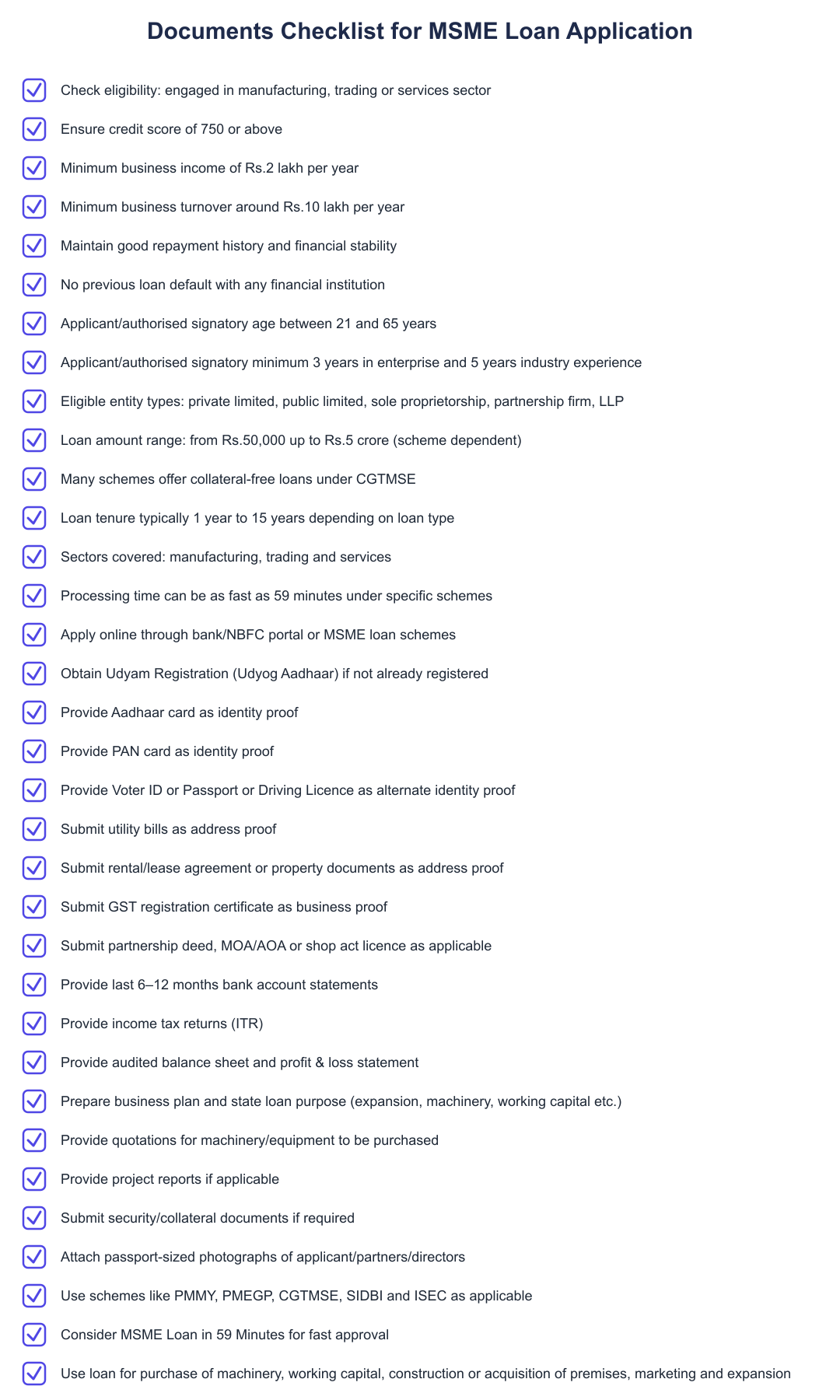
Lenders typically expect applicants to demonstrate good repayment behaviour and overall financial stability. Businesses should not have any previous loan default with a financial institution; a clean credit history and evidence of consistent cash flows strengthen the application. Exact credit score or turnover thresholds depend on the lender and scheme, so confirm the specific criteria when you apply.
Documents Required for MSME Loan
A complete document set helps lenders process MSME loan applications faster. Typical identity proofs accepted include Aadhaar, PAN, voter ID, passport and driving licence for the business owner, partners or directors. These establish the identities of the authorised signatories and stakeholders.
For address verification, common documents are utility bills, rental or lease agreements, property documents or passport entries showing the current business or residential address. Business proofs include registrations such as GST or Udyam (Udyog Aadhaar), partnership deeds, memorandum and articles of association, and licences like shop act registration.
Financial documentation normally requested covers the last 6–12 months’ bank account statements, income tax returns (ITR), audited balance sheets and profit & loss statements. If the loan is for a specific project or asset purchase, lenders may also ask for quotations of machinery or equipment, project reports and any security or collateral documents relevant to the facility.
Types of MSME Loans and Common Schemes
MSME financing can be broadly categorised into working capital loans for day‑to‑day operations and term loans for purchase of assets, expansion or construction. Working capital facilities help with inventory, payroll and raw material purchases, while term loans support longer‑term investments like machinery or premises.
Several government‑linked and public initiatives complement regular bank and NBFC products. Notably, many schemes offer credit guarantee arrangements that enable collateral‑free lending under the Credit Guarantee Trust Fund model. Other schemes focus on employment generation, micro‑enterprises or rapid online processing options designed to speed access to funds. Choose a product aligned to your purpose, whether starting a business, expanding capacity, buying equipment, meeting working capital needs or marketing and product launches.
MSME loans remain a practical route for businesses in manufacturing, trading and services to fund growth, manage working capital and invest in assets. Prepare the standard identity, address and financial documents, ensure your entity type and repayment history meet lender expectations, and consider schemes that offer credit guarantees to reduce collateral requirements. Comparing products and staying organised with paperwork will improve approval chances and help you secure the right financing for your business goals.
Frequently asked questions
What is an MSME loan and who can apply for it?
An MSME loan is a credit facility provided by banks and NBFCs to micro, small and medium enterprises for purposes like working capital, buying machinery, or business expansion. Eligible applicants include individuals and business entities such as proprietorships, partnership firms, LLPs, private and public limited companies operating in manufacturing, trading or services sectors; the applicant or authorised signatory should be between 21 and 65 years old and typically have at least three years in the enterprise with around five years’ industry experience. Lenders generally expect a healthy credit history (credit score around 750+), minimum income of about Rs. 2 lakh a year and turnover around Rs. 10 lakh a year, and no prior loan defaults. Several government-backed schemes (PMMY, PMEGP, CGTMSE, ISEC, SIDBI programmes) also make loans accessible, often with collateral-free options under guarantee schemes like CGTMSE.
What are the typical interest rates for MSME loans in 2026?
MSME loan interest rates in 2026 vary widely by lender and product, typically ranging from about 7.20% p.a. to 18%+ p.a., with NBFCs often charging higher rates than banks. For example, State Bank of India offers rates from 8.00% onwards, Canara Bank from 9.20% onwards, and Union Bank from 10.95% onwards, while NBFCs such as Mahindra Finance list 7.20% onwards and Muthoot Fincorp or Fullerton show rates of 17–18% onwards; lendingkart advertises a monthly rate starting at 1.25% (which annualises higher). Final rates depend on the borrower’s credit profile, loan amount, tenor, collateral, and whether the loan is under a subsidised government scheme like PMMY or ISEC. Always compare effective annual rates and processing/other fees before choosing a lender.
How much can I borrow and what is the usual loan tenure under MSME loan schemes?
MSME loans typically range from Rs. 50,000 up to Rs. 5 crore depending on the scheme and lender, with tenures commonly from 1 year to 15 years based on loan type (working capital vs term loan). Smaller loans (micro/working capital) usually have shorter tenures and faster disbursal, while term loans for machinery, expansion or land acquisition can extend up to 15 years where repayment capacity and security permit. Collateral requirements vary: many government-backed products and loans under CGTMSE are collateral-free up to prescribed limits, whereas larger facilities may require security or hypothecation of assets. Check scheme-specific caps (for example PMMY amounts and CGTMSE coverage) and lender policies before applying.
What documents are required to apply for an MSME loan?
You need identity proof (Aadhaar, PAN, passport, voter ID or driving licence), address proof (utility bills, rental agreement or property papers) and business proof such as GST registration, Udyam (Udyog Aadhaar), partnership deed, MOA/AOA or shop licence. Financial documents include last 6–12 months’ bank statements, income tax returns (ITR), audited balance sheets and profit & loss statements; lenders may also ask for a business plan, quotations for machinery, project reports and security/collateral documents if applicable. Additionally, passport-size photographs and any extra documents tied to promoter/director backgrounds or sector-specific licences may be required, and specific schemes (PMMY, SIDBI) sometimes have tailored document lists. Submitting complete and verified documents speeds up verification and reduces processing time for disbursal.
How do I apply for an MSME loan online and how long does approval take?
You can apply online by visiting the bank or NBFC’s loan portal, selecting the MSME product, filling the application form and uploading required documents; a lender representative will verify details and request any additional paperwork before sanction. Processing times vary: standard approvals can take a few days to a few weeks depending on document verification and credit appraisal, while special offers like the “MSME Loan for Startups in 59 Minutes” aim to sanction and disburse in under an hour for eligible applicants with pre-validated data. Offline applications follow similar steps at a branch; in both cases complete documentation, strong credit history and schemes with guarantee support (CGTMSE) speed up sanction and disbursal. Always confirm the lender’s advertised processing SLA and the conditions to qualify for expedited products.
What are the main types of MSME loans available to businesses?
The two main types are working capital loans (to meet day-to-day operational needs like inventory, salaries and raw material purchases) and term loans (for capital expenditure such as machinery, plant, land acquisition or construction). Working capital products include overdrafts, cash credit and bill discounting with shorter tenors, while term loans have longer repayment schedules tied to the asset life; loan amount, tenor and security depend on the purpose and borrower profile. Some lenders also provide specialised products under government schemes (PMMY, PMEGP, SIDBI) and packaged loans for startups, often with subsidised rates or guarantee cover under CGTMSE. Choose the type that matches your purpose, e.g., inventory financing via working capital, and machine purchase via term loan, to optimise cost and tenure.
Which government MSME loan schemes should I consider and what do they offer?
Key government schemes include Pradhan Mantri Mudra Yojana (PMMY) for micro-business credit, Prime Minister’s Employment Generation Programme (PMEGP) for new micro enterprises, Credit Guarantee Trust Fund for Micro & Small Enterprises (CGTMSE) which enables collateral-free loans, Interest Subsidy Eligibility Certificate (ISEC) for subsidised rates, and SIDBI programmes targeting MSME financing and support. PMMY covers small ticket loans typically up to Rs. 10 lakh through Mudra loan categories (Shishu, Kishore, Tarun), while CGTMSE provides credit guarantees to lenders so MSMEs can access loans without collateral up to scheme limits. SIDBI runs refinance and direct lending schemes and specific products for startups and MSME growth; benefits often include lower downpayment, easier access and faster processing under scheme guidelines. Compare eligibility, covered loan amounts, and subsidy/guarantee terms before applying to the scheme best suited to your business size and purpose.
Do MSME loans offer any specific benefits for startups and small businesses?
Yes, MSME loans help startups and small businesses access working capital and capital expenditure funding with features like lower ticket sizes, faster processing (some products promise 59-minute disbursal), and subsidy or guarantee support under government schemes that reduce collateral needs or cost of credit. Benefits include funding for machinery purchase, expansion, construction, inventory, marketing and payroll, with loan amounts typically from Rs. 50,000 up to Rs. 5 crore depending on scheme and lender. Government programmes like PMMY, PMEGP and CGTMSE further increase affordability by offering subsidised interest or guarantee coverage which encourages lenders to take on risk for newer or smaller borrowers. Having proper documentation, Udyam registration and good credit history improves chances of preferential rates and faster approvals.
Will I need collateral for an MSME loan and when is it mandatory?
Collateral is not always required for MSME loans; many government-backed schemes and loans covered by CGTMSE offer collateral-free lending up to specified limits, but larger loan amounts or certain lender products may require security or hypothecation of assets. Typically small ticket loans (e.g., under PMMY or CGTMSE coverage) are collateral-free, while term loans for high-value machinery, land acquisition or long-tenor financing may require charge on assets or third-party security. Lenders decide on collateral based on loan amount, business vintage, cash flows, credit score and scheme guarantees, strong financials and scheme-backed guarantees reduce the likelihood of collateral. Always check the specific lender and scheme terms to know whether collateral will be demanded for your loan amount and purpose.
Need help staying MSME compliant?
MoneyGence's AI Finance OS tracks your compliance, wallet share, and finances in one place, built for agencies and growing businesses.
Get started with MoneyGence