MSME Investment and Turnover Limits 2025: New Union Budget Changes
This guide explains, in plain language, what an increase in MSME (micro, small and medium enterprise) investment and turnover limits would mean for businesses and why entrepreneurs, accountants and managers should pay attention. You will learn how such a policy change typically affects enterprise classification, compliance requirements, access to government schemes and financing, and what practical steps companies can take to assess impact and prepare. The content focuses on operational and strategic implications rather than quoting regulations or numeric thresholds; it is designed to help business owners and finance teams think through the consequences of an upward revision and to prepare internal records and processes accordingly. Why this matters: changes to the way enterprises are classified can alter eligibility for procurement preferences, concessional credit, tax reliefs and other policy benefits tied to MSME status. Whether you run a small manufacturer, a service provider, or a growing startup, an adjustment to the investment or turnover benchmarks may shift your enterprise into a new category, with both opportunities and new responsibilities. This guide walks you through likely business impacts, a practical checklist to evaluate readiness, and recommended next steps for compliance, finance and operations teams.
What an increase in MSME investment and turnover limits generally means
When authorities decide to raise the thresholds that define micro, small and medium enterprises, the immediate effect is a change in which businesses qualify for each category. Enterprises that previously sat near a threshold may find themselves reclassified into a higher bracket without altering their core operations. Reclassification can be automatic based on prescribed criteria or may require businesses to self-declare according to the updated rules.
Reclassification affects both benefits and obligations. On the benefits side, some enterprises may either gain access to support measures designed for higher-category firms or lose access to measures that target smaller units. On the compliance side, different categories can carry different reporting obligations or eligibility conditions for schemes and procurement preferences. Businesses should therefore anticipate both administrative adjustments and strategic implications.
For policymakers, raising limits is usually intended to reflect economic changes, for example, inflation, industry growth, or a desire to broaden the base of firms that can avail certain support. For businesses, the key is translating a regulatory shift into concrete internal actions: updating accounting classification, reviewing contracts and certifications, and communicating changes to banks, suppliers and customers.
Why this matters to business operations and finance
Classification as a particular kind of MSME often determines access to targeted finance products, priority sector lending, procurement advantages and scheme-specific support. A higher threshold can broaden eligibility for some firms, while also changing the competitive landscape as more enterprises qualify for the same pool of benefits.
From a finance perspective, reclassification can influence how banks assess credit risk, which products are offered, and documentation banks require. It also affects internal budgeting and growth planning: firms that anticipate reclassification should model the likely impact on cash flows, working capital and capital expenditure plans under their new status.
Operationally, suppliers and customers may react to a change in classification. Some contracts reference MSME status for payment terms or pricing. Human resources and compliance teams will need to confirm whether any statutory registers, certificates or public listings need updates to reflect the new classification.
Practical steps to assess impact and prepare (checklist)
Gather your latest financial statements, investment ledgers and turnover records to establish the baseline used for classification under existing rules.
List government schemes, tax concessions, procurement preferences and finance products that reference your current category to see which will be affected by a move into a different bracket.
Discuss potential reclassification with lenders and tax/finance advisors to understand documentation or covenant changes and to renegotiate product terms if necessary.
Plan updates to accounting classifications, statutory registers and management reports so that internal and external disclosures reflect any new status promptly.
Inform suppliers, customers and relevant authorities about changes that affect contracts, payment terms or eligibility for programmes to avoid disputes or missed benefits.
Risk points and governance actions to consider
A change in classification can create transitional risks: disputes over which rules apply for a given financial year, lapses in claims for benefits, or inadvertent non‑compliance when firms fail to update records. Boards and senior management should assign clear ownership for assessing impacts and executing necessary filings or notifications.
Governance actions include establishing a small cross-functional task force (finance, legal, operations) to run through a scenario analysis, documenting decisions and maintaining an audit trail for any changes made to classification or certifications. This reduces the chance of penalties or disputes arising from inconsistent or untimely updates.
Finally, maintain conservative documentation practices: preserve contemporaneous calculations and communications that justify your classification position. If a retrospective clarification or correction is needed, having organised records will simplify compliance and engagement with authorities or financial institutions.
How to turn the change into an opportunity
Reclassification can be a moment to rethink strategy. If a higher threshold expands eligibility for favourable schemes, consider accelerating qualifying projects or investments to capture available support. Alternatively, if a move removes certain supports, it may be prudent to seek alternative incentives or renegotiate supplier terms to protect margins.
Use the transition to strengthen access to finance: approach lenders with a clear plan showing how the new classification supports growth and repayment capacity. A well-prepared business case backed by updated financials can improve bargaining power for credit terms.
Finally, review pricing, procurement and HR policies to ensure they align with the new competitive and regulatory environment. Where appropriate, communicate a positive narrative to customers and partners about the firm’s evolution, while transparently handling any contractual implications tied to MSME status.
An upward revision of MSME investment and turnover limits has broad operational, financial and strategic implications. Businesses that proactively assess their position, update records and engage stakeholders will be best placed to preserve benefits, manage risks and seize new opportunities. Use the checklist and governance steps above to begin your internal review and to coordinate next steps with advisors and lenders.
Frequently asked questions
What are the new MSME investment and turnover limits announced in Budget 2025-26?
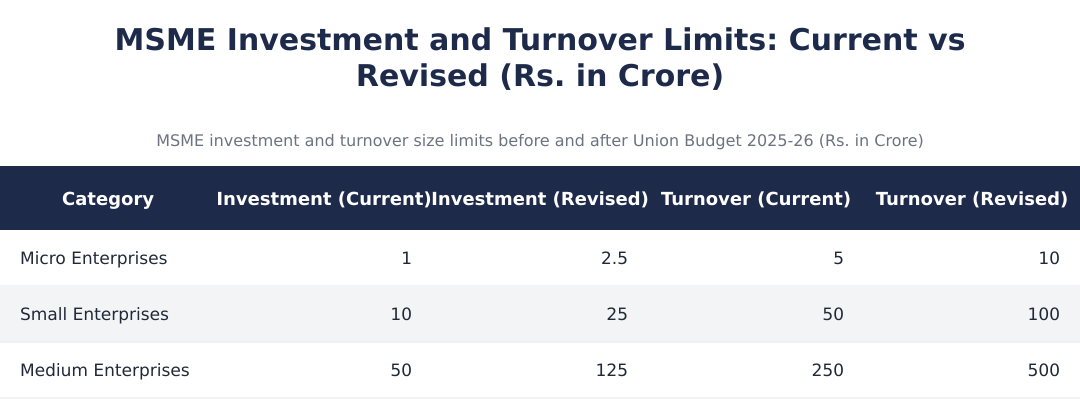
The Union Budget 2025-26 raises MSME thresholds so Micro enterprises now qualify with investment up to Rs. 2.5 crore and turnover up to Rs. 10 crore; Small enterprises with investment up to Rs. 25 crore and turnover up to Rs. 100 crore; and Medium enterprises with investment up to Rs. 125 crore and turnover up to Rs. 500 crore. These are revised from the earlier limits of Rs. 1 crore/5 crore for Micro, Rs. 10 crore/50 crore for Small and Rs. 50 crore/250 crore for Medium (investment/turnover respectively). The change expands the number of enterprises that can access MSME-specific benefits, procurement preferences and simplified compliance under central schemes. Businesses should check their investment in plant and machinery (or equipment) and annual turnover figures to determine their updated classification.
When do the revised MSME limits take effect and do they apply retrospectively?
The revised MSME investment and turnover limits announced in Budget 2025-26 take effect from the date specified in the Budget notification (typically announced for the coming financial year) and are not retrospective unless the Budget explicitly states retrospective application. Practically this means enterprises should use the new thresholds for classification from the notified effective date, usually from the start of the next financial year, so income and procurement decisions should be updated accordingly. For clarity and transitional compliance (for filings, tenders or credit facilities) firms should rely on the official Gazette or ministry circular that sets the effective date. If you have transactions that span the notification date, consult your chartered accountant or the official notification for transitional provisions.
How does raising the thresholds affect eligibility for MSME benefits and schemes?
Raising the investment and turnover thresholds increases the number of enterprises eligible for MSME-specific benefits such as easier credit access, priority sector treatment, government procurement preferences and targeted schemes. Firms that now fall within the revised Micro, Small or Medium bands can access these benefits provided they meet other scheme-specific conditions (for example, registration, compliance and documentation). The higher caps also allow growing businesses to retain MSME status longer, delaying migration to general enterprise regulations that may have stricter compliance or less favorable procurement treatment. However, eligibility for particular subsidies or state-level programmes may still depend on additional criteria beyond the federal thresholds.
What did the Budget say about increasing credit guarantees for MSMEs?
The Budget 2025-26 announced an increase in credit guarantees available to MSMEs to improve access to bank credit and reduce lenders' risk exposure, though the Budget summary provides the overall enhancement rather than scheme-level granular figures. Higher credit guarantees typically mean loans to MSMEs will be backed for a larger portion by government-supported guarantee schemes, enabling lending at potentially lower collateral requirements and faster approvals. Businesses should watch for detailed implementation circulars from the Ministry of MSME, CGTMSE (or other guarantee agencies) that will specify the revised guarantee coverage, cap per borrower and eligibility conditions. When the implementing agency releases details, lenders will update loan products and guarantee claim procedures accordingly.
What new schemes did Budget 2025-26 introduce for women entrepreneurs?
The Union Budget 2025-26 introduced targeted schemes to support women entrepreneurs, including dedicated credit lines and capacity-building programmes aimed at first-time and existing women-led MSMEs (details to be published by the implementing agencies). These schemes typically provide concessional finance, credit guarantees, mentorship and simplified application processes to boost female entrepreneurship and improve access to markets. Eligibility will usually require proof of majority ownership/control by women and registration under relevant MSME portals; specific funding limits, interest subvention or grant components will be available in the scheme guidelines. Women entrepreneurs should monitor ministry notifications and apply through designated banks or the MSME development portals once rollout details are published.
What support is being offered for first-time entrepreneurs in the Budget?
Budget 2025-26 includes new initiatives for first-time entrepreneurs that combine easier credit access, startup mentoring and specific financial supports to lower entry barriers for new businesses, with an emphasis on MSME registration and formalisation. These measures often include subsidised loan products with credit guarantees, incubation support, and simplified compliance assistance so founders can scale without immediate heavy capital requirements. Exact eligibility, loan sizes, repayment terms and application routes will be specified by implementing agencies and partner banks, first-time founders should look out for announcements from the Ministry of Commerce & Industry and MSME offices. Early-stage entrepreneurs may also benefit indirectly from higher MSME thresholds that allow newly growing firms to retain MSME benefits longer.
Do the revised thresholds change tax or GST treatment for MSMEs?
The Budget’s change in MSME investment and turnover thresholds does not directly alter tax rates or GST slabs, but it can affect indirect compliance requirements, eligibility for tax-based incentives and thresholds for certain simplified schemes that are MSME-specific. For example, higher turnover limits may allow more firms to remain under MSME-focused compliance relaxations or access tax-linked reliefs available only to registered MSMEs, but the underlying GST/Harmonized tax rates and income tax provisions require separate amendments if they are to change. Businesses should consult the Finance Ministry notifications and their tax advisors to see whether any concurrent tax/GST concessions were announced alongside the threshold revision and how to claim them. Record-keeping and returns should reflect the enterprise’s updated classification when applying for any scheme or benefit.
How should a business calculate investment in plant and machinery or turnover to check MSME classification?
To determine MSME classification under the revised limits, calculate 'investment in plant and machinery' (for manufacturing) or 'investment in equipment' (for services) as the book value of tangible assets excluding land and building, and use the enterprise’s aggregate annual turnover from all units to compare with the turnover thresholds. The assessment should be based on audited financial statements or statutory books for the relevant financial year, and turnover is normally the gross revenue before taxes and deductions. If your enterprise operates multiple units, combine their investments and turnover for classification; firms should keep supporting documents (audited accounts, GST returns, bank statements) to substantiate claims when applying for schemes or benefits. When in doubt, seek a professional accountant or refer to the MSME Ministry’s detailed definition circulars for classification rules.
If my business now qualifies as an MSME under the new limits, what immediate steps should I take?
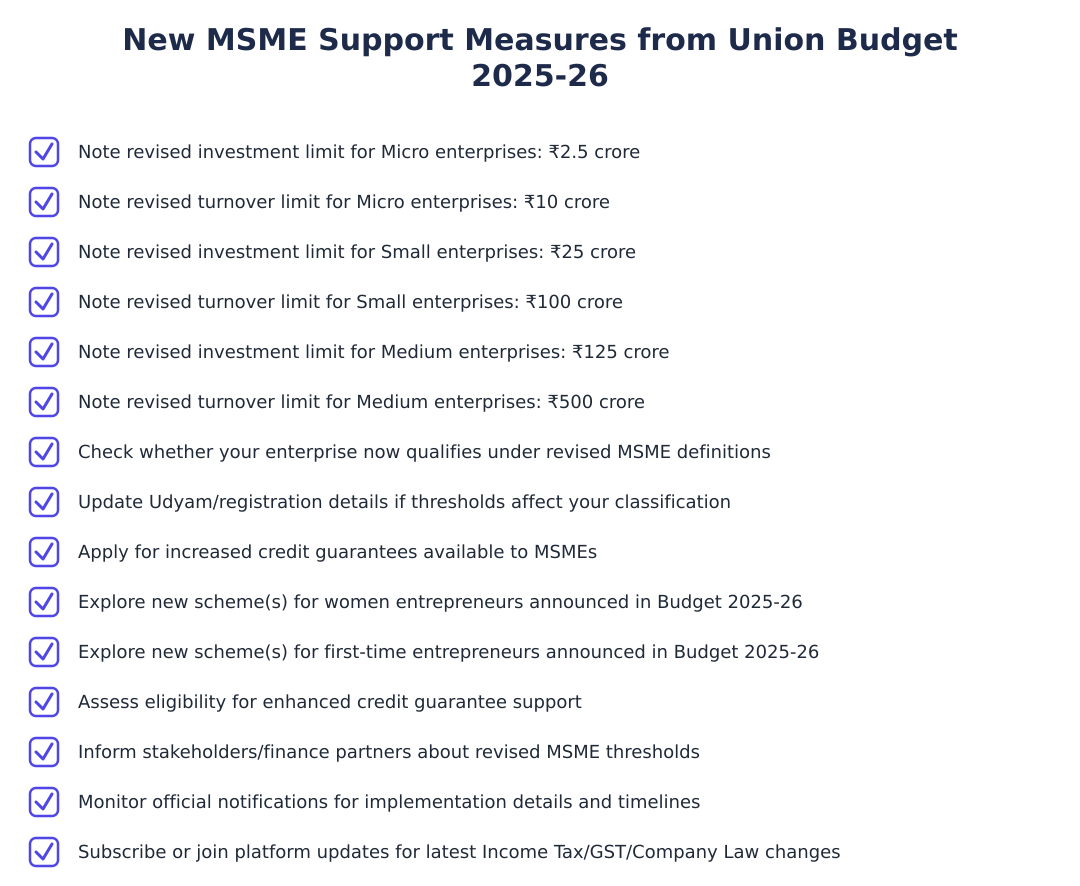
If your business falls within the revised MSME thresholds, immediately update your MSME registration or Udyam profile (if already registered, amend details as needed), inform your bank/credit provider to seek MSME-linked loan products, and review eligibility for schemes such as expanded credit guarantees and women/first-time entrepreneur programmes. Also ensure your accounting and statutory records (audited financials, GST returns) support the new classification because lenders and authorities will require documentary proof for benefits and procurement preferences. Finally, monitor notifications from the Ministry of MSME and implementing agencies for scheme application windows, and consult your CA or MSME helpdesk to claim any retroactive transitional benefits if notified.
Need help staying MSME compliant?
MoneyGence's AI Finance OS tracks your compliance, wallet share, and finances in one place, built for agencies and growing businesses.
Get started with MoneyGence