MSME Development Amendment Bill 2026: Payment & Dispute Reforms
This guide explains what businesses, accountants and advisors should watch for when amendments to MSME law introduce stronger payment and dispute-resolution measures. You will learn how a reformed legal framework can affect cash flow for micro, small and medium suppliers, what buyers should change in procurement and payables processes, how dispute-resolution options may evolve, and what practical steps advisers should take to help clients adapt. The aim is to translate legal reform into actionable commercial practices: improving invoice management, tightening contract terms, and preparing for faster remedies when payments are delayed. Understanding these themes matters because payment delays and weak dispute mechanisms are common pain points for smaller suppliers. Even without diving into legislative text, businesses can anticipate that reforms focused on payments and disputes will shift bargaining power, increase enforcement efficiency, and require closer coordination between finance, legal and operations teams. For advisors, the changes create opportunities to counsel clients on compliance, tax-positioning around disputed payments, and redesigning supplier onboarding and monitoring. This guide gives practical context and checklists you can use immediately to prepare for the operational, contractual and advisory implications of payment- and dispute-oriented MSME reform.
What payment-focused MSME reforms mean for cash flow
When a statute seeks to improve how quickly suppliers are paid, the immediate commercial effect is on working capital for smaller businesses. Faster or more enforceable payment obligations reduce the financing burden on suppliers and can free up cash to invest in production, payroll and growth. Buyers should therefore reassess the timing of their procurements and the liquidity impact of accelerated payment obligations.
Operationally, procurement, accounts payable and treasury teams must coordinate to ensure invoices are processed promptly. This often means tighter invoice verification workflows, clearer service-level agreements with internal stakeholders, and better vendor communication to avoid disputes that delay settlement. Even absent precise legal thresholds, the prudent step is to map current payment cycles and identify vendors most exposed to late payments so remediation can be prioritised.
How strengthened dispute-resolution pathways could change enforcement
Legislative emphasis on faster dispute resolution typically aims to provide simpler, quicker remedies than ordinary court litigation. For suppliers, that can mean easier access to adjudicative or alternative dispute resolution forums and faster execution of awards or settlements. For buyers, the change raises the need for disciplined record-keeping and rigorous contract management to defend against accelerated claims.
Businesses should review their contractual templates to ensure clarity around invoicing, acceptance criteria, and dispute escalation. Well-drafted terms reduce the likelihood of disputes reaching formal mechanisms. At the same time, both suppliers and buyers should familiarise themselves with any new forum’s procedures and timelines so they can respond promptly if a claim is filed.
Practical compliance and documentation steps for MSMEs and buyers
Good documentation is the single most important defence against payment disputes. Suppliers should keep complete records of purchase orders, delivery receipts, acceptance certificates and any written communications about changes in scope or timing. Buyers should ensure internal controls capture the same documents and that approvals are timely to prevent avoidable disputes.
Advisers should recommend routine audits of outstanding receivables and payables, and a remediation plan for long-outstanding items. Where possible, parties should agree written timelines for invoice submission and resolution channels to avoid ambiguity. Implementing basic digital invoicing and tracking tools can significantly reduce friction and create an auditable trail if disputes escalate.
What advisors and finance teams should do now
Accountants, tax advisors and in-house counsel should conduct a rapid assessment of their clients’ or employers’ exposure to MSME payment risk. Key activities include identifying critical suppliers, quantifying overdue payables, and reviewing relevant contract clauses that govern payment terms and dispute resolution. This assessment will inform whether policy changes to procurement, payment approval thresholds, or reserves are necessary.
Advisors should also prepare playbooks for responding to claims in any new fast-track dispute forums, covering evidence collection, engagement with opposing parties for early settlement, and tactical decisions about whether to pursue arbitration or mediation if available. Proactive advice now reduces the likelihood of sudden cashflow shocks and reputational issues later.
Longer-term strategic implications for supply-chain relationships
Stronger payment enforcement tends to encourage healthier buyer–supplier relationships over time. Buyers who honour timely payments benefit from supplier loyalty, reliability and potentially better commercial terms. Suppliers that see reliable cash flows are more likely to invest in quality and capacity, improving the overall efficiency of the supply chain.
Organisations should therefore view any law-driven tightening of payment regimes as an opportunity to redesign supplier engagement, moving from adversarial, transactional interactions toward more collaborative partnerships underpinned by transparent processes and predictable payment discipline.
Even without referencing specific statutory clauses or numbers, reforms that focus on payments and dispute resolution have clear operational and advisory consequences. Businesses should prioritise documentation, tighten processes across procurement and finance, and engage advisors to audit exposure and design response plans. Suppliers benefit from clearer enforcement routes, while buyers gain from proactively managing payables to preserve supplier relationships and reduce disruption.
Frequently asked questions
What key changes does the MSME Development (Amendment) Bill 2026 make to MSME classification?
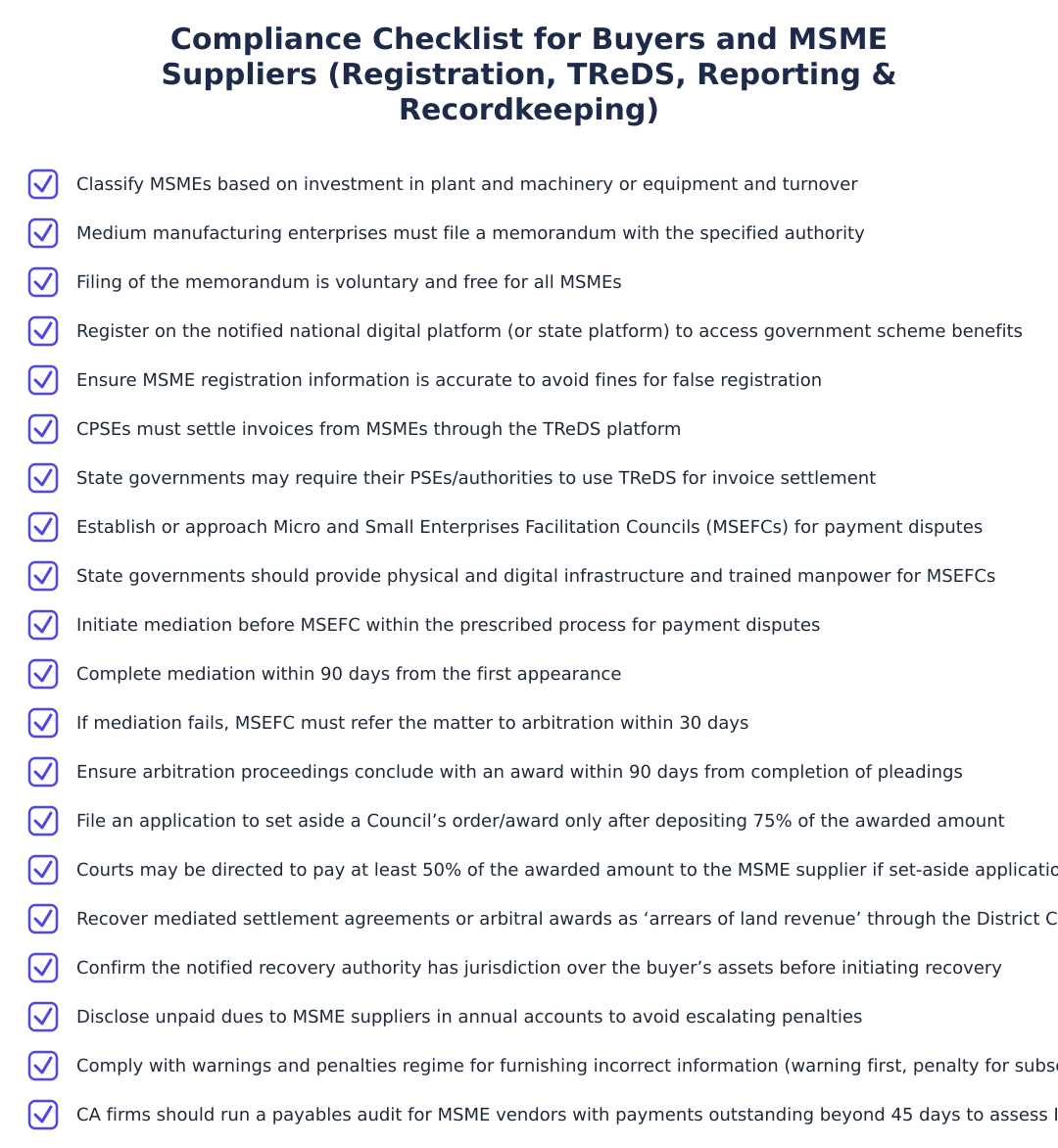
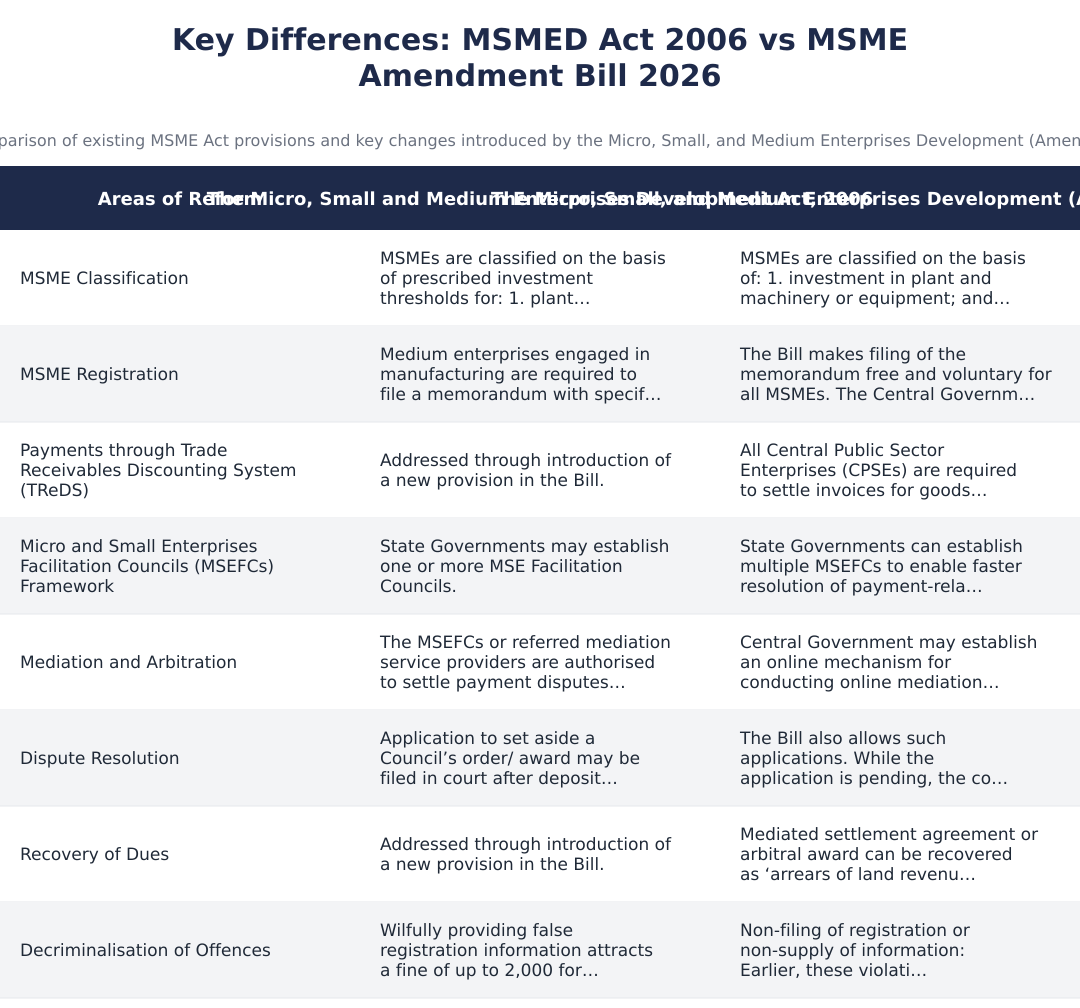
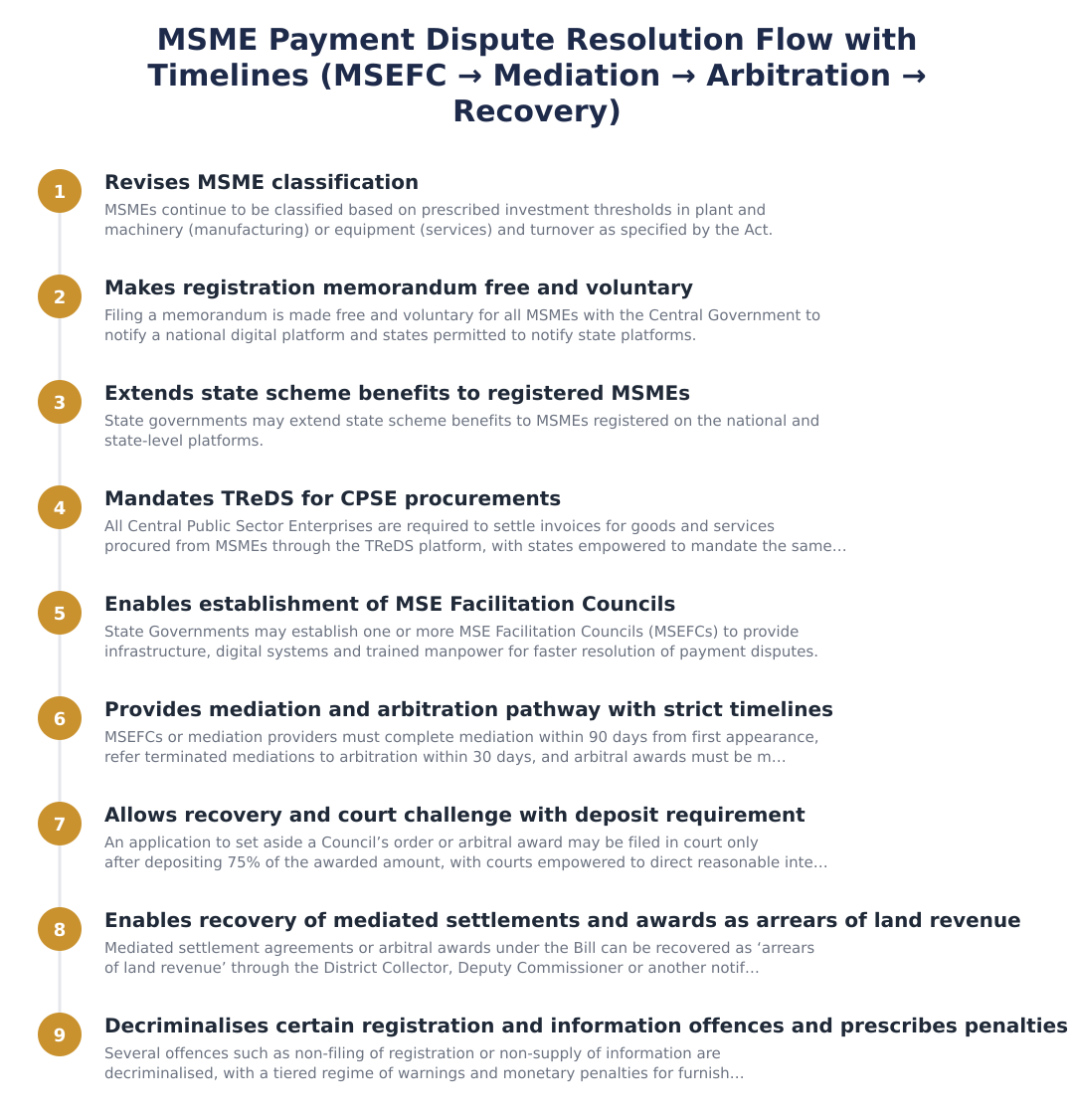
The Bill continues to classify MSMEs based on investment in plant and machinery or equipment and also on turnover. It retains the two-fold basis, investment thresholds for manufacturing plant and machinery and equipment for services, while explicitly recognising turnover as a criterion for classification. This means eligibility and benefits will still hinge on prescribed investment and turnover limits notified by the government, so businesses should check the updated thresholds when assessing their category. The change clarifies classification criteria to align with contemporary business models where turnover may better reflect scale for some enterprises.
Is MSME registration mandatory under the 2026 Amendment or is it voluntary and free?
The Bill makes filing the MSME memorandum voluntary and free for all MSMEs. Medium manufacturing enterprises previously required to file a memorandum now have the option to register without payment, and the Central Government will notify a national digital platform for registration while states may notify their own platforms. State governments can extend their scheme benefits only to MSMEs registered on the national or state-level platforms, so registration is voluntary but recommended if you want access to state benefits. Registration remains simplified and digital to encourage wider take-up without a fee barrier.
Are Central Public Sector Enterprises (CPSEs) required to pay MSMEs through TReDS under the new Bill?
Yes, the Bill requires all Central Public Sector Enterprises (CPSEs) to settle invoices for goods and services procured from MSMEs through the TReDS platform. This mandatory use of Trade Receivables Discounting System aims to address delayed payments and improve liquidity for MSME suppliers, and states may similarly mandate their Public Sector Enterprises (PSEs) and authorities to use TReDS. The provision targets timelier invoice settlement and easier access to invoice discounting for MSMEs, though private buyers are not explicitly mandated by the Bill. MSMEs should therefore ensure their invoice processes are compatible with TReDS to benefit from faster payments.
What dispute resolution mechanisms and timelines does the Bill introduce for payment disputes?
The Bill establishes or empowers Micro and Small Enterprise Facilitation Councils (MSEFCs) and specifies strict timelines for mediation and arbitration: mediation must be completed within 90 days from the first appearance, if mediation terminates the matter must be referred to arbitration within 30 days, and arbitral awards must be made within 90 days from completion of pleadings. The MSEFCs (or authorised mediation service providers) can attempt mediation, and if unsuccessful the matter moves to arbitration, with the Central Government allowed to set up online mechanisms for both mediation and arbitration. These timelines are aimed at speedy resolution of payment-related disputes and the Bill permits state governments to set up multiple MSEFCs with appropriate infrastructure and manpower. Faster dispute resolution should reduce cash-flow pressures on MSMEs awaiting adjudication.
How can MSMEs get an arbitral award or mediated settlement enforced under the new law?
Mediated settlement agreements or arbitral awards under Section 18 can be recovered as 'arrears of land revenue' through the District Collector, Deputy Commissioner or another notified authority with jurisdiction over the buyer's assets. This recovery route gives an expedited, executive mechanism to collect dues by treating the award as a revenue claim and enabling attachment or recovery procedures through the notified authority. The notified authority must have jurisdiction where the buyer's assets are located, so MSMEs should ensure enforceability steps are taken in the correct district. This provision strengthens practical recovery options beyond ordinary civil execution.
If a buyer challenges an MSEFC order or award in court, do MSMEs still get interim payments?
Yes, an application to set aside a Council’s order or award may be filed in court only after depositing 75% of the awarded amount, and while the application is pending the court can direct that a reasonable portion of the deposited amount be paid to the MSME supplier. Moreover, if the challenge remains pending for more than six months, the court must direct payment of at least 50% of the awarded amount to the MSME supplier. These provisions ensure that MSMEs receive substantial interim relief even when a buyer seeks to overturn an award, reducing the chance of complete non-payment during litigation. The mechanism balances the buyer’s right to challenge with the supplier’s need for cash flow security.
Which offences does the Bill decriminalise and what penalties replace criminal prosecution?
The Bill decriminalises offences such as non-filing of registration and non-supply of information that earlier attracted conviction and fines, replacing criminal prosecution with graded warnings and monetary penalties: furnishing incorrect information attracts a warning for the first instance and penalties for subsequent instances, while non-disclosure of unpaid dues by buyers attracts a warning first, a penalty second, and a fine on the third and subsequent instances. Wilfully providing false registration information remains punishable by a fine up to ₹1,000 for the first conviction and ₹1,000–₹10,000 for subsequent convictions, and failure to report unpaid dues in annual accounts attracts a minimum fine of ₹10,000. The move is intended to reduce criminal liability for technical breaches and encourage compliance through administrative penalties and escalating sanctions. Businesses should note the specific monetary bands and the shift from imprisonment/conviction risk to penalty-based enforcement.
How does the Amendment Bill interact with the Income Tax Act rule on deductibility of payments to MSMEs (Section 43B(h))?
The Bill does not change Section 43B(h) of the Income Tax Act, which requires payments to registered MSMEs to be made within 45 days (with written agreement) or 15 days (without written agreement) for the deduction to be allowed in the year of accrual; late payments are deductible only in the year of actual payment. However, by strengthening the civil law dispute-resolution and recovery framework (TReDS mandate for CPSEs, MSEFC timelines, recovery as arrears of land revenue), the Bill may make it easier for MSMEs to enforce timely payments, indirectly helping buyers avoid disallowance under 43B(h). Companies should therefore audit MSME payables and prioritise clearing invoices that are beyond the statutory timelines to prevent tax disallowance and litigation risk. CA firms advising buyers should assess exposure from outstanding MSME payments because the tax consequence (deduction only on payment) remains unchanged.
Can states set up their own MSE Facilitation Councils and require their PSEs to use TReDS?
Yes, the Bill allows State Governments to establish one or more Micro and Small Enterprise Facilitation Councils (MSEFCs) and to mandate their Public Sector Enterprises, authorities or entities to settle invoices through TReDS. States are empowered to provide necessary infrastructure, digital systems and trained manpower for MSEFCs and may also notify state digital registration platforms that can integrate with the national platform. Additionally, state scheme benefits may be extended only to MSMEs registered on the national or state-level platforms, giving states levers to improve timely payments and dispute resolution locally. MSMEs should check both central and state notifications to comply with any state-specific mandates.
Need help staying MSME compliant?
MoneyGence's AI Finance OS tracks your compliance, wallet share, and finances in one place, built for agencies and growing businesses.
Get started with MoneyGence