MSME-1 Filing Guide for Companies: Compliance & Deadlines
This guide explains MSME-1 filing for companies, what the return is, why regulators ask for it, who must prepare it, and practical steps companies can take to comply with the requirement. You will learn how to identify when MSME-1 is relevant, what information typically appears in the form, how to organise vendor records so filing is straightforward, and common pitfalls to avoid. The aim is to give company directors, finance teams and company secretaries a clear, practical roadmap so the filing is completed accurately and consistently as part of regular compliance routines. MSME reporting obligations exist to improve transparency about payments to micro and small suppliers and to help monitor timely settlement of dues. For companies that purchase from or owe money to MSME vendors, the exercise is both a statutory compliance and a reputational matter: accurate reporting demonstrates governance around supplier payments and highlights where working capital management may need tightening. This guide focuses on process, documentation, internal controls and practical tips to reduce errors when preparing MSME-1. It does not provide legal advice but sets out the everyday steps and considerations that will help you prepare the required information efficiently and reduce the risk of follow-up queries from regulators.
What MSME-1 Filing Means in Practice
At a practical level, MSME-1 is a reporting exercise through which companies disclose information about dues to micro and small suppliers. The form is intended to capture the existence of outstanding payments, the amounts involved, and contextual information about why payments may be overdue. For a finance team this means gathering the supplier ledger, purchase orders, delivery or acceptance records and any correspondence related to payment timelines.
Because the purpose of the form is transparency on payments to smaller vendors, companies should treat the task not merely as a compliance checkbox but as an opportunity to review supplier relationships. Preparing the return will often reveal systemic issues, for example delays in verification of supplier invoices, mismatches between contract terms and invoice dates, or bottlenecks in approvals, that, once fixed, improve cash flow predictability and vendor satisfaction.
Who Needs to Prepare the Information and When to Start
Responsibility for assembling MSME-1 information normally falls on the company’s finance department and company secretary, with input from procurement and vendor management teams. Early engagement by procurement is important because the supplier acceptance date or service completion date often determines whether a particular invoice becomes relevant for reporting.
Start the compilation process well before any filing window by running vendor ledger reports, identifying suppliers that classify as micro or small enterprises, and reconciling supplier assertions with your purchase records. If your business has many small vendors, create a repeatable workflow: standardise requests for vendor confirmation of their status, maintain a central repository of supplier documents, and document the rationale for payment delays where they occur.
Typical Data Points and Documents to Collect
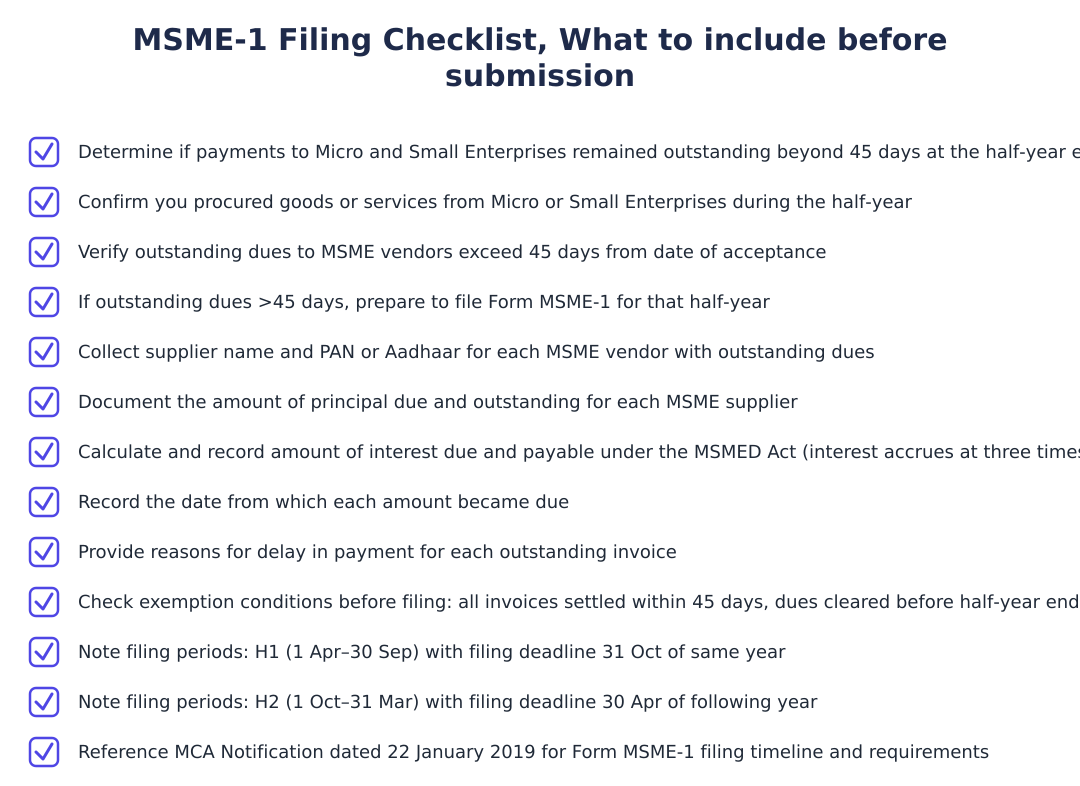
The MSME-related return typically requires a clear link between the seller (MSME) and the outstanding sum. Common items to collect include vendor identification (name and any identifier they provide), the outstanding principal amount, any interest claimed under the applicable micro/small enterprise legislation, and the date from which the amount is considered due. Procurement and accounts payable should be able to produce invoices, proof of acceptance or delivery, and records of communications about payment.
In addition to numeric fields, it is useful to gather qualitative explanations for delays. Where payments are late due to disputes, holdbacks, or administrative issues within the buyer’s approvals system, a concise note explaining the reason helps prevent back-and-forth queries later. Maintain an audit trail showing when reminders were issued and any settlement proposals discussed with the vendor.
Internal Controls and Reconciliation Steps
Implementing strong internal controls reduces mistakes in the filing. At a minimum, reconcile supplier ledgers to the ERP or accounting system for the reporting period and perform a second-level review where someone other than the preparer checks the list of reported vendors and amounts. Make sure that the person responsible for classifying a supplier as an MSME is independent of the person approving payments.
A best practice is to adopt a periodic cadence for reconciliation, for example monthly, so that the half-yearly or periodic MSME return is a summarised outcome of already-reconciled books. If your organisation uses automated vendor master-data controls, flag suppliers that self-identify as micro or small so their invoices can be monitored separately and pulled quickly for reporting.
Common Mistakes and How to Avoid Them
A frequent error is relying solely on vendor self-declarations without documentary support. To avoid this, maintain a basic file for each supplier with the evidence used to determine their status. Another common issue is misdating the point from which an amount becomes due; reconcile invoice dates with acceptance or delivery records and keep notes where there was an agreed payment schedule that differs from invoice timelines.
Also watch for omission of interest computations where vendors claim interest under applicable rules, even if your company disputes the claim, record the existence of the claim and the basis of any disagreement. Finally, avoid last-minute data pulls; a rushed filing increases the risk of transcription mistakes. Use the reconciled ledgers and have a formal sign-off process before submission.
MSME-related filings are an important compliance touchpoint between companies and their small suppliers. Treat the obligation as more than paperwork: use it as a forced health-check of vendor processes, payment timelines and internal controls. With disciplined record-keeping, regular reconciliation and clear ownership across procurement, accounts and company secretaries, the filing becomes routine and helps strengthen supplier relationships while reducing regulatory risk.
Frequently asked questions
When do companies have to file Form MSME-1?
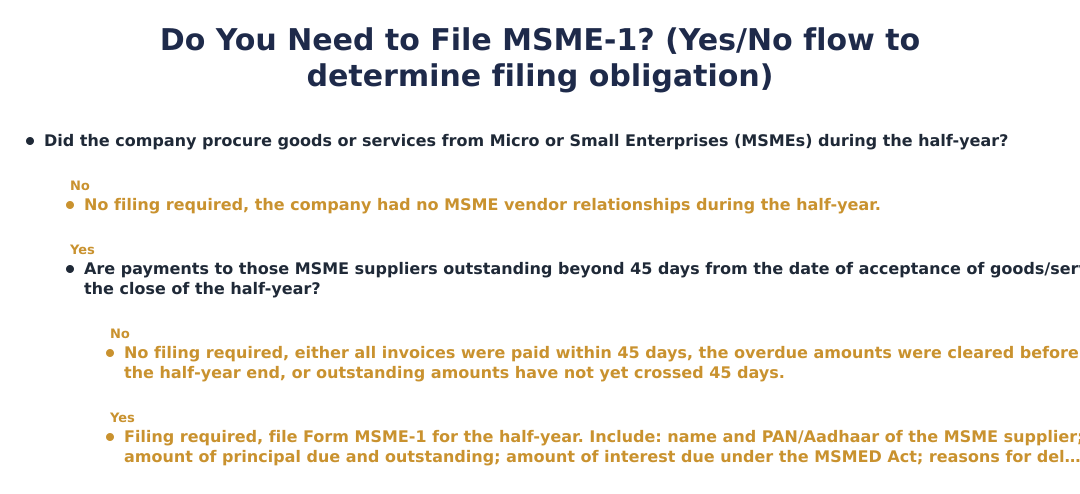
Companies must file Form MSME-1 only when payments to Micro and Small Enterprises remain outstanding beyond 45 days from the date of acceptance of goods or services. The requirement arises under Section 15 of the MSMED Act, 2006 which mandates payment within 45 days (or the agreed period not exceeding 45 days), and MCA's notification of 22 January 2019 prescribed MSME-1 for reporting such overdue amounts. If no invoices are overdue beyond 45 days at the half‑year end, or if overdue amounts were cleared before the cut-off date for the half‑year, filing is not required. The form is applicable to any buyer (including companies) who procured goods or services and has such outstanding dues at the half‑year close.
What is the filing deadline for MSME-1 for each half-year?
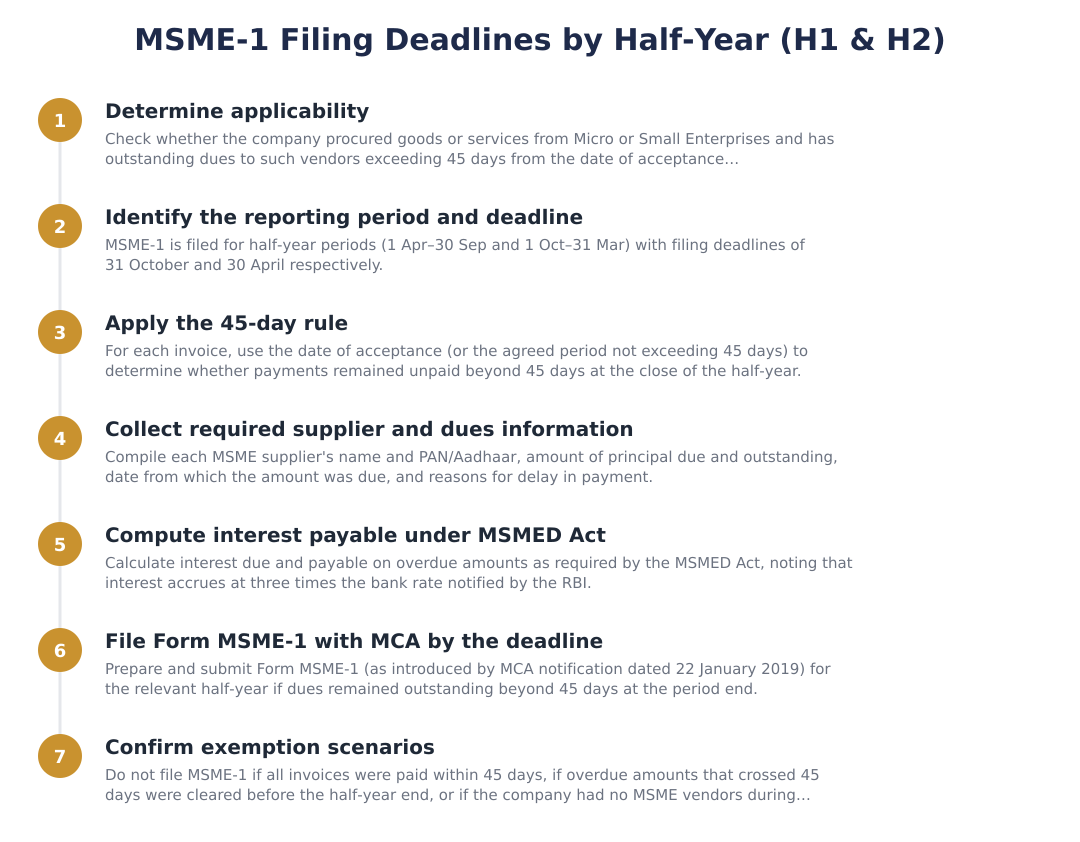
The MSME-1 filing deadline is 31 October for the half‑year 1 April–30 September (H1) and 30 April for the half‑year 1 October–31 March (H2). These deadlines follow the MCA notification framework which aligns reporting on an H1/H2 basis, so companies must assess overdue dues as on 30 September and 31 March and file by the respective dates. Missing the deadline does not remove the obligation to report overdue amounts; companies should file as early as possible and maintain records of payment dates and reasons for delay. Note that if dues were cleared before the half‑year end, no filing for that period is required.
Who is required to file MSME-1, is it only companies or other buyers too?
MSME-1 is required from buyers who have procured goods or services from Micro or Small Enterprises and have outstanding payments exceeding 45 days at the close of the half‑year; this typically includes companies but can apply to any buyer covered by the Companies Act or directed by the Central Government under Section 405. The statutory framework (MSMED Act and Section 15) applies to buyers generally, and MCA expressly introduced MSME-1 for companies, so corporate buyers must ensure compliance. If a business has no MSME vendor relationships in the half‑year, or if payments did not cross the 45‑day threshold by the half‑year end, filing is not required. Buyers should maintain documentation (invoices, acceptance dates, payment receipts) to establish whether reporting is necessary.
What specific details must be reported in Form MSME-1?
Form MSME-1 requires the supplier's name and PAN/Aadhaar, the principal amount due and outstanding, the interest amount due and payable under the MSMED Act, the date from which the amount became due, and the reasons for delay in payment. Interest for delayed payments is calculated at three times the RBI‑notified bank rate as per the MSMED Act, and the form expects the buyer to show interest accrued up to the reporting date. Accurate identification (PAN/Aadhaar) and itemised amounts help prevent disputes and support future audits; buyers should retain supporting documents such as invoices, acceptance evidence and payment communications. The form is intended to give a clear picture of overdue obligations to MSME suppliers each half‑year.
Are there any situations where a company does not need to file MSME-1 even if it deals with MSME suppliers?
Yes, a company need not file MSME-1 if all MSME invoices are paid within 45 days, if any amounts that exceeded 45 days were cleared before the half‑year closing date (30 September or 31 March), if the company had no MSME vendors during the period, or if outstanding dues exist but have not yet crossed the 45‑day threshold by the half‑year end. These four scenarios are recognised exceptions in the compliance framework, so companies should verify aging of payables as on the half‑year cut‑off before filing. If any overdue payments remain as on the cut‑off, the company must file and disclose amounts, interest and reasons for delay. Maintain ageing schedules and payment evidence to demonstrate eligibility for non‑filing where applicable.
How is interest on delayed MSME payments determined under MSMED Act for MSME-1?
Interest on delayed MSME payments is computed at three times the bank rate notified by the Reserve Bank of India (RBI), and the interest amount due and payable must be reported in MSME-1. The buyer must calculate interest from the date the payment became due (i.e., after 45 days or the agreed deadline) up to the reporting date and disclose that figure in the form. Use the RBI bank rate applicable for the relevant period to determine the multiplier; for accuracy, document the rate used, the calculation period and supporting invoices. This prescribed interest mechanism is statutory and failure to report or pay the interest may expose the buyer to claims from the MSME supplier.
What records should a company keep to support MSME-1 filings or non-filing?
Companies should keep invoices, proof of acceptance of goods/services, payment receipts or bank statements, ageing schedules of payables, communications with the MSME supplier and calculations showing interest accrued at three times the RBI bank rate. These records substantiate the amounts reported in MSME-1 and justify why filing was not required where applicable (for example, payments cleared before the half‑year end). Retain documentation for statutory audit periods and any inquiries by regulators, since Section 405 of the Companies Act empowers the Central Government to seek such information. Good recordkeeping reduces dispute risk and simplifies preparation of MSME-1 by providing clear dates and amounts for each supplier.
Where and how is Form MSME-1 filed, is it an MCA portal form?
Form MSME-1 is prescribed by the Ministry of Corporate Affairs and is to be filed as per MCA's notification of 22 January 2019, generally through the MCA e‑filing system or the manner specified by MCA in its procedural instructions. Companies must prepare the required details (supplier identity, amounts, interest, reasons, due date) and submit them within the half‑year deadlines (31 October for H1, 30 April for H2). If MCA issues an online template or portal update, follow the latest filing procedure and keep acknowledgement receipts for records. Check MCA circulars or the company secretary/legal team for any platform‑specific guidance or template changes before filing.
What happens if a company misses the MSME-1 filing deadline?
If a company misses the MSME-1 deadline it remains legally obliged to file the form for the relevant half‑year and should submit it as soon as possible, although MCA may not prescribe an explicit monetary penalty in the notification; non‑compliance can invite scrutiny from regulators and complaints from suppliers. Late filing could trigger follow‑up notices under Company Law or enquiries under Section 405 which empowers the Central Government to require payment information; recurrent non‑filing may attract adverse consequences during inspections or audits. To mitigate issues, file promptly with accurate disclosures, document reasons for delay, and where applicable evidence of subsequent payment or settlement of dues and interest. Consult legal or company secretarial counsel if a compliance pattern has caused supplier disputes or regulatory attention.
Need help staying MSME compliant?
MoneyGence's AI Finance OS tracks your compliance, wallet share, and finances in one place, built for agencies and growing businesses.
Get started with MoneyGence