Minimum Wages Act 1948: Rules, Applicability & Key Features
This guide explains the Minimum Wages Act, 1948: what it covers, why it exists, how minimum wages are fixed and revised, and how it applies across sectors and regions. You will learn which authorities set minimum wages, the basic methods used for fixing wage rates, protections the Act provides (including rules on payment in cash and prohibition of gender discrimination), and the institutional framework created to enforce the law. Understanding these rules matters for employers, payroll teams, HR professionals, labour contractors and workers because compliance affects wage bills, working hours, overtime obligations and exposure to penalties. The Act also shapes how wages respond to cost-of-living changes through mechanisms such as a cost of living allowance, and allows different wage treatment by category of work, region and worker type (for example, apprentices or adolescents). This guide sticks to the core statutory features and practical implications so you can quickly identify where the Act impacts your workplace and what processes to expect when wages are set or contested.
What is Minimum Wages Act 1948?
The Minimum Wages Act, 1948 establishes a legal framework for fixing minimum rates of wages in certain employment sectors. Its primary purpose is to ensure that workers in scheduled employments receive a wage floor below which employers cannot legally pay.
The Act sets out both the substantive obligation (minimum wages) and the institutional and procedural mechanisms, such as advisory bodies, inspectors and authorities, to determine, monitor and enforce those wages. It also provides for rules on working hours and overtime pay linked to those wage obligations.
Objectives of the Minimum Wages Act
The Act pursues multiple social and economic objectives: stabilising an adequate minimum wage, preventing exploitation of workers, maintaining a decent standard of living and fixing daily working hours appropriate to the employment. By setting a statutory wage floor, the law aims to provide income security for low-paid workers and reduce arbitrary or prejudicial wage practices.
To deliver these objectives the statute allocates powers and duties to government agencies, for example Labour Commissioners and inspectors, to ensure compliance, to investigate employer registers and to act on complaints related to underpayment. It also mandates mechanisms to adjust wages in response to changing living costs.
Salient Features of the Minimum Wages Act 1948
The Act requires that wages be paid in cash and mandates periodic fixation and revision of minimum wages. It contemplates advisory or competent authorities to compute and recommend cost of living allowances so that wages reflect economic changes over time.
The law recognises that different methods may be appropriate in different contexts: it permits fixing wages by minimum time rate, piece rate, guaranteed time rate for piece workers, and specified overtime rates. It also allows the appropriate government to make rules on hours of work and overtime payments.
Regional and categorical flexibility is built into the Act. Different wage rates can be prescribed by category of work within the same scheduled employment, by distinct scheduled employments, across regions, and for different classes of workers such as adolescents, adults, children and apprentices.
Finally, the Act provides for appointment of inspectors and authorities to investigate employer-maintained registers concerning wages and establishes penalties for paying less than the prescribed minimum wage, strengthening the enforcement architecture.
Minimum Wages Act Applicability
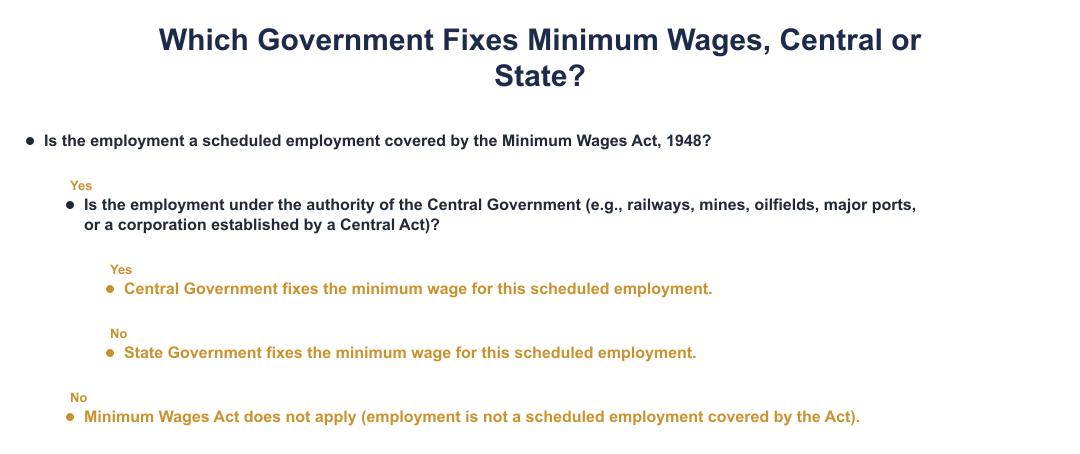
Applicability is shaped by the division of responsibilities between Central and State Governments. The Central Government fixes minimum wages for scheduled employments under its authority (for example, establishments or services under central control), while State Governments set wages for other scheduled employments within their territory.
The Act applies to the scheduled employments listed by the appropriate government; within those employments the government may differentiate wages by nature of work, region, or worker category. The law’s applicability also triggers related obligations such as maintaining registers and allowing inspection by authorised officers.
Fixation and Revision of Minimum Wages
The appropriate government (Central or State) is responsible for fixing and revising minimum wages and may appoint advisory or competent authorities to recommend adjustments over time.
Revision processes take into account cost of living changes; the Act contemplates computation of cost of living allowance (VDA) by designated authorities to adjust wages.
Wages may be fixed using different methods, minimum time rate, minimum piece rate, guaranteed time rate for piece workers, or an all-inclusive rate that incorporates allowances and concessions.
While fixing or revising wages, the government can prescribe different rates by category of work, by region, and for different classes of workers such as adolescents or apprentices.
Main Provisions, Enforcement and Remedies
Enforcement under the Act relies on appointed inspectors and authorities who can examine employer registers relating to wages. Labour Commissioners and other labour officers are given roles and duties to decide complaints about underpayment and ensure compliance.
If wages below the prescribed minimum are paid, the Act provides for penalties and punishments. In addition to penal consequences, authorities can direct employers to make arrears payments where wages were deficient and provide compensation within limits prescribed by the Act and its rules.
The Act also contains safeguards such as the prohibition of gender-based discrimination in recruitment and wage determination, as part of its broader aim to maintain fair and equitable wage practices.
Types of Wages Recognised under the Act
The Act recognises several methods of fixing wages to suit different employment and work patterns: minimum time rate (pay for time worked), minimum piece rate (pay per unit of output), guaranteed time rate (a time-based minimum for piece workers) and overtime rate (payment for hours worked beyond prescribed limits).
These categories allow governments and employers to design wage structures that reflect work realities while ensuring statutory minimum protections. The appropriate government can also prescribe how allowances and the cash value of concessions are treated when arriving at an all-inclusive wage rate.
The Minimum Wages Act, 1948 sets a statutory wage floor and an institutional framework for fixing, revising and enforcing minimum wages across scheduled employments. Central and State Governments both play defined roles in fixation and revision, supported by advisory bodies and inspectors. Employers should ensure wages are paid in cash, follow the prescribed methods of fixation, observe overtime rules and avoid discriminatory practices. Workers and their representatives can rely on the Act’s enforcement provisions and remedies where underpayment occurs.
Frequently asked questions
What does the Minimum Wages Act 1948 do?
The Minimum Wages Act 1948 fixes minimum rates of wages for scheduled employments to protect workers from exploitation and ensure a decent standard of living. It requires Central and State Governments to set and periodically revise minimum wages, prescribes working hours and overtime pay, and mandates cash payment of wages; discrimination based on gender in recruitment and wages is prohibited. The Act also provides for inspectors, labour officers and advisory boards to monitor compliance and compute cost of living allowances, and penalties for paying wages below the notified minimum. For example, the Act allows wages to be fixed area-wise (A/B/C) and by skill category (unskilled to highly skilled).
Who is responsible for fixing minimum wages under the Act?
Either the Central Government or the State Government fixes minimum wages depending on whether the employment is a scheduled central or state employment. The Central Government fixes wages for scheduled employments under its authority such as railways, mines, oilfields, major ports and corporations established by a Central Act, while the State Government handles all other scheduled employments. Both governments must consider cost of living and can appoint advisory boards and competent authorities to compute allowances like VDA (Variable Dearness Allowance). For example, wages for stone crushing or construction work would typically be set by the State Government.
Which employments are covered under the Minimum Wages Act 1948?
The Act applies to a wide list of scheduled employments such as shawl weaving, flour/rice/oil/dal mills, bidi making, plantations (tea/coffee/rubber), local authority work, construction and maintenance of roads and buildings, stone crushing, leather tanneries, mica works, and many types of mines. The schedule includes specific mines like gypsum, bauxite, manganese, copper, silica, iron ore, granite and others, and also public motor transport and other listed manufactories. Coverage is therefore sector-specific and the appropriate government (Central or State) notifies which employments are scheduled and subject to minimum wage rules.
What types of wages are defined under the Act?
The Act recognises minimum time rate, minimum piece rate, guaranteed time rate for piece workers, and overtime rate as the main types of wages. Minimum time rate is the wage for the work duration, minimum piece rate is for a unit of work done, guaranteed time rate ensures piece-workers receive a minimum equivalent time-rate, and overtime rate applies when work exceeds fixed daily hours. Wages may be expressed as basic wage plus Cost of Living Allowance (VDA) or as an all-inclusive rate that covers basic pay, VDA and any cash value of concessions.
How are minimum wages fixed and revised under the Act?
Minimum wages are fixed and revised by the appropriate government after considering factors like the cost of living, hours of work, and regional differences. The government may fix wages as a basic rate plus Cost of Living Allowance (VDA), as a basic rate with or without concessions, or as an all-inclusive rate covering basic pay and VDA; revisions are done from time to time as directed. Competent authorities and advisory boards assist by computing index numbers and recommending adjustments; inspectors are appointed to ensure employers maintain wage registers. For example, area-wise revisions produce different A/B/C rates reflected in schedules.
How much are some example minimum daily wages shown in the schedule (area A/B/C)?
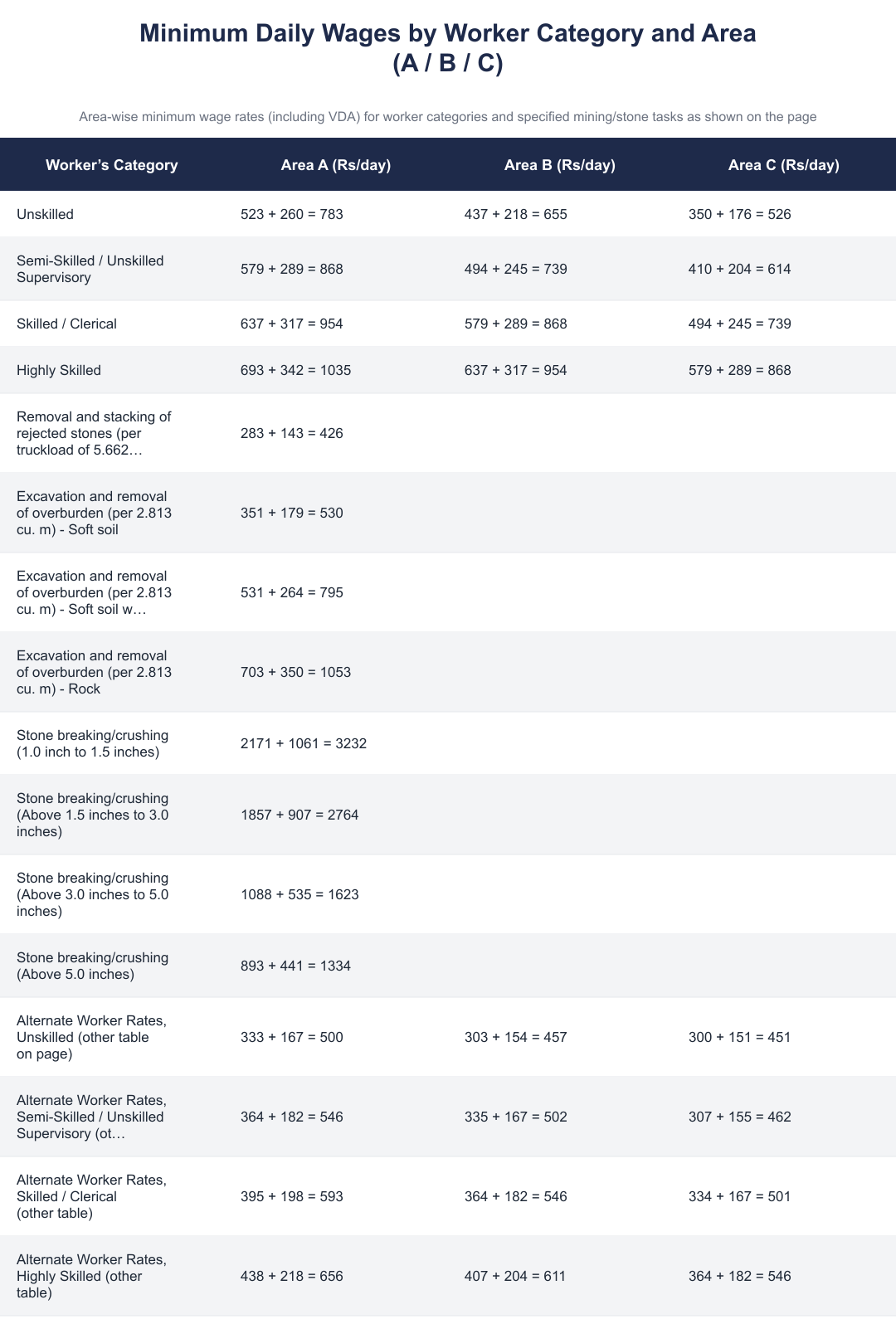
Example scheduled daily wages including VDA vary by area and skill: for Unskilled workers area A = Rs 783 (523 + 260), B = Rs 655 (437 + 218), C = Rs 526 (350 + 176). For Skilled/Clerical workers area A = Rs 954 (637 + 317), B = Rs 868 (579 + 289), C = Rs 739 (494 + 245). Highly skilled workers in area A get Rs 1,035 (693 + 342), area B Rs 954 (637 + 317) and area C Rs 868 (579 + 289); these are examples from notified schedules and can differ by state and employment.
What penalties apply if an employer pays less than the minimum wage?
If an employer pays less than the notified minimum wage, the Authority can direct payment of the deficit to the employee plus compensation up to ten times the deficit amount in claims for short payment. For other breaches, the Authority may direct payment of amounts due and compensation not exceeding Rs. 10, and the Act also prescribes punishments and penalties under state rules. Labour Commissioners, inspectors and designated authorities have powers to investigate registers and enforce compliance, and employers found guilty may face fines or imprisonment as per the Act and rules.
Can minimum wages differ by region, skill and employment?
Yes, minimum wages can differ by region (area A/B/C), by categories of workers (unskilled, semi-skilled, skilled, highly skilled), and by different scheduled employments. The Act explicitly allows different rates for different regions and types of work and permits special rates for adolescents, adults, children and apprentices. For instance, the same scheduled employment may have area-wise rates such as A = Rs 783 for unskilled and A = Rs 954 for skilled categories as per notified schedules.
How can an employee claim wages under the Minimum Wages Act 1948?
An employee can approach the designated Authority or Labour Commissioner to claim payment if wages below the minimum were paid; the Authority may order the employer to pay the deficit and award compensation as prescribed. For short-payment claims the Authority may direct payment of the shortfall plus compensation not exceeding ten times the deficit; in other cases it may direct payment of due amounts and compensation up to Rs. 10. Claims typically require proof of employment and wages paid, and inspections can be initiated since the Act empowers inspectors and labour officers to examine employer registers and records.
Need help staying Payroll compliant?
MoneyGence's AI Finance OS tracks your compliance, wallet share, and finances in one place, built for agencies and growing businesses.
Get started with MoneyGence