Lump Sum Calculator: Instant Future Value Calculator
A lumpsum calculator helps you estimate the future value of a one-time investment by applying compound growth over a chosen period. In this guide you will learn how the lumpsum calculator works (the formula behind the computation), how to use it with realistic inputs, a worked example to verify the math, when a lumpsum approach can be suitable for investors, and the practical benefits of using the calculator in financial planning. Understanding the mechanics behind the calculator, rather than treating it as a black box, lets you set realistic return expectations, compare alternatives, and decide whether to deploy surplus cash now or spread investments over time. This article is aimed at retail investors and financial planners who want a clear, actionable explanation of the lumpsum calculation and how it ties to decision-making. You will also find a simple example you can recompute manually to validate the tool’s output.
How Does the Lump-sum Calculator Work?
At its core the lumpsum calculator applies the compound interest formula to a single upfront investment to compute its future value after a given number of years at a specified annual rate of return. The standard formula used is FV = PV(1+r)^n where FV is the future value, PV is the present value or initial investment, r is the annual rate of return (expressed as a decimal), and n is the number of years the money is invested.
This formula compounds the investment annually (or conceptually at the frequency assumed by the calculator) so each year’s returns become part of the base that earns returns in subsequent years. Using the formula manually or in a calculator gives you the projected maturity value and the implied returns earned, which helps set expectations and compare potential outcomes across different rates and horizons.
How To Use the Lump-sum Calculator?
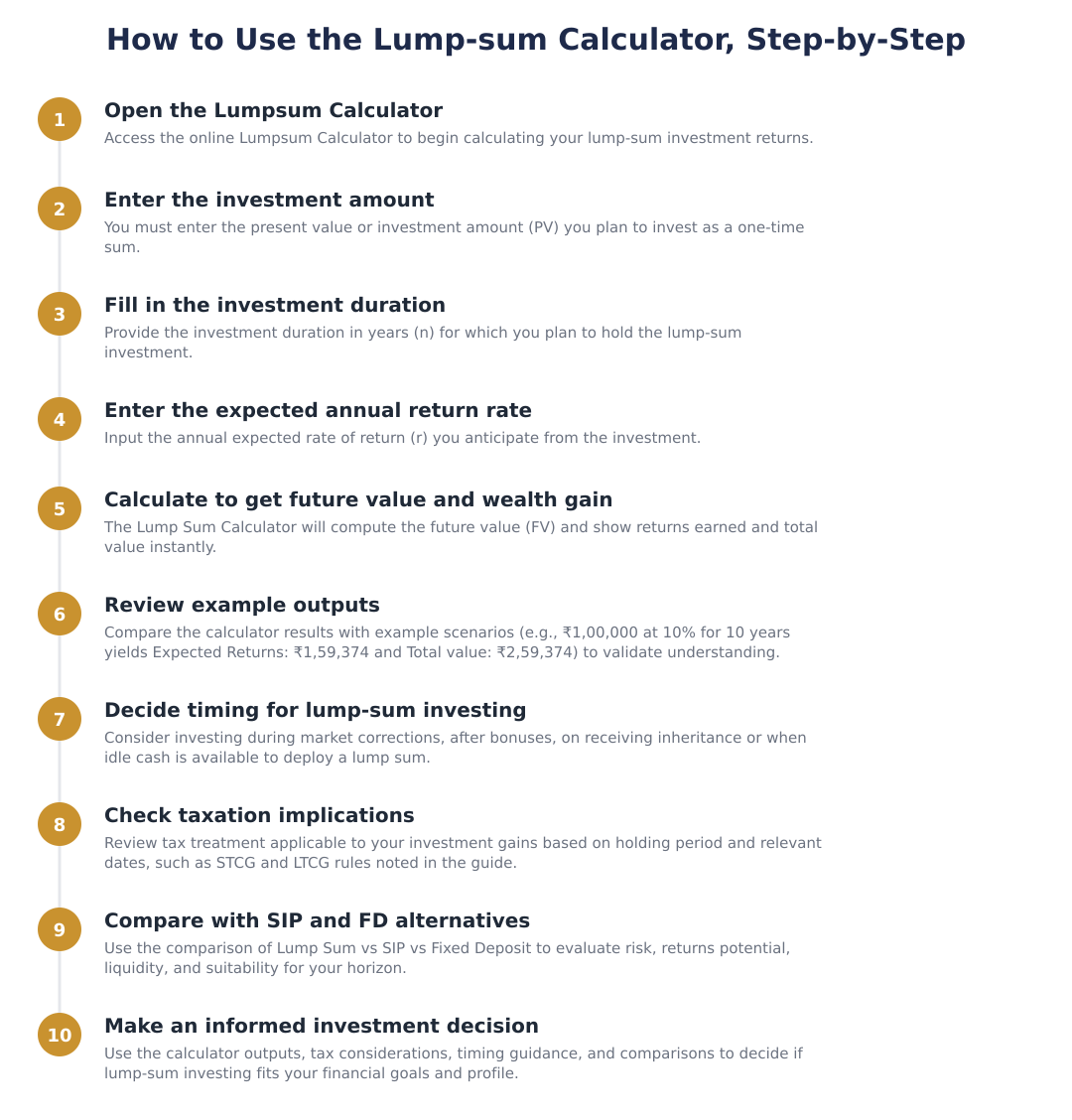
Provide the one-time amount you plan to invest now; this is the present value used in the formula.
Specify the annual rate of return you expect, expressed as a percentage (convert to decimal for the formula).
Specify the number of years you intend to keep the money invested; the calculator compounds for this many periods.
The calculator applies FV = PV(1+r)^n and displays the future value along with the returns earned (future value minus invested amount).
Worked Example for the Lump-sum Calculator
| Invested Amount | Expected Returns | Total value |
|---|---|---|
| ₹1,00,000 | ₹1,59,374 | ₹2,59,374 |
When Should You Invest Through a Lump Sum?
Lump-sum investing can be an appropriate strategy when you have surplus cash that you do not need for near-term expenses and you are comfortable with market risk for the investment horizon. It can be used to deploy bonuses, inheritances, or other windfalls into market-linked assets with the aim of benefiting from full market exposure from the start.
Guidance on suitability is advisory rather than a legal obligation: whether a lumpsum approach is right depends on your risk tolerance, investment horizon, and financial goals. Many investors compare the lump-sum option with systematic alternatives to decide which aligns best with their cash flow and temperament.
Benefits of the Lump-sum Calculator
A lumpsum calculator gives an immediate, transparent projection of what a single investment may grow to under assumed returns and a chosen time horizon. This helps set realistic expectations, validates financial planning assumptions, and makes it easier to compare outcomes across different rates and tenors.
Using the calculator to model scenarios (different rates or durations) supports decision-making about deploying surplus funds, choosing between alternatives, and assessing whether a target corpus is achievable. Because the outputs are produced from a clear formula, you can also replicate the math offline for verification or to explain results to stakeholders.
Taxation and Compliance Notes
Taxation and compliance depend on the instrument you choose and applicable tax rules; these are not handled directly by the lumpsum formula. You should consult relevant tax guidance or a tax professional for instrument-specific treatment and any compliance steps.
This page does not state penalties, section numbers, or precise compliance obligations. For clarity on liabilities and filing requirements consult official tax sources or a qualified adviser.
A lumpsum calculator is a straightforward tool driven by the compound interest formula FV = PV(1+r)^n. By entering an initial investment, an expected return and an investment horizon you can quickly see projected future value and the returns earned. Use the calculator to test scenarios, validate goals, and inform whether deploying a one-time sum now fits your overall plan; for taxation or compliance questions, seek authoritative tax guidance or a professional adviser.
Frequently asked questions
How does a lumpsum calculator work if I want to know future value quickly?
A lumpsum calculator computes the future value by applying compound interest to your one-time investment using the formula FV = PV × (1 + r)^n. Here FV is the future value, PV is the present investment amount, r is the annual rate of return (in decimal) and n is the number of years; for example, investing ₹1,00,000 at 10% for 10 years gives FV = 1,00,000 × (1.10)^10 = ₹2,59,374. The calculator automates this math so you instantly see both returns earned (₹1,59,374 in the example) and total value at maturity. It assumes returns compound annually unless the tool specifies a different compounding frequency.
How do I use the lumpsum calculator step by step?
To use the lumpsum calculator you enter three inputs: the investment amount (PV), the investment duration in years (n), and the expected annual rate of return (r). After entering these, the calculator displays the future value and the returns earned, for example, entering ₹1,00,000, 10% expected return and 10 years duration shows invested amount ₹1,00,000, expected returns ₹1,59,374 and total value ₹2,59,374. The tool is designed to be quick and convenient for novice investors to estimate maturity value and check whether the investment meets their financial goal. Make sure the expected return you enter reflects realistic market-linked or fixed-return assumptions depending on the asset type.
Can you give a clear example of a lumpsum calculation with numbers?
Yes, for example, if you invest ₹1,00,000 at an expected annual return of 10% for 10 years, the lumpsum calculator shows expected returns of ₹1,59,374 and a total value of ₹2,59,374. The calculation uses FV = PV × (1 + r)^n so FV = 100,000 × (1.10)^10 = 259,374. This illustrates how compounding grows a one-time investment over a medium to long-term horizon. You can change any of the three inputs (amount, rate, years) to see different outcomes instantly.
How are lump sum mutual fund gains taxed now and earlier?
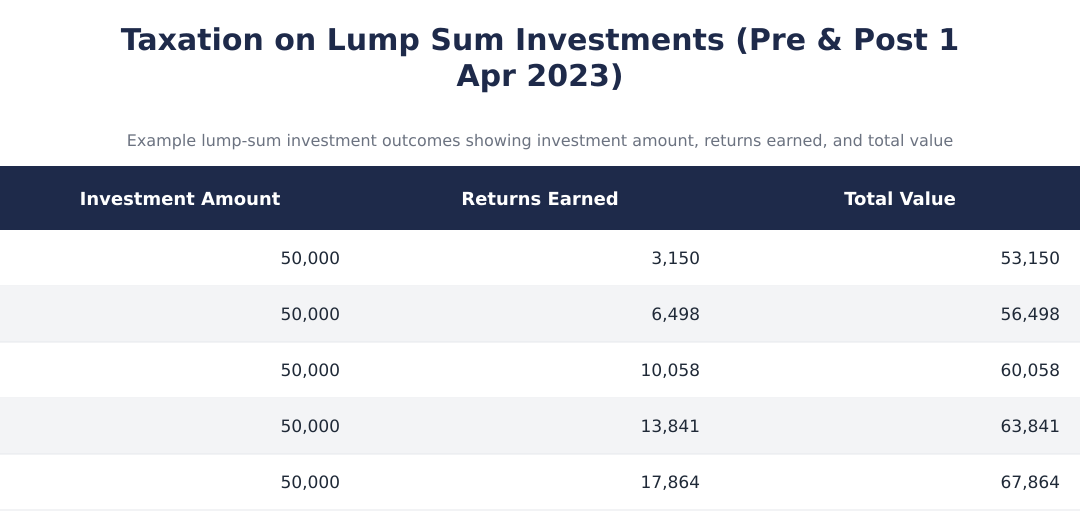
Post 1 April 2023, all gains on mutual funds are taxed as short-term capital gains (STCG) at the investor's slab rates regardless of holding period. For investments made before 1 April 2023, gains on units held for more than the specified period (pre-1 Apr 2023 > 2 years for debt funds) were taxed as long-term capital gains (LTCG) at 12.5% without indexation, while holdings within the short period were taxed as STCG at the investor's slab rate. Note that equity and debt have historically had different holding-period cut-offs (equity LTCG often >1 year) and recent law changes mean you must check acquisition date to determine which regime applies.
Lumpsum vs SIP vs FD, which is better for different goals?
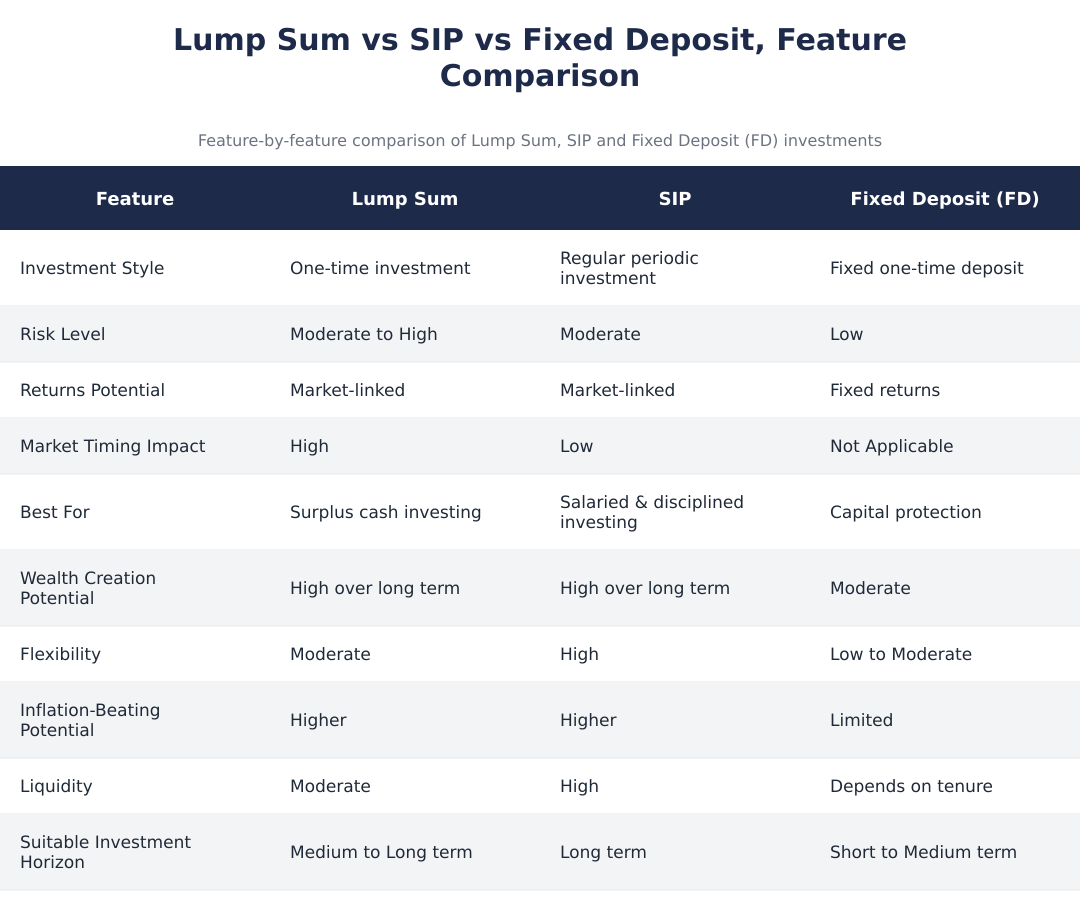
Lumpsum is a one-time investment best when you have surplus cash and want immediate market exposure, SIP (Systematic Investment Plan) is periodic investing suited for disciplined, salaried investors to average market timing risk, and FDs are fixed-deposit one-time investments offering low, guaranteed returns for capital protection. In terms of risk and returns: lumpsum and SIP are market-linked with higher wealth-creation potential over long term, while FDs give limited inflation-beating potential but lower risk. Choose lumpsum when you have idle cash or during market dips, SIP for rupee-cost averaging over long horizons, and FD when capital preservation and predictable returns are priorities.
When is it a good idea to invest through a lumpsum?
Investing lumpsum is sensible when you have surplus cash, receive a windfall (bonus, inheritance or incentives), or want to act during market corrections when valuations are attractive. It also suits long-term financial goals such as retirement or child education if you can tolerate short-term volatility and keep the money invested for the investment horizon. However, lumpsum carries higher market-timing risk compared with SIP, so many investors prefer lumpsum only when they have conviction or a long time horizon to ride out market swings.
What are the main benefits of using a lumpsum calculator?
A lumpsum calculator quickly shows the future value and returns on a one-time investment so you can determine if your financial goal is achievable within the chosen term. It helps you compare outcomes across different rates, durations and investment amounts, aids selection of investments (mutual funds, FDs) and improves financial planning by estimating maturity value and wealth gain. The tool is especially useful for novice investors to model scenarios, identify inflation-beating potential and manage expectations before committing surplus cash.
Who should consider investing via lumpsum according to practical investor profiles?
Lumpsum investing is suitable for salaried individuals who receive bonuses or incentives, high-net-worth individuals (HNIs) with large surplus cash, people receiving windfalls like inheritance or maturity proceeds, retirees deploying retirement corpus strategically, and first-time investors with long horizons seeking compounding benefits. Each profile should match their risk tolerance and time horizon, HNIs and windfall recipients often use lumpsum for diversification and growth, while first-time investors should ensure they can stay invested long enough to benefit from compounding. If you need regular liquidity or prefer risk smoothing, SIPs or FDs may be more appropriate.
What inputs and assumptions does the lumpsum formula require?
The lumpsum formula requires three inputs: PV (present value or invested amount), r (annual rate of interest in decimal form), and n (number of years), and computes FV = PV × (1 + r)^n assuming annual compounding. You must enter realistic expected return rates for the asset class you choose, for example, equity mutual funds may have higher expected returns than FDs, and remember the calculator typically does not factor in taxes or inflation unless it explicitly offers after-tax or inflation-adjusted modes. Changing any input instantly alters the future value and returns earned so you can test multiple scenarios before investing.
Need help staying Calculators compliant?
MoneyGence's AI Finance OS tracks your compliance, wallet share, and finances in one place, built for agencies and growing businesses.
Get started with MoneyGence