Loan Agreement Format – Free Sample Template & Guide
This guide explains what a loan agreement is, why businesses and individuals use one, and what typical components you should expect to find in a clear, enforceable document. Whether you are lending to a friend, borrowing for a business need, or drafting a financing contract for customers, a well-drafted loan agreement reduces misunderstandings, sets expectations, and creates a record that helps manage repayment and remedies if things go wrong. In this article you will learn the purpose of a loan agreement, the common clauses that make it effective, practical considerations when negotiating terms, and how to present the agreement so it is clear for all parties. The content is written to help non‑lawyers recognise the important parts that should be included and to prepare for discussions with legal or financial advisors. By the end of this guide you will be better equipped to spot missing elements, ask the right questions when reviewing a draft, and understand why each clause matters for protecting interests and preserving relationships between lender and borrower.
Loan Agreement
A loan agreement is a written contract between a lender and a borrower that records the terms under which money is lent and repaid. It is the primary document that converts a verbal understanding into a binding record. Beyond documenting the exchange of funds, the agreement sets expectations about payment timing, obligations of each party, and what happens if those obligations are not met.
Because a loan agreement creates a clear framework for the lending relationship, it reduces ambiguity and helps avoid disputes. It also provides a basis for enforcing rights if the borrower defaults or if a disagreement arises about the scope of the loan or repayment terms. While the specifics may vary depending on whether the loan is between individuals, companies, or financial institutions, the core purpose remains the same: to memorialise the parties’ intentions and provide a roadmap for performance and remedies.
Requirement of a Loan Agreement
Not every informal lending situation will require a formal, detailed agreement, but having one is advisable in most cases where money, business reputation, or relationships are at stake. A written agreement helps both parties to clarify terms that might be missed or misunderstood in an oral arrangement, such as repayment schedule, interest treatment, and consequences of non‑payment.
For businesses, a written loan agreement supports accounting and record‑keeping practices and can be important for tax, audit, and corporate governance purposes. For individuals, it helps preserve personal relationships by reducing future disagreement over what was promised. In short, a loan agreement acts as both a preventive tool and an evidentiary document if a dispute needs to be resolved later.
Contents of a Loan Agreement
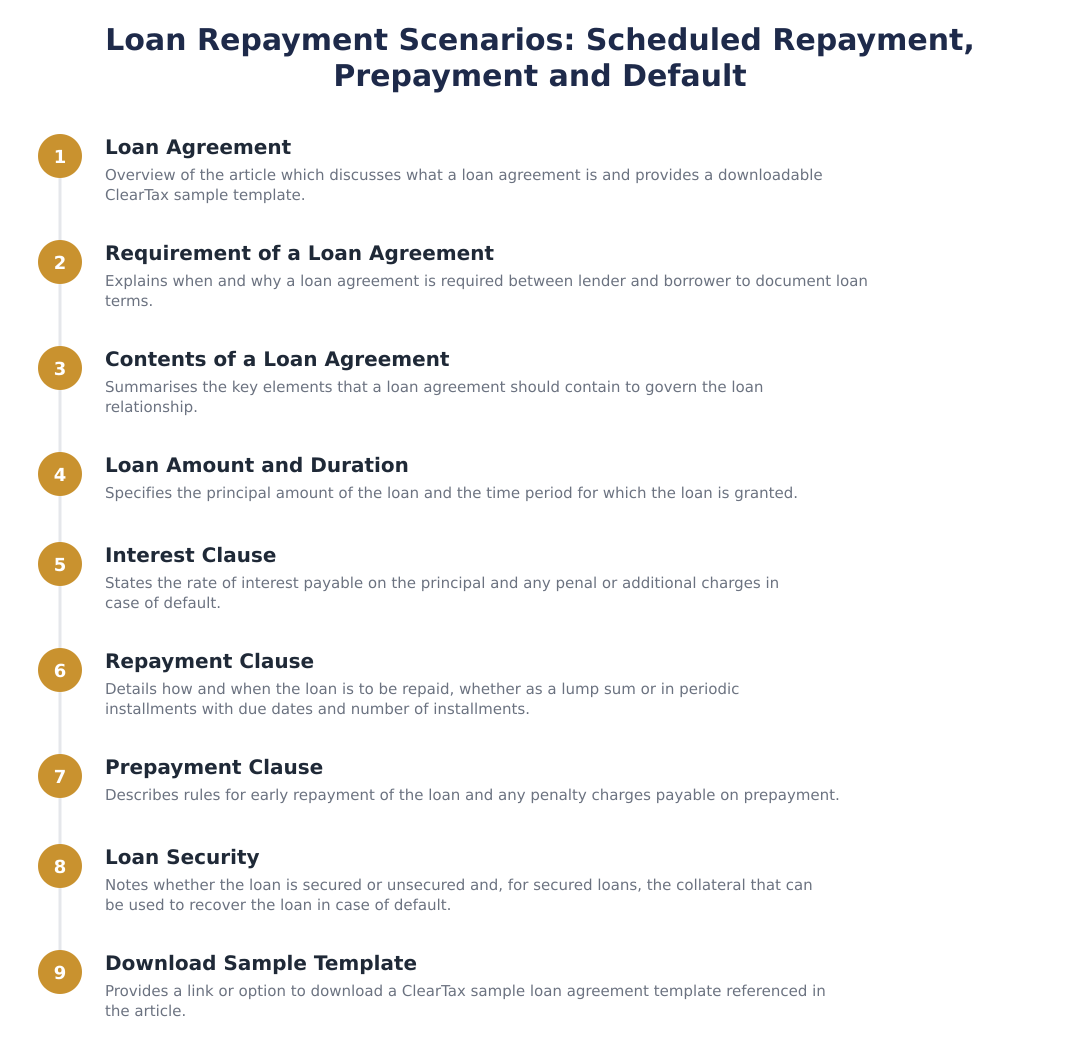
A comprehensive loan agreement typically begins by identifying the parties and stating the amount being lent. It then describes the repayment structure, which may be a single repayment at maturity or a schedule of periodic payments. Clear description of payment dates, acceptable payment methods, and any grace periods helps avoid confusion about when and how liabilities are to be discharged.
Another important element is the treatment of interest and charges. The agreement should state whether interest is payable, how it is calculated, and whether any additional charges apply in the event of late payment. Clauses dealing with prepayment, whether the borrower may repay early and whether any fee applies for early repayment, help both sides understand options for accelerating settlement.
Security for the loan, if any, should be defined in the agreement. For secured loans, the document should describe the collateral, the lender’s rights over it, and the process for realisation if the borrower defaults. For unsecured loans, the agreement should make that status explicit so the parties have a shared understanding of the lender’s remedies.
Finally, a robust agreement will include representations and warranties, events of default, remedies available to the lender, dispute resolution procedures, and basic administrative provisions such as notices, governing law, and signatures. These clauses allocate risk and set out the practical steps the parties will take if the relationship does not proceed as planned.
Related Articles
When preparing or reviewing a loan agreement it is useful to consult additional resources that cover drafting tips, sample clauses, and common pitfalls. Look for materials that explain how different repayment schedules affect cash flow for both lender and borrower, and those that illustrate how collateral descriptions should be drafted to avoid disputes.
Also consider reading practitioner guidance on negotiation points and checklists to ensure compliance with corporate policies or personal objectives. Combining a clear loan agreement with good supporting records, such as evidence of funds transferred and correspondence about the loan, strengthens the parties’ position if enforcement becomes necessary.
About the Author
Mayashree Acharya is the author of this guide. The content is intended to give readers a practical overview of loan agreements and what to look for when drafting or reviewing one.
This article is a general guide and is not a substitute for professional advice. For specific drafting needs or legal questions about a particular loan arrangement, consult a qualified lawyer or financial adviser.
A well-drafted loan agreement clarifies expectations, documents commitments, and provides procedures for repayment and remedies. Even when lending to acquaintances or within a small business, investing time to create a clear written agreement helps preserve relationships and reduce risk. Use this guide as a starting point to identify the important clauses and to prepare for further review with legal or financial professionals.
Frequently asked questions
What is a loan agreement and why do I need one?
A loan agreement is a written contract that records the terms under which a lender gives money to a borrower and why it is needed to clearly fix rights and obligations. It protects both parties by specifying the principal (loan amount), interest rate, repayment schedule, prepayment rules and remedies on default, so there is no ambiguity later. For businesses and individuals, a formal loan agreement helps evidence the transaction for legal, tax and compliance purposes and is especially important when collateral is involved or when parties are not related. Many lenders and tax advisors recommend using a written template to ensure standard clauses like penal interest and security are included.
What are the essential contents that must be included in a loan agreement?
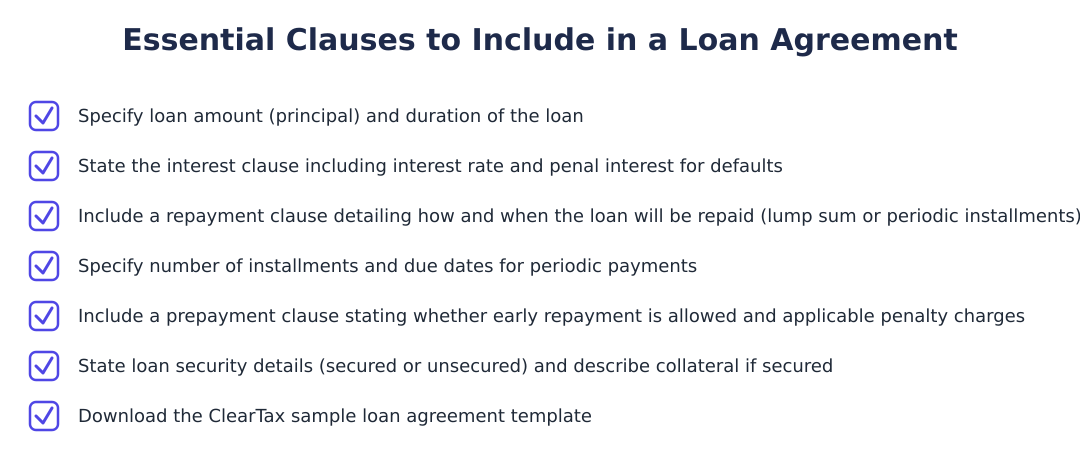
A loan agreement should at minimum include the loan amount (principal), duration (tenure), interest clause (rate and penal interest on default), repayment clause (schedule and method), prepayment clause and details of any security or collateral. The repayment clause should state whether repayment is lump sum or periodic, the number of installments and exact due dates; the interest clause should state the interest rate and any additional charges for late payment. If the loan is secured, the agreement must identify the pledged asset (for example house or vehicle) and the lender’s rights on default; if unsecured, that should be explicitly stated. Including these elements reduces disputes and helps with enforcement and tax documentation.
How should I write the loan amount and duration in the agreement?
You should state the exact principal amount in figures and words and the precise loan duration (start date and end date or number of months/years). For example, specify Rs. 5,00,000 (Rupees Five Lakh only) repayable over 36 months starting from 01/07/2026, so there is no ambiguity. Including both dates and the tenor (months/years) helps calculate interest accurately and determines installment amounts and due dates. Always ensure the dates align with the repayment clause and any security creation timelines.
What should an interest clause in a loan agreement specify?
The interest clause must specify the exact rate of interest, the calculation method (simple or compound), the frequency of interest computation and any penal interest for defaults. For example, the clause can state interest at 10% per annum calculated on a reducing balance with a penal interest of 2% per month on overdue amounts. It should also describe when interest accrues (monthly, quarterly) and whether GST or other taxes apply to interest charges. Clear interest terms prevent disputes over how much is payable and how late fees are applied.
How should repayment terms be framed in the loan agreement?
Repayment terms must clearly state if repayment is a lump sum or periodic instalments, the number and amount of instalments, exact due dates and the mode of payment. For example, the agreement can specify 36 equal monthly instalments of Rs. X each due on the 5th of every month starting 05/08/2026 and payable by bank transfer to the lender’s account. It should also detail consequences of missed payments, grace periods (if any), and whether early repayments adjust future instalments or tenure. Precise repayment terms help both parties plan cash flows and enforce recovery if needed.
What is a prepayment clause and how does it work in a loan agreement?
A prepayment clause governs early repayment of the loan and usually allows prepayment subject to payment of a penalty to compensate the lender for lost interest. For example, the clause may permit full or partial prepayment after 12 months provided the borrower pays a prepayment penalty of 2% of the prepaid principal. It should specify whether the penalty applies to partial prepayments, how prepayment affects future instalments or tenure, and any notice period required. Including a clear prepayment clause prevents disputes when a borrower wants to clear the debt early.
What does it mean when a loan is secured or unsecured in the agreement?
A secured loan is backed by collateral (an asset like a house or vehicle) that the lender can use to recover dues on default, while an unsecured loan has no such security and relies solely on the borrower’s promise. The loan agreement must identify the pledged asset and describe the lender’s right to enforce the security, for example by sale of the asset on default; in contrast, an unsecured loan agreement should state that no collateral exists. Secured loans typically attract lower interest rates because the lender’s risk is reduced, whereas unsecured loans carry higher rates and greater emphasis on creditworthiness. Documentation to create security (like mortgage deeds) is often executed along with the loan agreement.
Where can I get a reliable loan agreement template to download?
You can download a sample loan agreement template from ClearTax that contains standard clauses for principal, interest, repayment, prepayment and security and can be customized to your facts. The ClearTax sample template provides a ready-to-use format with headings for loan amount and duration, interest clause, repayment clause, prepayment terms and details about secured or unsecured status, making it easier to prepare a complete agreement. Always review and adapt the template to reflect the agreed numbers, dates and any special conditions, and consider legal review for large loans or complex security arrangements. Using a template ensures you include commonly required clauses and reduces the risk of omissions.
Need help staying Finance Templates compliant?
MoneyGence's AI Finance OS tracks your compliance, wallet share, and finances in one place, built for agencies and growing businesses.
Get started with MoneyGence