LLP Annual Filing India: How to File Form 8 & Form 11
This guide explains the annual filings an Indian Limited Liability Partnership (LLP) needs to complete and why meeting these compliance requirements matters for the business. You will learn which statutory returns are central to LLP annual compliance, what each filing represents in broad terms, and how annual compliance fits into the LLP’s overall corporate housekeeping and tax obligations. The guide focuses on practical implications for partners, the importance of maintaining proper books and transparency, and common touchpoints where LLPs interact with regulators during the year. Timely and accurate annual filings underpin an LLP’s good standing: they keep the LLP compliant with corporate law, help maintain trust with banks, creditors and vendors, and reduce the risk of administrative action or difficulty in obtaining approvals later. While this guide highlights the core annual returns that LLPs must submit, it also clarifies where to look for more detailed, form-specific instructions and when to consult a professional adviser. Note: the guide states the essential statutory requirement that all registered LLPs need to file the two principal annual forms mentioned in the body.
Compliances by LLP
LLPs, like other business entities, are required to follow a set of annual compliance steps to remain in good legal standing. These compliances include maintaining proper accounting records, preparing statements that reflect the financial position of the LLP, and submitting statutory returns that summarise key information about the LLP’s operations and partners. Adhering to these routines supports transparency and helps partners demonstrate fiduciary responsibility.
A central statutory requirement for every registered LLP is the filing of two specified annual forms. All registered firms have to fill Form 8 & 11 (annual filings for LLP). These submissions form the basic framework of the LLP’s annual corporate reporting and are a routine part of its regulatory obligations.
Beyond form filing, maintaining organised records throughout the year, such as books of account, supporting vouchers and minutes of partner meetings, makes the annual process smoother and reduces the risk of errors or omissions in statutory returns. When records are complete, partners and advisers can prepare filings with confidence and provide consistent information to other regulatory and financial stakeholders.
Statements of Accounts and Solvency
One of the core deliverables during the LLP annual cycle is the preparation of financial statements that present the LLP’s accounts and solvency position. These statements are prepared from books of account and evidence whether the LLP is solvent (able to meet its liabilities) at the relevant reporting date. Preparing clear, reconciled accounts is the foundation for accurate statutory filings and for the partners to take informed business decisions.
Even where an LLP’s operations are small, documenting income, expenses, assets and liabilities helps demonstrate proper financial stewardship. Partners have a responsibility to ensure that the figures presented in statutory submissions reflect the underlying accounting records and that the LLP maintains these records in a way that supports the statements prepared for filing.
Good practice includes maintaining routine reconciliations, documenting contingent liabilities with adequate notes, and ensuring that any significant transactions are appropriately authorised and recorded. These practices reduce the likelihood of queries or follow-up from regulators and make statutory compliance less burdensome.
Filing Annual Return
The annual return is the profile-level filing that summarises key information about the LLP for the year, such as the partners, authorised representatives, and certain statutory declarations. For LLPs, statutory filings are submitted through prescribed electronic forms as part of the regulatory framework. As noted above, all registered firms have to fill Form 8 & 11 (annual filings for LLP).
Preparing the annual return requires collating governance information, partner particulars and confirming certain statements about accounts and solvency. Accuracy is important because the details in the annual return form part of the public record for the LLP and are relied upon by external parties like banks and service providers.
While this guide outlines the type of information typically covered by annual returns, LLPs should review the official form instructions at the time of filing and consider professional assistance if there is any uncertainty. A professional adviser can help ensure consistency between financial statements and return disclosures, and can advise on supporting documents to retain.
Filing and Audit requirement under Income Tax Act
Annual corporate compliance interacts with income tax obligations, since the LLP’s financial statements form the basis for tax filings. Preparing organised accounts and reconciling tax-related figures during the year simplifies tax return preparation and helps in meeting any statutory audit requirements that may arise under tax laws.
Whether an LLP requires a tax audit depends on provisions of the tax law and the LLP’s financial thresholds and circumstances. Because specific thresholds and rules are subject to the statute and periodic changes, LLPs should refer to the Income Tax Act, notifications and professional advisers to determine whether an audit is required in their particular case.
Maintaining complete documentation, books of account, invoices, contracts and bank statements, supports both the tax return and any audit engagement. If an audit is necessary, starting the process early and coordinating with the auditor ensures a smoother completion of both tax and statutory filings.
Frequently Asked Questions
This FAQ section covers common queries LLPs have about year-end filings. The fundamental statutory position to bear in mind is that all registered firms have to fill Form 8 & 11 (annual filings for LLP). Beyond that core obligation, many practical questions arise about timing, consequences and attachments to the forms.
Because specific procedural details, timelines and penalties are governed by the official rules and are updated from time to time, LLPs seeking precise guidance on due dates, fees, late filing consequences, and the list of required attachments should consult the regulatory authority’s website or a chartered professional adviser. The FAQ answers below provide general direction and point to practical next steps rather than form-specific statutory text.
In summary, annual compliance for an LLP revolves around maintaining accurate books, preparing statements of accounts and solvency, and filing the required annual returns. Remember the baseline statutory requirement: all registered firms have to fill Form 8 & 11 (annual filings for LLP). For detailed form-level instructions, deadlines and potential consequences for non-compliance, consult the official filings portal or a professional adviser so you can complete filings correctly and on time.
Frequently asked questions
What annual filings does an LLP need to do every year?
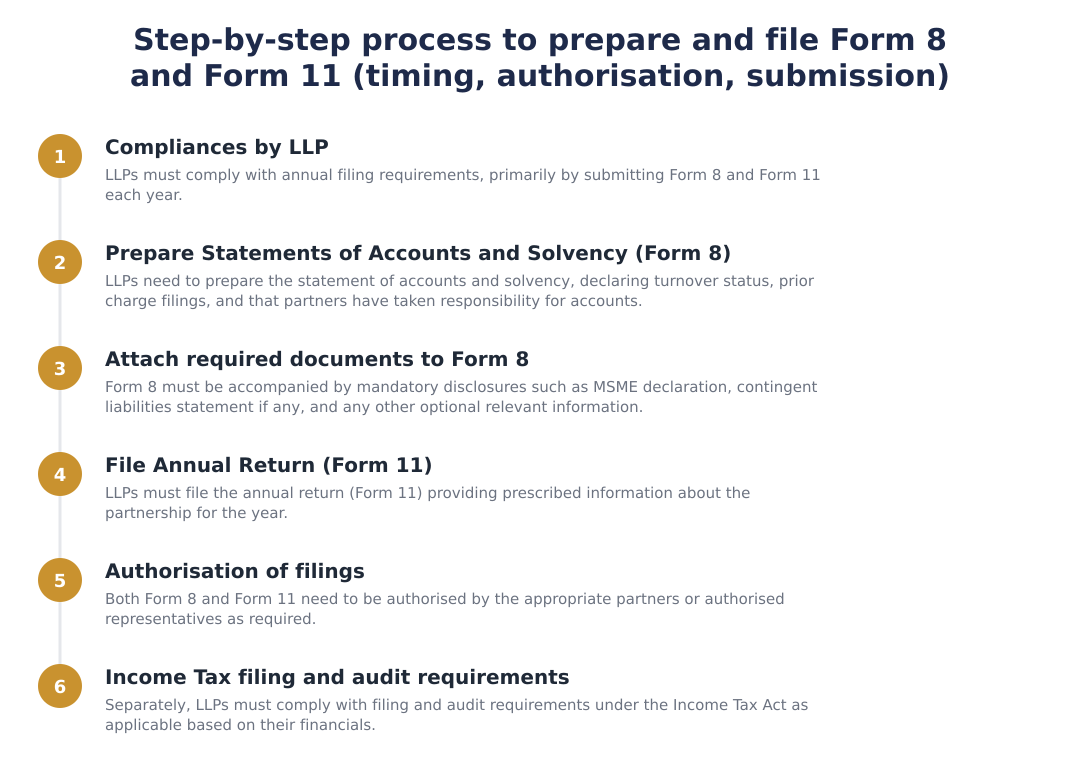
An LLP must file two annual forms with the Registrar of Companies: Form 8 (Statement of Accounts and Solvency) and Form 11 (Annual Return). Form 8 contains the balance sheet, profit & loss account and solvency declaration, while Form 11 provides information about partners, changes during the year and confirmations required by the LLP Act. Both forms must be filed every financial year and supported by the required attachments such as MSME disclosures or contingent liabilities, where applicable.
What is Form 8 and what information must an LLP provide in it?
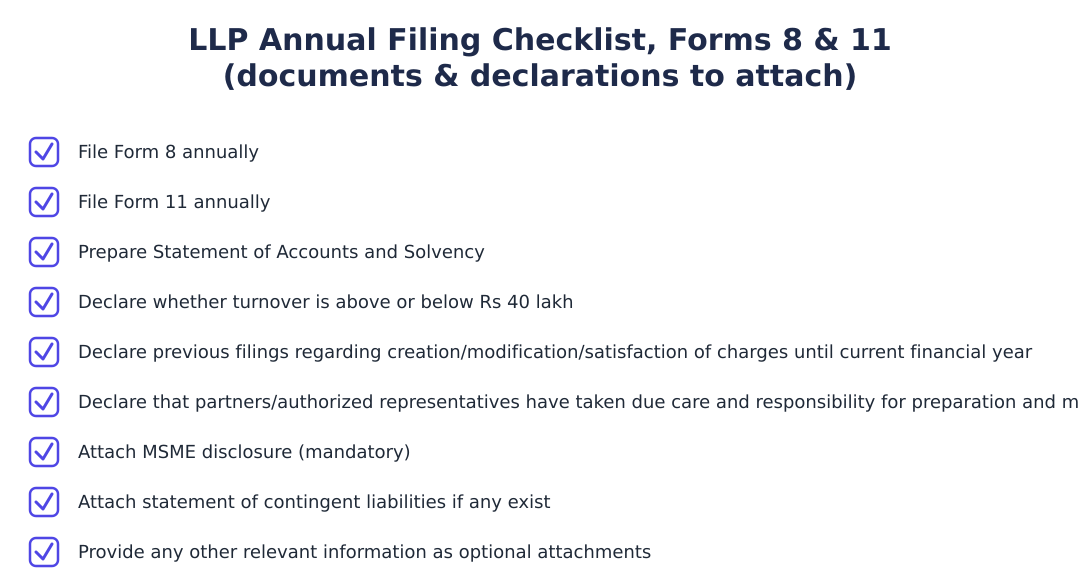
Form 8 is the Statement of Accounts and Solvency that an LLP must file yearly and it must include the balance sheet, profit & loss account and a solvency declaration signed by the partners. The form must state whether the LLP’s turnover is above or below Rs 40 lakh, declare earlier filings about creation/modification/satisfaction of charges up to the current year, and confirm that partners or authorised representatives have taken responsibility for preparing and maintaining accounts. Attachments may include disclosure under the MSME Development Act where applicable and a statement of contingent liabilities if any exists.
What is Form 11 and what information does it require?
Form 11 is the LLP Annual Return that must be filed each year and includes details of partners, designations, changes during the financial year and confirmations about compliance. The form asks for particulars of the LLP’s partners and any changes in partnership structure during the year, statutory declarations and relevant contact details; it also serves as confirmation that the LLP has complied with filing requirements. Failure to file Form 11 can attract penalties and liabilities for the LLP and its designated partners under the LLP Act.
Who must sign and authorise Form 8 and Form 11 for an LLP?
Both Form 8 and Form 11 must be authorised and digitally signed by a designated partner or an authorised representative of the LLP who has the authority to sign statutory filings. The authorised signatory must take responsibility for the accuracy of statements made, including financial declarations and partner information, and ensure any required attachments (like MSME disclosures) are included. Using the designated partner’s Digital Signature Certificate (DSC) is the standard method of authentication for MCA filings to ensure validity.
What attachments do I need to submit with Form 8?
Along with Form 8, an LLP must attach the financial statements (balance sheet and profit & loss account) and necessary declarations; specific attachments include an MSME disclosure (mandatory if applicable) and a statement of contingent liabilities if any exist. The form also allows optional additional information if relevant, and requires disclosure about prior filings related to charges on assets up to the current year. Omitting mandatory attachments can lead to non-compliance notices or penalties from the Registrar.
What happens if an LLP does not file Form 8 or Form 11 on time?
Failure to file Form 8 or Form 11 within the prescribed time attracts penalties and legal consequences under the LLP Act, and the designated partners can be held liable for non-compliance. The Registrar may charge late filing fees and the LLP will remain non-compliant until the forms are regularised, which can affect creditworthiness and invite further enforcement action. Repeated or prolonged default can lead to higher penalties and possible prosecution of responsible partners, so timely filing is essential to avoid escalating consequences.
If I incorporated my LLP close to the financial year-end, do I still need to file the annual return?
Yes, even if an LLP was incorporated near the financial year-end, it must still file Form 8 and Form 11 for that financial year because these filings cover every registered LLP for each year. The filings will reflect the LLP’s financial and partner information for the portion of the year it existed, and any required attachments (MSME disclosures, contingent liabilities) must be provided if applicable. New LLPs should check the Registrar’s prescribed timelines to ensure timely compliance and avoid penalties for the first year.
When is an LLP required to get its accounts audited under the Income Tax Act?
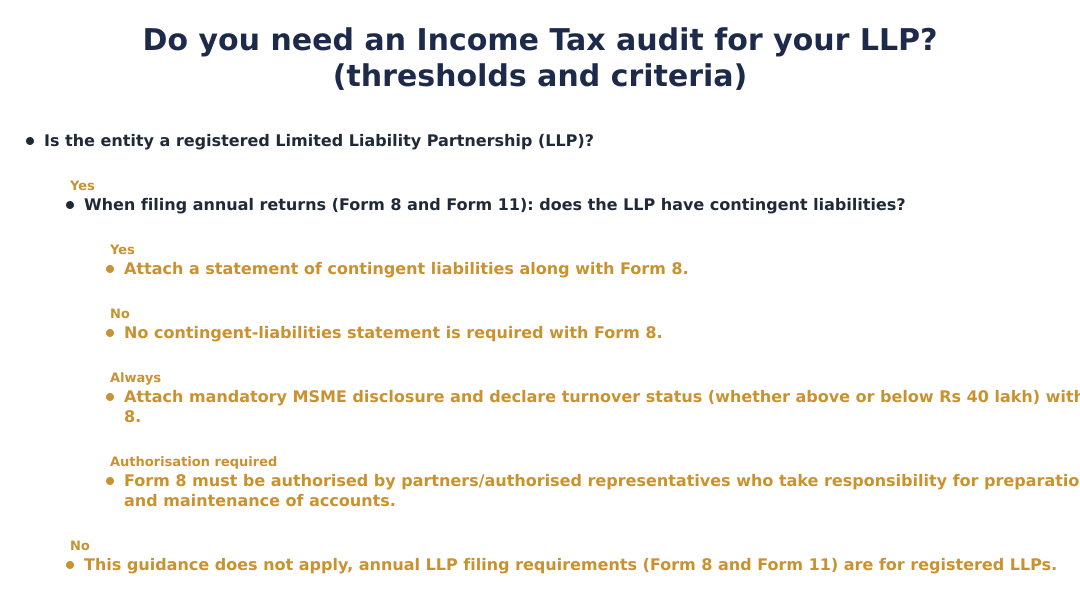
An LLP is required to get its accounts audited under the Income Tax Act if its total turnover or gross receipts exceed the statutory threshold (for example, if turnover exceeds the prescribed limit) or when other conditions in the Income Tax Act trigger audit applicability. The audit under the Income Tax Act is separate from MCA filings and must be carried out by a qualified chartered accountant who issues an audit report; the audited accounts are then used for tax compliance and can be required for Form 8 attachments. LLPs should consult the current Income Tax thresholds and rules each year because audit applicability and thresholds can change.
What specific disclosures related to MSME must an LLP attach and when is it mandatory?
An LLP must attach a disclosure under the Micro, Small and Medium Enterprises (MSME) Development Act, 2006 as a mandatory attachment to Form 8 if it has outstanding dues or transactions with suppliers classified as MSMEs. This disclosure identifies amounts due to MSME suppliers and the status of payments, and must be filed whenever such liabilities exist during the financial year. Failure to include mandatory MSME disclosures where applicable can render the filing incomplete and expose the LLP to compliance action by the Registrar.
Need help staying Company Registration compliant?
MoneyGence's AI Finance OS tracks your compliance, wallet share, and finances in one place, built for agencies and growing businesses.
Get started with MoneyGence