Labour Welfare Fund (LWF) Deduction: Salary, Contribution & Benefits
This guide explains the Labour Welfare Fund (LWF) in India, what an LWF deduction in salary means, who must contribute, and how workers and employers interact with the scheme. You will learn how the LWF is structured across states, what kinds of welfare services it funds, how contributions are collected and remitted, and the practical steps employers typically follow to comply. Understanding LWF is important for payroll teams, HR professionals, small-business owners and employees because it affects salary deductions, compliance calendars and access to worker benefits administered at the state level. The LWF is a state-level mechanism, individual state legislatures establish the fund and its rules, so the details you see on a pay slip or compliance notice will depend on the state where the establishment is located. This guide focuses on the common principles that apply across states: that employers deduct employee contributions, that both employer and employee contribute, and that the State Labour Welfare Board or an equivalent authority administers the fund and uses it to provide services such as education, medical care and vocational training. You will also find a short practical outline of the typical registration and remittance flow, and answers to frequently asked questions that clarify how LWF shows up in payroll, where to find the correct rates, and how to access benefits.
What is the Labour Welfare Fund (LWF) in India?
The Labour Welfare Fund is a statutory welfare arrangement created through enactments of various state legislatures. Each state that has established an LWF frames its own law or rules setting out who is covered, the contribution mechanism and the welfare objectives to be met. Collectively, these state laws are designed to provide financial and social welfare support to workers and labourers within the state.
Administration of the fund is handled at the state level. State governments or dedicated State Labour Welfare Boards are responsible for collecting contributions, maintaining records and disbursing funds for authorised welfare activities. Because the LWF operates under state legislation, the specific provisions, such as who must contribute, contribution frequency and procedural formalities, vary from state to state.
Labour Welfare Fund (LWF) Applicability
Applicability of the LWF depends on the individual state enactment. States specify which establishments, categories of workers and employers fall within the scope of the Act; as a result, an employer may be liable in one state but not in another depending on local law and thresholds set by that state.
Where the Act applies, both the employer and the workers to whom the Act is applicable are required to contribute to the Labour Welfare Fund. Practically this means employers must identify covered employees, apply the contribution rules set by the state and ensure that employee contributions are deducted from salaries and remitted along with the employer’s share.
Labour Welfare Fund (LWF) benefits
Funds collected under LWF are used to finance a range of worker-oriented services and facilities. Typical welfare purposes listed under state schemes include educational facilities for children, medical facilities for workers and their families, transport to facilitate commuting to work, and loans for housing at concessional rates.
Beyond those core services, state boards also focus on programs such as establishing home industries and subsidiary occupations to support unemployed workers and women, providing vocational training to enhance employability, and supplying nutritious food to children. The precise set of benefits and the eligibility rules for accessing them are determined by the administering State Labour Welfare Board.
LWF contribution and remittance, typical compliance steps
Check the Labour Welfare Fund rules for the state where the establishment operates to confirm whether the establishment and its employees are covered and to identify the applicable contribution frequency and rates.
Where the Act applies, the employer deducts the employee’s contribution from salary in accordance with the state rules.
The employer adds its own contribution as required by the state provisions and prepares the total amount for remittance.
Employers and covered establishments can register and make LWF contributions through their respective State Labour Welfare Fund or Labour Welfare Board website where an online portal is available; follow the portal’s process to file and pay.
LWF deduction, practical notes
Frequency and timing of deductions vary across states, some require monthly deductions, while others set half-yearly or yearly schedules. Employers must follow the frequency specified by the state law that governs their establishment.
Because LWF is administered by state authorities, payroll and HR teams should maintain state-specific documentation and reconcile remittances with the state Labour Welfare Board’s records. Where online portals exist, use them for registration, filing and payment to reduce administrative risk and ensure timely compliance.
Frequently Asked Questions
What is LWF in the salary slip?, When applicable, LWF appears as a statutory deduction on the salary slip representing the employee’s share of the Labour Welfare Fund, which the employer is required to deduct and remit to the state fund.
What is the Labour Welfare Fund deduction in salary?, The deduction is the employee portion of the contribution to the state Labour Welfare Fund; its rate and frequency are set by the state law that applies to the establishment.
What is the amount of the Labour Welfare Fund contribution?, Amounts and split between employer and employee vary by state; refer to the LWF rules of the specific state or the State Labour Welfare Board for the exact figures and contribution schedule.
How do you fill the Labour Welfare Fund form online?, Where a state provides an online portal, employers and establishments register with the State Labour Welfare Board and follow that portal’s instructions to submit forms and payments.
How to apply for a Labour Welfare Fund?, Application and registration processes are handled by the State Labour Welfare Board; employers should approach the board or use its official website (if available) to complete registration and compliance formalities.
How to calculate the Labour Welfare Fund amount?, Calculation depends on the state-prescribed rate and the frequency of deduction (monthly, half-yearly or yearly); consult the applicable state rules to compute contributions.
How to claim the Labour Welfare Fund?, Benefits and claims are administered by the State Labour Welfare Board; specific claim procedures, eligibility conditions and documentation requirements are set out by the administering authority in that state.
Because the Labour Welfare Fund operates under state laws and is administered by State Labour Welfare Boards, employers and employees should always refer to the specific state rules or the state board’s website for definitive rates, schedules and procedural forms. Following the state-prescribed deduction frequency, registering where required, and using available online portals will help ensure timely remittance and access to the welfare benefits funded by LWF.
Frequently asked questions
What is the Labour Welfare Fund (LWF)?
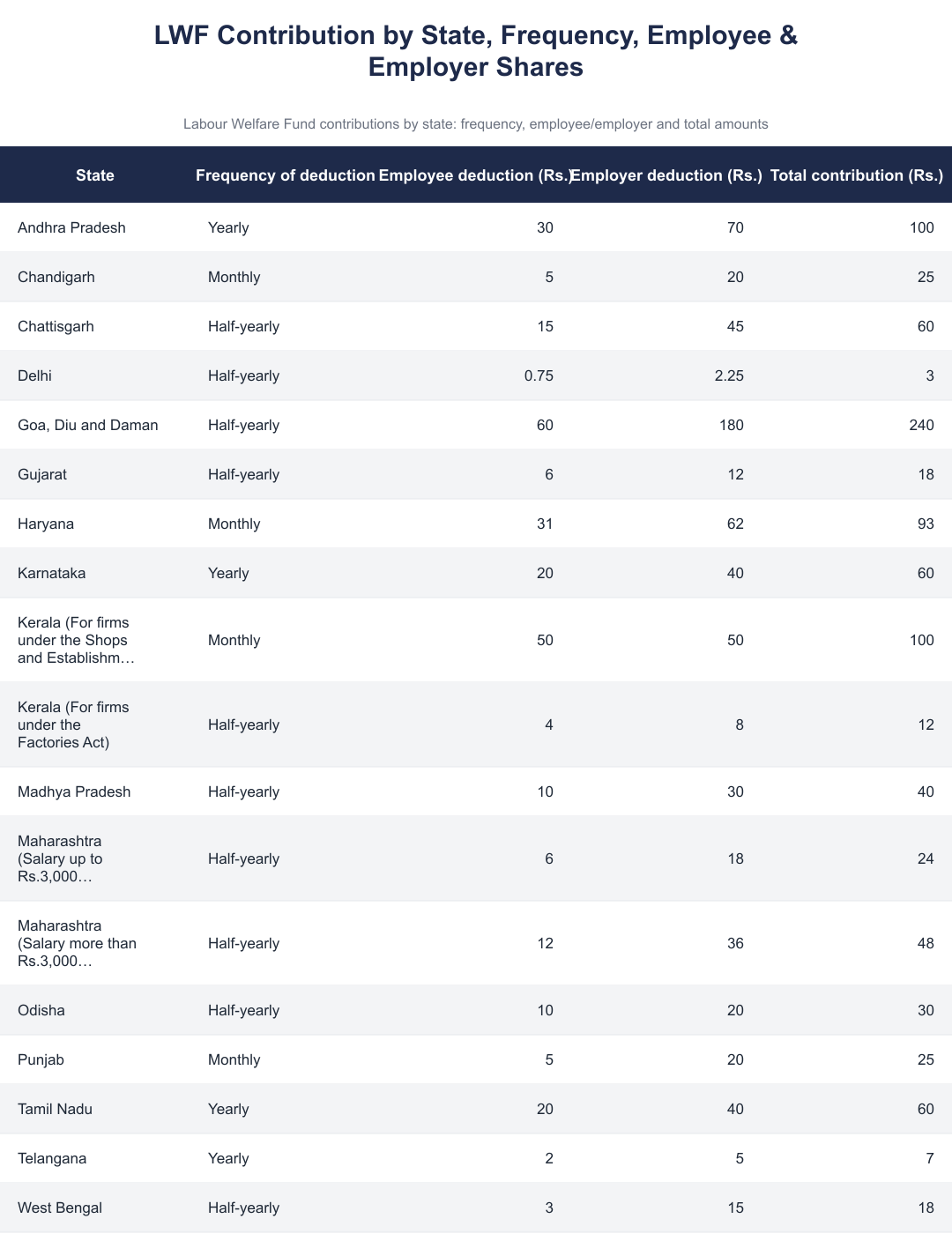
The Labour Welfare Fund (LWF) is a state-level social security fund where employers and workers contribute to finance welfare measures for employees. Sixteen Indian states and union territories have enacted LWF laws under which specified establishments and factories must contribute fixed amounts (shared between employer and employee) to provide benefits like medical aid, education, transport and vocational training. Contributions and the frequency of deduction (monthly, half-yearly or yearly) differ by state; for example, Andhra Pradesh requires a yearly contribution of Rs.100 (Rs.30 employee + Rs.70 employer) while Delhi requires half-yearly Rs.3 (Rs.0.75 employee + Rs.2.25 employer). The fund is administered by the respective state Labour Welfare Board which disburses benefits and manages claims.
Which states in India have the Labour Welfare Fund?
Sixteen states and union territories have active Labour Welfare Fund laws: Andhra Pradesh, Chandigarh, Chhattisgarh, Delhi, Goa (including Daman and Diu), Gujarat, Haryana, Karnataka, Kerala, Madhya Pradesh, Maharashtra, Odisha, Punjab, Tamil Nadu, Telangana and West Bengal. These are the jurisdictions where employers may be required to deduct and remit LWF contributions according to local rules. Note that Kerala has two different schedules: one for firms under the Shops and Establishments Act (monthly Rs.100 total) and another for firms under the Factories Act (half-yearly Rs.12 total).
What benefits does Labour Welfare Fund provide to workers?
LWF provides a range of welfare benefits such as educational facilities for children, medical facilities for workers and their families, transport for commuting, housing loans at concessional rates, support for home industries and subsidiary occupations, vocational training and nutritional programs for children. These services are financed by the pooled contributions of employers and employees and administered by the state Labour Welfare Board. Availability and scope of benefits vary by state and are determined by the respective LWF rules and schemes.
How much is deducted from my salary for LWF?
The employee share of LWF deduction varies by state and frequency, for example, Chandigarh and Punjab deduct Rs.5 monthly from employees, Kerala (Shops & Establishment) deducts Rs.50 monthly, and Maharashtra deducts Rs.6 or Rs.12 half-yearly depending on salary slab (up to Rs.3,000 or above). Total contributions (employee + employer) range from about Rs.6 to Rs.480 depending on state rules and frequency. Always check your state's LWF schedule because some states charge yearly or half-yearly amounts and different employer-employee splits apply.
How frequently is LWF deducted and paid to the board?
LWF deduction frequency depends on the state law and can be monthly, half-yearly or yearly; for instance, Haryana and Chandigarh require monthly deductions, many states like Delhi, Gujarat and Maharashtra require half-yearly payments, while Andhra Pradesh, Karnataka, Tamil Nadu and Telangana require yearly remittance. Employers are responsible for deducting the employee share from wages and remitting the combined employer and employee contributions to the state Labour Welfare Fund according to the prescribed schedule. Late or non-payment can attract penalties as per the respective state Act.
How is the LWF contribution split between employer and employee?
LWF contribution is split between employer and employee in fixed proportions specified by each state's LWF rules; for example, in Andhra Pradesh the split is Rs.30 employee + Rs.70 employer (total Rs.100), in Delhi it is Rs.0.75 employee + Rs.2.25 employer (total Rs.3) per half-year, and in Haryana it is Rs.31 employee + Rs.62 employer monthly (total Rs.93). The employer must deduct the employee portion from salary and add the employer portion when remitting the total amount to the state board. The exact amounts and splits are prescribed in the state schedule and may differ by salary slabs in some states (e.g., Maharashtra).
How do I claim benefits from the Labour Welfare Fund?
To claim LWF benefits you must apply to the respective state Labour Welfare Board using the prescribed claim form and provide supporting documents as required by that state's procedure, and some states also offer online claim submission through their LWF portal. The board verifies eligibility (such as employment under establishments covered by the Act and up-to-date contributions) before disbursing benefits like medical aid or educational assistance. If contributions are not current for your establishment, the claim may be rejected until the employer remits outstanding dues.
Who is covered and who is exempt from the Labour Welfare Fund?
Coverage depends on the specific state Act; generally, workers employed in factories, establishments or industries specified in the state schedule are covered and both employers and employees of those establishments must contribute, while some small establishments or certain categories of workers may be exempt as defined by the state law. Because each state frames its applicability criteria, you should consult the relevant state Labour Welfare Fund Act or the state's LWF/Board website to confirm whether your establishment and job role are covered or exempt. Exemptions, if any, and thresholds (for example, salary-based slabs) will be listed in the state rules.
How can an employer register and pay LWF online?
Employers must register with their respective state Labour Welfare Board and many states provide an online portal to register establishments, file returns and remit LWF contributions electronically. The exact process and URL will vary by state, employers should visit the official Labour Welfare Board website for their state to complete registration, upload required documents and make payments according to the prescribed frequency. Keep records of payment receipts and registration details because these are needed to support employee claims and to show compliance during inspections.
Need help staying Payroll compliant?
MoneyGence's AI Finance OS tracks your compliance, wallet share, and finances in one place, built for agencies and growing businesses.
Get started with MoneyGence