ITR Forms AY 2026-27: Simple Guide for First-Time Taxpayers
This guide explains ITR forms for Assessment Year 2026–27 in plain language for first-time taxpayers and students. You will learn why ITR forms are updated each year, which types of income push you to different ITR forms, how pre-filled information from the tax department can help, and a few practical checks to avoid common filing mistakes. The aim is to make form selection and basic pre-filing preparation less intimidating, whether you are a salaried student, an intern earning small interest, or someone earning money from freelance work or online tutoring. Understanding these basics early helps you file correctly, avoid rework later, and use the department’s pre-filled data effectively. The guide focuses on common scenarios and simple rules that determine which ITR to use, how to treat professional income like freelance or tuition receipts, and why you should review statements such as the Annual Information Statement (AIS) and Form 26AS before final submission. By the end, you will have a clear checklist of things to verify and a sense of how your income mix affects the correct ITR choice.
Why Are ITR Forms Revised Every Year?
The Income Tax Department revises ITR forms annually with clear goals: to make filing easier for taxpayers, improve transparency, reduce incorrect reporting, align return fields with the information the department already holds, and encourage voluntary compliance. Annual updates help ensure the forms capture relevant income types and disclosures that reflect changes in reporting channels and taxpayer behaviour.
For first-timers, yearly revisions mean the layout, pre-filled fields and required disclosures may change from one assessment year to the next. Reviewing the updated form and related guidance before you file reduces the chance of selecting the wrong form or missing information that the department already has recorded.
Key Changes in ITR Forms for AY 2026–27
Although form layouts change every year, the core idea is to better match taxpayer disclosures with data available to the department. Pre-filled information from systems such as the Annual Information Statement (AIS) and Form 26AS plays a larger role now, so taxpayers should expect more fields to be auto-populated.
For taxpayers this means less manual entry but also a greater need to verify pre-filled figures. If the pre-filled information is accepted without checking, you could either omit income that should be reported or overlook mismatches between your records and the department’s data.
1. Wider Eligibility for ITR-1 and ITR-4
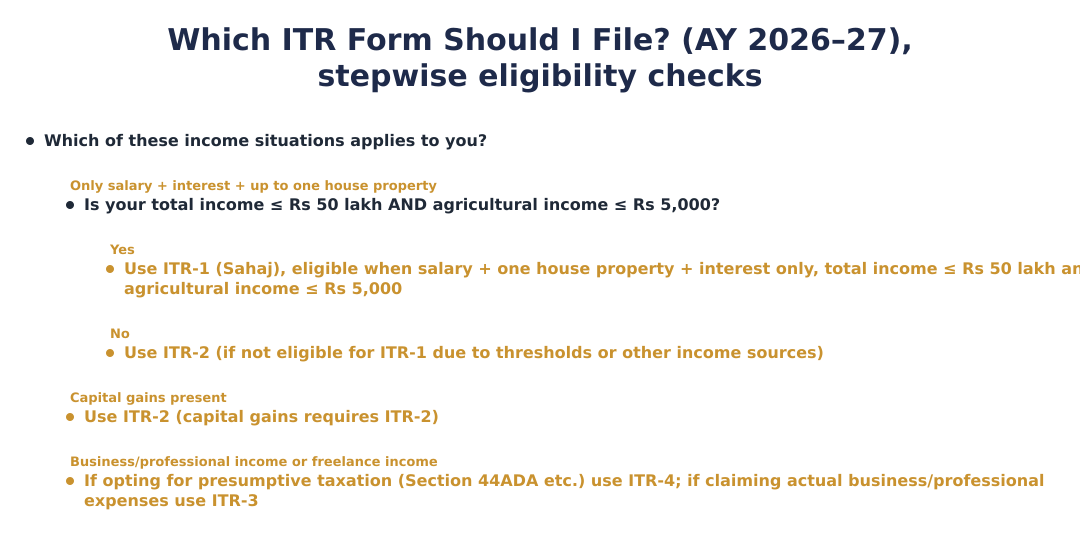
Salaried individuals with eligible income generally use ITR-1. This form is designed for taxpayers with simpler income profiles such as salary and certain other incomes that fit within the form’s scope.
Small businesses and professionals who opt for the presumptive taxation scheme may use ITR-4, subject to eligibility. Choosing ITR-4 is an option for those who prefer presumptive taxation, but you must ensure you meet the scheme’s conditions before selecting this form.
2. Greater Importance of Annual Information Statement (AIS)
Pre-filled ITR information, including data from the Annual Information Statement (AIS) and Form 26AS, may contain salary income, bank interest, fixed deposit interest, dividend income, securities and mutual fund transactions, TDS and other financial transactions reported to the Income Tax Department. AIS is now a central reference point for reconciling your records with what the department has received from third parties.
Before you accept pre-filled entries, download and review your AIS or Form 26AS to confirm accuracy. Verifying these statements helps prevent mismatches and ensures that income reported by banks, employers or brokers is also reflected correctly in your return.
3. Better Use of Pre-filled ITR Information
Pre-filled information reduces manual entry and the scope for typing errors. For first-time filers this can be a major convenience because commonly reported items such as salary and bank interest may already appear in the return.
However, pre-filled data is only useful when verified. Differences between your personal records and the department’s data, for example, missing entries from a bank or a freelance platform, must be corrected before final submission so the return accurately reflects your total income.
4. Additional Disclosure Requirements in ITR
ITR forms increasingly ask for disclosures that align with information reported by third parties. This helps the department match taxpayer returns with its records and reduces incorrect reporting. For taxpayers, this trend means paying closer attention to all income streams that may be reported on your behalf.
Be mindful of income types that commonly generate third-party reporting, such as bank interest, dividends and securities transactions, and check that these are shown in your AIS/Form 26AS. If they are missing, you should bring supporting documents when filing to establish the correct position.
5. Importance of Choosing the Correct ITR Form
Selecting the right ITR form is the starting point for a correct return. Taxpayers with more complex sources of income, for example, capital gains or business and professional income, may need ITR-2, ITR-3 or other ITR forms rather than the simpler ITR-1 or ITR-4.
If you have income from business or profession and you wish to use presumptive taxation, ITR-4 may be suitable subject to eligibility. Always match your income mix against the scope of each form before filing to avoid re-filing or correction later.
Why Students Should Understand Income Tax Early
Students who start earning, through internships, part-time jobs, freelance tutoring or content creation, benefit from knowing which income is taxable and how it should be reported. Early familiarity reduces mistakes and helps maintain clear records from the start.
Note that freelance or tuition income can be treated as professional income under Section 44ADA. If you have such income, it affects which ITR you should use and whether presumptive taxation is an option. Understanding this classification early prevents misreporting freelance receipts as other types of income.
Common Mistakes to Avoid in ITR Filing
One frequent error is failing to check the AIS and Form 26AS before filing. Since these statements may contain salary, bank interest, FD interest, dividends, securities and mutual fund transactions, and TDS details, overlooking them can lead to omissions or mismatches.
Another typical mistake is selecting the wrong ITR form. Salaried individuals with eligible income generally use ITR-1, while taxpayers with capital gains or business/professional income may require other ITRs. If you changed jobs during the year, remember that both Form 16s must be combined and the aggregate income assessed, this combined income can change your form eligibility and the tax slab computation.
A Few Simple Tips Before ITR Filing
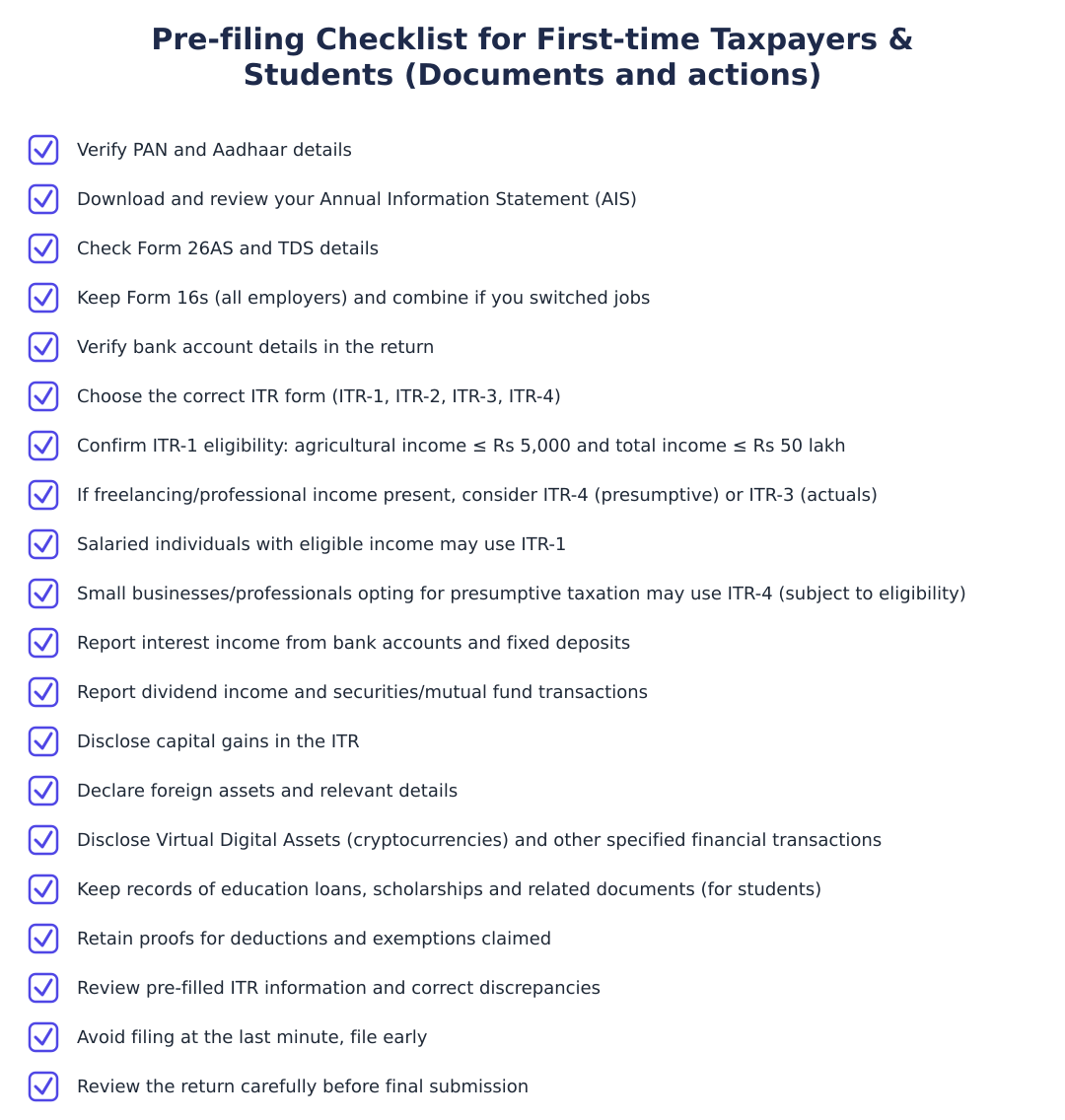
Download and review your AIS and Form 26AS so the department’s pre-filled entries match your records for salary, interest, dividends and securities transactions.
If you changed employers during the year, combine all Form 16s and assess the aggregate income to confirm the correct ITR form and tax computation.
Treat freelance or tuition receipts as professional income under Section 44ADA when applicable, and choose the ITR form that matches that classification.
Confirm whether your income profile fits ITR-1, ITR-4 or a different ITR so you don’t have to amend the return later.
Author Info
This guide is written to help first-time taxpayers and students understand the practical decisions involved in picking and filing the correct ITR form for AY 2026–27. It draws on official updates about form revisions, the role of pre-filled information, and basic income classification rules.
For more detailed scenarios or complex questions about your specific return, consider consulting a tax professional who can review your records and advise on the correct form and disclosures.
Filing the correct ITR for AY 2026–27 becomes easier when you know why forms change, how pre-filled data works, and which income types dictate form choice. Verify your AIS/Form 26AS, combine any multiple Form 16s, and treat freelance or tuition income appropriately under Section 44ADA where applicable. These simple checks will reduce errors and make filing smoother for first-time taxpayers and students.
Frequently asked questions
What are the main changes to ITR forms for AY 2026–27 I should know about?
The main changes for AY 2026–27 include wider eligibility for ITR-1 and ITR-4, greater reliance on the Annual Information Statement (AIS), more extensive use of pre-filled data in returns, and additional disclosure requirements such as for capital gains, foreign assets and Virtual Digital Assets (VDAs). These changes aim to reduce manual entry and mismatches by taxpayers, for example, TDS and financial transaction data will appear in pre-filled fields and in the AIS for verification. Taxpayers with any new reportable items (like VDA transactions or foreign asset holdings) must disclose these even if previously unaware, otherwise they risk notices or penalties. Finally, the emphasis on choosing the correct ITR form has increased because mismatches between filed form and pre-filled AIS data can trigger scrutiny.
Who can use ITR-1 (Sahaj) and what's changed this year?
ITR-1 (Sahaj) is for salaried individuals whose total income is up to Rs 50 lakh and who have agricultural income not exceeding Rs 5,000, and the eligibility has been widened but these caps still apply. ITR-1 remains limited to salary/pension, one house property (not brought forward losses), and income from other sources such as interest and dividends; any capital gains, business income, or higher agricultural income disqualify you. If you have freelance or professional income, or capital gains from securities, you must use ITR-3/ITR-4/ITR-2 as applicable. Always cross-check the AIS and pre-filled fields because expanded pre-filled reporting can reveal ineligible income that would force a different form.
When is ITR-4 (presumptive scheme) the right form to use?
ITR-4 is appropriate for small businesses and professionals who opt for the presumptive taxation scheme under Sections 44AD/44ADA/44AE and meet the turnover or gross receipts limits prescribed for those schemes. Under the presumptive rules, you declare income at a prescribed rate instead of maintaining full books, for example, professionals under Section 44ADA may declare 50% of receipts as income (subject to limits). If you maintain books, claim actual expenses, or have income beyond the presumptive thresholds, you must use other ITRs such as ITR-3. Verify that your income and turnover fall within the specific limits before filing, because AIS or pre-filled data may show receipts that take you outside presumptive eligibility.
What is the Annual Information Statement (AIS) and why should I check it before filing?
The Annual Information Statement (AIS) is a consolidated report the Income Tax Department provides showing financial transactions reported about you, you should check it because much of your pre-filled ITR data comes from AIS entries like TDS, high-value transactions and securities trades. Reviewing the AIS helps you spot mismatches, missing TDS, unreported income and any third-party reported transactions before filing, which reduces the chance of receiving notices. For example, AIS will include bank interest, mutual fund and securities transactions; if you find an unrecognized entry you can seek correction from the reporting entity before filing. Always download and reconcile AIS with Form 26AS and your records to ensure correct disclosure.
How reliable is the pre-filled information in the ITR form for AY 2026–27?
Pre-filled information in the ITR form is increasingly reliable because it is sourced from statutory reports such as TDS statements, Form 26AS and the AIS, but it is not error-free and must be verified by you before submission. Pre-filled fields typically include salary, TDS, interest income, dividend details and reported securities transactions; however, banks or employers sometimes report incorrect amounts or miss entries. You must cross-check pre-filled figures with Form 16, bank statements and transaction reports and correct or disclose any differences in the return. Filing with unchecked pre-filled data can result in mismatches and potential notices from the tax department.
What additional disclosures do I need to make in AY 2026–27 returns?
For AY 2026–27 you must declare additional items such as capital gains (including securities), foreign assets, income from Virtual Digital Assets (VDAs) and other specified financial transactions as required by the revised forms. These disclosures are designed to match the department's reporting and AIS entries, so even small VDA trades or foreign bank interest must be reported if present. Failing to disclose these can lead to mismatch notices, demand notices or penalties under information mismatch provisions. If you have any such transactions, gather supporting documents and include them in the correct schedules of the appropriate ITR form.
Which common mistakes should first-time filers and students avoid?
Common mistakes include selecting the wrong ITR form, not reconciling AIS/Form 26AS with your records, forgetting to report interest income and TDS, and filing at the last minute without verification, these errors frequently trigger notices. Students and interns often misclassify internship stipends, freelance income or scholarship receipts; for example, freelance income may be business/professional income requiring ITR-3/4 rather than ITR-1. Also ensure PAN and Aadhaar are updated and bank account details are correct, and combine multiple Form 16s if you changed jobs during the year. Avoiding these mistakes means checking pre-filled data, gathering Form 16/Form 16A, bank statements and investment proofs before filing.
How should students who earned from freelancing or internships file their ITR?
Students with freelancing or professional income should not use ITR-1 if that income exists; instead they must choose ITR-3 or ITR-4 depending on whether they opt for presumptive taxation or maintain books, and include such income under business/professional income. Internship stipends that are taxable and not treated as scholarship must be included in gross total income; if tax was deducted, the TDS will appear in Form 26AS and AIS and should be reconciled. Small or occasional freelance receipts under presumptive thresholds may fit Section 44ADA (professional income) and thus ITR-4, but confirm turnover and applicability before opting for presumptive tax. Keep invoices, bank receipts and Form 26AS handy to substantiate receipts when filing.
What simple steps should I take before filing my ITR to avoid issues?
Before filing, verify PAN and Aadhaar linkage, download and reconcile your Annual Information Statement (AIS) and Form 26AS, collect Form 16/Form 16A if available, and confirm bank account details for refund processing. Ensure you choose the correct ITR form based on income sources, salary only (with limits) generally means ITR-1, capital gains require ITR-2, business/profession needs ITR-3/4, and double-check pre-filled entries against your records. Keep supporting documents like bank statements, proofs of investments and TDS certificates for at least the assessment period in case of queries. Filing early after this reconciliation reduces the risk of mismatches and notices from the tax department.
Need help staying Income Tax compliant?
MoneyGence's AI Finance OS tracks your compliance, wallet share, and finances in one place, built for agencies and growing businesses.
Get started with MoneyGence