Income Tax Slabs FY 2025-26 & FY 2026-27 – New & Old Regimes
This guide explains how Indian income tax slabs work for financial years FY 2025-26 and FY 2026-27, how the two tax regimes (new and old) differ in approach, and how common provisions such as rebates and standard deduction interact with slab rates to change your final tax bill. You will learn the conceptual difference between the new and old regime, when a rebate or standard deduction can reduce your tax to zero, how cess is applied to computed tax, and practical steps to compute tax liability for a salaried individual. The guide also outlines the calculation flow you should follow each year and points you to what changed in Budget 2026 in terms of assessment-year mapping so you can align income to the correct filing year. This is intended for taxpayers who want to decide between regimes, understand outcome drivers (taxable income, exemptions, deductions, rebates), and compute an approximate tax liability before filing their ITR. Note: this article focuses on explaining rules and calculation methodology; for exact slab numbers and thresholds please refer to the official Finance Act or your tax advisor, since specifics are updated periodically.
What are Income Tax Slabs?
Income tax slabs are tiered ranges of taxable income where each tier is taxed at a different rate. Slabs create a progressive tax system: as your taxable income moves into higher brackets, only the income within that bracket is taxed at the higher rate. The slab structure determines the marginal rate of tax you pay on the next rupee of income and, combined with available exemptions and deductions, determines the total tax payable.
Understanding slabs matters because selecting a tax regime (where applicable) and claiming eligible deductions directly affects which parts of your income fall into which slab. For many taxpayers the decision of which regime to use depends less on a single slab rate and more on the interaction between total taxable income, available deductions/exemptions and rebates.
Practically, taxpayers should focus on reducing taxable income through permitted deductions and on modelling their final liability under both regimes, if both options are available, before deciding which one gives the lower net tax.
New Tax Regime Slabs For FY 2025-26 (AY 2026-27)
The new tax regime is an alternative set of tax slabs accompanied by the removal or restriction of many common exemptions and deductions. Its purpose is to simplify tax computation by offering lower slab rates in exchange for doing away with several allowances and section-based deductions.
When considering the new regime, the key questions are: how much of your gross income becomes taxable after the limited set of deductions allowed under the new regime, and whether the lower slab rates offset the loss of popular exemptions. A side-by-side comparison using your actual numbers is the only reliable way to decide.
For FY 2025-26 remember that this financial year maps to Assessment Year (AY) 2026-27 for filing and assessment purposes, so use AY 2026-27 when looking up rules, forms or due dates in official portals.
Old Tax Regime Slabs For FY 2025-26 (AY 2026-27)
The old tax regime retains the traditional exemptions and deductions (for example, certain investment-linked deductions, house rent allowance, and home loan interest offsets) which are useful for taxpayers who claim such benefits. The structure under the old regime still uses slab rates but operates with a different basic exemption and a larger set of allowable reductions to taxable income.
Choosing the old regime is often beneficial for taxpayers who routinely use the suite of deductions and exemptions to lower their taxable income. The decision should be based on a comparison of net tax under both regimes after accounting for all deductions you can legally claim for that year.
As with the new regime, use the correct assessment-year mapping, FY 2025-26 corresponds to AY 2026-27, when checking forms or limits published for that filing year.
Rebate Under Section 87A
Section 87A provides a rebate that can reduce income-tax payable to zero for taxpayers whose taxable income is within a specified limit. The rebate calculation works after computing the tax as per applicable slab rates and before adding cess and surcharge.
Rebates are helpful because they directly reduce the tax liability rather than the taxable income. However, rebates are generally linked to a taxable-income threshold and may not apply to incomes taxed at special rates (for example, certain capital gains taxed under separate provisions). Always confirm rebate eligibility for the relevant assessment year when preparing your return.
Standard Deduction
A standard deduction is a flat amount allowed to salaried taxpayers to cover common employment-related expenses, it's subtracted from gross salary to arrive at taxable salary. It simplifies tax computation by replacing the need to claim multiple small allowances and reimbursements.
Which regime you are in determines the standard deduction available to you. When modelling tax under either regime, apply the correct standard deduction for the regime you choose before computing slab-wise tax on the resulting taxable income.
How Rebate and Standard Deduction can reduce your Tax to Zero?
A standard deduction reduces taxable income, while a rebate directly reduces the tax computed on that income. When combined, these two can reduce the tax liability to zero if the taxable income after applying standard deduction falls within the rebate threshold and the computed tax is fully absorbed by the rebate.
To know whether your tax becomes zero, first compute taxable income after applying the standard deduction and other permitted reductions (depending on the regime). Next compute tax using the slab rates applicable for your chosen regime. If the tax before cess is less than or equal to the rebate available, the tax component can become zero, remember that cess is still added afterwards.
Note that rebates do not typically apply to incomes taxed under special rates, and some deductions are not available under the new regime. So the interplay between which deductions you can claim and rebate eligibility determines whether your final tax liability reaches nil.
Surcharge & Cess Rates
After computing the tax liability based on applicable slab rates and applying any rebate, the tax computed is further adjusted for surcharge (if applicable) and cess. Surcharge depends on total income and is applied before cess; surcharge rates and applicability thresholds are determined by the Finance Act for the relevant year.
Health & Education Cess is charged on the income tax (after adding surcharge, if any) and is levied at 4%. This cess is added to every taxpayer's computed tax and increases the final tax payable; in many example calculations you will therefore see a 4% addition called out explicitly.
Budget 2026 Impact: Income Tax Slabs For FY 2026-27
Budget updates typically adjust slab rates, thresholds, deductions and rebates. When looking up changes announced in Budget 2026, remember the assessment year mapping: FY 2026-27 corresponds to AY 2027-28. Use AY 2027-28 references for any formal notifications, circulars or form updates arising from Budget 2026.
If you are planning for FY 2026-27, monitor official releases for precise numeric changes to slabs, exemptions, surcharge bands and rebate limits. Those numeric changes determine whether it is beneficial to switch regimes or restructure investments in the coming year.
How to Calculate Income Tax For FY 2025-26?
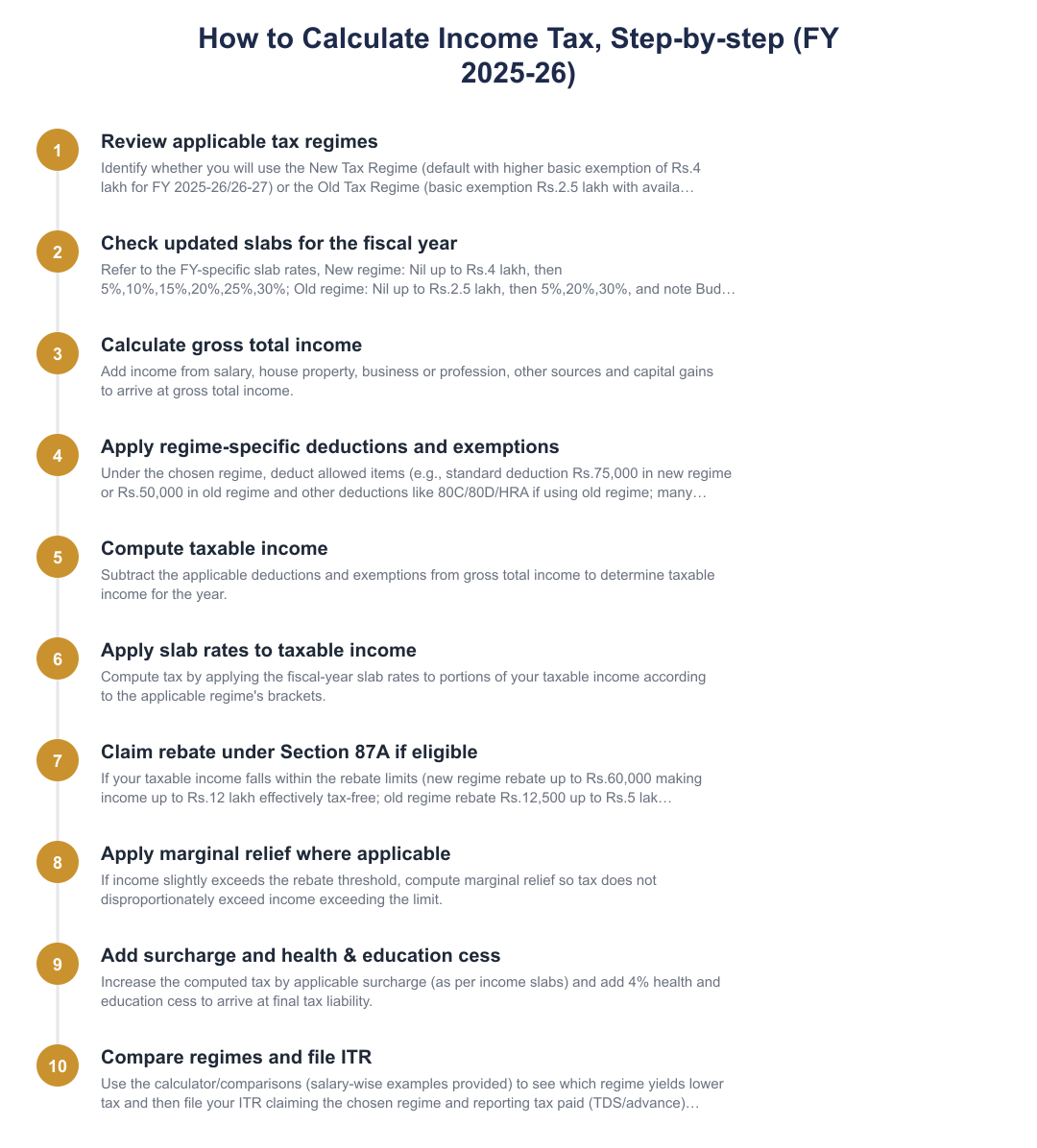
Aggregate income from all heads, salary, house property, business or profession, capital gains and other sources, to arrive at gross total income.
Deduct the standard deduction and other eligible exemptions or section-based deductions permitted under the regime you have chosen to compute taxable income.
Apply the slab-wise rates applicable to your taxable income under the selected regime to compute gross tax before rebate.
If eligible, apply the rebate (for example under Section 87A) which reduces the tax computed. Keep in mind certain incomes taxed at special rates may not qualify for rebate.
If applicable, add surcharge on tax and then add the Health & Education Cess at 4% on the tax plus surcharge.
Reduce any tax already paid via TDS, TCS or advance tax to arrive at net tax payable or refundable.
Income Tax Calculation Example (conceptual)
A worked example helps illustrate flow without relying on specific slab figures. Start with gross salary, subtract the standard deduction applicable under your chosen regime to get taxable salary. Add any other taxable income to arrive at total taxable income.
Next, apply the slab rates for your regime to compute tax before rebate. If your taxable income lies within the rebate threshold, the rebate may reduce the tax to zero. Finally add cess (4%) to the remaining tax amount, and then subtract taxes already paid via TDS or advance tax to get the final payable or refundable amount.
This conceptual sequence is the same irrespective of exact numeric thresholds; replace the numbers with those relevant for AY 2026-27 when doing your personal computation or when using an official calculator.
Old v/s New Tax Regime - Which is Better For FY 2025-26?
There is no single answer: which regime is better depends on your individual circumstances, the amount and type of income you earn, and how many deductions and exemptions you can and do claim. Taxpayers with large eligible deductions typically find the old regime favorable, while those with limited deductions may benefit from the new regime's lower slab rates.
The practical approach is to compute tax under both regimes for FY 2025-26 (filed in AY 2026-27) using your actual figures for income, standard deduction, deductions/exemptions and rebates, include surcharge if relevant and add the cess at 4% to the computed tax. Choose the regime that results in the lower final tax payable.
Deciding between the old and new tax regimes requires modelling your own income, deductions and rebate eligibility for the relevant assessment year. For FY 2025-26 remember to use AY 2026-27 references when checking official notifications, and always add Health & Education Cess at 4% to the computed tax. If in doubt, run parallel computations under both regimes or consult a tax professional before filing your ITR.
Frequently asked questions
What are the income tax slab rates under the new tax regime for FY 2025-26 (AY 2026-27)?
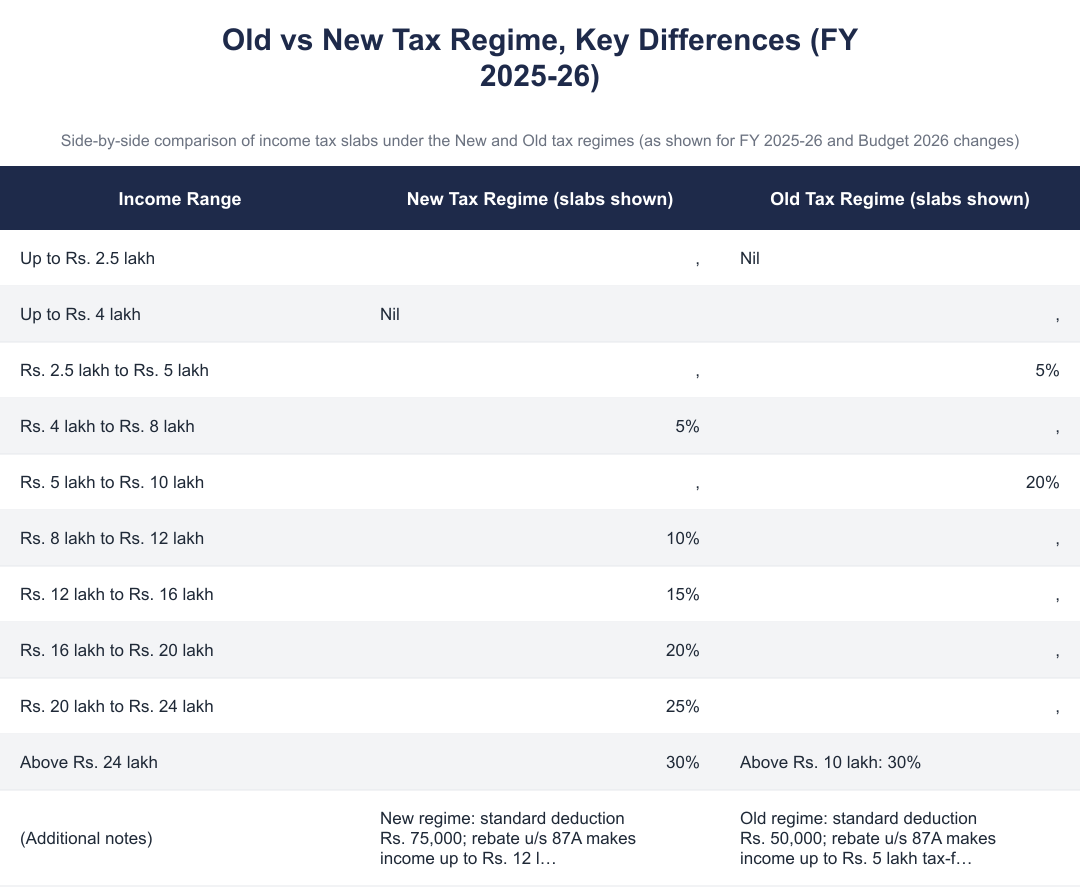
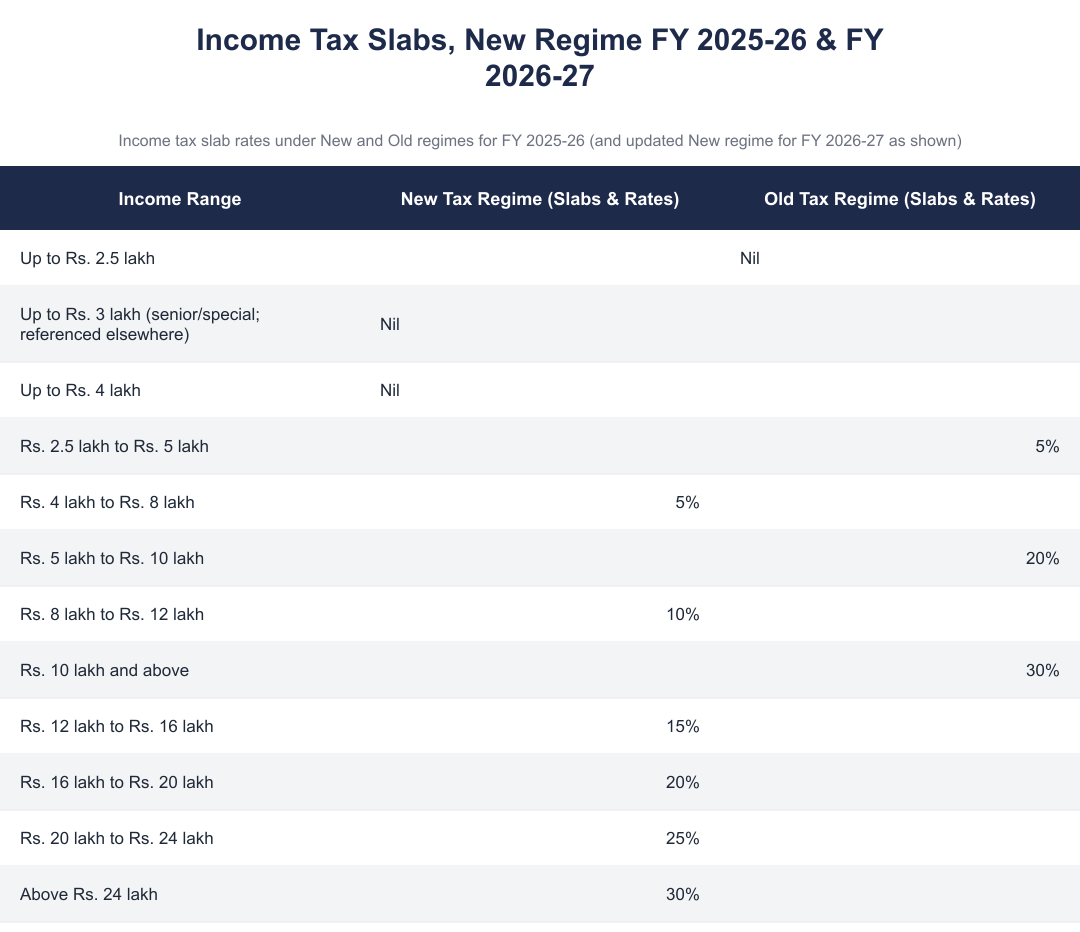
Under the new tax regime for FY 2025-26, income up to Rs. 4 lakh is tax-free and rates then rise from 5% to 30% across bands; specifically 5% for Rs. 4–8 lakh, 10% for Rs. 8–12 lakh, 15% for Rs. 12–16 lakh, 20% for Rs. 16–20 lakh, 25% for Rs. 20–24 lakh and 30% above Rs. 24 lakh. The new regime also includes a standard deduction of Rs. 75,000 for salaried employees and a rebate u/s 87A that can make income up to Rs. 12 lakh effectively tax-free. Note that common exemptions and most section 80 deductions (like 80C, 80D), HRA and home loan interest are not available under this regime. When computing final tax, add health and education cess of 4% (and surcharge if applicable).
What are the income tax slab rates under the old tax regime for FY 2025-26 (AY 2026-27)?
Under the old tax regime for FY 2025-26 the basic exemption limit is Rs. 2.5 lakh and rates are 5% for Rs. 2.5–5 lakh, 20% for Rs. 5–10 lakh and 30% above Rs. 10 lakh. The old regime allows common deductions and exemptions such as Section 80C (up to Rs. 1.5 lakh), Section 80D, HRA exemption and home loan interest for self-occupied property, and a standard deduction of Rs. 50,000 for salaried taxpayers. A smaller rebate u/s 87A applies in the old regime (effectively making taxable income up to Rs. 5 lakh tax-free under older rules), and cess of 4% applies on computed tax along with surcharge where relevant.
How does the Section 87A rebate work for FY 2025-26?
Section 87A rebate for FY 2025-26 can reduce your tax liability up to Rs. 60,000, effectively making taxable income up to Rs. 12 lakh tax-free under the new regime. The rebate under the new regime is larger (up to Rs. 60,000) compared with the old regime (previously Rs. 12,500 making income up to Rs. 5 lakh tax-free), but rebate is not available for incomes taxed at special rates such as certain capital gains (e.g., STCG under Sec 111A, LTCG under special provisions). To benefit, your computed tax before rebate should be equal to or less than Rs. 60,000; excess tax beyond that remains payable after applying rebate, and cess (4%) and surcharge still apply on the final tax.
What is marginal relief under the new income tax regime and when does it apply?
Marginal relief under the new tax regime reduces tax payable when a taxpayer's total tax exceeds the amount by which their total income exceeds the rebate threshold, ensuring tax doesn’t jump disproportionately; it applies when taxable income slightly exceeds the rebate limit (for FY 2025-26, the rebate ceiling is Rs. 12 lakh). For example, if taxable income is Rs. 12,10,000 the excess Rs. 10,000 can be used to limit the tax to the difference so that marginal relief reduces tax payable (illustrated example: tax computed Rs. 61,500 but after marginal relief tax payable becomes Rs. 10,400). Marginal relief calculations are specific to the excess over the rebate threshold and should be computed before adding cess and surcharge.
What is the standard deduction for salaried individuals for FY 2025-26?
The standard deduction for salaried individuals under the new tax regime for FY 2025-26 is Rs. 75,000, while under the old regime it is Rs. 50,000. This deduction reduces gross salary to arrive at taxable salary; for example a salary of Rs. 15,00,000 minus Rs. 75,000 yields taxable salary of Rs. 14,25,000 under the new regime. Standard deduction is allowed irrespective of other exemptions but under the new regime many other exemptions and deductions (HRA, 80C, 80D, home loan interest) are not available. The standard deduction reduces taxable income before applying slab rates, rebate and cess.
What are the income tax slabs for senior citizens and super senior citizens in FY 2025-26?
For FY 2025-26, senior citizens (aged 60–80) under the old regime have a higher basic exemption of Rs. 3 lakh, and super senior citizens (aged 80+) have a basic exemption of Rs. 5 lakh under the old regime. The slab progression for senior citizens follows the same rates beyond the basic exemption: 5% for the next band, 20% and 30% for higher incomes as applicable; similarly super senior citizens pay the normal rates after their Rs. 5 lakh exemption. Note that these higher basic exemption limits refer to the old tax regime, the new regime’s unified basic exemption of Rs. 4 lakh applies irrespective of age. Cess of 4% and surcharge where applicable are additional.
How do I calculate my income tax for FY 2025-26, step by step?
To calculate income tax for FY 2025-26: first compute Gross Total Income by adding salary, house property, business/profession, other sources and capital gains; next subtract deductions/exemptions allowed under the chosen regime (for new regime many deductions like 80C/80D/HRA are disallowed). Then apply the applicable slab rates (new regime: 0% up to Rs. 4 lakh, 5% up to Rs. 8 lakh, etc.; old regime: 0% up to Rs. 2.5 lakh, 5% up to Rs. 5 lakh, etc.) to get tax, apply rebate u/s 87A if eligible, compute marginal relief if needed, and add health & education cess at 4% and surcharge if applicable. Finally subtract TDS/TCS and advance tax already paid to arrive at net tax payable or refund due.
How do I decide whether the new or old tax regime is better for me for FY 2025-26?
Which regime is better depends on your income level and the deductions/exemptions you can claim: the new regime offers lower slab rates and a higher basic exemption (Rs. 4 lakh) plus a Rs. 75,000 standard deduction and larger rebate, but disallows most deductions like 80C, 80D, HRA and home loan interest; the old regime allows these deductions and may be better if you claim significant tax-saving investments or exemptions. Use a comparison: for many examples in FY 2025-26 the new regime yields lower tax for taxable incomes up to around Rs. 20–30 lakh if you don’t claim large deductions, but the old regime can be better if you have high 80C, 80D or HRA claims, sample calculations show savings of Rs. 1–2+ lakh in some cases. The right approach is to compute tax under both regimes (after applicable deductions) including cess and surcharge, then choose the lower tax outcome.
What surcharge and cess rates apply to income tax for FY 2025-26?
Health and education cess is charged at 4% on the income tax payable for FY 2025-26, and surcharge applies for higher incomes at rates that differ by income bracket (for very high incomes the surcharge can range and affects effective rates, with Budget changes affecting very high-income bands). For incomes up to Rs. 50 lakh there is no surcharge; slabs in the provided comparison show surcharge steps for incomes above Rs. 50 lakh and escalating up to higher percentages for multi-crore incomes, and the highest bracket previously attracted up to 37% effective rate in the old regime for very large incomes. Always compute surcharge on the tax before cess, then add 4% cess on (tax + surcharge) to arrive at the final tax payable.
Need help staying Income Tax compliant?
MoneyGence's AI Finance OS tracks your compliance, wallet share, and finances in one place, built for agencies and growing businesses.
Get started with MoneyGence