Income Tax New Forms 2025: Comparative Guide to Rules 2026
This guide compares the redesigned income-tax forms introduced by recent legislative and rule changes, and explains what tax professionals, businesses and taxpayers need to know to comply smoothly. You will learn how the new forms differ from the older versions in layout, the practical implications for filing and record-keeping, common implementation pitfalls and pragmatic checks you should adopt before submitting returns or certificates. The comparison focuses on how data flows between taxpayers, deductors and tax authorities, where pre-filled information may require verification, and how procedural changes affect timelines and documentation. Whether you prepare returns for salaried individuals, manage TDS/TCS obligations for clients, or advise corporates on compliance, this guide helps you prioritise tasks, avoid common mismatches and set up internal controls that reduce the risk of rework. The content is structured to be practitioner-friendly: clear explanations of the form-level changes, a walkthrough of practical checks to perform, notes on certificate formats and mapping issues, and suggested steps to manage transition-related exceptions. This will save you time during filing season and reduce downstream queries, corrections and client distress caused by avoidable errors.
High-level changes: what to expect
The recent overhaul of filing forms and supporting rules emphasises clearer data capture, standardised fields and closer alignment between payer-reported data and taxpayer returns. Expect redesigned schedules and re-organised sections that aim to make the forms more logical for specific taxpayer profiles. From a practical standpoint the new layout may shift where particular items are reported, for example, income heads, deductions and certificate references could appear in different places compared with older forms.
For practitioners, this means paying attention to mapping tables, form instructions and software updates before filing. Even when the substantive tax treatment remains unchanged, layout changes can cause mismatches in pre-filled data, mis-entry of amounts and confusion over where supporting details should be disclosed. A deliberate pre-filing review of the altered sections and a checklist for each taxpayer type will reduce filing errors.
Practical verification steps before filing
When forms and reporting formats change, pre-filled information from third-party sources does not always align perfectly with what the new form expects. Practitioners should compare payer-provided statements, deductor certificates and the pre-filled fields on the draft return side-by-side. Focus first on items that are commonly mismatched in transitions, interest/dividend reporting, contractor/professional receipts, and tax credit entries, and verify the nature of each amount rather than assuming the pre-fill is correct.
Maintain a short reconciliation worksheet for each client showing source document, how it appears in the pre-fill, and how it should be entered on the new form. This worksheet becomes important evidence if the tax authority raises queries later. Also check any certificate or challan references; certificates issued under an earlier format may still be operative but often need to be cross-checked against the new form's field expectations.
TDS/TCS certificates and section mapping, practitioner notes
Certificate formats and section/item references are frequently reworked when rules are updated. That can lead to deductors submitting challans or certificates that reference legacy item numbers or field labels. In practice this triggers mismatches in taxpayer credit statements and causes returns to show unclaimed or incorrectly classified credits.
To avoid this, instruct deductors to use the updated certificate template and verify the certificate’s item identifier before accepting it for filing. If a certificate is produced in an older format but remains within its stated validity, document the reconciliation so you can support your entries if a query arises. Keep a log of any rejected or corrected certificates and the actions taken to remedy mapping issues.
Operational controls and software readiness
Tax filing software and in-house templates must be updated to reflect new forms and field mappings. Coordinate with software vendors early and run test filings in a sandbox environment where possible. Confirm that import routines for third-party data (bank statements, payer reports, AIS/ pre-fill files) map to the correct fields in the updated return layout.
Internally, update client intake checklists and staff training materials to reflect the new forms. Allocate time for additional reviews during the first filing cycle after the change and set expectations with clients about the likelihood of extra documentation requests or minor corrections. A short, documented quality-control review prior to submission will reduce the burden of post-filing adjustments.
Dealing with transition exceptions and queries
During the transition period there will be legitimate cases where older certificates or pre-fills cannot be perfectly reconciled with the new form fields. In such cases, prepare a concise reconciliation note stating the source document, the discrepancy, and the reasoned basis for the treatment adopted in the return. Retain supporting documents so you can respond promptly to any notices or calls for clarification.
When faced with authority queries, respond with clear cross-references to the reconciliation worksheet and the original source documents. Timely, well-documented responses tend to resolve most transition-related queries without escalation. If systemic issues appear, for example, many clients receiving similar mismatches, coordinate with industry groups or software vendors to push for corrective action at source.
Adapting to new forms and rules requires a mix of technical checks and practical process changes. Focus on mapping source documents to the new layout, updating software and checklists, documenting reconciliations for exceptions, and training staff for the first filing cycle. These steps will help you minimise corrections, protect clients’ tax credits and navigate transition queries with confidence.
Frequently asked questions
What are the main changes in the new Income Tax forms under the Income Tax Act, 2025 and Rules, 2026?
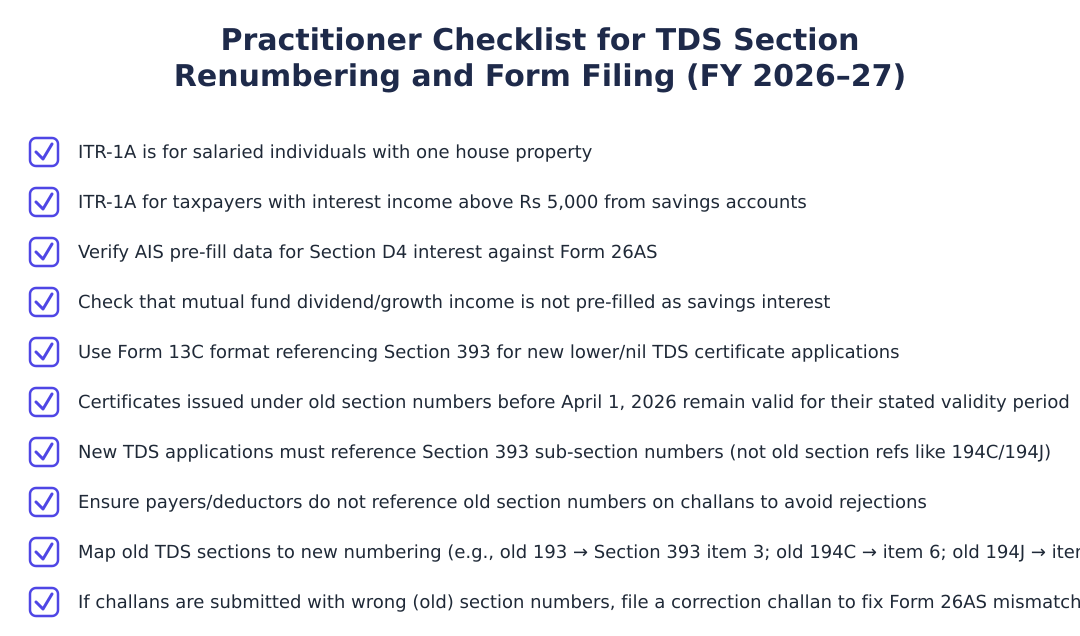
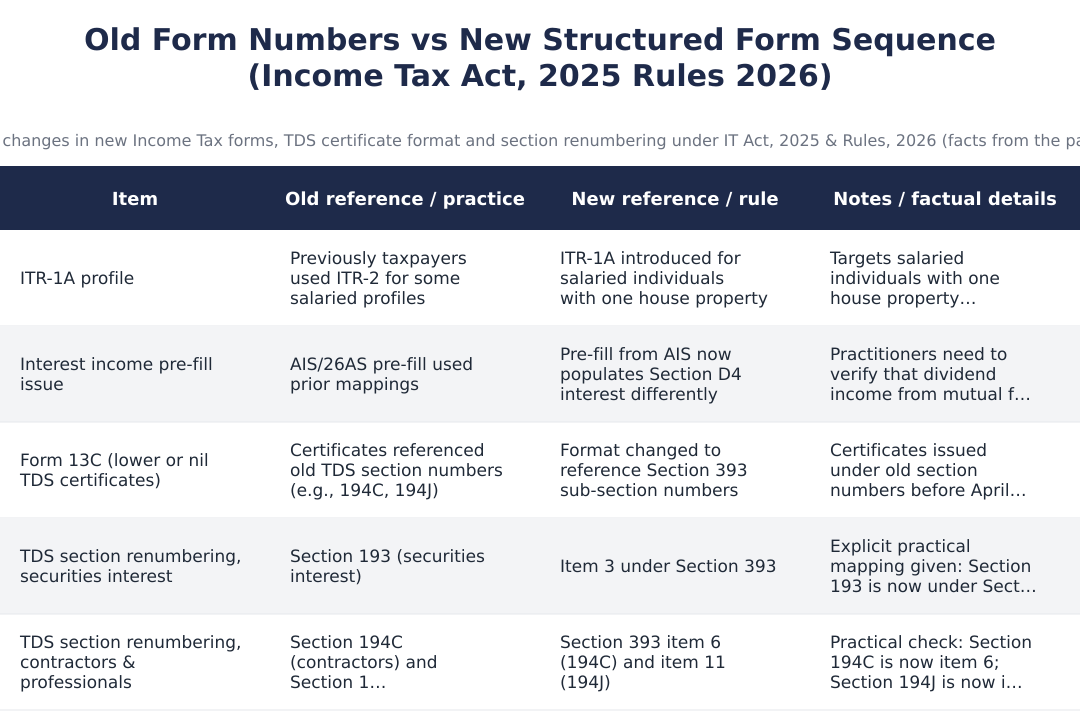
The main changes replace old form numbers with a structured, sequential numbering across categories to simplify compliance and improve clarity. The new regime groups forms by category and gives them consecutive numbers so taxpayers and practitioners can find related forms easily; for example ITR, TDS, and certificates follow predictable sequences. The update also aligns form references with renumbered sections of the Act (such as TDS sections moved under Section 393), and introduces refreshed formats like ITR-1A and Form 13C with practical filing implications. Expect transitional rules allowing old certificates issued before April 1, 2026 to remain valid for their stated validity period while new applications must use the new section references.
Who should use the new ITR-1A form and how does it differ from the old ITR-1 or ITR-2?
ITR-1A should be used by salaried individuals with one house property and savings bank interest above Rs 5,000, offering a simpler filing alternative to ITR-2 for this profile. The CBDT describes ITR-1A as streamlined: it focuses on salary income, a single house property and limited interest income, and pre-fills relevant AIS/26AS data into a concise layout. In practice, taxpayers must still verify pre-filled fields, practitioners note AIS may populate interest differently than 26AS and can misclassify mutual fund growth-option distributions as savings interest, so manual checks are necessary. If you have capital gains, multiple house properties, or complex income heads, you should not use ITR-1A and must file the appropriate higher ITR form.
What practical issues have arisen with AIS pre-fill and ITR-1A interest income fields?
Practical issues include AIS pre-filling interest income (Section D4) differently from how Form 26AS reported amounts, and sometimes misclassifying mutual fund growth-option payouts as savings interest. This can cause mismatches in reported income, so taxpayers and practitioners must reconcile AIS, 26AS and bank statements before filing ITR-1A. If a mismatch is found, correct the classification with the payer (e.g., mutual fund) or report the correct head with an explanatory statement and retain supporting documents for future queries. Minor mismatches may require amendment via revised return or rectification procedures depending on materiality and tax impact.
How has Form 13C changed with the transition to Section 393 and what should applicants note?
Form 13C now requires applicants to reference Section 393 sub-section numbers instead of the old TDS section numbers when seeking lower or nil TDS certificates. Certificates issued under old section numbers before April 1, 2026 remain valid until the validity date printed on them, but new applications filed after the transition must use the new section mapping (for example, old sections like 194C/194J map to specific item numbers in 393). Practitioners should ensure online application portals and certificate formats use the updated references to avoid rejections, and include relevant supporting documents as per the revised rules. If a payer receives a certificate citing an old section after the transition, advise them to retain the certificate (if issued before April 1, 2026) and seek clarification from the CPC or issue corrected certificate if necessary.
What are common reasons TDS challans and Form 26AS show mismatches after the renumbering of TDS sections?
Common reasons include payers entering old section numbers on challans or in returns while the IT backend expects the new Section 393 item numbers, leading to mismatches in challenge reconciliation and Form 26AS. Specifically, items like securities interest (old 193) moved to 393 item 3, contractors (old 194C) to item 6, and professionals (old 194J) to item 11; using old codes causes rejects or misallocations. To fix this, payers must file correction challans with the correct new section item, and deductors should update payroll/TDS software templates to use the new numbering. Taxpayers who spot mismatches should ask the payer for corrected challans and retain correspondence and correction proof for future assessments.
Are certificates and forms issued under old section numbers before April 1, 2026 still valid?
Yes, certificates issued under the old section numbers before April 1, 2026 remain valid for the validity period stated on each certificate. The transitional provision allows existing certificates to be relied upon until they expire, so taxpayers and deductors need not immediately reissue those documents. However, any new certificates or fresh applications filed after the transition date must reference the renumbered sections (e.g., Section 393 items). Where systems or payers are still producing documents with old references after the cut-off, it's prudent to obtain clarification or corrected documents to avoid downstream mismatches in AIS/26AS.
How should practitioners handle client challans that get rejected because of old section references?
Practitioners should ask the payer to re-file or submit a correction challan using the new Section 393 item numbers and retain proof of the correction to resolve Form 26AS mismatches. Many rejections stem from payers entering legacy section numbers on the challan; a correction challan (or corrected TDS return) mapping to the new item will align records. Also advise clients to reconcile AIS, bank statements and Form 26AS promptly and to request the payer provide revised receipts or acknowledgement; where necessary, file rectifications or GST/ITR revisions once corrected. In large-scale or systemic rejections, practitioners should contact the CPC or IT helpdesk and document communications for compliance records.
How does the new structured sequence of form numbers improve tax compliance for taxpayers and software providers?
The structured sequence groups related forms together and assigns predictable numbers, making it easier for taxpayers and tax-software providers to locate and implement the correct forms and validation rules. This reduces filing errors caused by confusion over legacy form numbers, simplifies UI design for tax portals, and standardises API integrations for AIS/26AS and TDS systems. For practitioners, predictable numbering speeds up template updates and training, but they must still watch transitional details like section renumbering that affect challan mappings and certificate formats. Overall, the change aims to reduce inadvertent rejections and mismatches, but success depends on timely software updates and clear communication to deductors and taxpayers.
Need help staying Income Tax compliant?
MoneyGence's AI Finance OS tracks your compliance, wallet share, and finances in one place, built for agencies and growing businesses.
Get started with MoneyGence