Income Tax Act 2025: Key Changes, Slabs & Section Mapping
This guide explains the Income Tax Act 2025 and what taxpayers and tax professionals need to know about its structure, chapter layout, how tax slabs and section mapping differ from the older law, and practical steps to adapt to the change. You will learn how the new Act re-organises provisions, why lawmakers pursued reform, how common concepts, such as salary, house property, deductions and TDS, are carried forward in a reorganised form, and what to watch for when filing returns or updating accounting and payroll systems. The intention of this guide is to give a clear, usable summary that helps salaried individuals, businesses, NRIs and tax professionals prepare for transitions in compliance, reporting and planning. This is not a substitute for the official statute or professional advice; readers should consult the enacted text and their tax advisor for transaction-specific decisions. The guide focuses on the practical implications of a consolidated, modern tax code: simpler chapter and section layouts, clearer mapping of old provisions to new ones, renaming of common return and TDS forms, and the broader policy goals that usually accompany comprehensive tax law reform. By the end of the article you will understand the areas most likely to affect payroll, deductions, reporting of digital assets, TDS compliance, and how to approach cross-referencing between the old and new Acts during the transition.
What is the Income Tax Act 2025?
The Income Tax Act 2025 is a re-engineered statute intended to consolidate and modernise the direct tax law framework. It reorganises income tax provisions into a refreshed chapter and section layout that aims to make the law easier to read and apply. The Act frames taxable income categories, deductions, exemptions and compliance mechanics in a consolidated form so that users can follow logical groupings rather than hunting through numerous scattered provisions.
From a practical standpoint, the new Act is meant to serve as the governing statute for income taxation going forward, replacing the earlier statute which had been the law for many decades. Because the reorganisation changes section numbers, chapter headings and names of some forms, practitioners need to map old references to new ones when interpreting case law, licences, contracts and software.
Why was the Income Tax Act 2025 introduced?
Large-scale tax reform efforts typically aim to simplify language, reduce litigation caused by ambiguous drafting, align the law with technological developments, and make compliance easier for taxpayers and administrators. A re-codified Act provides an opportunity to reorganise provisions such as deduction rules, withholding (TDS) provisions and procedural obligations into coherent clusters.
In addition to simplification, modernisation of tax law helps regulators address new economic phenomena, for example, digital financial products and novel payment mechanisms, by creating clearer taxing provisions and administrative rules. For businesses and tax professionals, the goals are better readability, more predictable outcomes, and easier maintenance of payroll, accounting and tax return systems.
How to approach the transition (practical steps)
Treat the transition as a project: identify where your organisation relies on specific section numbers, forms, or slab references in payroll, accounting software, contracts and internal policies. Create a cross-reference register that links every old section or form in use to its counterpart in the new Act.
Update compliance calendars and workflows after confirming the official commencement timeline from the government. Train payroll and accounts teams on renamed forms and reorganised heads of income so TDS, advance tax and return filings remain accurate. Where uncertainty exists, obtain written clarification from tax advisers or through official notifications before changing system logic.
What has been carried forward, key concepts that remain
Even when a statute is restructured, fundamental taxation concepts such as the taxation of salary, business income, capital gains, income from house property, and the existence of deductions and exemptions usually carry forward. Practically, this means that while section numbers and schedules may change, the underlying bases of computation and many taxpayer rights and obligations will be recognisable under the new framework.
Likewise, compliance pillars like withholding obligations, advance tax payments and the duty to file income-tax returns remain central to the system. Taxpayers should therefore focus on mapping provisions rather than assuming wholesale change to everyday obligations; the primary work is reconciling where rules now sit in the new Act and ensuring systems reflect those references.
How the new Act affects taxpayers and businesses
For salaried taxpayers, the main operational impact is likely to be in how payroll systems refer to deduction provisions, exempt allowances and the form of tax certificates issued by employers. Employers should align Form issuance, payroll deductions and annual reporting with the renamed or renumbered provisions in the new Act.
For businesses and tax teams, key tasks include updating tax software, revising tax accounting notes, and checking that TDS deduction logic conforms to any consolidated withholding provisions. Non-resident taxpayers and those with specialised income, for example from cross-border transactions or digital assets, should review the rebuilt chapters that deal with taxation of foreign-sourced income and technology-driven financial products, and consult advisors for specific structuring or reporting changes.
Mapping old sections to new sections, best practices
Where the new Act changes section numbers, compile a mapping table for the provisions most relevant to your operations (salary heads, common deductions, house property rules, capital gains, TDS heads). Use authoritative government cross-reference tables and the enacted text rather than relying on secondary summaries, and retain copies of both old and new references for audit and legal continuity.
When relying on earlier judicial precedents or tax authority rulings that cite old section numbers, always translate those citations into the corresponding provisions under the new Act before applying them to current cases. This approach prevents misapplication of precedent and supports consistent legal argumentation during the transition period.
A restructured Income Tax Act offers the promise of clearer drafting and more streamlined compliance, but the operational burden of transition falls on taxpayers, employers and tax professionals. Focus on mapping, system updates, training and timely consultation of the enacted statute and official notifications. Where in doubt, obtain professional advice to ensure reporting and withholding remain accurate during the changeover.
Frequently asked questions
What is the Income Tax Act 2025?
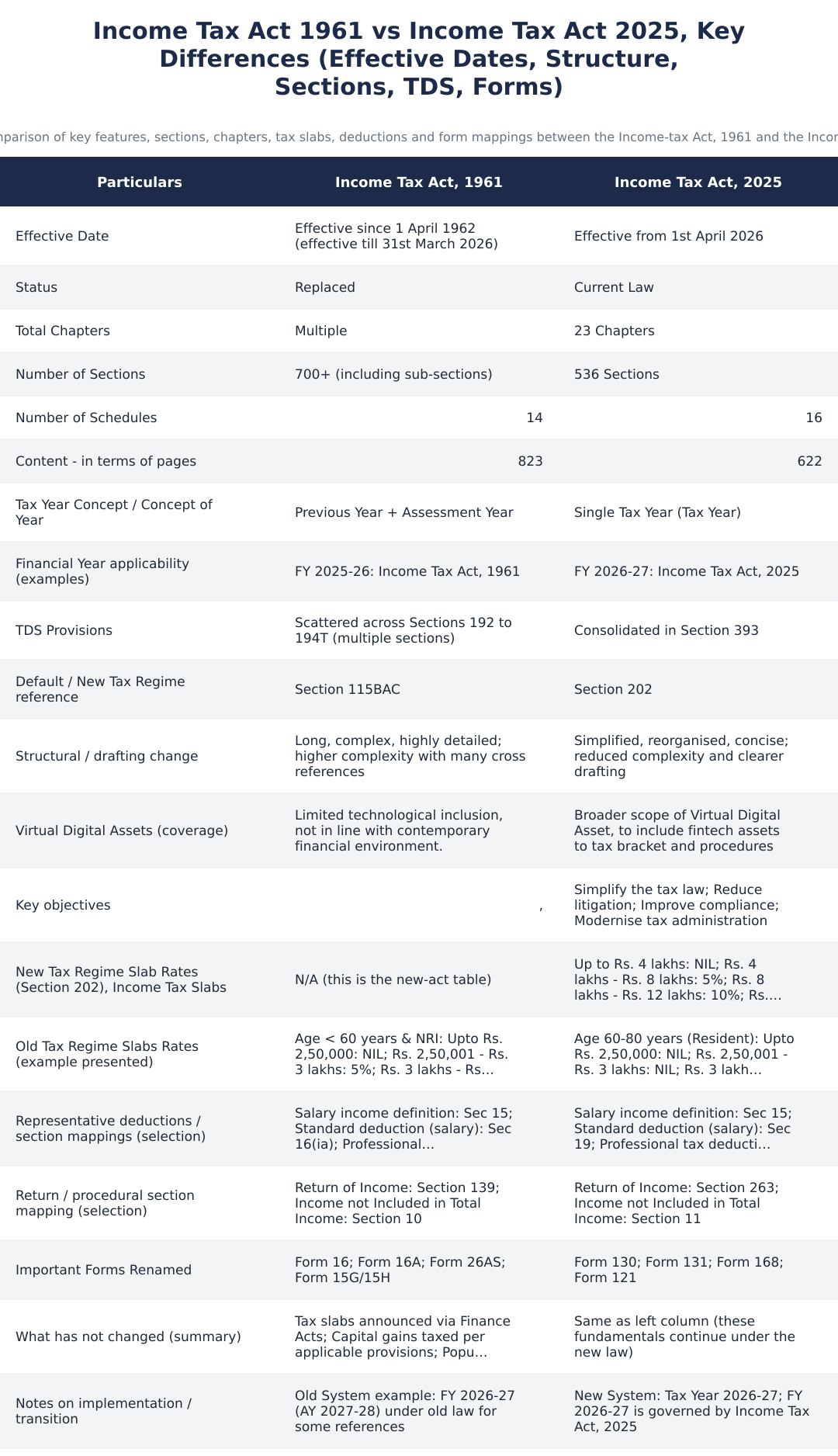
The Income Tax Act 2025 is the new consolidated law governing direct taxes in India that replaces the Income-tax Act, 1961 effective from 1 April 2026. It restructures tax law into 23 chapters and 536 sections (down from 700+ sections under the 1961 Act) and introduces a single Tax Year concept instead of the previous 'Previous Year + Assessment Year' framework. The Act aims to simplify provisions, reduce litigation, modernise administration and improve compliance through clearer drafting and digital-friendly procedures. It retains core taxation principles (salary, house property, business income, capital gains) while reorganising sections and schedules for clarity.
Why was the Income Tax Act 2025 introduced?
The Income Tax Act 2025 was introduced to simplify and modernise India’s income tax law, reduce litigation, improve taxpayer compliance, and align provisions with contemporary financial activities. The 1961 Act had become complex after decades of amendments, with scattered provisions and outdated language; the 2025 Act reorganises and consolidates many provisions (for example, TDS rules consolidated under Section 393). It also explicitly covers modern instruments such as virtual digital assets and updates deduction and compliance provisions to be more user-friendly. The reform is intended to make tax administration more automated and reduce ambiguity for taxpayers and tax authorities.
When does the Income Tax Act 2025 come into effect?
The Income Tax Act 2025 comes into effect from 1 April 2026, and it will apply to the Tax Year 2026-27 and onwards. For the financial year 2025-26 (assessment year 2026-27) taxpayers will still follow the Income-tax Act, 1961 when filing returns. Practical transition tables show FY 2025-26 governed by the 1961 Act and FY 2026-27 governed by the 2025 Act, so planning and compliance should account for that effective date. Any forms, section references and compliance timelines change from 1 April 2026 as per the new Act.
What is the Tax Year under the Income Tax Act 2025?
Under the Income Tax Act 2025, 'Tax Year' replaces the old pair of 'Previous Year' and 'Assessment Year' and is the single reference period for income tax assessment from FY 2026-27 onwards. This means income earned and assessed will be both referred to by the same Tax Year (for example, Tax Year 2026-27) instead of separate previous and assessment years. The change is intended to simplify compliance and reduce taxpayer confusion about which year income relates to. Practically, returns for income earned in Tax Year 2026-27 will be prepared and assessed using provisions and forms prescribed under the 2025 Act.
What are the income tax slab rates under the new Act (new tax regime)?
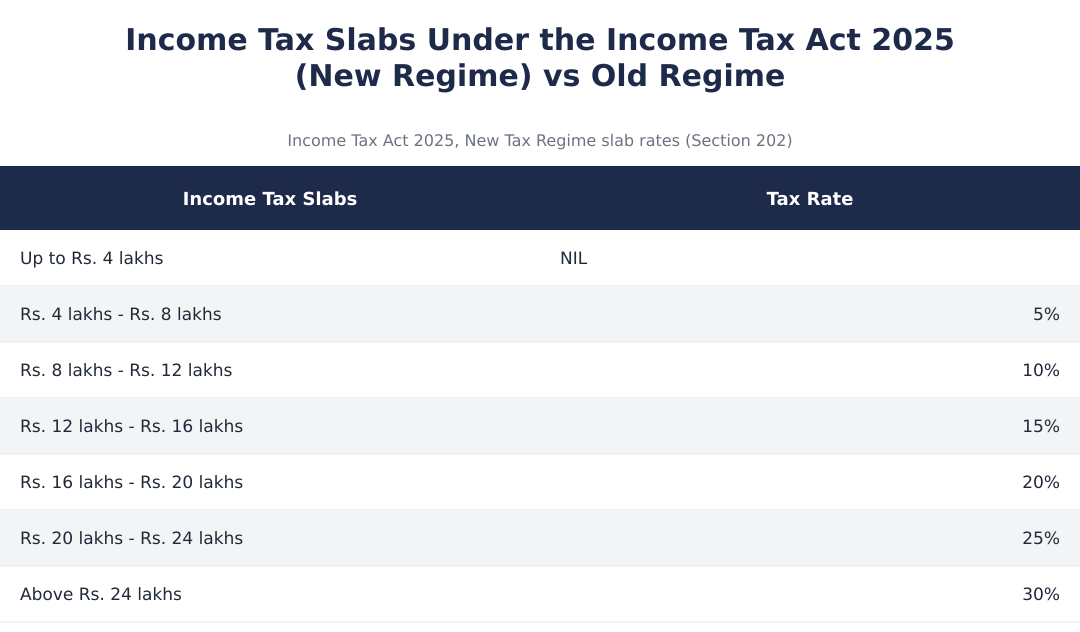
Under the Income Tax Act 2025, the new tax regime (Section 202) uses the following slab rates: up to Rs. 4,00,000 – NIL; Rs. 4,00,001–8,00,000 – 5%; Rs. 8,00,001–12,00,000 – 10%; Rs. 12,00,001–16,00,000 – 15%; Rs. 16,00,001–20,00,000 – 20%; Rs. 20,00,001–24,00,000 – 25%; above Rs. 24,00,000 – 30%. These rates are applicable subject to any yearly Finance Act modifications and form the default structure under the reformed regime; rebates and cess rules continue to apply as notified. Taxpayers can compare with the old regime before electing where applicable, since the new slabs became effective from Tax Year 2026-27.
What are the old (pre-2025 Act) tax slabs and who do they apply to?
Under the legacy Income-tax Act, 1961 (applicable for FYs up to 2025-26), slab rates varied by age: for individuals and NRIs below 60 years the slabs started with nil up to Rs. 2,50,000, 5% for Rs. 2,50,001–3,00,000, 5% for Rs. 3–5 lakhs, 20% for Rs. 5–10 lakhs and 30% above Rs. 10 lakhs. Separate threshold relaxations existed for senior citizens (60–80 years) and super senior citizens (above 80), with higher nil or lower-tax bands (for example, many slabs were nil up to Rs. 3–5 lakhs depending on age). These slabs remained in force until FY 2025-26 and were replaced by the single Tax Year slab system under the 2025 Act from 1 April 2026.
What major deductions continue under the Income Tax Act 2025 and have their section numbers changed?
Popular deductions such as 80C investments, NPS, health insurance premium, education loan interest and home loan interest continue under the Income Tax Act 2025 but many have been renumbered. Examples: 80C investments are under Sec. 123, pension/annuity (old 80CCC) moved to Sec. 123, NPS deduction (old 80CCD) to Sec. 124, health insurance (old 80D) to Sec. 126, and education loan interest (old 80E) to Sec. 129; standard salary deduction moved to Sec. 19 and home loan interest to Sec. 22. While the substance of most deductions remains, taxpayers must reference the new section numbers when claiming deductions and complying with documentation requirements under the 2025 Act.
How were TDS provisions changed in the Income Tax Act 2025?
TDS provisions were consolidated and streamlined in the Income Tax Act 2025, with many scattered sections brought under a single framework, notably Section 393 for TDS. The consolidation reduces cross-references and simplifies compliance for payers, while procedural changes (new return forms and digital reporting) aim to improve automation and reduce errors. Despite consolidation, the obligation to deduct and deposit tax at source, and to furnish returns and statements, continues; rates and specific thresholds may still be prescribed separately or via rules. Tax withholding on certain incomes (salary, interest, professional fees) remains applicable, now administered under the consolidated provisions of the new Act.
Which important tax forms have been renamed under the Income Tax Act 2025?
Several commonly used income tax forms were renamed under the Income Tax Act 2025 to align with the new section and procedural structure; for example Form 16 is renamed Form 130, Form 16A is Form 131, Form 26AS is Form 168, and Form 15G/15H are combined/renamed as Form 121. These renamed forms will be used for salary certificates, TDS statements, tax credit statements and declarations from the effective date (1 April 2026) and must be used by employers, deductors and taxpayers when furnishing information. Taxpayers and payroll teams should update templates and processes to use the new form numbers and verify any changes in the information required on each renamed form. Legacy forms and numbering remain relevant only for periods governed by the 1961 Act (i.e., before Tax Year 2026-27).
Need help staying Income Tax compliant?
MoneyGence's AI Finance OS tracks your compliance, wallet share, and finances in one place, built for agencies and growing businesses.
Get started with MoneyGence