Income Tax Act 2025: 10 FAQs on Key Changes & Implementation
This FAQ-style guide explains what to expect from the new Income Tax Act (referred to here as the Income Tax Act 2025) and helps taxpayers, tax professionals and small businesses understand the practical consequences of a major tax law rewrite. You will learn what the Act aims to change compared with the prior law, how the concept of a “tax year” differs from older terminology, what the two competing tax regimes mean in practice, and where to look for authoritative details on rates, rebates and filing processes. Because a government statute replaces an older act only after official notifications and implementing rules, the guide focuses on clarifying concepts, common points of confusion, and sensible next steps for compliance rather than quoting unconfirmed numeric thresholds. That approach helps you prepare: it highlights what questions to ask your tax adviser, which documents and records to retain, and how to track official circulars and forms that will set the operational details. Whether you are an individual taxpayer deciding between tax regimes, a chartered accountant advising clients, or a business aligning payroll and reporting systems, this guide gives a clear, practical orientation to the transition and the kinds of changes that typically matter most when a country consolidates or replaces long-standing tax legislation.
1. What is the Income Tax Act 2025?
The Income Tax Act 2025 is the name commonly used to refer to a consolidated statute that updates and replaces the earlier income tax framework. Conceptually, such an Act reorganises tax law language, restates taxable categories, consolidates procedures and may reframe definitions to make the statute clearer and more modern.
From a taxpayer’s perspective, a replacement Act typically keeps the core principle, taxing income, but can change how different kinds of income are classified, how deductions and rebates are described, and how compliance procedures are structured. The precise legal provisions that matter for any taxpayer will be set out in the enacted text and subsequent rules and notifications issued by the tax administration.
2. When will the Income Tax Act 2025 come into effect?
The effective date of a new tax statute depends on the enactment and the specific commencement provisions included within the law itself. Typically, an Act will state the date on which different parts become operative, and the government may issue a separate notification to bring provisions into force on specified dates.
Practical compliance requires watching for official commencement notifications and any transitional rules that explain how pending assessments, returns, or matters started under the earlier law will be handled. Tax professionals and businesses should monitor the tax authority’s website and formal gazette notifications for authoritative timing.
3. What are the key changes introduced in the Income Tax Act 2025?
A replacement Income Tax Act usually brings several categories of change: structural (reorganising chapters and sections), definitional (clarifying or redefining terms), procedural (amending filing, assessment and appeal processes), and substantive (modifying rates, slabs, rebates or deductions). The exact combination varies by jurisdiction and the policy objectives behind the reform.
For taxpayers, the most important changes are those that affect calculation of taxable income, the availability of specific deductions or exemptions, and any procedural shifts in how returns are filed or notices are issued. Until the government publishes the enacted text and implementing rules, it is prudent to treat press summaries as indicative and rely on official instruments for compliance.
4. What is “Tax Year”?
The term “tax year” typically denotes the accounting period used to determine tax liability for individuals and entities. A reform may introduce or redefine the term to replace older concepts such as separate financial and assessment years, simplifying references throughout the statute.
From an operational standpoint, a clarified tax year concept affects due dates, filing windows and the period for which income and deductions are computed. Any change to this concept should be understood in the light of transitional rules that explain how ongoing matters started under the previous calendar will move to the new system.
5. What about tax slabs and rebate limits under the new law?
A new Act may revise tax slab structures, rates and rebate thresholds to meet policy objectives like simplification or progressivity. Exact slab amounts, rates and rebate mechanics are specified in the enacted law and accompanying notifications, and those figures are what practitioners must use when computing liability.
Because numeric thresholds determine take-home pay, compliance obligations and comparative planning between regimes, taxpayers should consult the official statute or the tax administration’s detailed guidance for the authoritative slab and rebate figures once they are published.
6. Will the old tax regime continue and how does it compare with the new one?
When a jurisdiction introduces a new consolidated Act, it may retain an older tax regime as an option alongside a new default regime, or it may fully replace the old framework. Whether both regimes continue, and the rules for choosing between them, will be set out in the enacted provisions and transition rules.
From a decision-making perspective, taxpayers typically weigh the benefits of available deductions and exemptions under the old regime against the lower rates or simplified structure of a new regime. Until official comparative tables or guidance are published, consult a tax adviser to model different scenarios based on the enacted provisions.
7. Why might the Income Tax Act 1961 be replaced?
Large, long-standing statutes are sometimes replaced to modernise language, remove inconsistencies, incorporate judicial developments, and make the law more accessible. A replacement exercise is also an opportunity to reorganise provisions so they align with contemporary tax administration practices and digital filing environments.
Such legislative updates are typically driven by policy goals like simplification, transparency and administrative efficiency. The replacement process also gives lawmakers a chance to address legacy issues that are difficult to resolve through piecemeal amendments.
8. Does the Income Tax Act 2025 change the tax filing process?
A new statutory framework may introduce revised filing terminology, updated forms, or changed timelines. However, the practical filing mechanics often remain similar in the short term, with the tax authority issuing updated forms, instructions and FAQs to guide filers through any operational changes.
Taxpayers should watch for official communications about new or amended return forms, e‑filing portal updates, and any procedural guidance on how transitional years should be reported. Early preparation, such as reconciling records, updating payroll systems and coordinating with advisers, reduces the risk of errors during the first filing season under the new law.
When a country enacts a new Income Tax Act, the broad goals are usually clarity, modernisation and administrative efficiency. For taxpayers the immediate priorities are to track official commencement notifications, review the enacted text for numeric thresholds and procedural rules, and consult a tax professional to model the impact on their situation. Rely on government releases and the published statute for authoritative details rather than preliminary summaries.
Frequently asked questions
What is the Income Tax Act 2025?
The Income Tax Act 2025 is the new Indian tax law introduced to replace the Income-tax Act, 1961 and to simplify the country's income tax framework. It reorganises tax provisions, uses clearer language, and updates sections for easier interpretation while retaining core concepts like taxable income and filing requirements. The Act preserves both the New and Old tax regimes but revises slab rates, rebate limits and introduces the single concept of a ‘Tax Year’. It is intended to modernise compliance and reduce complexity that had built up in the 1961 Act over decades of amendments.
When does the Income Tax Act 2025 come into effect?
The Income Tax Act 2025 comes into effect from 1 April 2026. That date marks the start of the first Tax Year under the new law and replaces references to Financial Year and Assessment Year from the earlier Act. Tax events and filing for periods beginning on or after 1 April 2026 will be governed by the 2025 Act, while past years remain subject to the 1961 Act as applicable. Transitional rules may apply for ongoing assessments and compliance actions spanning the changeover.
What are the key changes introduced by the Income Tax Act 2025?
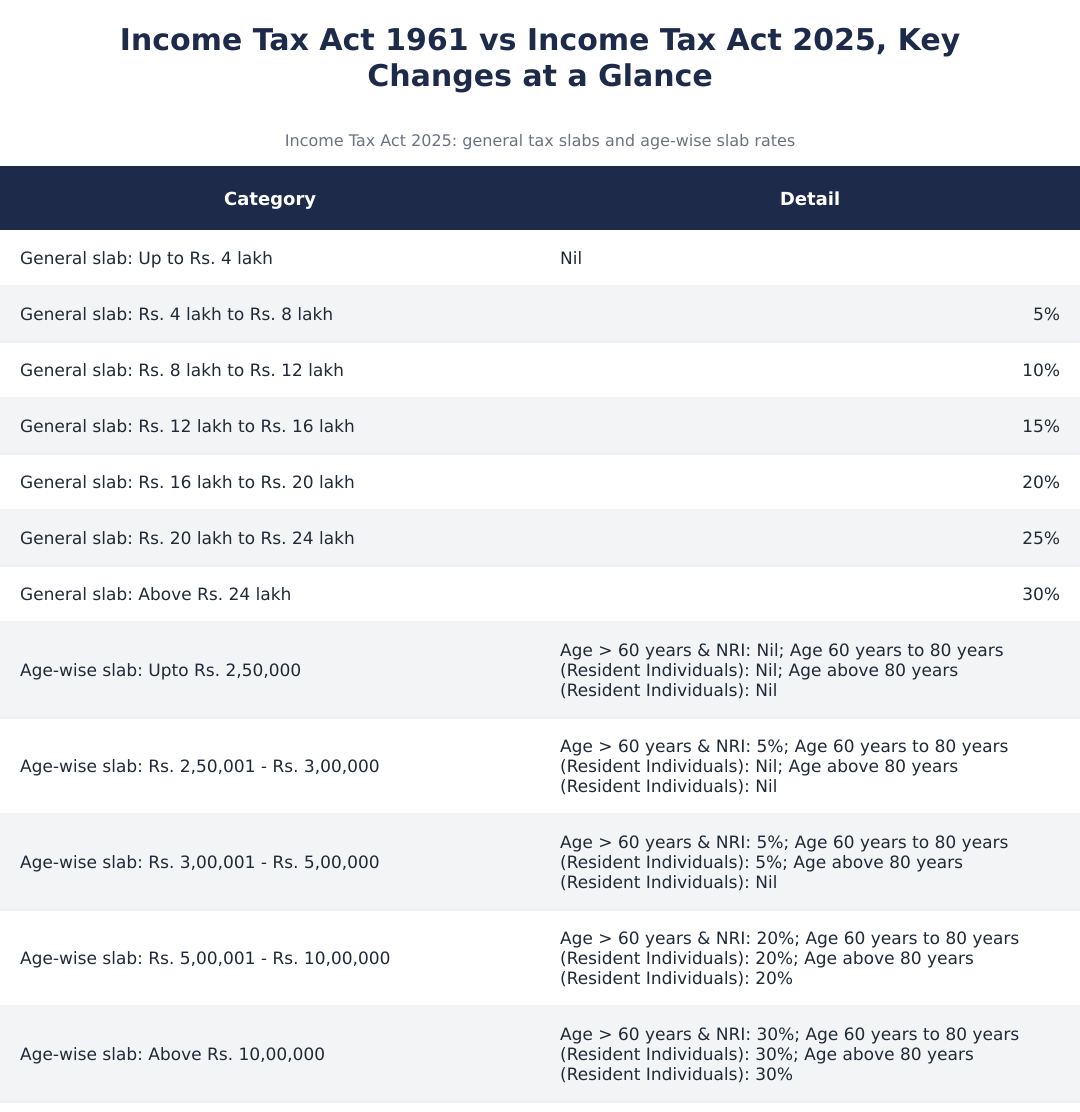
Key changes include replacing the Financial Year/Assessment Year system with a single 'Tax Year', reorganising and simplifying sections for clarity, updating tax slabs and rebate limits, and formally continuing both New and Old tax regimes. The Act aims to reduce complexity by clearer language and better-structured provisions which should help taxpayers and tax professionals interpret rules more easily. It also introduces updated slab rates (for example, zero tax up to Rs. 4 lakh in the New Regime and revised thresholds for senior citizens under the Old Regime) and clarified rebate mechanics. These reforms are focused on administrative simplification rather than a complete overhaul of taxation principles.
What does ‘Tax Year’ mean under the new law?
'Tax Year' means a period of 12 months commencing on 1 April and ending on 31 March of the following year. This single term replaces the earlier pair of terms 'Financial Year' and 'Assessment Year' to simplify tax period references. All calculations, filings and deadlines under the Income Tax Act 2025 refer to the Tax Year unless the Act specifies otherwise. For example, the Tax Year 2026-27 runs from 1 April 2026 to 31 March 2027 and governs income earned in that period under the 2025 Act.
What are the income tax slabs under the Income Tax Act 2025?
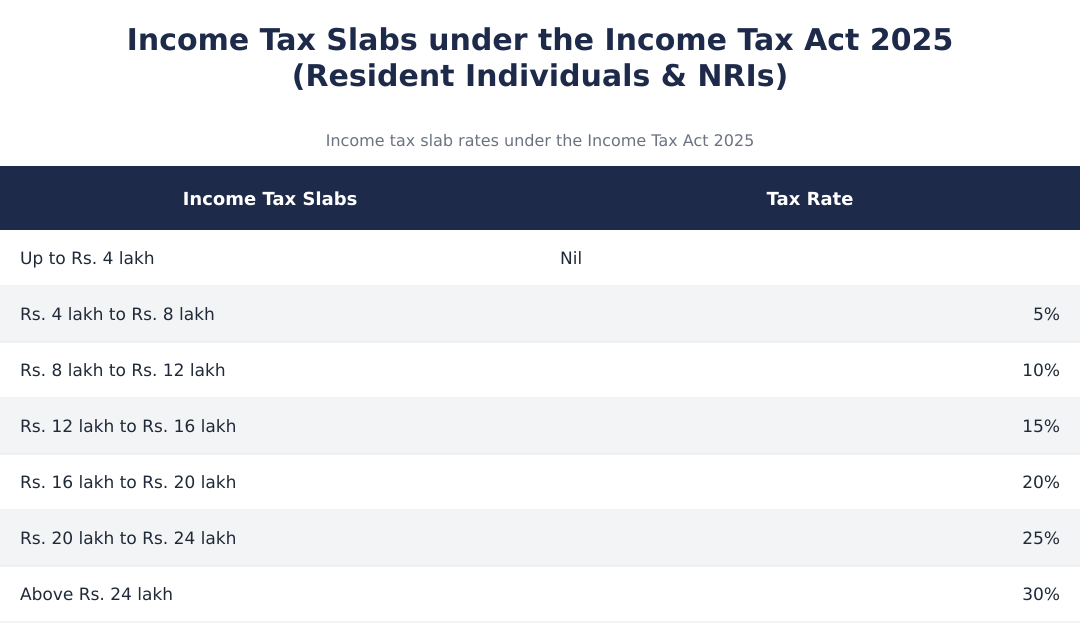
The Income Tax Act 2025 prescribes progressive slab rates where higher income is taxed at higher rates; under the New Tax Regime the slabs are: up to Rs. 4 lakh, Nil, Rs. 4–8 lakh, 5%, Rs. 8–12 lakh, 10%, Rs. 12–16 lakh, 15%, Rs. 16–20 lakh, 20%, Rs. 20–24 lakh, 25%, and above Rs. 24 lakh, 30%. The Old Tax Regime retains age-based slabs for senior and super-senior citizens (for example, nil up to Rs. 2.5 lakh for most residents and higher basic exemptions for those above 60 and 80). These slabs are used to compute tax before applicable rebates, cess and surcharges. Taxpayers should compare both regimes to determine which yields lower tax for their specific income and deductions.
What are the rebate limits under the Income Tax Act 2025?
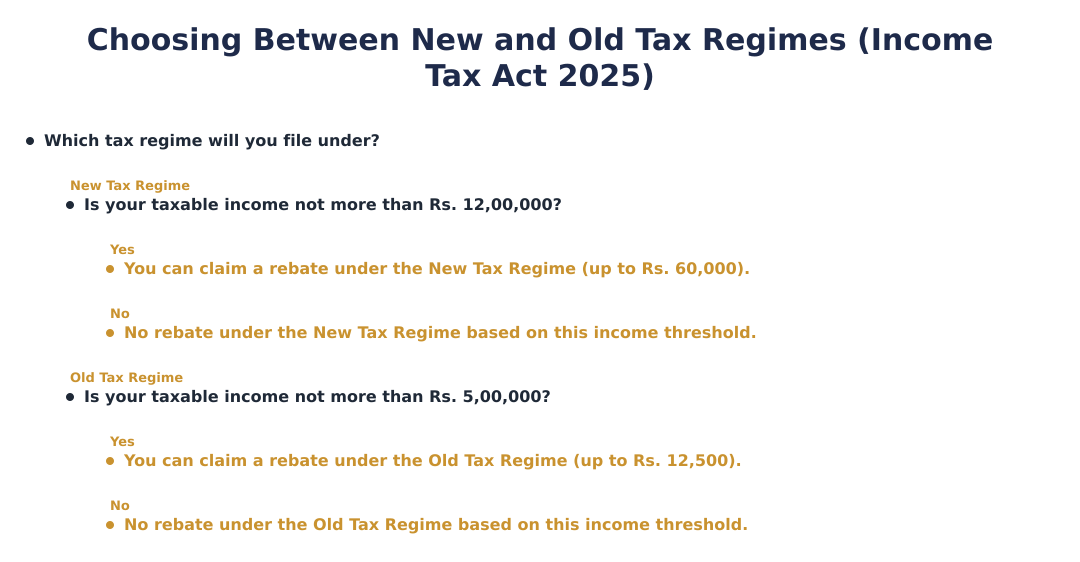
Rebate limits differ by regime: under the New Tax Regime a taxpayer with total income up to Rs. 12,00,000 can claim a rebate up to Rs. 60,000, while under the Old Tax Regime a taxpayer with income up to Rs. 5,00,000 can claim a rebate up to Rs. 12,500. These rebates reduce the tax liability directly and are subject to the income thresholds specified for each regime. Where a taxpayer's tax liability after slabs is lower than the rebate cap, the rebate is limited to the actual tax payable and will not be refundable beyond tax computed. Always verify which regime you are filing under, because the rebate thresholds apply separately to New and Old regimes.
Will the Old tax regime continue under the Income Tax Act 2025?
Yes, the Old Tax Regime continues under the Income Tax Act 2025 as an optional scheme while the New Tax Regime is the default regime. Taxpayers may elect to opt for the Old Regime if its deductions and exemptions make it more favourable for their situation, subject to conditions and election rules in the Act. The Old Regime retains age-based exemption limits and allows certain deductions that are not available in the New Regime, so individuals should compute tax liability under both before deciding. Switching rules and eligibility conditions are set out in the Act and in annual return forms.
How does Income Tax Act 2025 compare with the Income Tax Act 1961?
The 2025 Act replaces the 1961 Act with a restructured, clearer and more modern statute but retains the fundamental tax framework such as progressive rates, taxable categories and the availability of New and Old regimes. Major differences include the introduction of the single 'Tax Year' term, reorganised sections for easier interpretation, updated slab rates and rebate limits, and explicit continuation of both tax regimes. The objective was simplification and reduction of ambiguity introduced into the 1961 Act by decades of piecemeal amendments. Substantive tax principles (like income heads, taxability rules and penalties) largely remain but are recast for clarity and administrative ease.
Why was the Income Tax Act 1961 replaced by the 2025 Act?
The Income Tax Act 1961 was replaced to simplify and modernise India's income tax law which had become lengthy and complex due to numerous amendments over decades. Lawmakers aimed to reorganise provisions, use clearer drafting, reduce ambiguity, and improve taxpayer compliance and ease of administration. The replacement also provided an opportunity to update tax slabs, rebates and terminology (such as introducing 'Tax Year') to reflect current policy priorities. The replacement was intended to be evolutionary, streamlining the statute without upending core taxation principles used in practice.
Does the Income Tax Act 2025 change the tax filing process?
The Income Tax Act 2025 does not fundamentally change the requirement for taxpayers to file an annual Income Tax Return (ITR), but it simplifies the law and introduces the Tax Year concept which clarifies reporting periods. Filing formats, forms and electronic filing processes are expected to be updated to reflect new slabs, rebate limits and regime elections, but the basic annual return workflow remains. Tax authorities will issue revised ITR forms and guidance to implement changes, and taxpayers should follow transitional instructions for the first Tax Year starting 1 April 2026. Routine compliance steps like payment of advance tax, TDS reporting and belated return provisions continue subject to any amended procedural rules in the Act.
Need help staying Income Tax compliant?
MoneyGence's AI Finance OS tracks your compliance, wallet share, and finances in one place, built for agencies and growing businesses.
Get started with MoneyGence