HSN Code List & GST Rate Finder, Search HSN Codes India
This guide explains HSN (Harmonized System of Nomenclature) codes and how they integrate with India’s GST compliance. You will learn what an HSN code is, how the HSN structure is organised worldwide and in India, how HSN and SAC (Services Accounting Code) differ, and when and how many digits of the HSN need to be declared on invoices and returns. Understanding HSN is important for correct tax classification, for smooth customs clearance on imports and exports, and to avoid disputes or mismatches in GST filings. The guide also summarises how sections, chapters, headings and sub‑headings work within the HSN system and gives concrete declaration rules that businesses must follow for invoices and cross‑border transactions. Whether you are a manufacturer, trader, service provider or compliance professional, this article will help you identify the correct code level to report and explain the practical implications of declaring the right number of digits on different documents under GST.
What is HSN Code?
HSN (Harmonized System of Nomenclature) is a uniform classification of goods that serves as the base for customs tariffs and the collection of international trade statistics. It organises goods into a hierarchical structure of sections, chapters, headings and sub‑headings so that similar goods are classified under the same numeric codes for international comparability.
In practice, HSN codes provide a standardised way to describe goods on invoices, shipping documents and statutory returns. This uniformity helps tax administrations, customs authorities and businesses speak the same language when it comes to product classification, tariff application and statistical reporting.
Structure of HSN Code in India
The HSN system is hierarchical: each Section is divided into Chapters, each Chapter into Headings, and each Heading into Sub‑Headings. Section and Chapter titles describe broad categories of goods, while headings and subheadings describe products in increasing detail.
An HSN code example follows this logic: the first two digits represent the chapter number, the next two digits represent the heading, and the last two digits represent the specific product code. For example, the first two digits 62 indicate the chapter for articles of apparel and clothing accessories that are not knitted or crocheted; the next two digits 13 would indicate the heading for handkerchiefs; and the final two digits 90 would be the product code for handkerchiefs made of other textile materials.
Digits of HSN to be declared on invoices (by AATO / invoice type)
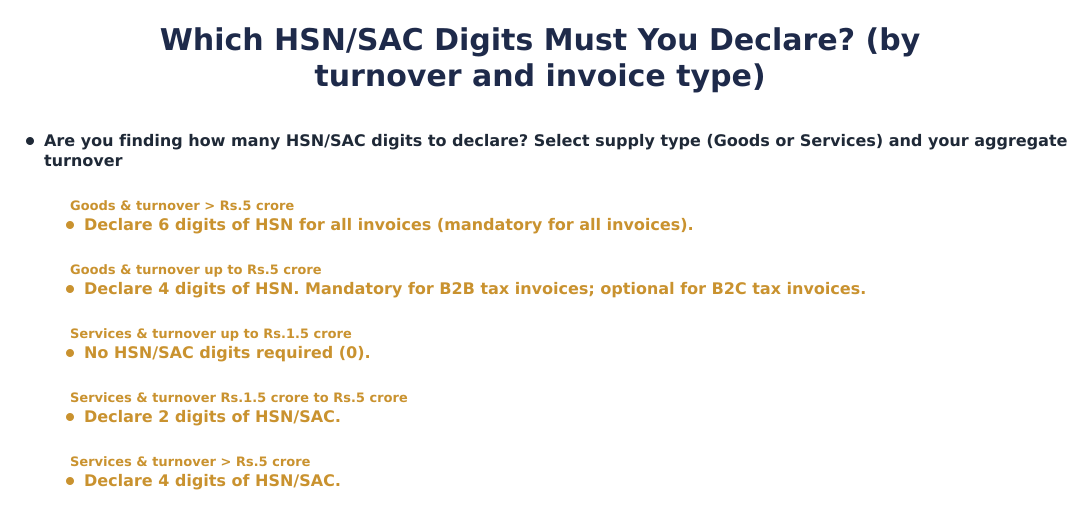
| AATO* for the previous financial year | Type of Invoices | No. of digits of HSN to be declared |
|---|---|---|
| Up to Rs.5 crore | Mandatory for B2B tax invoices | 4 |
| Optional for B2C tax invoices | 4 | |
| More than Rs.5 crore | Mandatory for all invoices | 6 |
Alternate turnover thresholds and HSN digits
| Transaction Charges | No. of digits of HSN to be declared |
|---|---|
| Upto 1.5 crore | 0 |
| 1.5 crore- 5 crore | 2 |
| More than 5 crore | 4 |
Services Accounting Code (SAC) in GST
Services are classified under a parallel system called SAC. SAC codes have a consistent pattern: the first two digits are 99 for services, the next two digits indicate the major nature of the service, and the last two digits indicate the detailed nature of the service. For example, in a SAC code the first two digits being 99 identify the entry as a service, the next two digits might represent legal services, and the last two digits would specify a narrower description such as legal documentation.
SAC is used in GST documents and returns for services the same way HSN is used for goods. Declaring the SAC helps tax authorities and businesses classify and reconcile supplies of services consistently across invoices and statutory filings.
Declaration rules and exports/imports
HSN codes must be declared in every tax invoice issued by the taxpayer under GST. For cross‑border transactions, all 8 digits of the HSN code are mandatory in case of exports and imports under GST.
Beyond exports and imports, the number of digits to be declared on domestic invoices and documents depends on turnover and the type of invoice, for B2B and B2C invoices and for taxpayers with higher aggregate turnover, different digit‑level declaration rules apply as summarised in the tables above.
How to locate the right HSN code for your product
Identify the broad category your product belongs to by checking Sections and Chapters (for example, textiles, chemicals, machinery). Section and Chapter titles describe broad categories of goods.
Within the chapter, look for headings that describe groups of related products; headings provide more detailed classification than chapters.
Choose the sub‑heading that most precisely describes your product to arrive at the 4‑, 6‑ or 8‑digit HSN code as required for your transaction.
If you supply services, use the SAC structure where the first two digits are 99, the next two indicate the major nature of service and the last two give the detailed nature.
HSN chapter list, chapter and commodity examples
The HSN is organised into sections and chapters covering all major commodity groups. For example, Section I covers animals and animal products with chapters such as "Animals" (Chapter 1) and "Meat and edible offal" (Chapter 2). Section IV covers prepared food and beverages with chapters including "Sugar and sugar confectionery" (Chapter 17) and "Beverages, vinegar, and spirits" (Chapter 22).
Other chapter examples include Chapter 84 for nuclear reactors, machinery and mechanical appliances, Chapter 85 for electrical machinery and equipment, Chapter 90 for optical and precision instruments, Chapter 62 for articles of apparel not knitted, Chapter 64 for footwear, Chapter 71 for precious metals and stones, and Chapter 47 for pulp of wood or other fibrous cellulosic material. These chapter headings guide users to the right heading and sub‑heading for specific products.
Correct HSN or SAC classification is essential for GST compliance, customs clearance and accurate reporting. Use the hierarchical approach, section, chapter, heading, sub‑heading, for goods and the 99‑based SAC pattern for services. Follow the digit‑declaration rules that apply to your turnover and transaction type, and declare all 8 digits for exports and imports to avoid mismatches or delays.

Frequently asked questions
What is an HSN code and why is it used under GST?
An HSN code (Harmonized System of Nomenclature) is an internationally standardised numeric system used to classify goods and it is used under GST to determine tax rates and ensure uniform classification. The HSN system groups products in chapters and headings (for example Chapter 1–99) so similar goods get the same code worldwide, helping customs, trade statistics and taxation. Under GST in India, declaring the correct HSN code helps apply the correct GST slab (0%, 5%, 12%, 18% or 28%) and avoids disputes or penalties for misclassification. Businesses use HSN codes on invoices and returns to provide an HSN-wise summary of outward supplies and for easier compliance and audit trails.
How is an HSN code structured in India and how many digits are used?
An HSN code is a multi-digit code based on the international HS system, and in India businesses must declare 4 or 6 digits depending on turnover and invoice type. The international HS structure starts with 2 digits for chapter, 4 digits for heading, and 6 digits for sub‑heading; India requires at least 4 digits for many businesses and 6 digits for larger taxpayers or specific cases. For B2B invoices and taxpayers with turnover up to ₹5 crore, 4 digits are mandatory; taxpayers with turnover above ₹5 crore must declare 6 digits on all invoices. Certain thresholds and document types (B2C optional/mandatory rules) determine how many digits you must report on GST invoices and returns.
Who must declare HSN codes on their invoices under GST and what are the turnover thresholds?
Businesses must declare HSN codes on invoices according to their aggregate turnover: upto ₹1.5 crore declare 0 digits, ₹1.5–₹5 crore declare 2 digits for returns (but 4 digits for invoices in some cases), and over ₹5 crore declare 4 or 6 digits depending on invoice type, with mandatory 6 digits for turnover above ₹5 crore. The common practical rule is: up to ₹5 crore turnover, 4 digits are mandatory on B2B invoices and optional on B2C; more than ₹5 crore turnover, 6 digits are mandatory for all invoices. Separate transaction-charge tables also indicate number of HSN digits to be declared for returns and documents, so businesses must check current GST notifications for precise application. Non‑compliance can lead to issues with input tax credit claims or scrutiny during assessments.
What is UQC and why does it matter for GST invoices?
UQC (Unit Quantity Code) is the standardized code used to indicate the quantity unit of goods (like kg, litres, pieces) on GST invoices, and it matters because it ensures uniformity and clarity for taxation and return filing. Every invoice for supply of goods should show the UQC alongside the quantity to help tax authorities and recipients identify units used consistently across transactions. Using the correct UQC helps in HSN-wise summaries and in reconciling supplies with input tax credit claims, especially for goods measured in different units. The UQC list is part of GST compliance requirements and should be selected from the prescribed codes when preparing invoices.
What is SAC and when should I use a SAC code instead of an HSN code?
SAC (Services Accounting Code) is the classification system for services under GST and you should use a SAC code for all service supplies instead of an HSN goods code. SAC codes categorise services similarly to how HSN classifies goods and are used on invoices, returns and to determine applicable GST rates on services. For any supply that is a service (consultancy, professional, transport, etc.), quoting the correct SAC on the invoice is important for levy, compliance and for the recipient to claim input tax credit. Goods and services are distinct under GST, so choose HSN for physical goods and SAC for services; Chapter 99 covers services in the broader classification list.
How can I find the correct HSN code for my product quickly?
You can find the correct HSN code by searching the HSN chapter and heading list and matching your product to the closest description; online HSN/GST rate finders let you search by product name or browse chapters. The HSN list is organised by chapters (for example Chapter 1 to Chapter 99) and each chapter contains commodity descriptions, matching the product description to the heading and sub-heading will give you the 4‑ or 6‑digit HSN. Many GST portals and HSN code finders let you type a product name (for example “cotton cloth” or “mobile phone”) and will return the likely HSN and applicable GST rate; if in doubt, consult a customs tariff schedule or a tax professional for confirmation. Correct classification is important because it determines the GST slab (0%, 5%, 12%, 18% or 28%) and compliance obligations.
What are the GST rate slabs and how do they relate to HSN codes?
GST in India is levied in five broad slabs, 0%, 5%, 12%, 18% and 28%, and each HSN code is mapped to one of these rates depending on the nature of the good. When you identify the correct HSN code for a product, that code determines the GST rate applicable to that product as per the tariff schedule. Some goods may have exemptions (0%) or special rates, and a single chapter can contain items attracting different slabs, so precise HSN classification is necessary to pick the correct rate. Businesses should verify the rate for the specific 4/6-digit HSN sub-heading rather than relying on chapter-level generalisations to avoid under/overcharging GST.
What is an HSN-wise summary of outward supplies and when is it required?
An HSN-wise summary of outward supplies is a consolidated list of outward supplies grouped by HSN code that taxpayers must provide in GST returns to show taxable outward supplies by classification. This summary helps the tax authorities reconcile outward supplies, track tax collected by HSN, and allows buyers to verify HSN details for input tax credit claims. The level of detail required in the summary (number of HSN digits) follows turnover thresholds, generally 4 digits for many taxpayers and 6 digits for larger taxpayers, so businesses should prepare their returns accordingly. Including accurate HSN-wise summaries reduces errors in returns and support smoother audits and reconciliations.
What is the chapter-wise distribution of goods in the HSN and how does it help classification?
The HSN is organised into sections and chapters (for example Section I covers animals and animal products, Section XI covers textiles) and each chapter groups related commodities to simplify classification and search. This chapter-wise distribution, like Chapter 1 for animals, Chapter 47 for pulp and paper, Chapter 84 for machinery, helps taxpayers narrow down where a product fits before selecting the specific heading and sub-heading for the exact HSN. Using the chapter and commodity descriptions reduces ambiguity when determining the correct 4‑ or 6‑digit HSN and corresponding GST rate. For complex or borderline items, referring to the chapter notes and examples or consulting a customs/tax expert can avoid misclassification.
Need help staying GST compliant?
MoneyGence's AI Finance OS tracks your compliance, wallet share, and finances in one place, built for agencies and growing businesses.
Get started with MoneyGence