GSTR-9 Annual Return: Due Date, Applicability & Filing Guide
This guide explains GSTR-9, the annual GST return that consolidates a taxpayer’s monthly and quarterly GST filings for a financial year. You will learn what GSTR-9 is, what information it collects, practical steps to prepare and file it, and the reconciliation work required to make your annual return accurate and defensible. Accurate GSTR-9 filing matters because it is the year‑end summary of outward and inward supplies, tax paid, and the input tax credit (ITC) claimed during the year; errors or omissions can create reconciliation mismatches, trigger notices, and require corrective payments. This article focuses on the structure and purpose of the form, the core disclosures it requires, and a pragmatic checklist of steps to prepare GSTR-9 efficiently. The content is written for business owners, finance teams, and GST practitioners who need a clear, actionable roadmap to compile their annual GST return from the data already reported in GSTR‑1, GSTR‑2A/2B and GSTR‑3B throughout the year.
What is the GSTR-9 Annual Return?
GSTR-9 is the annual GST return that consolidates all GSTR-1, GSTR-2A/2B and GSTR-3B data for a financial year, covering outward and inward supplies, tax paid and ITC. It serves as a single, comprehensive statement that aggregates the transactions a taxpayer has reported in periodic returns during the year.
Because it is a consolidation of all monthly and quarterly returns filed in the year, GSTR-9 is intended to present a reconciled picture of your sales, purchases and tax positions. The form brings together information from multiple return types so that discrepancies can be identified and corrected at year end.
Who should use GSTR-9 (applicability in practice)
In practice, GSTR-9 is used by taxpayers who have been filing periodic GST returns such as GSTR-1 and GSTR-3B and who therefore have a year’s worth of outward and inward supplies to consolidate. Because the form pulls data from GSTR-1, GSTR-2A/2B and GSTR-3B, any registered person who has reported transactions in these returns will need to prepare a consolidated annual statement.
Preparing GSTR-9 is an exercise in reconciliation: you must compare your books and accounting records with the information already reported in periodic returns to ensure that turnovers, tax liabilities and ITC claims align. This makes the form especially important for entities with regular supplies and purchases where data flows across multiple returns and vendors.
GSTR-9 contents and format: what information is disclosed
GSTR-9 contains details of outward and inward supplies for the financial year under CGST, SGST & IGST along with cess and HSN codes. The form requires taxpayers to report consolidated turnover by tax head and the HSN classifications used across the year.
The return requires disclosures of annual sales (taxable and non‑taxable), annual inward supplies and ITC availed, classification of purchases as inputs, input services and capital goods, and ITC reversals. These disclosures are designed to capture not just amounts but also the nature of supplies and where ITC was utilized or needed to be reversed.
Because the form aggregates entries from the year, detail-level reconciliation is often necessary: line items in GSTR-9 should tie back to the sums of GSTR-1, GSTR-2A/2B and GSTR-3B entries, and to your purchase and sales ledgers, so that any adjustments can be identified and explained.
The format therefore reflects both transaction totals and specific reconciliation disclosures (for example, adjustments to ITC), enabling tax authorities and taxpayers to compare year-end positions against the periodic filings already submitted.
GSTR-9 filing steps (practical preparation and filing checklist)
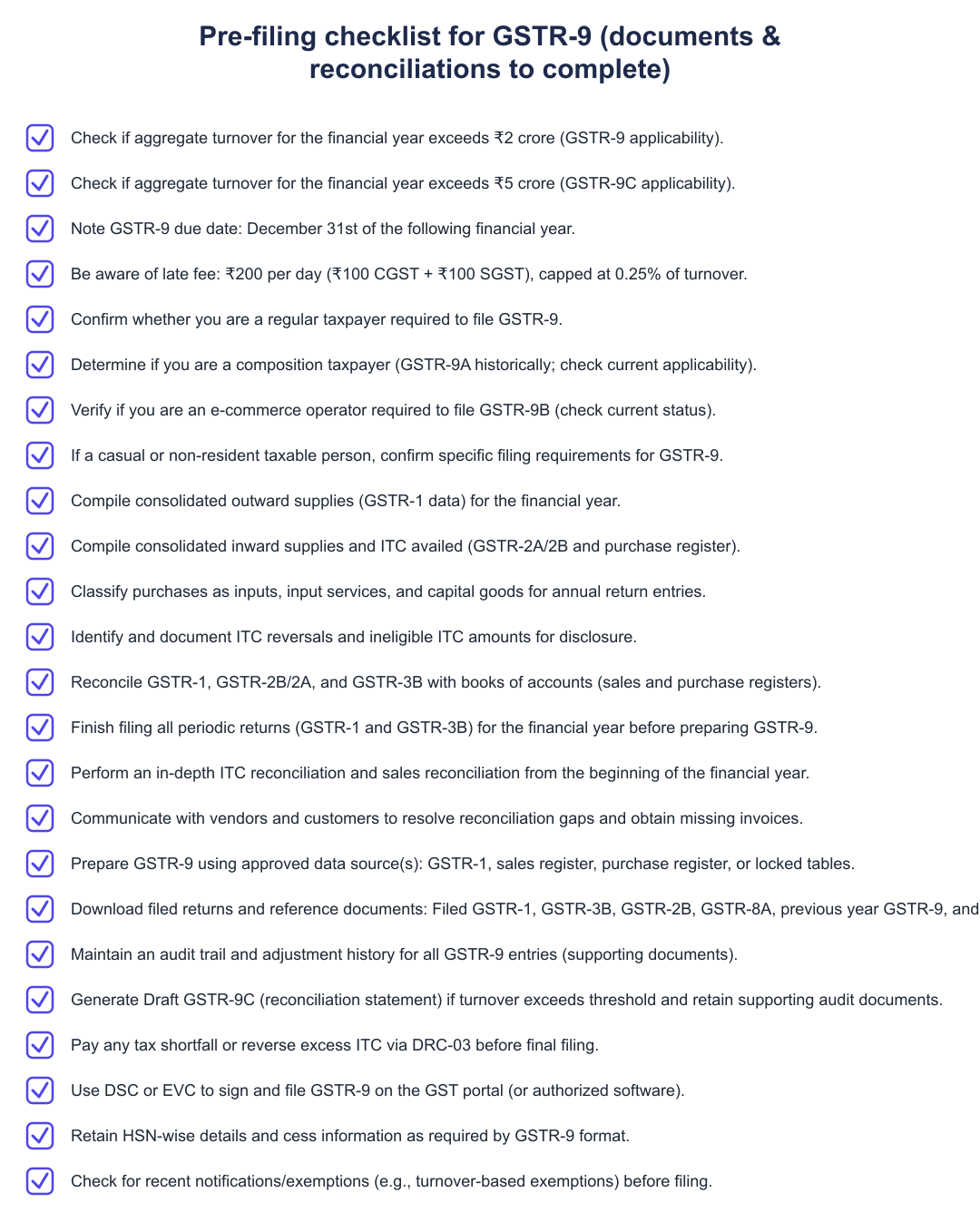
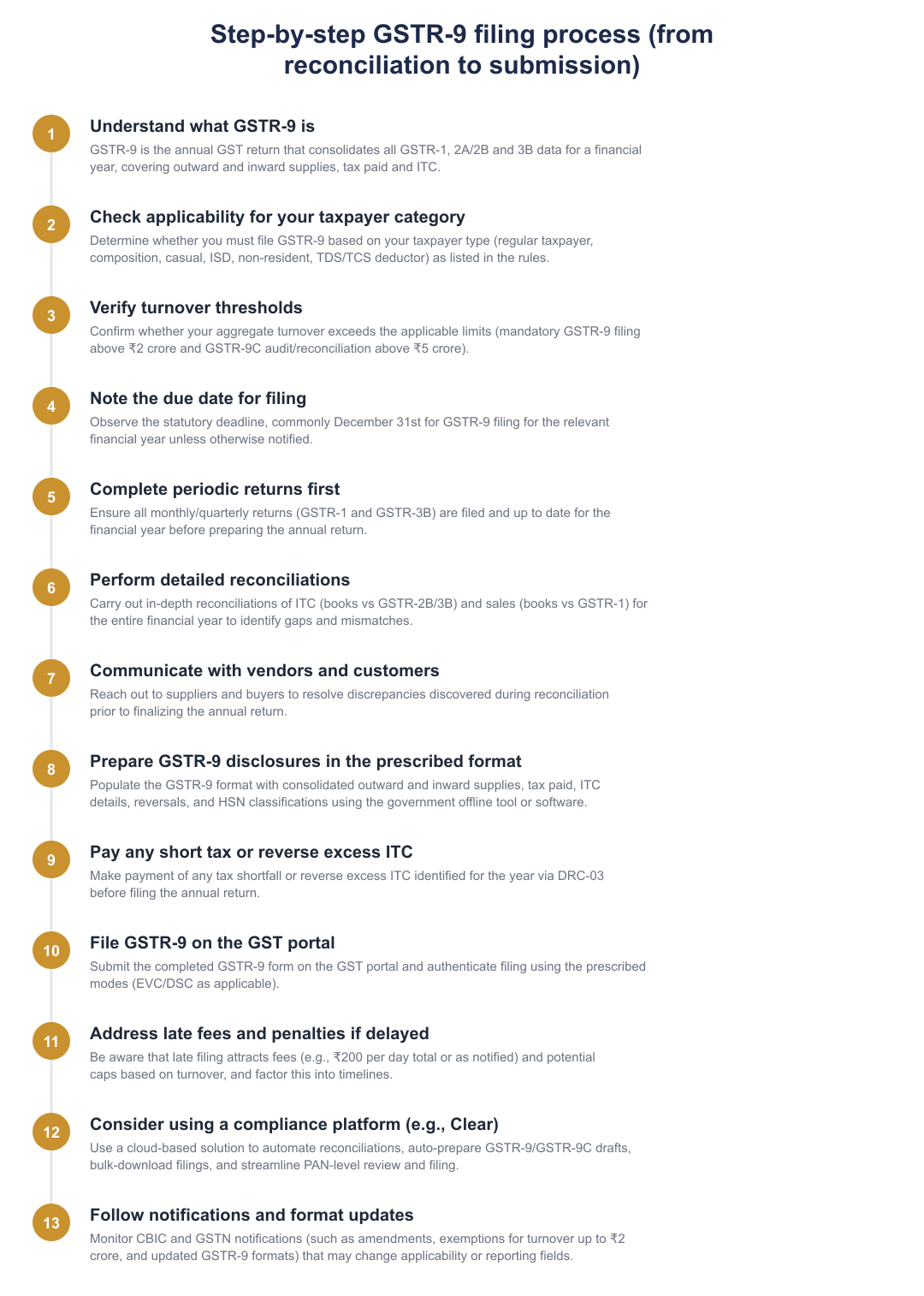
Ensure GSTR-1 and GSTR-3B (and any other periodic returns) are filed and up to date before preparing the annual return so the annual consolidation reflects the latest reported data.
Reconcile input tax credit and sales figures from your books with the data in GSTR-2A/2B, GSTR-1 and GSTR-3B to identify discrepancies that must be adjusted or explained in the annual return.
Reach out to vendors and customers to resolve mismatches found during reconciliation, obtain amended documents if needed, and ensure inward/outward supplies align across records.
If reconciliation reveals short payment of tax or excess ITC claims, prepare and pay the necessary tax via the prescribed payment route (for example, using the appropriate challan) before finalising the annual return.
Prepare the consolidated figures and reconciliation disclosures for the form, and file GSTR-9 on the GST portal once all adjustments and verifications are complete.
Practical tips: reconciling and documenting figures
Because GSTR-9 consolidates multiple return types, maintain clear audit trails showing how each annual figure is derived from periodic returns and books. Documenting the computation and any adjustments will make the filing defensible in case of queries or audits.
Classify purchases into inputs, input services and capital goods in your working papers, and separately track ITC reversals with supporting calculations. This helps ensure the categories required by the form are populated correctly and that reversals are explained and supported.
Use a systematic approach to reconcile HSN-wise supplies and cess liabilities where relevant, and retain correspondence with suppliers/customers for any corrected invoices or reconciliations. A disciplined month‑by‑month reconciliation during the year significantly reduces year‑end effort and surprise adjustments.
GSTR-9 is the comprehensive annual consolidation of a taxpayer’s GST life for the year, bringing together outward and inward supplies, tax paid and ITC entries reported across periodic returns. Careful reconciliation, timely corrective payments if required, and clear documentation of adjustments are the keys to an accurate annual return. Following a disciplined preparation checklist will make filing GSTR-9 smoother and reduce the risk of post‑filing queries.
Frequently asked questions
What is GSTR-9 and why do I need to file it?
GSTR-9 is the annual GST return that consolidates a taxpayer's outward supplies, inward supplies, tax paid and input tax credit for a financial year, and it must be filed by eligible taxpayers to reconcile monthly/quarterly returns. It brings together data from GSTR-1, GSTR-2A/2B and GSTR-3B and requires disclosure of tax liability, ITC availed, and any reversals or adjustments for the year. Filing GSTR-9 ensures transparency, completes statutory compliance for the year, and helps identify mismatches that may require payment via DRC-03. For FY 2024-25 and thereafter the form has been updated to include new ITC reporting fields and IMS-based auto-population under recent notifications.
Who is required to file GSTR-9 for a financial year?
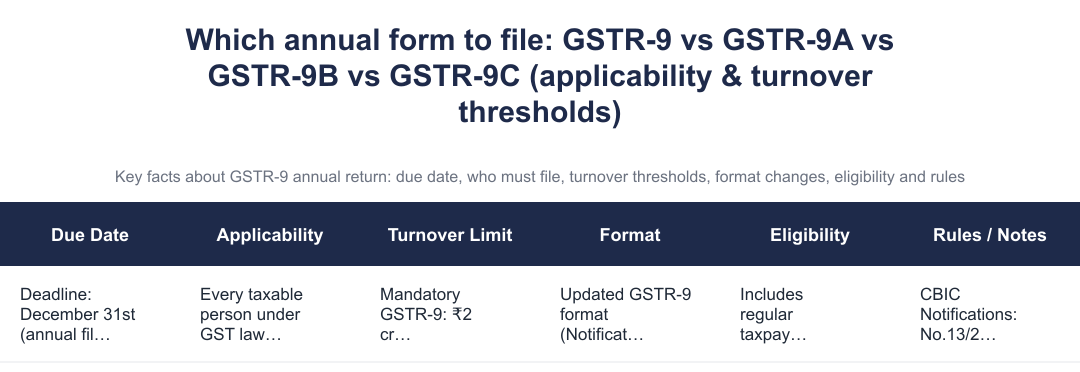
As per Notification No. 15/2025‑Central Tax, taxpayers whose aggregate turnover in a financial year exceeds ₹2 crore are required to file GSTR-9. However, persons under the composition scheme (who file GSTR-9A), casual taxable persons, input service distributors, non-resident taxable persons, persons paying TDS under section 51, and persons collecting TCS under section 52 are exempt from filing GSTR-9. Additionally, GSTR-9C (reconciliation statement) is mandatory only for taxpayers with aggregate turnover exceeding ₹5 crore in a financial year and must be self-certified or audited as applicable. Recent rule changes and FAQs also permit IMS-based auto-population and have refined applicability thresholds for specified years.
What is the due date for filing GSTR-9?
The due date for filing GSTR-9 is 31st December following the end of the financial year (for example, GSTR-9 for FY 2025‑26 is due on 31st December 2026). Late filing attracts penalties: a late fee of ₹200 per day (₹100 CGST + ₹100 SGST) which is capped at 0.25% of the aggregate turnover of the taxable person. Taxpayers should ensure monthly/quarterly returns (GSTR-1 and GSTR-3B) are up to date before preparing GSTR-9, since GSTR-9 is a consolidation of those returns. Some amnesty or procedural relaxations have been announced in certain years, but the standard statutory due date remains 31st December unless specifically extended.
What are the turnover limits for GSTR-9 and GSTR-9C?
GSTR-9 is mandatory for taxpayers with aggregate turnover exceeding ₹2 crore in a financial year, while GSTR-9C (annual reconciliation/audit) is required for taxpayers with aggregate turnover exceeding ₹5 crore in a financial year. Taxpayers below ₹2 crore are exempt from filing GSTR-9 per Notification No. 15/2025‑Central Tax, though they must still comply with regular monthly/quarterly returns as applicable. The ₹5 crore threshold triggers the requirement to prepare and attach a reconciliation statement (GSTR-9C), which may need auditor certification depending on the law and turnover. Always verify the applicable year’s notifications because the government periodically amends thresholds and formats.
What changed in the GSTR-9 format and rules recently?
Recent CBIC notifications (Nos. 13/15/16/2025‑Central Tax) revised the GSTR-9 format and rules by introducing new ITC reporting fields, exempting taxpayers with turnover up to ₹2 crore from filing GSTR-9, and enabling IMS‑based ITC auto‑population and additional reversal disclosures. Notification No. 13/2025 amended CGST Rules to add ITC reporting fields; No. 15/2025 provided the ₹2 crore exemption; and No. 16/2025 updated the format for auto-population and reversals. These changes aim to simplify reconciliation, reduce manual entries, and improve accuracy by leveraging invoice matching systems (IMS) to auto-populate eligible ITC. Taxpayers should use the latest offline/online tools or compliant software to capture the new fields and disclosures when preparing their returns.
What are the main sections and disclosures required in GSTR-9?
GSTR-9 requires consolidated disclosures of outward supplies, inward supplies, tax paid, and input tax credit across CGST, SGST and IGST, including HSN-wise details and tax-paid summaries; it also requires reconciliation of figures with GSTR-1 and GSTR-3B and disclosure of ITC reversals. The form asks for bifurcation of outward supplies between taxable and non-taxable, details of inward supplies and ITC availed classified as inputs, input services and capital goods, and any adjustments or reversals of ITC. The updated format includes new fields for IMS-based ITC auto-population and additional reversal disclosures introduced by recent notifications. Accurate HSN reporting, correct classification of supplies, and clear disclosures of adjustments are essential because GSTR-9 is used for audit and compliance checks.
How do I prepare and file GSTR-9 step-by-step?
To prepare and file GSTR-9, first ensure all GSTR-1 and GSTR-3B returns for the year are filed and perform a detailed reconciliation of sales, purchases and ITC against GSTR-1, GSTR-2B and books; then populate the GSTR-9 form using the government offline tool or a compliant software, pay any tax shortfall via DRC-03, and submit the return on the GST portal. Practical steps include communicating with vendors/customers to resolve mismatches, classifying purchases as inputs/input services/capital goods, making disclosures for reversals, and keeping an audit trail of adjustments. Many taxpayers use cloud-based tools that auto-prepare GSTR-9 and GSTR-9C, allow bulk downloads of historical returns, and let you file multiple GSTINs with EVC/DSC from a single screen to save time and reduce errors. Remember to retain documentation supporting reconciliations and any additional tax payments for future assessment or audit.
What are the penalties and late fee for delayed GSTR-9 filing?
If you file GSTR-9 after the due date, the late fee is ₹200 per day (₹100 CGST + ₹100 SGST) which is capped at 0.25% of the taxpayer's aggregate turnover; interest may also apply on any unpaid tax. The cap means that once the total late fee reaches 0.25% of turnover, no further late fee accrues, but interest on tax dues continues as per statute. In some years the government has announced amnesty or specific schemes to waive or reduce penalties, so check current circulars or notifications before filing. To avoid penalties, reconcile early, pay any short-paid tax via DRC-03, and file the annual return well before 31st December.
Are there any reliefs or amnesty schemes for late or past GSTR-9 filings?
Yes, periodically the government announces reliefs; for example, specific amnesty measures for GSTR-9 were provided in 2023 and individual years may have scheme-based relaxations, but these are time-bound and subject to conditions. Amnesty schemes can include waiver or reduction of late fees or simplified compliance for past years, but they typically require filing within the scheme window and may not waive interest or other statutory liabilities. Always verify the exact scope, eligibility and timelines in the official CBIC notification or GSTN FAQs before relying on an amnesty, because the availability and terms change year to year. If eligible, use the relief window to regularize past non-filing and pay dues via prescribed challans (like DRC-03) to avoid future scrutiny.
Need help staying GST compliant?
MoneyGence's AI Finance OS tracks your compliance, wallet share, and finances in one place, built for agencies and growing businesses.
Get started with MoneyGence