GST Registration Threshold Limit: State-wise Limits & Guide
This guide explains the GST registration threshold limits that determine when a business must register under the Goods and Services Tax (GST) regime in India. You will learn the current turnover thresholds for sale of goods and for service providers, the date from which the revised limits for goods apply, what components to include when calculating aggregate turnover, and which categories of persons are compulsorily required to register regardless of turnover. Understanding these thresholds matters because registration triggers tax collection, compliance obligations (returns, invoicing, input tax credit rules) and, in many cases, interaction with e-commerce platforms or reverse-charge mechanisms. The guide pulls together the verified changes that came into force on 1st April 2019 for supply of goods, clarifies that service-provider limits did not change, and lists the specific classes of persons who must obtain GST registration irrespective of turnover. If you are a manufacturer, trader, or service provider trying to determine whether your business needs GST registration, this article provides the authoritative numeric thresholds and the precise components you must count in your turnover calculation so you can make a compliant decision.
Overview of Earlier Limits, New Limits and the Date of Applicability
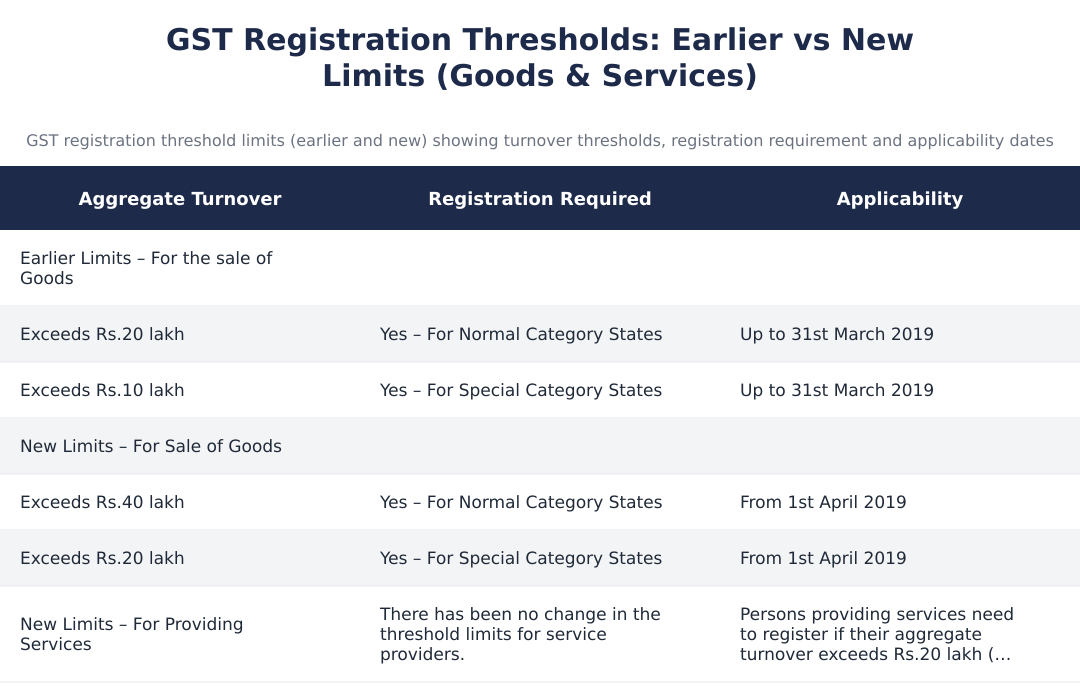
The GST registration threshold for supply of goods was revised and the new limits are applicable from 1st April 2019. For manufacturers and persons engaged in sale of goods, the threshold was raised to Rs.40 lakh for normal category states and to Rs.20 lakh for special category states, with effect from that date.
Prior to 1st April 2019 the thresholds for sale of goods were lower: registration was required where aggregate turnover exceeded Rs.20 lakh in normal category states and Rs.10 lakh in special category states (these earlier limits applied up to 31st March 2019).
For service providers there was no change in threshold limits as part of this revision: persons providing services continue to require registration if their aggregate turnover exceeds Rs.20 lakh (normal states) and Rs.10 lakh (special states).
States Who Opted for the New Limit
The source facts provided to this guide do not include a verified list of states or union territories that opted for the new threshold limits. Therefore this section does not attempt to list individual states.
If you need state-specific applicability (for example, whether your state is treated as a normal or special category state for threshold purposes), consult the official notifications from the government or your tax advisor, because the treatment can affect whether the Rs.40 lakh or Rs.20 lakh threshold applies to your business.
Who are Compulsorily Required to Register for GST?
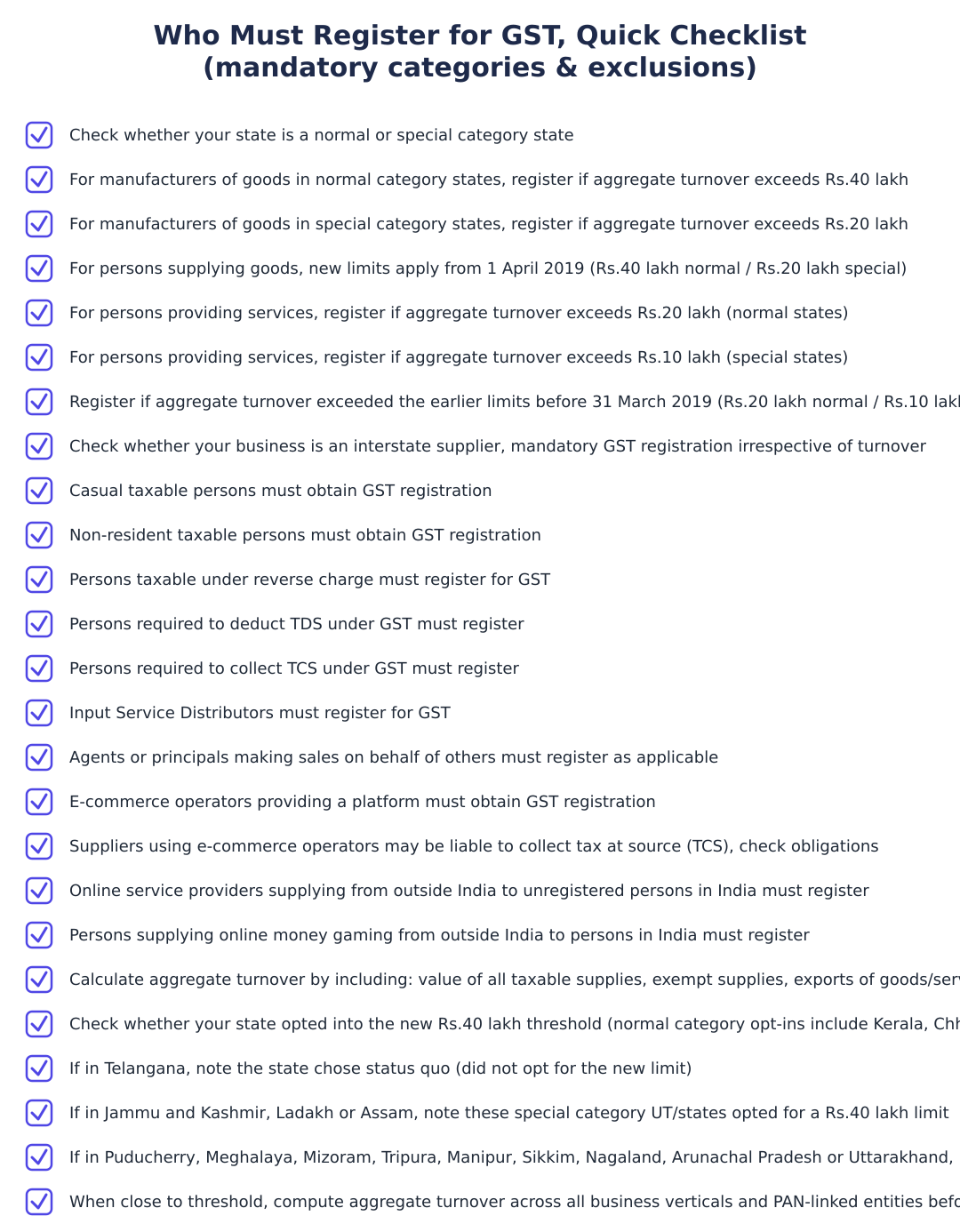
Certain categories of persons must register under GST irrespective of their aggregate turnover. These compulsory classes include interstate suppliers, casual taxable persons, persons liable to tax under reverse charge, and non-resident taxable persons. Registration is mandatory for these groups even if their turnover is below the monetary thresholds.
Other specifically mandated registrants include persons required to deduct TDS under GST, persons required to collect TCS under GST, Input Service Distributors, persons making sales on behalf of others (agents or principals), e-commerce operators who provide a platform to suppliers, suppliers who make supplies through e-commerce and are liable to collect tax at source, online service providers located outside India supplying to non-registered persons in India, and persons supplying online money gaming from outside India to persons in India.
How to Calculate GST Threshold Limit?
Threshold calculations are based on aggregate turnover. The verified definition of aggregate turnover requires inclusion of the value of all taxable supplies, exempt supplies, exports of goods or services or both, and inter-state supplies of persons having the same PAN. Count these elements together when comparing your turnover against the applicable threshold.
Do note that the statutory definition and notifications may also specify additional inclusions or exclusions (for example, certain central or state specific items) in other contexts. For a correct computation in borderline cases, reconcile your accounting records to these four core components and, if necessary, obtain professional guidance to ensure no applicable element is omitted.
Changes in the Threshold Limits to opt into the Composition Scheme
The verified facts provided do not include any details about changes to threshold limits for opting into the composition scheme. This guide therefore does not state any composition scheme limits or eligibility criteria.
If you are considering the composition scheme, check the latest official GST notifications or consult a tax professional to determine current composition thresholds, eligibility conditions and the effective dates of any changes.
Frequently Asked Questions
Q: From what date did the new thresholds for sale of goods become applicable? A: The new thresholds for sale of goods (Rs.40 lakh for normal states and Rs.20 lakh for special states) are applicable from 1st April 2019.
Q: Have the threshold limits for service providers changed? A: No. There has been no change for service providers, registration is required if aggregate turnover exceeds Rs.20 lakh in normal states and Rs.10 lakh in special states.
Q: What items should be included while computing aggregate turnover? A: Include the value of all taxable supplies, exempt supplies, exports of goods or services or both, and inter-state supplies of persons having the same PAN.
Q: Are there categories that must register even if turnover is below the threshold? A: Yes, interstate suppliers, casual taxable persons, persons taxable under reverse charge, non-resident taxable persons, persons required to deduct TDS or collect TCS under GST, Input Service Distributors, agents/principals selling on behalf of others, e-commerce operators and certain cross-border online suppliers are required to register irrespective of turnover.
In summary, for sale of goods the current GST registration thresholds are Rs.40 lakh (normal states) and Rs.20 lakh (special states) effective from 1st April 2019, while service providers remain subject to the existing Rs.20 lakh/Rs.10 lakh thresholds. Use the aggregate-turnover components listed here to compute whether your business crosses the applicable limit, and remember that certain classes of persons must register regardless of turnover. For state-specific applicability or composition-scheme questions, refer to official notifications or consult a tax adviser.
Frequently asked questions
What is the GST registration threshold limit for manufacturers of goods?
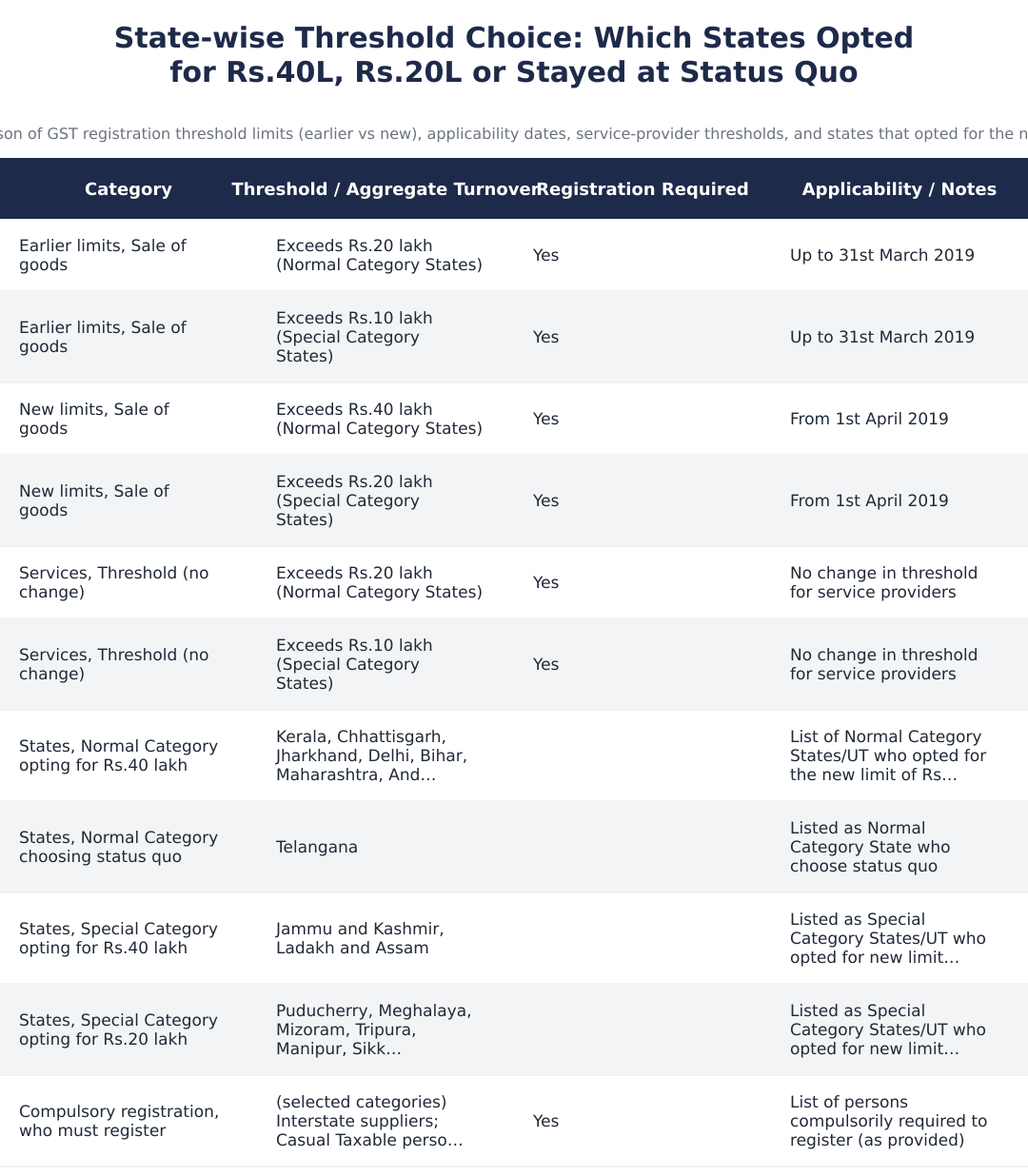
The GST registration threshold limit for manufacturers of goods is Rs.40 lakh in normal category states and Rs.20 lakh in special category states. These new limits for sale of goods became applicable from 1st April 2019 and replaced the earlier limits of Rs.20 lakh (normal) and Rs.10 lakh (special). Service providers, however, still follow the earlier thresholds (Rs.20 lakh for normal and Rs.10 lakh for special states). If your aggregate turnover in a financial year exceeds the applicable state threshold, you must register for GST.
Which states chose the new Rs.40 lakh threshold for normal category states?
Several normal category states and UTs opted for the new Rs.40 lakh threshold, including Kerala, Chhattisgarh, Jharkhand, Delhi, Bihar, Maharashtra, Andhra Pradesh, Gujarat, Haryana, Goa, Punjab, Uttar Pradesh, Himachal Pradesh, Karnataka, Madhya Pradesh, Odisha, Rajasthan, Tamil Nadu, West Bengal, Lakshadweep, Dadra & Nagar Haveli and Daman & Diu, Andaman & Nicobar Islands and Chandigarh. Telangana chose to maintain the status quo (did not adopt the new Rs.40 lakh limit). These state choices determine whether businesses in that state follow Rs.40 lakh or the earlier lower limits for goods.
Which special category states opted for the Rs.20 lakh and Rs.40 lakh limits?
Among special category states/UTs, Jammu & Kashmir, Ladakh and Assam opted for the Rs.40 lakh limit while Puducherry, Meghalaya, Mizoram, Tripura, Manipur, Sikkim, Nagaland, Arunachal Pradesh and Uttarakhand opted for the Rs.20 lakh limit. The remaining special category territories retained their previous choices based on individual state notifications. These choices determine whether manufacturers in those special category areas must register at Rs.20 lakh or Rs.40 lakh aggregate turnover.
Do service providers get the increased Rs.40 lakh threshold like goods suppliers?
No, service providers did not get the increased Rs.40 lakh threshold; the threshold for service providers remains unchanged. Service suppliers must register if their aggregate turnover exceeds Rs.20 lakh in normal category states and Rs.10 lakh in special category states. Therefore the Rs.40 lakh limit applies only to the sale of goods where the state has opted in.
Who is compulsorily required to register for GST regardless of turnover?
Certain categories of persons must register for GST irrespective of turnover, including interstate suppliers, casual taxable persons, persons liable under reverse charge, non-resident taxable persons, persons required to deduct TDS/TCS under GST, input service distributors, agents selling on behalf of principals, e-commerce operators, suppliers on e-commerce liable to collect tax at source, online service providers from outside India to non-registered persons in India, and persons supplying online money gaming from outside India. These classes are mandated to register even if their aggregate turnover is below the state-specific threshold limits. Failure to register when required attracts penalties and compliance obligations.
How do you calculate aggregate turnover for determining the GST threshold?
Aggregate turnover is calculated by summing the value of all taxable supplies, exempt supplies, exports of goods or services, and inter-state supplies of persons having the same PAN for the current financial year. This total includes everything made in the course of business but excludes central and state GST (CGST/SGST) components for the purposes of threshold computation. Use the aggregate turnover figure to compare against the applicable state threshold (e.g., Rs.40 lakh or Rs.20 lakh) to determine registration requirement.
Did the rules for opting into the composition scheme change with the new thresholds?
The article notes there were changes in threshold limits to opt into the composition scheme, but it does not list specific new composition limits in the provided content. Generally, composition scheme thresholds are set separately and states may notify limits; affected taxpayers should check the latest notifications for exact figures and effective dates. If you are considering composition, verify the current aggregate turnover ceiling and eligibility conditions with the relevant state/central GST circulars.
If my business is in two states, how does the threshold limit apply?
If your business operates in multiple states but has the same PAN, the aggregate turnover for GST threshold purposes is computed on a pan-India basis by summing turnover across all states and units. The consolidated aggregate turnover is compared to the applicable threshold to determine whether registration is required, and interstate supplies are included in this calculation. Once the turnover crosses the threshold, registration is required in each state where supplies are made as per GST rules.
When should I register if my turnover crosses the threshold during the financial year?
You must obtain GST registration from the date your aggregate turnover exceeds the applicable threshold in that financial year, i.e., registration is required once the turnover crosses Rs.40 lakh (normal states for goods) or Rs.20 lakh (special states for goods) or the corresponding service thresholds. Practically, register immediately after you determine that projected or actual turnover will exceed the limit to avoid non-compliance. Retroactive liability and penalties can arise if you delay registration after you were required to be registered.
Need help staying GST compliant?
MoneyGence's AI Finance OS tracks your compliance, wallet share, and finances in one place, built for agencies and growing businesses.
Get started with MoneyGence