GST Refund Under Section 54: Complete Guide on Zero‑Rated & IDS Claims
This guide explains how to claim GST refunds under Section 54 with a focus on zero-rated supplies (exports), Inverted Duty Structure (IDS) refunds, and the key procedural and judicial touchpoints that affect limitation and entitlement. You will learn which date is the "relevant date" for different refund categories (exports by sea/air/land, export of services, IDS, appellate orders, provisional assessments, supplies to persons other than the supplier, and the default rule), the two primary routes for export refunds (IGST-paid and LUT/Bond), the updated IDS computation rules and supporting statement requirements, and common filing mistakes that cause rejections or delays. The guide also summarises important notifications, circulars and rules that change how refunds are computed and processed, including the retrospective and prospective rule amendments, the Finance Act 2024 restriction for goods under export duty, and interest and time limits under Sections 54 and 56. This is practical guidance: you will get clarity on which documentary evidence establishes the relevant date (for example, shipping bill/LEO, EGM/GSTR-1 corroboration, FIRC/BRC for foreign exchange, and invoice dates for advance service receipts), understand the operational routes (Rule 96 automatic IGST refunds vs. Rule 89 ITC refunds), and be alerted to systemic checks (GSTR-1 filing requirement, prohibition on double claims, SEZ officer certificate). Where the verified materials changed law or procedure, such as Rule 89(5) restricting IDS refunds to ITC on input goods, this guide explains what that means for computing refunds and for preserving claims within limitation periods.
Category of refund, Relevant date and explanation
| Category of Refund | Relevant Date | Explanation |
|---|---|---|
| Export of goods by sea / air | Date of departure of ship / aircraft | Typically the Let Export Order date |
| Export of goods by land | Date of crossing the customs frontier | Corroborated by EGM / GSTR-1 data |
| Export of services (receipt of foreign exchange) | Date of receipt of foreign exchange by supplier | Evidenced by FIRC / BRC from bank |
| Export of services (advance receipt) | Date of issue of invoice | Where foreign exchange received in advance |
| Inverted duty structure (IDS) | Due date of GSTR-3B for the period in which claim arises | Inserted w.e.f. 01.10.2022, Notification No. 18/2022-CT |
| Order of Appellate Authority / Court | Date of communication of judgment / order | Applied in GTL Infrastructure, HC held limitation directory |
| Provisional assessment, final order | Date of adjustment after final assessment | , |
| Person other than supplier | Date of receipt of goods / services | e.g., UN agencies, embassies under Section 55 |
| Any other case | Date of payment of tax | Default provision |
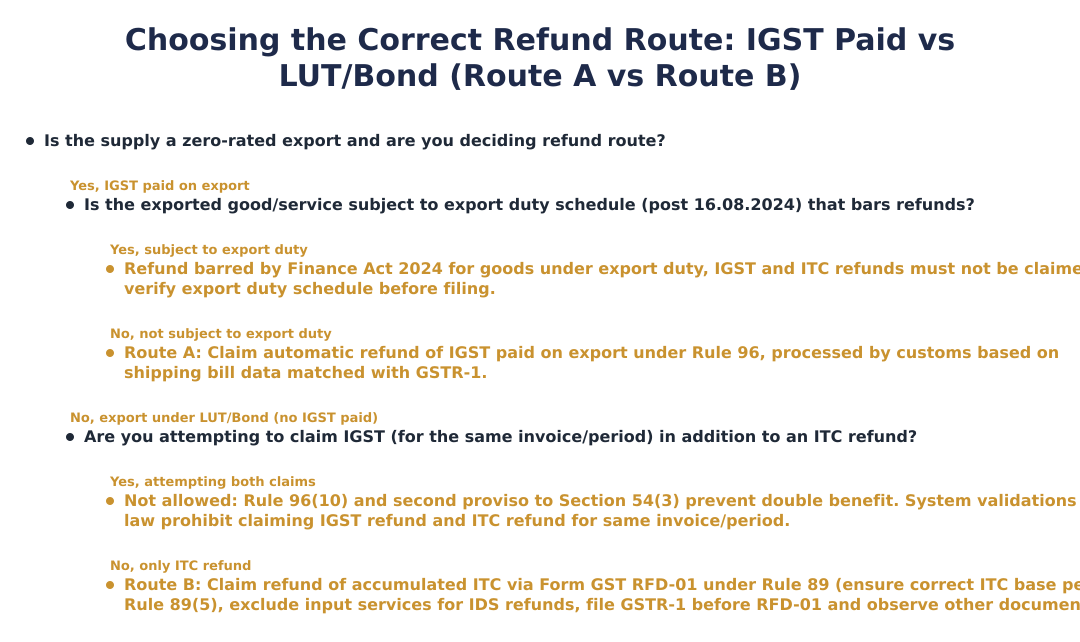
Routes for export refunds
| Route | Mechanism |
|---|---|
| Route A: Export with payment of IGST | Claim automatic refund of IGST paid on export under Rule 96- processed by customs on the basis of shipping bill data matched with GSTR-1 |
| Route B: Export under LUT/Bond without payment of IGST | Claim refund of accumulated ITC through Form GST RFD-01 filing under Rule 89 |
IDS refunds: formula change and practical effect
The IDS refund computation was substantively revised by amendments to Rule 89(4)/(5). The Rule 89 formula allocates Net ITC to zero-rated and non-exempt supplies proportionally. A major change introduced (and clarified by later amendments and circulars) restricts the refundable quantum for IDS claims so that input services are excluded from the refundable Net ITC. In other words, the practical effect is that refund available under IDS is limited to ITC attributable to input goods rather than the broader pool of ITC including input services.
This restriction aligns with judicial pronouncements (notably VKC Footsteps as reflected in the notified amendments) and was given retrospective effect from 01.07.2017 by Notification 26/2018-CT where specified. Subsequent amendments (Notification 14/2022-CT dt. 05.07.2022) revised the IDS formula and CBIC guidance clarified prospective operation in some respects. For practitioners, the upshot is to prepare IDS refund claims using the Rule 89(5) approach, Net ITC minus ITC on input services, so that the numerator effectively becomes ITC on input goods only, applied proportionally against the turnover of IDS supplies.
Key procedural forms, timelines and interest
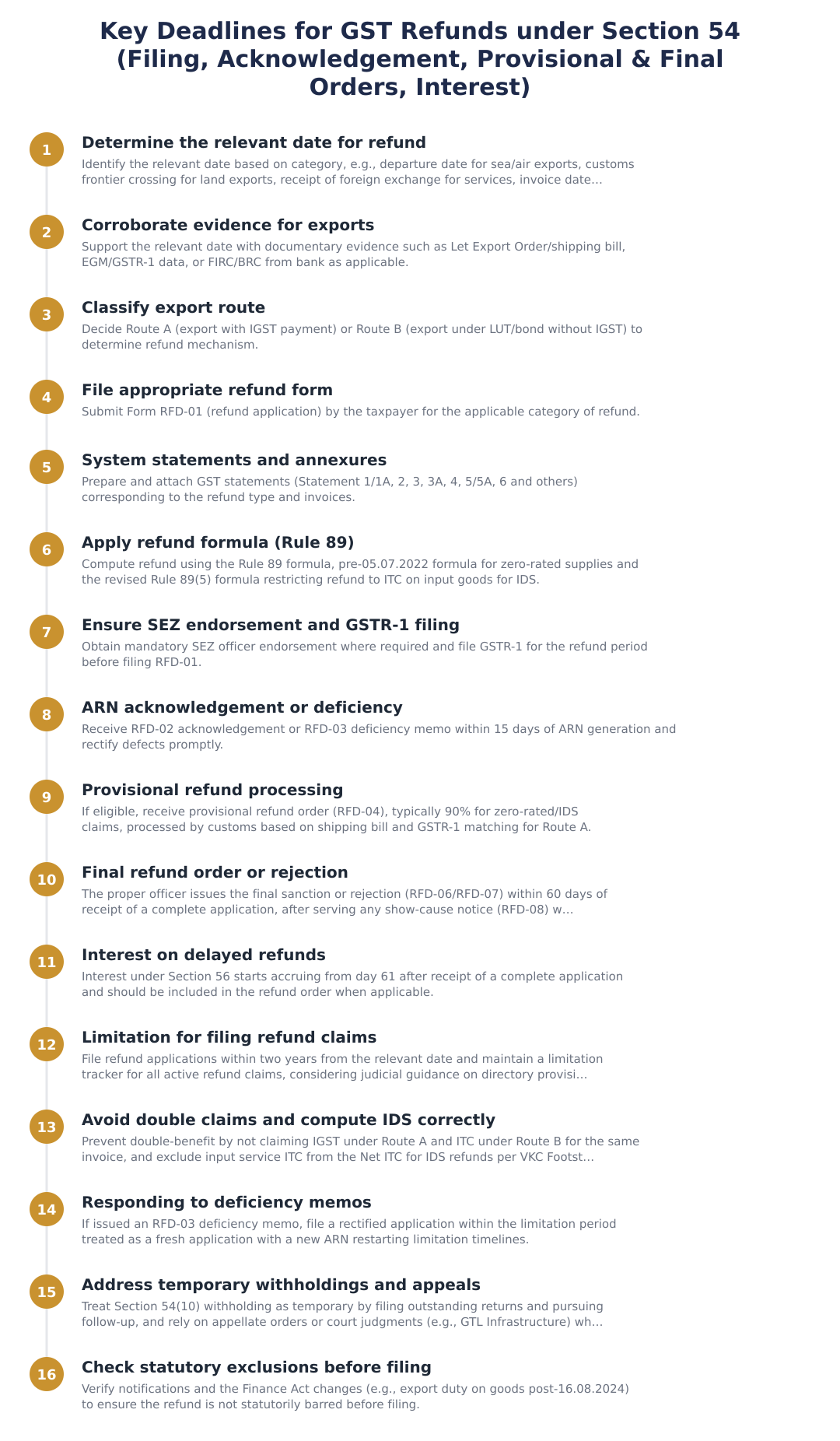
Refund administration uses a set of prescribed forms (RFD-01 to RFD-11). The taxpayer initiates a refund with RFD-01. The proper officer must acknowledge (RFD-02) or issue a deficiency memo (RFD-03) within 15 days of ARN. For zero-rated supplies and IDS, a provisional refund order (RFD-04) for 90% may be issued within 7 days of RFD-02 under the stated instructions. A final refund sanction or rejection (RFD-06 or RFD-07) is to be issued within 60 days of receipt of a complete application.
Limitation and interest are important: the refund application must be filed within two years from the relevant date. Interest under Section 56 begins to accrue from day 61 after receipt of a complete application, Notification 13/2017-CT sets the rate of 6% for delayed refunds (Section 56). If a deficiency memo (RFD-03) is issued, filing a rectified application restarts limitation from the new ARN date; an RFD-03 should therefore be treated as an opportunity to correct defects rather than abandoning the claim.
Common mistakes, system restrictions and important notifications
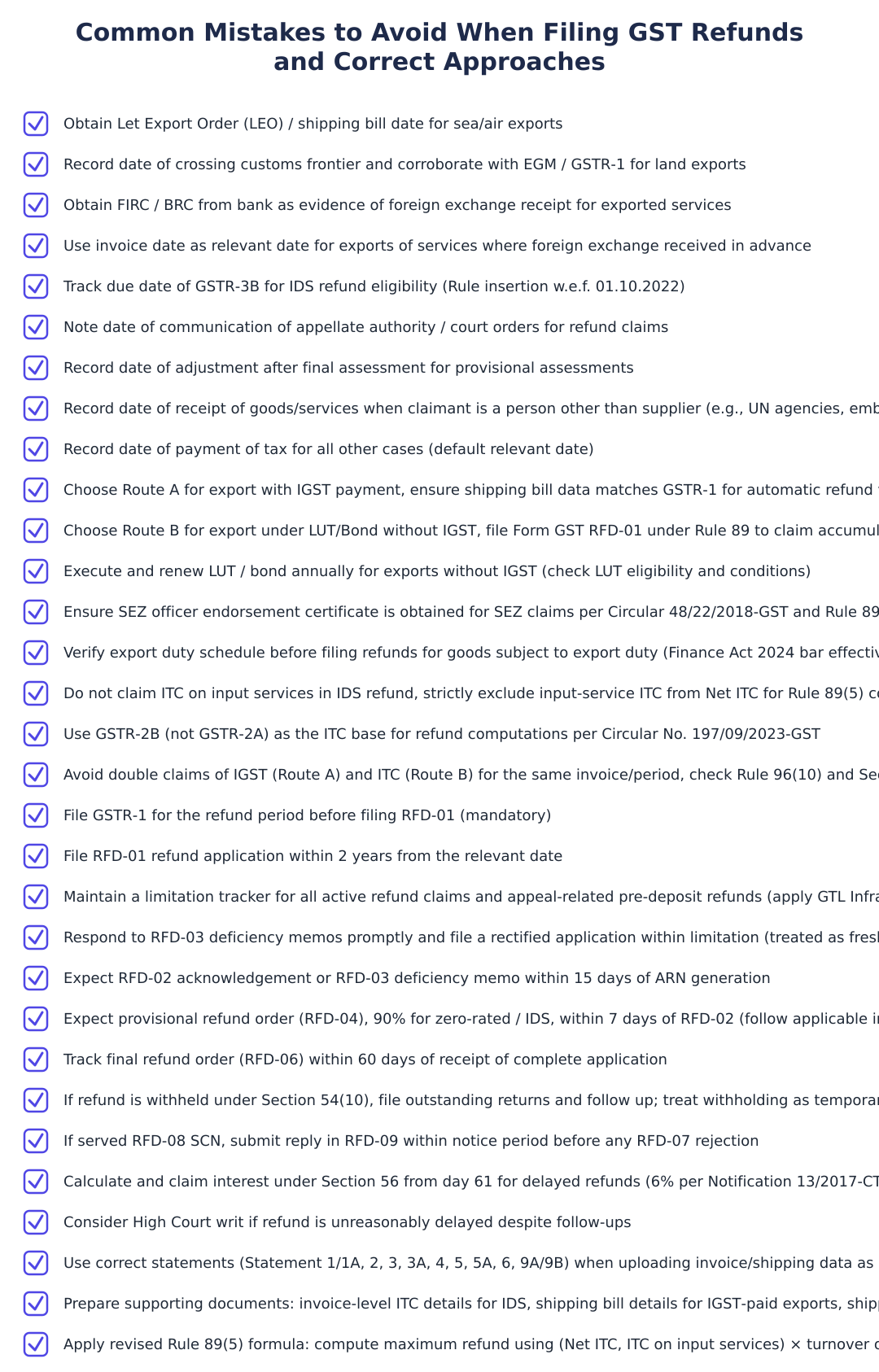
Several recurring errors lead to avoidable rejections or delays. Do not file a refund application before filing GSTR-1 for the refund period, GSTR-1 filing is mandatory before RFD-01. Avoid double claims: claiming IGST refund under Route A and ITC refund under Route B for the same invoice/period is prohibited by the second proviso to Section 54(3) and Rule 96(10); the system also validates and blocks such double benefits.
Other pitfalls: failing to obtain the SEZ officer endorsement where applicable (mandatory per Circular 48/22/2018-GST and Rule 89(2)(e)/(f)); claiming refunds for goods subject to export duty after 16.08.2024 (Finance Act 2024 bars IGST and ITC refund for zero-rated supply of goods subject to export duty); and using GSTR-2A instead of GSTR-2B for the ITC base in refund computations (use GSTR-2B per Circular No. 197/09/2023-GST). Keep these notifications and circulars in mind when assembling documentary evidence and computing refundable amounts.
Refund processing timeline, key events and statutory deadlines
Within 2 years from the relevant date, this initiates the refund claim.
Proper officer must issue RFD-02 or RFD-03 within 15 days of ARN; rectify and refile if RFD-03 is received.
For zero-rated supplies and IDS, a provisional order for up to 90% may be issued within 7 days of RFD-02.
Proper officer to pass final order within 60 days of receipt of complete application.
Interest under Section 56 begins from day 61 after receipt of a complete application for delayed refunds.
A SCN (RFD-08) must be issued and taxpayer given at least 15 days to reply prior to passing RFD-07 (rejection).
Practical compliance for GST refunds under Section 54 requires correct identification of the relevant date, strict adherence to route-specific rules (Rule 96 for IGST-paid exports; Rule 89 for LUT/Bond ITC refunds), careful computation under the revised IDS formula (excluding ITC on input services), timely filing within two years, and prompt response to deficiency memos. Keep documentary evidence such as shipping bills/LEO, EGM/GSTR-1 corroboration, FIRC/BRC, and SEZ officer certificates ready. Be mindful of the Finance Act 2024 restriction on goods subject to export duty and of the statutory timelines for provisional and final orders so that interest, limitation and appellate consequences are properly managed.
Frequently asked questions
What is the 'relevant date' for claiming a GST refund on export of goods by sea or air?
The relevant date for claiming a GST refund on export of goods by sea or air is the date of departure of the ship or aircraft, typically the Let Export Order (LEO) date. This date is used to compute the two-year limitation period for filing the refund application under Section 54. The departure/LEO must be corroborated with the shipping bill and matched with GSTR-1/EGM data when claiming IGST refunds under Rule 96. If there is any mismatch between shipping documents and GSTR-1, customs-processed automatic refunds may be held up until reconciled.
When is the relevant date for refund of GST on export of services where foreign exchange is received?
For exported services where foreign exchange is received, the relevant date is the date the supplier actually receives the foreign exchange, evidenced by a FIRC or BRC from the bank. This receipt date starts the two-year limitation period within which the taxpayer must file the refund application under Section 54. If the payment is received in advance, the relevant date instead becomes the date of issue of the invoice for the advance. Ensure you retain and upload the bank-issued FIRC/BRC to substantiate the refund claim and avoid rejection or RFD-03 deficiency notices.
What are Route A and Route B for export refunds and how do they differ?
Route A is export with payment of IGST where the exporter claims an automatic refund of IGST paid on export under Rule 96 processed by customs using shipping bill data matched with GSTR-1; Route B is export under LUT/bond without payment of IGST where the exporter claims refund of accumulated input tax credit (ITC) by filing Form GST RFD-01 under Rule 89. Route A refunds are triggered by customs on matching data and typically concern IGST-paid invoices, while Route B requires computation using the Rule 89 formula and supporting statements (Statements 2/3/3A, etc.). Exports under LUT must be supported by an annual LUT/bond (Form RFD-11) and SEZ endorsements where applicable to avoid deficiency in processing.
How is the refund amount for inverted duty structure (IDS) claims calculated after the 2022/2024 changes?
For IDS refunds, the revised Rule 89(5) formula (post 05.07.2022) limits the refund to ITC on input goods only by calculating Maximum Refund = (Net ITC, ITC on Input Services) x (Turnover of IDS Supplies) / Adjusted Total Turnover. Net ITC for this purpose includes ITC on inputs and input services, but the formula subtracts ITC on input services, effectively restricting the refund to input goods, consistent with the Supreme Court ruling in VKC Footsteps (2021). Use GSTR-2B as the ITC base per Circular No.197/09/2023-GST, and present invoice-level ITC details in Statement 1/1A for IDS claims to avoid rejection.
What documents and statements do I need to file a GST refund under Rule 89 (RFD-01)?
You must file Form GST RFD-01 with all prescribed statements and supporting documents: Statement 1/1A (invoice-level ITC for IDS), Statement 2/3/3A/4/5/5A/6 as applicable (exports with/without IGST, SEZ supplies, deemed exports), shipping bills/EGM/GSTR-1 reconciliation, FIRC/BRC for export of services, and SEZ officer endorsement certificates where required by Rule 89(2)(e)/(f). Missing mandatory documents, such as SEZ endorsement or prior GSTR-1 filing for the refund period, are common grounds for issuance of RFD-03 deficiency memos and delay or rejection of the claim. If you receive RFD-03, rectify and refile the application within limitation; the corrected application is treated as a fresh ARN and restarts the time limits.
What are the timelines for processing GST refund applications and when does interest start?
After filing RFD-01, the proper officer must issue RFD-02 (acknowledgement) or RFD-03 (deficiency memo) within 15 days of ARN, and may issue a provisional refund order (RFD-04) within 7 days of RFD-02 for 90% provisional payment in zero-rated/IDS cases; the final refund order (RFD-06) must be passed within 60 days of receipt of a complete application. Interest under Section 56 begins to accrue on delayed refunds from day 61 after receipt of the complete application, and the statutory rate (Notification 13/2017-CT) applies. If the department withholds under Section 54(10) for outstanding returns, that is temporary, file outstanding returns and follow up; consider High Court writs if delays are unreasonable.
What common mistakes should I avoid when filing GST refund claims?
Common mistakes include filing after the two-year limitation without tracking relevant dates, claiming ITC on input services in IDS refunds (disallowed after VKC Footsteps/Rule 89(5)), using GSTR-2A instead of GSTR-2B for ITC base, not obtaining mandatory SEZ officer endorsement certificates, and claiming refunds for goods subject to export duty after Finance Act 2024 which bars IGST/ITC refunds for such goods. Also avoid double-claiming IGST under Route A and ITC under Route B for the same invoice/period, Rule 96(10), second proviso to Section 54(3), and system validations prevent double benefit. Maintain a limitation tracker and reconcile shipping bills/GSTR-1 before filing to reduce the risk of RFD-03 and delays.
Can the tax officer withhold a refund under Section 54(10) and is that final rejection?
No, withholding a refund under Section 54(10) is a temporary measure and not a final rejection; the provision allows the proper officer to withhold refunds pending dues or compliance but does not substitute for a final order under RFD-06/RFD-07. Taxpayers should file outstanding returns or clarify issues and follow up for processing; if the authority still unduly delays or refuses refunds, judicial remedies such as writ petitions in the High Court can be considered. Also note that a final rejection must be communicated through the prescribed forms (RFD-07/RFD-06) with statutory timelines and opportunity to reply to an SCN (RFD-08/RFD-09).
How do recent judgments affect limitation and pre-deposit rules for refund appeals?
Recent High Court rulings like GTL Infrastructure (Jharkhand HC 2025) held that certain limitation language using ‘may’ is directory, which can benefit taxpayers seeking pre-deposit refunds following appeals; however courts have otherwise emphasized strict compliance with statutory timelines for Section 54 refunds. Taxpayers should maintain a limitation tracker and rely on precedent where applicable, but also remember that courts generally allow limited scope for equitable relief and require strict adherence to procedural conditions unless clear judicial relief exists. Where legislation or notifications (e.g., Notification No.18/2022-CT inserting dates) change timelines or procedures, follow the updated rules and attach relevant judicial orders when filing or pursuing refund claims.
Need help staying GST compliant?
MoneyGence's AI Finance OS tracks your compliance, wallet share, and finances in one place, built for agencies and growing businesses.
Get started with MoneyGence